Sanna Marin became the youngest leader in the world when she took over as Finland’s Prime Minister in 2019.(Reuters: Remo Casilli)
When Finland’s Prime Minister, Sanna Marin, and Sweden’s leader, Magdalena Andersson, met for a key press conference in April, it became a defining moment for both countries.
For decades, Finland and Sweden had clung to their non-militarily-aligned status, pursuing close ties with Europe, while maintaining a cordial relationship with their eastern neighbour, Russia. But the war in Ukraine changed everything.
While Ms Marin refused to give any kind of timetable on the decision at the time, she hinted at the press conference that Finland’s bid would happen “quite fast”.
NATO leaders emerged from their summit in Madrid this week touting a more muscular alliance ready to face down Russia and start tackling the long-term challenges from China. And it’s starting to look like they finally have plans in place to put their money where their mouths are.
TTCT – Cuối tháng 6 này, thao diễn hải quân hằng năm RIMPAC của Mỹ, quy tụ hải quân 26 quốc gia, sẽ khai diễn. Trước đó, từ cuối tháng 5, hải quân Trung Quốc và Nga đã độc lập diễn tập cũng trên Thái Bình Dương. Bên cạnh quan hệ đối kháng sẵn có, năm nay còn thêm tác động của cuộc chiến Ukraine, nên các cuộc diễn tập này càng hàm chứa tính đối đầu.
Hôm 3-6, Hãng tin Thổ Nhĩ Kỳ AA loan tin 40 tàu chiến và 20 máy bay tham gia diễn tập thuộc hạm đội Thái Bình Dương của Nga tại phía đông nước này từ ngày 3 tới 10-6.
Cũng theo AA, cuộc tập trận nhằm phối hợp nhóm tàu trên với không quân của hải quân trong việc rèn kỹ năng săn ngầm, tác xạ các mục tiêu trên mặt nước và trên không, đồng thời tổ chức tiếp tế trên biển cho hải quân trong vùng biển Thái Bình Dương.
Binh sĩ các nước Úc, Mỹ, Sri Lanka, Malaysia, Brunei, Nhật Bản, và New Zealand chụp ảnh chung trên tàu sân bay trực thăng HMAS Adelaide trong cuộc tập trận RIMPAC 2018. Ảnh: navy.mil
NYT – Russia’s invasion of Ukraine has civilians in Taiwan taking China’s aggression more seriously.
Civilians participating in a battle simulation during a combat medic training workshop near Taipei in May. Since the war in Ukraine began, a growing number of Taiwanese have been making their own preparations for war.Credit…Lam Yik Fei for The New York Times
Taiwan has spent more than seven decades under the threat of an invasion: China sees the island as a breakaway part of its territory. In the months since Russia invaded Ukraine, Taiwanese citizens have come to view a Chinese incursion as a more serious possibility than ever. My colleague Amy Qin, who’s based in Taipei, Taiwan’s capital, recently reported on how the island is preparing. I called her to learn more.
PARIS/BERLIN/WASHINGTON, June 13 (Reuters) – Is it better to engage with Russian President Vladimir Putin over his invasion of Ukraine or to isolate him? Should Kyiv make concessions to end the war, or would that embolden the Kremlin? Are ramped up sanctions on Russia worth the collateral damage?
These are some of the questions testing the international alliance that swiftly rallied around Ukraine in the days after the Russian invasion but that, three months into the war, is straining, officials and diplomats told Reuters.
By Robbie Gramer, a diplomacy and national security reporter at Foreign Policy, and Amy Mackinnon, a national security and intelligence reporter at Foreign Policy.
An aerial view of crosses, floral tributes, and photographs of the victims of the battles for Irpin and Bucha that mark the graves in a cemetery in Irpin, Ukraine, on May 16.
JUNE 10, 2022, 3:48 PM
As Russia continues its assault on Ukraine, top Biden administration officials are working behind the scenes with the Ukrainian government and European allies to document a tsunami of war crimes allegedly committed by Russian forces.
But the sheer volume of the documented war crime cases could be too overwhelming for Ukraine’s justice system as well as for the International Criminal Court (ICC), raising questions of how many cases will be brought to trial and how many accused Russian war criminals could ultimately face justice.
This week, policymakers, business executives and other public figures gathered in Davos, Switzerland where the World Economic Forum’s largest meeting took place in person after a two-year hiatus. We sat this one out, but our warning from Davos 2020 on how corruption eats away at democracy still rings true.
Ukrainian President Volodymyr Zelenskyy addresses Davos 2022 on 23 May.
Photo: Sikarin Fon Thanachaiary/World Economic Forum on Flickr Tiếp tục đọc “No more parties in Davos for Kleptocrats”→
China and Russia have grown increasingly close in recent years, including as trading partners, in a relationship that brings both opportunities and risks as Russia reels from tough new sanctions led by the West in response to its invasion of Ukraine. Total trade between China and Russia jumped 35.9% in 2021 last year to a record US$147.9 billion, according to Chinese customs data, with Russia serving as a major source of oil, gas, coal and agriculture commodities, and running a trade surplus with China.
Since sanctions were imposed in 2014 after Russia annexed Ukraine’s Crimea, bilateral trade has expanded by more than 50% and China has become Russia’s biggest export destination The two were aiming to boost total trade to US$200 billion by 2024, but according to a new target unveiled last month during Russian President Vladimir Putin’s visit to Beijing for the Winter Olympics, the two sides want bilateral trade to grow to US$250 billion.
When vladimir putin was first elected president of Russia in 2000, he changed little in the office he inherited from Boris Yeltsin. Yet in place of a pen on the desk, Mr Putin put a television remote control, one visitor noted. The new president would obsess over the media, spending the end of his days watching coverage of himself. One of his first moves was to bring under Kremlin control the country’s television networks, including ntv, an independent oligarch-owned channel, which had needled the new president with unflattering depictions of him as a dwarf in a satirical show called Kukly, or Puppets.
After more than two decades in power, today Mr Putin is the puppet master. The state controls the country’s television channels, newspapers and radio stations. The Kremlin gives editors and producers metodichki, or guidance on what to cover and how. As young audiences shift online, the Kremlin seeks to control the conversation there, leaning on social networks and news aggregators, blocking or undermining unco-operative digital media and flooding popular platforms, such as the messaging app Telegram, with state-approved content. Propaganda has long propped up Mr Putin’s regime. Now it fuels his war machine.
Since the president announced a “special military operation” in Ukraine on February 24th, control over information has become even tighter. Censorship laws bar reporting that cites unofficial sources. Calling the war a “war” is a crime. Protesters are detained for holding signs that contain eight asterisks, the number of letters in the Russian for “no to war”. Many Western social networks and platforms, including Facebook, Twitter and Instagram, have been banned or blocked. The last remaining influential independent media bastions have been pushed off air. Dozhd, an online tv station, has suspended its streams; Novaya Gazeta, a liberal newspaper whose editor recently won the Nobel Peace Prize, has halted publication; Echo Moskvy, a popular liberal radio station, no longer broadcasts from its longtime Moscow home on 91.2FM.
“Zelenskyy quoted Chaplin’s final speech in “The Great Dictator,” which was released in 1940, in the early days of World War II: “The hate of men will pass, and dictators die, and the power they took from the people will return to the people.”
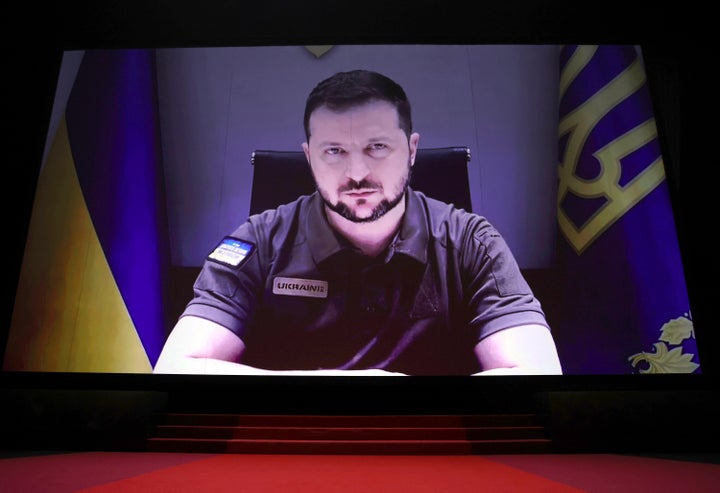
The 75th Cannes Film Festival kicked off Tuesday with a live satellite video address from Ukrainian President Volodymyr Zelenskyy.
May. 17, 2022, 04:09 PM EDT
President of Ukraine Volodymyr Zelenskyy appears via remote during the opening ceremony of the 75th international film festival, Cannes, southern France, Tuesday, May 17, 2022. (Photo by Vianney Le Caer/Invision/AP)
BY JORDAN WILLIAMS AND LAURA KELLY – 04/18/22 6:20 PM ET
Russia has been accused of using everything from so-called vacuum bombs to chemical weapons as it fights to overtake Ukraine.
Some of the worst weapons that Moscow has allegedly used are indiscriminate in their nature, prompting concerns about their impact on civilian populations from Ukrainian officials, the West, and human rights groups monitoring the war.
“There is deliberate targeting of civilian populations and noncombatants, which is against international law,” said John Erath, senior policy adviser for the Center for Arms Control and Nonproliferation. “And it really does not matter what type of weapon is being used. That is really bad.”
Ukraine’s President Volodymyr Zelensky released a video statement on May 8, the UN’s designated “Time of Remembrance and Reconciliation for Those Who Lost Their Lives During the Second World War,” in which he reflected on the phrase “never again”.







 CVD
CVD 