From Omen to Opportunity: How Cheap Oil Is Accelerating Sustainable Energy Investment

An increasingly unprofitable global oil market is driving fuel prices to historic lows and hemorrhaging investment in conventional energy sources. Breaking with tradition, cheap oil no longer foretells disaster for renewable energy companies. On the contrary, disillusioned fossil fuel investors are seeking high-growth opportunities—just in time to ride the renewables wave in the wake of the 2015 Paris climate talks.

worldwatch – Crashing out in February at $27 per barrel, crude oil prices have reached their lowest point in over 13 years, since the 2003 U.S.-led invasion of Iraq. Despite a modest recovery in March driven by expectations for reduced production, investors remain skeptical of underlying oil market fundamentals and are reducing their exposure. These selloffs have dragged down the stock prices of large conventional energy companies listed in the Standard & Poor’s 500 Index by 13 percent and have cost investors more than $703 billion since the record-high oil prices of June 2014.

Responding to these selloffs, oil companies have tightened their belts, decommissioning two-thirds of their rigs and sharply cutting investment in oil field exploration and development, while an estimated 250,000 oil workers have lost their jobs. A Wood Mackenzie report identified 68 major oil and natural gas projects—representing a combined value of $380 billion and output of 2.9 million barrels of oil equivalent (boe) per day—that have been put on hold since late 2014. Besides reducing operating costs, oil companies hope that these measures will have a stabilizing effect on the market by reducing productive capacity in the medium to long term. Tiếp tục đọc “From Omen to Opportunity: How Cheap Oil Is Accelerating Sustainable Energy Investment”

Our Energy Transformation in 2015

Germany Could Make $2 Billion By Exporting Electricity

November 10th, 2015 by

cleantecnica – The Fraunhofer Institute has found that Germany made about €1.7 billion, or $1.93 billion, in 2014 by selling surplus electricity. In 2015, that amount could reach €2 billion or $2.2 billion. Germany may also achieve a record export surplus of 40 TWh of electricity in 2015. “Over the past years, Germany was able to secure higher prices for its electricity exports than it paid for electricity imports,” explained Fraunhofer professor, Bruno Burger.

germancliffsRenewables added 118 TWh of energy production capacity in Germany from the period beginning in 2010 through 2014. What are some of Germany’s other exports? According to one source, Germany exported about $2.6 billion in pharmaceuticals to Japan in 2014. In 2007, cheese exports were about €2.7 billion. Tiếp tục đọc “Germany Could Make $2 Billion By Exporting Electricity”

Powering the Internet with renewable energy

December 3, 2015

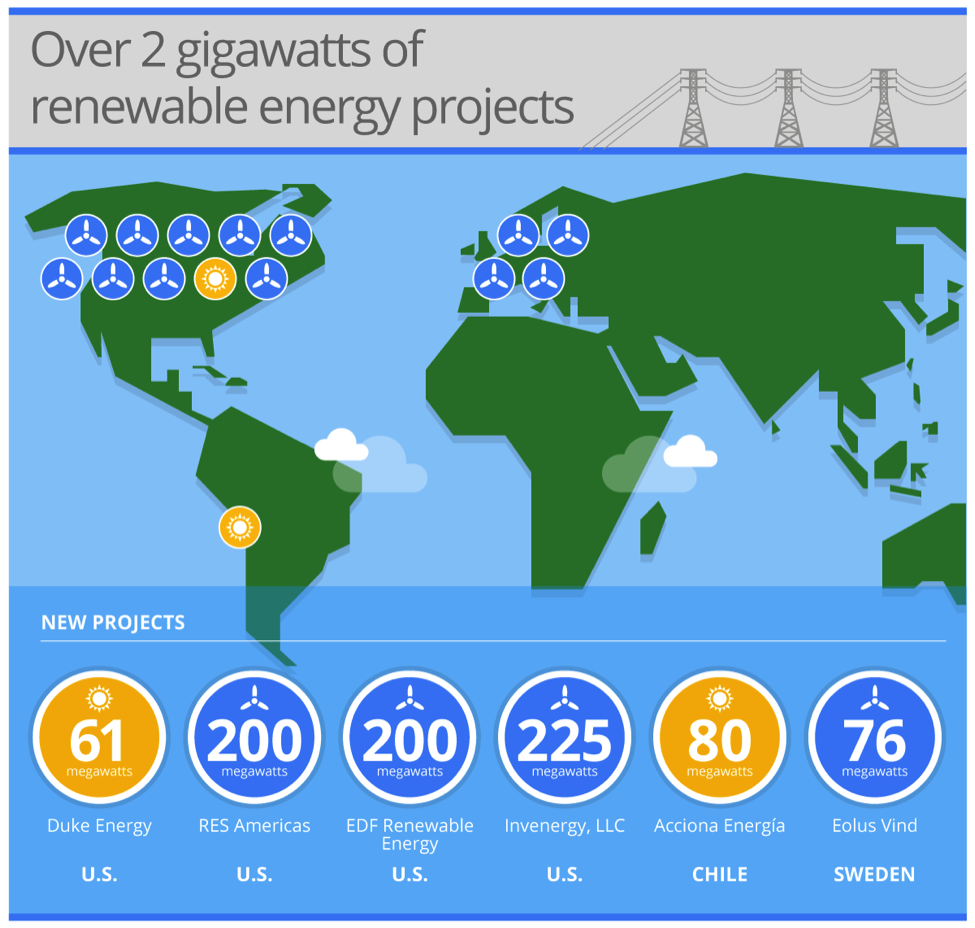
Googleblog – Today we’re announcing the largest, and most diverse, purchase of renewable energy ever made by a non-utility company. Google has already committed to purchase more renewable energy than any other company. Now, through a series of new wind and solar projects around the world, we’re one step closer to our commitment to triple our purchases of renewable energy by 2025 and our goal of powering 100% of our operations with clean energy. 842 MW of renewable energy around the world Today’s agreements will add an additional 842 megawatts of renewable energy capacity to power our data centers. Across three countries, we’re nearly doubling the amount of renewable energy we’ve purchased to date. We’re now up to 2 gigawatts—the equivalent to taking nearly 1 million cars off the road. These additional 842 megawatts represent a range of locations and technologies, from a wind farm in Sweden to a solar plant in Chile.

These long-term contracts range from 10-20 years and provide projects with the financial certainty and scale necessary to build these wind and solar facilities—thus bringing new renewable energy onto the grid in these regions. For our part, these contracts not only help minimize the environmental impact of our services—they also make good business sense by ensuring good prices. Our commitment to a sustainable energy future Since we opened our very first owned data center in 2006, we’ve been working to promote renewable and sustainable energy use in several ways:

  • First, we’re building the world’s most efficient computer infrastructure by designing our data centers to use as little energy as possible.

Tiếp tục đọc “Powering the Internet with renewable energy”

Top 5 Developments Enabling Shift to 100 Percent Renewable Energy

Renewableenergyworld – A growing number of companies, cities, states and countries are aiming for, and achieving, a goal of obtaining power from 50 percent, 75 percent or even 100 percent renewable energy, thanks, in part, to a set of major developments that are enabling the resource shift, according to a new report from Clean Edge.

Commissioned by SolarCity, the report Getting to 100 discusses what is driving the transition to increasing levels of renewable energy consumption and identifies the successes and challenges of both governments and companies in targeting, and/or achieving, 100 percent renewable energy goals.

According to the report, these five developments are supporting the trend toward higher penetrations of renewable energy:

  • A resilient grid
  • A rise in net zero buildings and smart connected devices
  • Energy storage availability and affordability
  • Proliferation of utility-scale renewables
  • Cost-effective status of distributed solar across geographies

Distributed Solar Becomes Cost-Effective Across Geographies

The proliferation of ever-cheaper distributed solar generation – residential, commercial and community – is a key driver toward the 100 percent renewable energy goal, according to the report.

“The cost curves are undeniable,” the report said. “The plummeting prices of solar panels have been well-documented, but the industry has recently been attacking balance-of-system costs and so-called soft costs (such as marketing, customer acquisition, permitting, and installation) as well.” Tiếp tục đọc “Top 5 Developments Enabling Shift to 100 Percent Renewable Energy”

Leading powers to double renewable energy supply by 2030

study published this month by the World Resources Institute (WRI) analysed the Intended Nationally Determined Contributions (INDCs) of the 10 largest greenhouse gas emitters to determine how much they will clean up their energy mix in the next 15 years.

Harmonizing the Benefits of Distributed Energy Resources for the Benefit of the Grid

We need to set the right framework for DER integration, argues Stephanie Wang.

by Stephanie Wang, November 13, 2015
{title}

greentechmedia – California is rethinking how to incentivize consumers to manage their energy use. In September, the California Public Utilities Commission (CPUC) said it would seek to create an integration framework to make choosing and integrating distributed energy resources easier for consumers.

The CPUC found that “harmonization” of consumer benefits and “system” (grid and societal) benefits is necessary for integrating more distributed energy resources (DERs). How can we harmonize these benefits with simple, scalable solutions that work for consumers and communities?
Equalize or align benefits

Let’s start with a fundamental question on the definition of harmonization. Does that mean equalization of benefits — ensuring that benefits to consumers and the system are roughly equal? Tiếp tục đọc “Harmonizing the Benefits of Distributed Energy Resources for the Benefit of the Grid”