Antarctica warming much faster than models predicted in ‘deeply concerning’ sign for sea levels

theguardian.com Graham Readfearn @readfearnThu 7 Sep 2023 16.00 BST

Study finds ‘direct evidence’ of polar amplification on continent as scientists warn of implications of ice loss
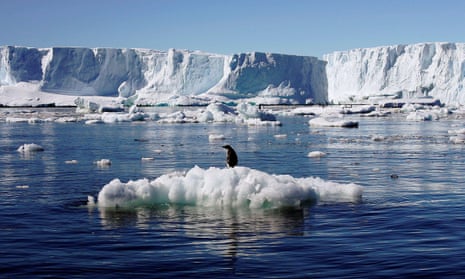
An Adelie penguin in Antarctica.
An Adelie penguin in Antarctica. The icy continent is heating faster than climate models had predicted, a study has found. Photograph: Reuters/Alamy

Antarctica is likely warming at almost twice the rate of the rest of the world and faster than climate change models are predicting, with potentially far-reaching implications for global sea level rise, according to a scientific study.

Scientists analysed 78 Antarctic ice cores to recreate temperatures going back 1,000 years and found the warming across the continent was outside what could be expected from natural swings.

In West Antarctica, a region considered particularly vulnerable to warming with an ice sheet that could push up global sea levels by several metres if it collapsed, the study found warming at twice the rate suggested by climate models.

Tiếp tục đọc “Antarctica warming much faster than models predicted in ‘deeply concerning’ sign for sea levels”

Ice Loss and the Polar Vortex: How a Warming Arctic Fuels Cold Snaps

insideclimatenews_The loss of sea ice may be weakening the polar vortex, allowing cold blasts to dip south from the Arctic, across North America, Europe and Russia, a new study says.
A strong versus weakened polar vortex. Credit: NOAA

A strong polar vortex (left, from December 2013) is centered over the Arctic. A weakened polar vortex (right, from January 2014) allows cold air to dip farther south. Credit: NOAA

When winter sets in, “polar vortex” becomes one of the most dreaded phrases in the Northern Hemisphere. It’s enough to send shivers even before the first blast of bitter cold arrives.

New research shows that some northern regions have been getting hit with these extreme cold spells more frequently over the past four decades, even as the planet as a whole has warmed. While it may seem counterintuitive, the scientists believe these bitter cold snaps are connected to the warming of the Arctic and the effects that that warming is having on the winds of the stratospheric polar vortex, high above the Earth’s surface.

Here’s what scientists involved in the research think is happening: The evidence is clear that the Arctic has been warming faster than the rest of the planet. That warming is reducing the amount of Arctic sea ice, allowing more heat to escape from the ocean. The scientists think that the ocean energy that is being released is causing a weakening of the polar vortex winds over the Arctic, which normally keep cold air centered over the polar region. That weakening is then allowing cold polar air to slip southward more often.

Tiếp tục đọc “Ice Loss and the Polar Vortex: How a Warming Arctic Fuels Cold Snaps”

Venezuela is likely to be the first country to lose all of its glaciers, but unfortunately it will not be the last country.

Venezuela is losing its last glacier

Glacierhub.com

Humboldt Glacier, 14 December 2011 (Source: The Photographer/ Creative Commons).

Venezuela used to have five glaciers. Today, only one remains. The last glacier in Venezuela, the Humboldt glacier, is about to disappear. “Reduced to an area of ten football pitches, a tenth of its size 30 years ago, it will be gone within a decade or two,” reports The Economist. Once Venezuela loses the Humbolt, it will become the first country in modern history to have lost all of its glaciers.

The glacier is expected to completely vanish in ten to twenty years, and scientists have expressed the importance of studying the glacier in its last stages. However, the political and economic crisis in Venezuela makes it difficult to study the glacier. In the past, studies have shown how rapid glacier retreat affects the water cycle in glacier-dependent basins, which changes water regulation and availability. Thus, the disappearance of the Humboldt glacier will impact local communities as run-off stability and water supply for agriculture change. Tiếp tục đọc “Venezuela is likely to be the first country to lose all of its glaciers, but unfortunately it will not be the last country.”

Loss of diversity near melting coastal glaciers

Loss of diversity near melting coastal glaciers

Sedimentation impacting an entire ecosystem on seafloor

Date:
November 13, 2015
Source:
Alfred Wegener Institute, Helmholtz Centre for Polar and Marine Research
Summary:
Melting glaciers are causing a loss of species diversity among benthos in the coastal waters off the Antarctic Peninsula, impacting an entire seafloor ecosystem. This has been verified in the course of repeated research dives, the results of which were recently published by experts from Argentina, Germany and Great Britain.

Tiếp tục đọc “Loss of diversity near melting coastal glaciers”