Impacts of 25 years of groundwater extraction on subsidence in the Mekong delta, Vietnam

IOPscience

Many major river deltas in the world are subsiding and consequently become increasingly vulnerable to flooding and storm surges, salinization and permanent inundation. For the Mekong Delta, annual subsidence rates up to several centimetres have been reported. Excessive groundwater extraction is suggested as the main driver. As groundwater levels drop, subsidence is induced through aquifer compaction. Over the past 25 years, groundwater exploitation has increased dramatically, transforming the delta from an almost undisturbed hydrogeological state to a situation with increasing aquifer depletion. Yet the exact contribution of groundwater exploitation to subsidence in the Mekong delta has remained unknown. In this study we deployed a delta-wide modelling approach, comprising a 3D hydrogeological model with an integrated subsidence module. This provides a quantitative spatially-explicit assessment of groundwater extraction-induced subsidence for the entire Mekong delta since the start of widespread overexploitation of the groundwater reserves. We find that subsidence related to groundwater extraction has gradually increased in the past decades with highest sinking rates at present. During the past 25 years, the delta sank on average ~18 cm as a consequence of groundwater withdrawal. Current average subsidence rates due to groundwater extraction in our best estimate model amount to 1.1 cm yr−1, with areas subsiding over 2.5 cm yr−1, outpacing global sea level rise almost by an order of magnitude. Given the increasing trends in groundwater demand in the delta, the current rates are likely to increase in the near future.

Read full article here

Climate change is triggering a migrant crisis in Vietnam

Theconversation

The Vietnamese Mekong Delta is one of Earth’s most agriculturally productive regions and is of global importance for its exports of rice, shrimp, and fruit. The 18m inhabitants of this low-lying river delta are also some of the world’s most vulnerable to climate change. Over the last ten years around 1.7m people have migrated out of its vast expanse of fields, rivers and canals while only 700,000 have arrived.

On a global level migration to urban areas remains as high as ever: one person in every 200 moves from rural areas to the city every year. Against this backdrop it is difficult to attribute migration to individual causes, not least because it can be challenging to find people who have left a region in order to ask why they went and because every local context is unique. But the high net rate of migration away from Mekong Delta provinces is more than double the national average, and even higher in its most climate-vulnerable areas. This implies that there is something else – probably climate-related – going on here. Tiếp tục đọc “Climate change is triggering a migrant crisis in Vietnam”

Only a fundamental mindset shift can save the Mekong Delta: expert

Last update 11:10 | 16/12/2017

VietNamNet Bridge – Well-meant but misguided climate change interventions in the Mekong Delta are set to do more harm than good, and only a change in policymakers’ mindset can reverse the damage, an independent researcher and expert said on December 14.

Mekong Delta, save, solar energy, Vietnam economy, Vietnamnet bridge, English news about Vietnam, Vietnam news, news about Vietnam, English news, Vietnamnet news, latest news on Vietnam, Vietnam
Nguyen Huu Thien (standing), expert on Mekong Delta ecology, responds to questions at a workshop on the region’s water and energy needs held on December 14 in Hanoi. — VNA/VNS Photo Trong Kien

The change in mindset would involve a shift from forceful interventions to embracing natural cycles, said Nguyen Huu Thien.

Thien, whose work focuses on the Mekong Delta’s ecology, was giving his assessment of Resolution No 120 on sustainable development for the Mekong Delta that Prime Minister Nguyen Xuan Phuc signed in November. Tiếp tục đọc “Only a fundamental mindset shift can save the Mekong Delta: expert”

Mekong Delta to improve tourism services

Last update 11:29 | 27/11/2017

VietNamNet Bridge – The number of tourists to the Mekong Delta has increased significantly as many tourism programmes have been successful over the last year, according to provincial authorities.

Mekong Delta, tourism services, improve, Vietnam economy, Vietnamnet bridge, English news about Vietnam, Vietnam news, news about Vietnam, English news, Vietnamnet news, latest news on Vietnam, Vietnam
The number of tourists to the Mekong Delta has increased, but more and better tourism products are expected to further promote tourism in the area. — VNA/ VNS Photo

Many attractions in the Mekong Delta have maintained their high traffic since the beginning of the year.

The Department of Culture, Sports, and Tourism in Dong Thap Province reported that the province welcomed 110,000 arrivals in October, up 25 per cent year-on-year. This brought the number of arrivals to 2.5 million in the first 10 months, up 24 per cent year-on-year. Tiếp tục đọc “Mekong Delta to improve tourism services”

Nghị quyết về Phát triển bền vững ĐBSCL thích ứng với Biến đổi khí hậu – Số 120/NQ-CP

CHÍNH PHỦ
——-

CỘNG HÒA XÃ HỘI CHỦ NGHĨA VIỆT NAM
Độc lập – Tự do – Hạnh phúc
—————

Số: 120/NQ-CP

Hà Nội, ngày 17 tháng 11 năm 2017


NGHỊ QUYẾT

VỀ PHÁT TRIỂN BỀN VỮNG ĐỒNG BẰNG SÔNG CỬU LONG THÍCH ỨNG VỚI BIẾN ĐỔI KHÍ HẬU

CHÍNH PHỦ

Căn cứ Luật Tổ chức Chính phủ ngày 19 tháng 6 năm 2015;

Căn cứ Nghị quyết số 24-NQ/TW ngày 03 tháng 6 năm 2013 của Ban Chấp hành Trung ương Đảng khóa XI về chủ động ứng phó với biến đổi khí hậu, tăng cường quản lý tài nguyên và bảo vệ môi trường;

Căn cứ Kết luận số 28-KL/TW ngày 14 tháng 8 năm 2012 của Bộ Chính trị về phương hướng, nhiệm vụ, giải pháp phát triển kinh tế – xã hội và bảo đảm an ninh, quốc phòng vùng đồng bằng sông Cửu Long đến năm 2020;

Trên cơ sở kết quả của Hội nghị về phát triển bền vững đồng bằng sông Cửu Long thích ứng với biến đổi khí hậu ngày 26 – 27 tháng 9 năm 2017; thảo luận, biểu quyết của các Thành viên Chính phủ tại phiên họp Chính phủ thường kỳ tháng 9 năm 2017,

QUYẾT NGHỊ:

Tiếp tục đọc “Nghị quyết về Phát triển bền vững ĐBSCL thích ứng với Biến đổi khí hậu – Số 120/NQ-CP”

Resolution aims for sustainable Mekong Delta development – Nghị quyết về phát triển bền vững Đồng bằng sông Cửu Long thích ứng với biến đổi khí hậu


Viet Nam News Update: November, 20/2017 – 10:01

Prime Minister Nguyễn Xuân Phúc has signed a resolution to sustainably develop the Mekong Delta as apart of an effort to cope with climate change. — Photo tinmoitruong

HCM City – Prime Minister Nguyễn Xuân Phúc has signed a resolution to sustainably develop the Mekong Delta as apart of an effort to cope with climate change.

The resolution points out that the Mekong Delta accounts for 12 per cent of the national area and 19 per cent of population, contributes 50 per cent of the rice crop, 65 per cent of aquaculture, 70 per cent of fruit, 95 per cent of exported rice and 60 per cent of exported fish. Tiếp tục đọc “Resolution aims for sustainable Mekong Delta development – Nghị quyết về phát triển bền vững Đồng bằng sông Cửu Long thích ứng với biến đổi khí hậu”

Using Remote Sensing to Map Rice Paddy Drop in the Mekong Delta

Gislounge_The Mekong River Delta is an important water source flowing through South East Asia. Primarily feeding the rice fields of Vietnam, the Mekong River Delta has long been an area of great fertility due to water flow and silt build up. However, agricultural efforts in the area have shown a decline in production because of the weather effects of El Niño. This year’s El Niño has been particularly strong, causing droughts in South East Asia.

Satellites including Europe’s Sentinel-1A can now track the rise and fall of different agricultural products around the world. The satellite’s imagery showed that rice production in the Mekong Delta has decreased in the past year, threatening the livelihoods of local farmers as well as food security worldwide. Tiếp tục đọc “Using Remote Sensing to Map Rice Paddy Drop in the Mekong Delta”

PM approves climate change, green growth programme

Update: November, 03/2017 – 10:30 vietnamnews

Prime Minister Nguyễn Xuân Phúc has green lighted the target programme to cope with climate change and promote green growth during 2016-20. — Photo VGP

HÀ NỘI — Prime Minister Nguyễn Xuân Phúc has green lighted the target programme to cope with climate change and promote green growth during 2016-20.

The programme is designed to improve local residents’ abilities to adapt to climate change, boost green growth and transition towards a low-carbon economy. Tiếp tục đọc “PM approves climate change, green growth programme”

Farmers shift to more resilient crops in the Delta

Update: November, 05/2017 – 09:00 vietnamnews
Wrapped fruit: Bùi Văn Buôn checks on the tứ quý mangoes in his garden in Bến Tre Province. — VNS Photo Hoàng Nguyên

Viet Nam News Beset by climate change impacts, Mekong Delta farmers give up on rice, but the real answer lies in organic farming, experts aver.

By Hoàng Nguyên

MEKONG DELTA – When Bùi Văn Muôn decided to grow tứ quý mango trees 16 years ago, he did not expect the fruit would become a key agricultural crop cultivated to adapt to climate change.

“Back then, when I asked neighbours to buy and plant tứ quý mango trees here, they showed little interest as the fruit tasted a bit sour and they thought it might not fetch good prices in the market,” the 50-year-old farmer in Bến Tre Province recalled. Tiếp tục đọc “Farmers shift to more resilient crops in the Delta”

Fruit park project encroaches on river, poses subsidence hazards in southern Vietnam

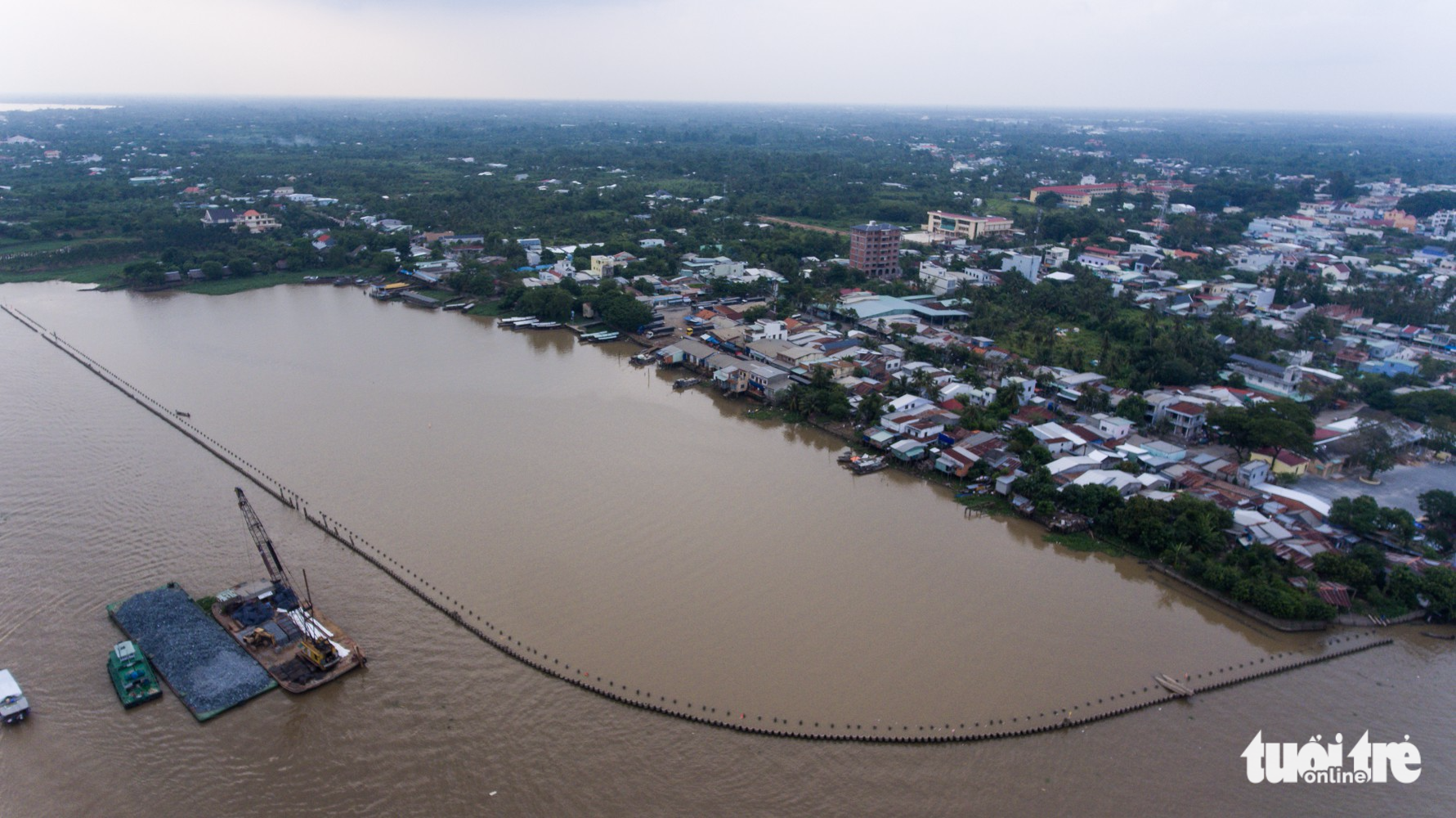
About 6.8 hectares of the river will be filled to prepare for the construction

By Tuoi Tre News

October 29, 2017, 16:28 GMT+7

​Fruit park project encroaches on river, poses subsidence hazards in southern Vietnam
About 6.8 hectares of the Tien (Front) River will be reclaimed for the construction of a fruit park in the Mekong Delta province of Tien Giang. Photo: Tuoi Tre

A park project in Vietnam’s Mekong Delta has sparked concern among local residents for blatantly encroaching on a large area of a river, as it may cause the riverbank to collapse anytime.

For the past six months, people in Cai Lay and Cai Be Districts, Tien Giang Province, have been worried by the construction of a fruit park as it will take up a considerable portion of a local waterway.

Locals and experts fear that the project would cause changes to the natural torrent of the river, resulting in subsidence in nearby areas. Tiếp tục đọc “Fruit park project encroaches on river, poses subsidence hazards in southern Vietnam”

Mekong Delta: Adapt to saltwater intrusion by using aquaculture

Last update 07:40 | 25/10/2017
VietNamNet Bridge – Instead of trying to prevent saltwater invasion and desalinizing, it would be better to adapt to the new circumstances and think of developing aquaculture in Mekong Delta, scientists say.vietnam economy, business news, vn news, vietnamnet bridge, english news, Vietnam news, news Vietnam, vietnamnet news, vn news, Vietnam net news, Vietnam latest news, Vietnam breaking news, Mekong Delta, climate change, rice granary

In the Mekong Delta, one of the largest key agriculture production zones in the country, alkaline soil accounts for 18.6 percent of total area, located along the East Coast belt and the Gulf of Thailand. In the context of climate change, desalinizing is an impossible mission, or will be too costly.

Meanwhile, alum land accounts for 40 percent of the zone’s total area, mostly located in depression areas, where it is very difficult to clear alum. Scientists have warned that saline intrusion would reach more deeply into the mainland in the future as a result of  climate change. Tiếp tục đọc “Mekong Delta: Adapt to saltwater intrusion by using aquaculture”

Vấn đề nông dân – di cư là… cơ hội của ĐBSCL

thesaigontimes.vn Chủ Nhật,  15/10/2017, 08:52 (GMT+7)
Dương Văn Ni


ĐBSCL dễ bị tổn thương hơn trước các thiên tai như bão tố, lụt lội. Ảnh: LÊ HOÀNG VŨ

(TBKTSG) – Sự thay đổi cực đoan của các yếu tố thời tiết như nhiệt độ, mưa, gió (biến đổi khí hậu), nước biển dâng và việc các quốc gia phía thượng nguồn sử dụng nguồn nước cho thủy điện, nông nghiệp, công nghiệp đã làm cho đồng bằng sông Cửu Long (ĐBSCL) đối diện thường xuyên với các vấn đề như hạn hán, mặn xâm nhập, ngập lụt, lún sụt mặt đất, thiếu hụt phù sa gây ra sạt lở bờ sông, bờ biển, làm xáo trộn đời sống kinh tế – xã hội và suy thoái tài nguyên thiên nhiên.

Tiếp tục đọc “Vấn đề nông dân – di cư là… cơ hội của ĐBSCL”

Dân sống thấp thỏm vì… sạt lở

Cập nhật ngày: 23/10/2017 08:56:01

ĐTO – Do ảnh hưởng của thủy triều và tác động của dòng chảy, những ngày qua, tại xã Long Thuận, huyện Hồng Ngự, tình hình sạt lở liên tiếp xảy ra gây thiệt hại về tài sản và xáo trộn đời sống người dân. Nhiều hộ dân sống trong vùng sạt lở lo lắng vì thời điểm mùa mưa lũ, tình trạng sạt lở sẽ càng phức tạp.


Đoạn sạt lở tại đầu đường nhánh Mương Lớn, ấp Long Thạnh, xã Long Thuận

Dự báo thời gian tới, tình hình sạt lở có thể sẽ diễn biến phức tạp, do hiện nay vẫn là thời điểm mùa mưa lũ, nền đất tại các khu vực sạt lở rất mềm, cùng với đó, độ dốc cao và tác động của dòng chảy cũng có khả năng gây ra sạt lở tại các điểm nóng.

Tiếp tục đọc “Dân sống thấp thỏm vì… sạt lở”

Vì sao sông Tiền, sông Hậu sâu bất thường?

16/08/2016 08:01 GMT+7

TTO – Các nhà khoa học cảnh báo sông Tiền (dài 250km) và sông Hậu (dài 200km) ngày càng bị sâu thêm, thay vì được bồi lắng như trước đây. Trong khoảng 10 năm gần đây hai sông này sâu thêm từ 5-7m.

Nghiên cứu và khảo sát mới nhất của các nhà khoa học cho thấy sông Tiền – sông Hậu ngày càng sâu bất thường, gây ảnh hưởng nghiêm trọng đến môi trường sống. Trong ảnh: một trong những thiệt hại thấy rõ ở đoạn sông Tiền khu vực huyện Cái Bè, tỉnh Tiền Giang bị sạt lở kéo nhà dân xuống sông – Ảnh: T.B.

Theo các chuyên gia, có nhiều nguyên nhân dẫn đến tình trạng này, trong đó quan trọng nhất là việc khai thác cát bừa bãi và xây các đập thủy điện trên dòng chính Mekong. Tiếp tục đọc “Vì sao sông Tiền, sông Hậu sâu bất thường?”

$143.5m Mekong sluice project comes under fire

Last update 09:59 | 09/06/2017

VietNamNet Bridge – The VND3.3 trillion (US$143.5 million) Cai Lon-Cai Be dual sluice project aims to control saline intrusion and adapt to climate change in Cuu Long (Mekong) Delta Province of Kien Giang. However, experts, managers and residents are uncertain about its impact.

Mekong sluice project, prevent saline intrusion, Vietnam economy, Vietnamnet bridge, English news about Vietnam, Vietnam news, news about Vietnam, English news, Vietnamnet news, latest news on Vietnam, Vietnam
The Cai Be River in Kien Giang Province. — Photo tienphong.vn

Last year, Mekong Delta region suffered from the most severe saline intrusion and droughts in nearly a decade.

In response, two sluices will be built to prevent saline intrusion to the west and south of Hau River between 2017 and 2020 under the management of the Ministry of Agriculture and Rural Development (MARD). Tiếp tục đọc “$143.5m Mekong sluice project comes under fire”