The North Korean leader, Kim Jong-un, has pledged to shutter a nuclear test site and invite foreign experts and journalists to witness the decommissioning in May as he prepares to meet Donald Trump as early as next month.
Kim also said there was no need for the North to maintain a nuclear arsenal if a peace treaty is formalised and relations with the US improve, according to South Korea’s presidential office.
“Once we start talking, the United States will know that I am not a person to launch nuclear weapons at South Korea, the Pacific or the United States,” Kim was quoted as saying by Yoon Young-chan, a spokesman for the South Korean president, Moon Jae-in.
“If we maintain frequent meetings and build trust with the United States and receive promises for an end to the war and a non-aggression treaty, then why would be need to live in difficulty by keeping our nuclear weapons?”
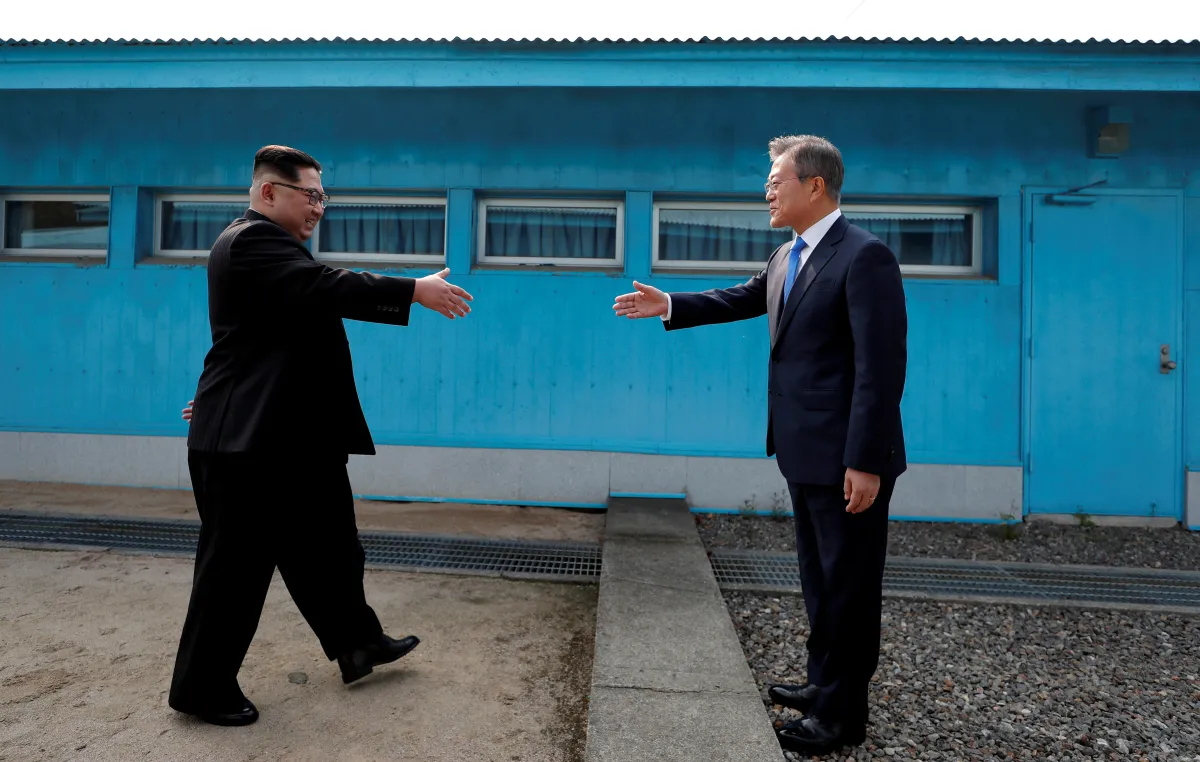
Kim made the comments during meeting with Moon on Friday, where the two leaders signed a declaration calling for a “nuclear-free Korean peninsula”. Kim earlier said the North would halt nuclear and missile tests, but this was the first mention of inviting foreign observers.
“Some say that we are terminating facilities that are not functioning, but you will see that we have two more tunnels that are bigger than the existing ones and that they are in good condition,” Yoon quoted Kim as saying.
North Korea conducted all six of its nuclear tests at its Punggye-ri facility, buried deep beneath mountains, between 2006 and 2017. There had been speculation last week that the site was damaged beyond repair, a claim Kim seemed to rebuff. Little is known about the North’s military infrastructure so most intelligence is gleaned from satellite photos.
“This is a small but welcome step. But, as always, we must take North Korea’s actions with appropriate caution,” said Mintaro Oba, a former US diplomat who focused on North Korea policy. “We can’t rule out that Kim Jong-un wants to be seen as a maverick. He has a clear taste for bold moves that surprise the international community, something that sets him apart from his father.”
The US and South Korea still needed to maintain continuous dialogue with Pyongyang, Oba said, and he warned Kim is “a master of defining the public narrative”.
A meeting between the leaders of the US and North Korea could take place within “three or four weeks”, Trump said at a rally on Saturday in Michigan. He also warned any discussions “may not work out, I leave”.
Kim also pledge to align the North’s timezone with the South during the inter-Korean summit. Pyongyang time is currently 30 minutes ahead of Seoul, a change instituted by Kim in 2015. The change was framed at the time as a break with Japan’s colonial legacy on the peninsula from 1910 to 1945.
“I feel sad to see that there are two clocks hung on the wall of the Peace House, one for Seoul time and the other for Pyongyang time,” Kim said during his talks with Moon. “Since it is us who changed the time standard, we will return to the original one.”
The unified time zone was meant to ease communication between the South and US, Yoon said.

 CVD
CVD 