Thailand’s forest communities fall victim to country’s climate promises

devex.com

Greenhouse gas emissions can be offset by carbon sinks such as forests, but expanding these areas can put Indigenous communities, reliant on the forests, at risk.

By Rebecca L. Root // 11 October 2023
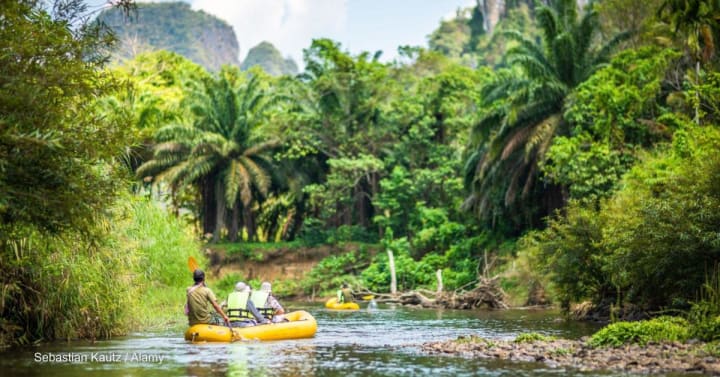
Khao Sok rainforest in Thailand. Photo by: Sebastian Kautz / Alamy

From Khao Sok National Park in the southwest to Phu Chi Fa Forest Park in the north, forests cover around 30% of Thailand’s total area. Approximately 23 million people live near or in these lush green landscapes, depending on them for sustenance and livelihoods. But that’s now at risk, due to both climate change-related threats and the policies implemented to protect the forests.

Warangkana Rattanarat, Thailand country director for The Center for People and Forests, warned that the arrival of El Niño earlier this year has caused long droughts and less rain, damaging crops and other forest resources. This has affected the availability of food, as well as the income local people can derive from forest resources, she added.

The country has also experienced floods and the highest temperatures on record this year, impacting forests and the communities within them. In the GermanWatch Global Climate Risk Index 2021, Thailand ranked at number nine globally for long-term climate risks.

Additionally, there are land and tenure rights issues for Indigenous forest communities to contend with, and national climate commitments that have the potential to negatively impact such communities, said experts.

Tiếp tục đọc “Thailand’s forest communities fall victim to country’s climate promises”

I mourn the loss of Australia’s Indigenous voice vote – and won’t forgive the media’s mendacity

theguardian.com Thomas Keneally

Thomas Keneally

The polls had been favourable until a brutal press campaign kicked in against this kindly, long-overdue change

  • Thomas Keneally is the author of the Booker-winning Schindler’s Ark

Wed 18 Oct 2023 13.26 BST

Last Sunday, many in Australia profoundly mourned the loss of the Indigenous voice to parliament referendum, the greatest kindly amendment ever to be proposed for the Australian constitution, those dreary old articles of association by which our states and territories rub along together in far-flung federation.

When the referendum was announced in March this year, it was as a result of a message to mainstream Australia from Indigenous Australia, a statement made at Uluru near Alice Springs by Aboriginal representatives. They suggested constitutional recognition of the Aboriginal race’s ancient discovery and ownership of Australia, and proposed that their community’s disadvantages in modern Australia could be addressed through a group of Aboriginal delegates who would advise on federal laws affecting Aboriginal Australians.

https://9f16b9aa9979ae753e00d73da3e26298.safeframe.googlesyndication.com/safeframe/1-0-40/html/container.html

The ownership matter is no longer as controversial as it once was. In the 1970s a Torres Strait Islander named Eddie Mabo was shocked to hear that his garden on Murray Island belonged to the crown. He undertook a long, brave journey from regional courts all the way to the high court, to prove that his tropic garden was not the crown’s, but his own. That decision in 1992 declared that Indigenous Australians had never ceded sovereignty over their land. There were cries that every white-owned house and swimming pool would be imperilled, but the truth was that the decision allowed the Aboriginal people to claim in reality traditional and unalienated, as in not yet purchased under title and built-upon, land. With that decision began the custom of the “welcome to country”: a local tribesman, or at least an Aboriginal Australian, briefly, as a small polite gesture, welcoming people to public events and citing the local tribe and its elders, men and women, past and present. This will continue to be the practice; an acknowledgment of the established fact.

Tiếp tục đọc “I mourn the loss of Australia’s Indigenous voice vote – and won’t forgive the media’s mendacity”

Australia rejects Indigenous referendum in setback for reconciliation

Reuters.com By Praveen Menon, Lewis Jackson, Wayne Cole

https://www.reuters.com/video/?videoId=RW001014102023RP1&jwsource=em

SYDNEY (Reuters) -Australia on Saturday decisively rejected a proposal to recognise Indigenous people in the constitution, in a major setback to the country’s efforts for reconciliation with its First Peoples.

Australians had to vote “Yes” or “No” in the referendum, the first in almost a quarter of a century, on the question of whether to alter the constitution to recognise Aboriginal and Torres Strait Island people through the creation of an Indigenous advisory body, the “Voice to Parliament”.

Nationwide, with almost 70% of the vote counted, the “No” vote led “Yes” 60% to 40%. Australian broadcaster ABC and other TV networks have projected that a majority of voters in all six of Australia’s states would vote against altering the 122-year-old constitution.

Tiếp tục đọc “Australia rejects Indigenous referendum in setback for reconciliation”

Timeline: Indigenous Voice, treaty and truth in Australia

Aljazeera.com

Indigenous people’s 60,000 years of connection to their country should be recognised, leaders say.

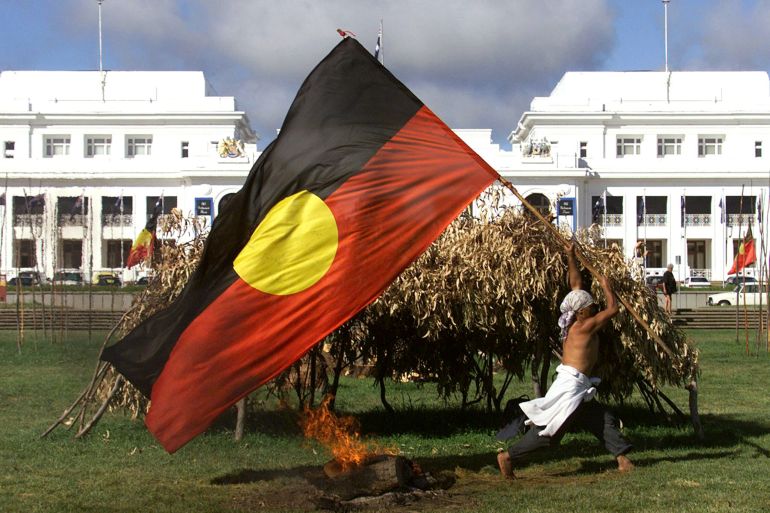
An Aboriginal protester runs past a fire and make-shift shelter with an Aboriginal flag outside the old parliament House building in Canberra
The Aboriginal Tent Embassy has been a continued site of protest outside old Parliament House in Australia’s Canberra since 1972 [File: David Gray/Reuters]

By Al Jazeera Staff

Published On 13 Oct 202313 Oct 2023

The Australian referendum on an Indigenous Voice to Parliament is part of a long history of Aboriginal people fighting for their voice to be heard.

The referendum was called after Aboriginal and Torres Strait Islander leaders issued the Uluru Statement from the Heart, a petition calling for a First Nations Voice to be enshrined in the Australian constitution.

Tiếp tục đọc “Timeline: Indigenous Voice, treaty and truth in Australia”

Explainer: Australia has voted against an Indigenous Voice to Parliament. Here’s what happened

theconversation.com

A majority of Australian voters have rejected the proposal to establish an Aboriginal and Torres Strait Islander Voice to Parliament, with the final results likely to be about 40% voting “yes” and 60% voting “no”.

What was the referendum about?

In this referendum, Australians were asked to vote on whether to establish an Aboriginal and Torres Strait Islander Voice to Parliament. The Voice was proposed as a means of recognising Aboriginal and Torres Strait Islander peoples as the First Peoples of Australia in the Constitution.

The Voice proposal was a modest one. It was to be an advisory body for the national parliament and government. Had the referendum succeeded, Australia’s Constitution would have been amended with a new section 129:

In recognition of Aboriginal and Torres Strait Islander peoples as the First Peoples of Australia:

i. there shall be a body, to be called the Aboriginal and Torres Strait Islander Voice

Tiếp tục đọc “Explainer: Australia has voted against an Indigenous Voice to Parliament. Here’s what happened”

Indigenous group takes Brazil to court in landmark case

by Sam Cowie | Thomson Reuters Foundation  Friday, 21 April 2017 09:00 GMT

This is the first time the Brazilian state stands accused of indigenous rights violations at an international courtBy Sam Cowie

SAO PAULO, April 21 (Thomson Reuters Foundation) – An international human rights commission has accused Brazil of failing to obey its own constitution and ringfence ancient tribal territories in a landmark court case that pits the state against indigenous people.

Brazil could be forced to pay damages if it loses the trial in the Inter-American Court of Human Rights, which is hearing evidence from both sides in Guatemala.

“This case could strengthen the fight of indigenous people, who continue to have their rights threatened in Brazil,” said Raphaela Lopes, a lawyer at Global Justice, a non-governmental organisation that is supporting the case.

The case seeks to end a vicious dispute over land which the indigenous Xucuru people say has dragged on for 27 years, cost it lives and threatens to erode an ancient way of life.

“Our case is emblematic of indigenous people across Brazil,” Marcos Xucuru, leader of the indigenous group, told the Thomson Reuters Foundation by telephone.

“More than 20 years after the constitution, demarcating land is still in chaos, during which time violence against indigenous people continues to increase,” said Xucuru.

Brazil has been a pioneer in setting aside – or demarcating – parcels of land for its indigenous people, a process meant to safeguard their culture, ward off unwelcome incomers and enshrine legal rights over ancient turf. Tiếp tục đọc “Indigenous group takes Brazil to court in landmark case”