Xinjiang exports to US dip in September but still higher year on year despite forced labour law

Machinery and mechanical equipment top category of products shipped from region, whose month-on-month decline aligns with weakening in Chinese exportsUS customs chief insists ‘seeing good examples of compliance so far’ with recently implemented Uygur Forced Labour Prevention Act
Published: 2:00am, 25 Oct, 2022

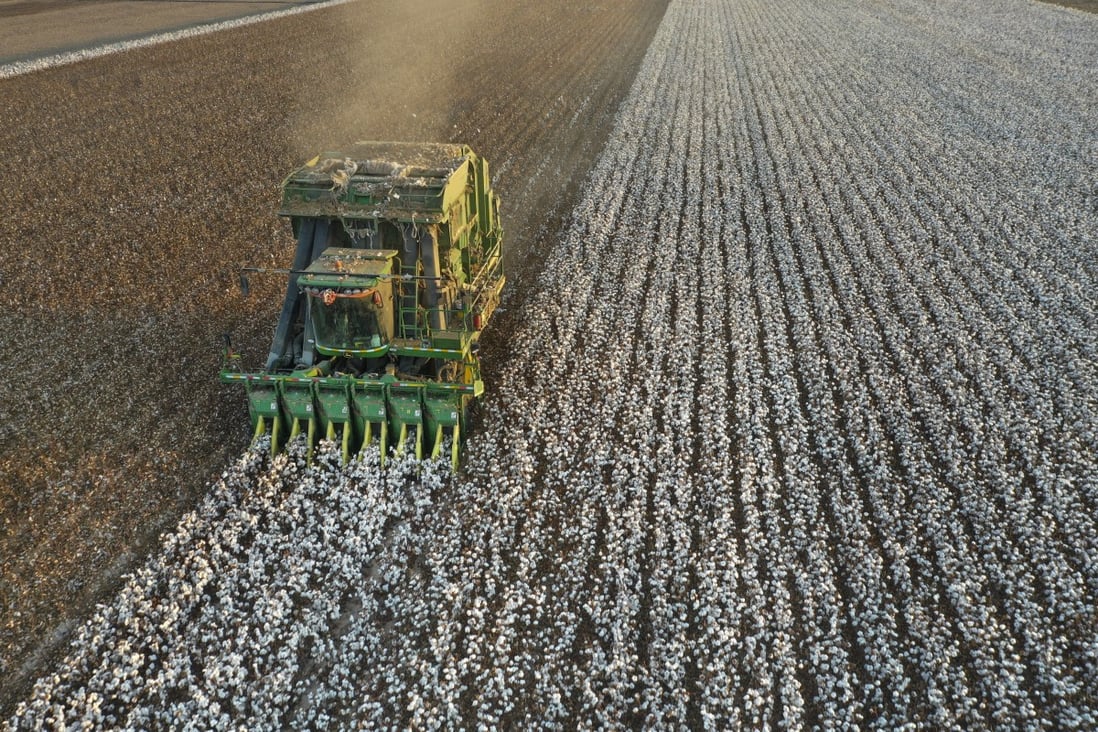
Xinjiang’s exports to the United States dropped in September after soaring for two consecutive months, but were still nearly three times as high as the same month last year, according to the latest Chinese customs data – despite a Washington law that seeks to ban goods from the far-west region of China due to forced labour allegations.

The shipments from Xinjiang to the US have appeared to continue even as officials from the US customs agency insist that they have been effectively enforcing the Uygur Forced Labour Prevention Act, which kicked in on June 21.

Companies from the Xinjiang Uygur autonomous region in September exported US$21.05 million worth of goods to the US, slashed by more than half compared with the figure for August, but more than double the tally in June, trade data showed.

The month-on-month decline of Xinjiang exports to the US was in line with the overall weakening of Chinese exports.

https://multimedia.scmp.com/widgets/graphicsEmbeds/charts2/chart/?id=CHG2022092115_columnN2UB

Tiếp tục đọc “Xinjiang exports to US dip in September but still higher year on year despite forced labour law”

Indigenous peoples must benefit from science

20 October 2015

Article tools

Nature – The sun has been pale for months here in Sumatra and the skies are grey all day — choked with pollution from the massive fires that rage across the Indonesian island. Since the late 1990s, the haze caused by these annual fires has posed a significant threat to the health of Sumatra’s rural communities. This year’s haze is especially bad and has affected major cities, both here and abroad; consequently, the fires have again made headlines around the world.

Many of these news stories blame the big palm-oil companies for the fires. Slash-and-burn techniques remain the cheapest way to clear forest for new plantations. But scientific evidence suggests that this simple narrative is not absolutely true. A number of surveys have found that the bulk of these fires are started outside the official oil-palm concessions. Small-scale farmers seem to be more to blame.

The haze in Indonesia is not just an environmental issue; it is a complex socio-economic problem that is driven partly by conflict over land ownership between palm-oil companies and rural communities — a struggle that the companies usually win. Tiếp tục đọc “Indigenous peoples must benefit from science”

Ethnic minorities in Vietnam: Out of sight

Continuing grinding poverty in Vietnam’s minority regions is a liability for the Communist Party

Economist – XU XEO GIA ekes out a living in Pho, a remote village in Vietnam’s northern mountains. Mr Gia comes from the Hmong ethnic minority. He is grateful for the education and health-care subsidies that his family receives from the government. But he struggles on marginal land to raise livestock and grow rice. The odd $25 he earns from selling a pig is just enough to clothe his children and keep creditors at bay. “Life is getting better,” he says, “but not fast enough.” Tiếp tục đọc “Ethnic minorities in Vietnam: Out of sight”