Fukushima’s Nuclear Wastewaters Have Been Released. Now What?

34,303 views Oct 10, 2023 #Radioactive#CNAInsider#Japan

Japan has completed phase one of wastewater release from the Fukushima-Daiichi nuclear disaster. Despite assurances from the government and IAEA representatives that the water’s radioactive particles, specifically Tritium, are not harmful, many in Japan and the region are not appeased.

Insight’s Genevieve Woo travels across Fukushima to find out what has happened since the release. She finds fishermen off the coast of Japan who are worried about their livelihoods. Meanwhile, China and Hong Kong seafood curbs continue. What repercussions will the wastewater have on Japan and its neighbours? What has happened one month after the water release? And does the data support further release of waters?

00:00 Introduction

01:30 Activists protest discharge of radioactive water

05:34 Treating radioactive wastewater before release

08:07 Fukushima’s fishermen unhappy

13:00 Impact on Fukushima’s tourism industry

17:59 People living near the plant react to the release

23:42 How much radiation is there really?

28:18 Distrust towards TEPCO and the Japanese government

35:08 China’s import ban on Japanese seafood

37:13 Does the rest of Japan have fears about the wastewater release?

42:41 Japan’s future nuclear power plans

=============== ABOUT THE SHOW: Insight investigates and analyses topical issues that impact Asia and the rest of the world.
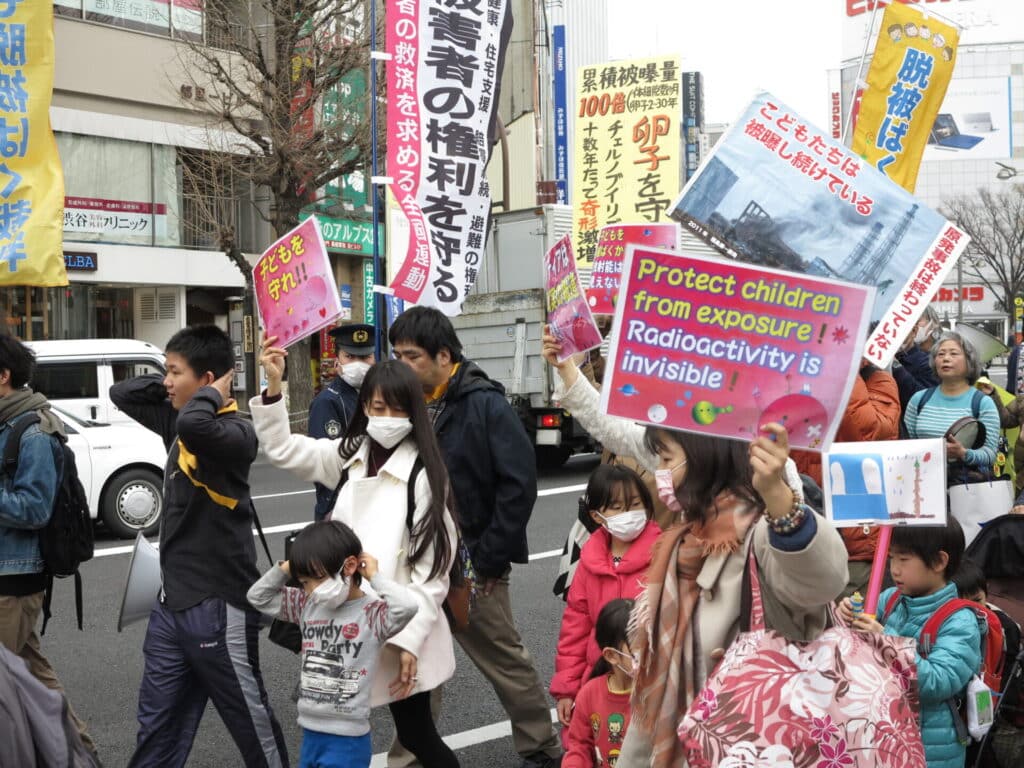
Fukushima wastewater issue will further divide a nation, split families, and cause ‘atomic divorce’

thebulletin.org By Maxime Polleri | October 17, 2023

 Mothers march in Tokyo against radiation exposure risks five years after the Fukushima nuclear disaster on March 5, 2016. (Photo by Maxime Polleri)Share
In a bid to dispel seafood worries around the release of Fukushima nuclear wastewater into the ocean, Japan’s Prime Minister Fumio Kishida ate an array of sashimi late in August; the raw fish ranged from flounder to sea bass caught in the Fukushima area. It is “safe and delicious,” he joyfully declared during a public relations effort to revitalize the fishing industry, which has been affected by a Chinese seafood ban and consumer anxieties over the wastewater release.

Many applauded Kishida’s comment, which echoes the same government narrative around post-Fukushima food safety, as well as his firm support for the release of tritium-contaminated water—a discharge process that the International Atomic Energy Agency stated complies with operational safety limits for radiation.

But as someone who studied the aftermath of the Fukushima nuclear disaster for more than a decade, I believe that this decision will irreversibly erode public trust and create irreparable long-lasting tensions. During my years of research in Japan as an anthropologist, I witnessed first-hand how state policies around Fukushima’s economic recovery are fragmenting communities, which constitutes an enduring catastrophe of its own.

Tiếp tục đọc “Fukushima wastewater issue will further divide a nation, split families, and cause ‘atomic divorce’”

Radioactive Glass Beads May Tell the Terrible Tale of How the Fukushima Meltdown Unfolded

ScientificAmerican

The microscopic particles unleashed by the plant’s explosions are also a potential environmental and health concern

Radioactive Glass Beads May Tell the Terrible Tale of How the Fukushima Meltdown Unfolded
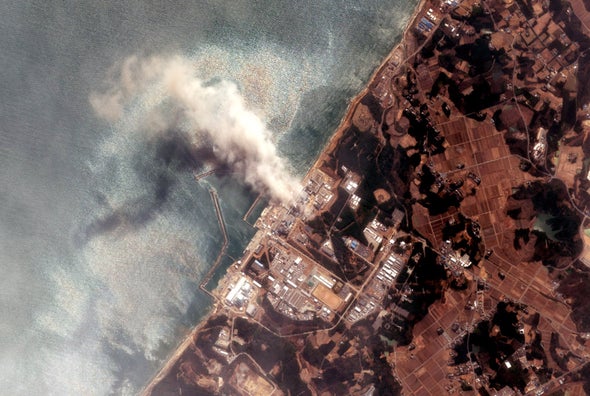
The Fukushima Dai-ichi Nuclear Power plant after a massive earthquake and subsequent tsunami on March 14, 2011 in Futaba, Japan. Credit: Getty Images

On March 14 and 15, 2011, explosions unleashed invisible radioactive plumes from the Fukushima Daiichi Nuclear Power Plant, crippled three days earlier when the strongest recorded earthquake in Japan’s history triggered a massive tsunami. As the plumes drifted over the neighboring countryside, their contents—including radioactive cesium, a by-product of the plant’s fission reactions—fell to the ground and over the ocean.

What no one knew or expected was the fallout also contained bacteria-size glassy beads, with concentrations of radioactive cesium that were far higher than those in similar-size motes of tainted dust or dirt. Tiếp tục đọc “Radioactive Glass Beads May Tell the Terrible Tale of How the Fukushima Meltdown Unfolded”

Japan admits that Fukushima worker died from radiation

theguardian.com

After denials, government ordered to pay compensation to family of lung cancer victim

Contamination experts work at the site of the Fukushima disaster.
 Contamination experts work at the site of the Fukushima disaster. Photograph: Christopher Furlong/Getty Images

Japan has acknowledged for the first time that a worker at the Fukushima nuclear power plant, destroyed by an earthquake and tsunami more than seven years ago, died from radiation exposure.

A magnitude 9.0 earthquake struck in March 2011, triggering a tsunami that killed about 18,000 people and the world’s worst nuclear disaster since Chernobyl 25 years earlier. Tiếp tục đọc “Japan admits that Fukushima worker died from radiation”

Điện hạt nhân: nhiều nhược điểm chưa có giải pháp

TS Đinh Văn Nguyên, Cộng hòa Ireland

Tác giả viết bài này để tưởng nhớ 30 năm thảm họa hạt nhân Chernobyl (Liên Xô cũ) và 5 năm thảm họa hạt nhân Fukushima (Nhật Bản), và chia sẻ để ủng hộ đề xuất của Chính phủ và EVN về dừng điện hạt nhân. Ngoài những nhược điểm của bản thân công nghệ như chưa có hệ thống làm nguội tối ưu, chưa có giải pháp bền vững cho chất thải phóng xạ và nhiễm xạ, bài viết này sẽ trình bày nhiều nhược điểm khác chưa có giải pháp của điện hạt nhân. Một số kết luận và kiến nghị được đưa ra ở cuối bài viết. Tác giả không cho phép bất kỳ cá nhân/tổ chức nào sử dụng bài viết này hay một phần của bài với mục đích chính trị.

1. Nguy cơ gây thảm họa cao và ảnh hưởng nghiêm trọng, lâu dài khi có sự cố

Tiếp tục đọc “Điện hạt nhân: nhiều nhược điểm chưa có giải pháp”

Fukushima and the oceans: What do we know, five years on?

sciencedaily :  30, 2016Source:Goldschmidt ConferenceSummary:A major international review of the state of the oceans five years after the Fukushima disaster shows that radiation levels are decreasing rapidly except in the harbor area close to the nuclear plant itself where ongoing releases remain a concern.

A major international review of the state of the oceans 5 years after the Fukushima disaster shows that radiation levels are decreasing rapidly except in the harbour area close to the nuclear plant itself where ongoing releases remain a concern. At the same time, the review’s lead author expresses concern at the lack of ongoing support to continue the radiation assessment, which he says is vital to understand how the risks are changing.

These are the conclusions of a major 5 year review, with multi-international authors who are all working together as part of a Scientific Committee on Oceanic Research (SCOR) Working Group. The report is being presented at the Goldschmidt geochemistry conference in Japan. The review paper is also published in Annual Review of Marine Science*. The main points made by the report are: Tiếp tục đọc “Fukushima and the oceans: What do we know, five years on?”

The Effects of Fukushima Linger after Five Years, but Not from Radiation

While hundreds died in the evacuation, none perished as a result of exposure to radiation.

technologyreview : The Fukushima Daiichi nuclear accident, which began on March 11, 2011, uprooted thousands of Japanese people, set the worldwide nuclear power industry back a decade, and caused a run on potassium iodide (said to help ward off thyroid cancer). What it didn’t do was kill anyone from radioactive fallout.

A Greenpeace report released this week, Nuclear Scars: The Lasting Legacies of Chernobyl and Fukushima,” takes a harsher view, saying that “the health consequences of the Chernobyl and Fukushima catastrophes are extensive.” But most of the report dwells on Chernobyl, and it notes that the primary effects of Fukushima were “mental health disorders, such as depression, anxiety and Post Traumatic Stress Disorder.” Put another way: fear and panic resulting from the accident (and from the loss of homes and livelihoods) were more dangerous than the radiation.
Tiếp tục đọc “The Effects of Fukushima Linger after Five Years, but Not from Radiation”

Lessons from Fukushima

7 March 2016
Author: Editors, East Asia ForumAs we approach the 5th anniversary of the 11 March 2011 earthquake, tsunami and nuclear meltdown which devastated Japan’s Tohoku region, how has the Japanese state absorbed the lessons of that triple disaster?

eastasiaforum_ The scale of the disaster was massive: a 9.0 magnitude earthquake, the most powerful to hit Japan in recorded history, which triggered a 40-metre-high tsunami that took out the Fukushima Daiichi nuclear power plant. Over 20,000 perished, an evacuation zone carved out around Fukushima Daiichi will remain uninhabitable for tens of thousands of years, and 100,000 people from the evacuation zone and surrounding areas are still living as nuclear refugees. Tiếp tục đọc “Lessons from Fukushima”

Greenpeace launches high tech investigation into radiation impacts of Fukushima disaster on Pacific Ocean

Press release – 25 February, 2016

greenpeace – Tokyo, 25 February 2016 – Greenpeace Japan today announced it is conducting an underwater investigation into radiation contamination from the Fukushima Daiichi nuclear plant into the Pacific Ocean. The survey will be conducted from a Japanese research vessel using a one of a kind Remotely Operated Vehicle (ROV), fitted with sensitive gamma radiation spectrometer and sediment sampler.

On the opening day of the investigation, Mr Naoto Kan, the former Prime Minister of Japan and leader at the time of the nuclear accident, joined the crew of the Greenpeace flagship, the Rainbow Warrior. As the country nears the fifth anniversary of the Fukushima disaster Mr. Kan called for a complete phase out of nuclear power.

“I once believed Japan’s advanced technology would prevent a nuclear accident like Chernobyl from happening in Japan. But it did not, and I was faced with the very real crisis of having to evacuate about 50 million people at risk from the Fukushima Daiichi nuclear accident. I have since changed my mind,” said Mr. Kan on board the Greenpeace ship, Rainbow Warrior. “We do not need to take such a big risk. Instead we should shift to safer and cheaper renewable energy with potential business opportunities for our future generations.”

Tokyo Electric Power Company (TEPCO) has produced over 1.4 million tonnes of radioactive contaminated water in an effort to cool the hundreds of tonnes of molten reactor fuel in Fukushima Daiichi reactor units 1, 2 and 3 [1]. In addition to the initial releases of liquid nuclear waste during the first weeks of the accident and the daily releases from the plant ever since, contamination  also flows from land, particularly the forests and mountains of Fukushima, and will continue to contaminate the Pacific Ocean for at least 300 years.(2)

“The Fukushima disaster is the single largest release of radioactivity into the marine environment in history. There is an urgent need to understand the impacts this contamination is having on the ocean, how radioactivity is both dispersing and concentrating and its implications,” said Shaun Burnie, Senior Nuclear Specialist with Greenpeace Germany.

“TEPCO failed to prevent a multiple reactor meltdown and five years later it’s still an ongoing disaster. It has no credible solution to the water crisis they created and is failing to prevent the further contamination of the Pacific Ocean.”

Tiếp tục đọc “Greenpeace launches high tech investigation into radiation impacts of Fukushima disaster on Pacific Ocean”