The Fourth Industrial Revolution: a seductive idea requiring critical engagement

Published: June 8, 2022 2.58pm BST The Conversation

Authors

  1. Ruth Castel-Branco, Research Manager, University of the Witwatersrand
  2. Hannah J. Dawson, Senior Researcher, Southern Centre for Inequality Studies, University of the Witwatersrand

Disclosure statement

The authors do not work for, consult, own shares in or receive funding from any company or organisation that would benefit from this article, and have disclosed no relevant affiliations beyond their academic appointment.

Partners

University of the Witwatersrand provides support as a hosting partner of The Conversation AFRICA.

View all partners

CC BY NDWe believe in the free flow of information
Republish our articles for free, online or in print, under Creative Commons licence.
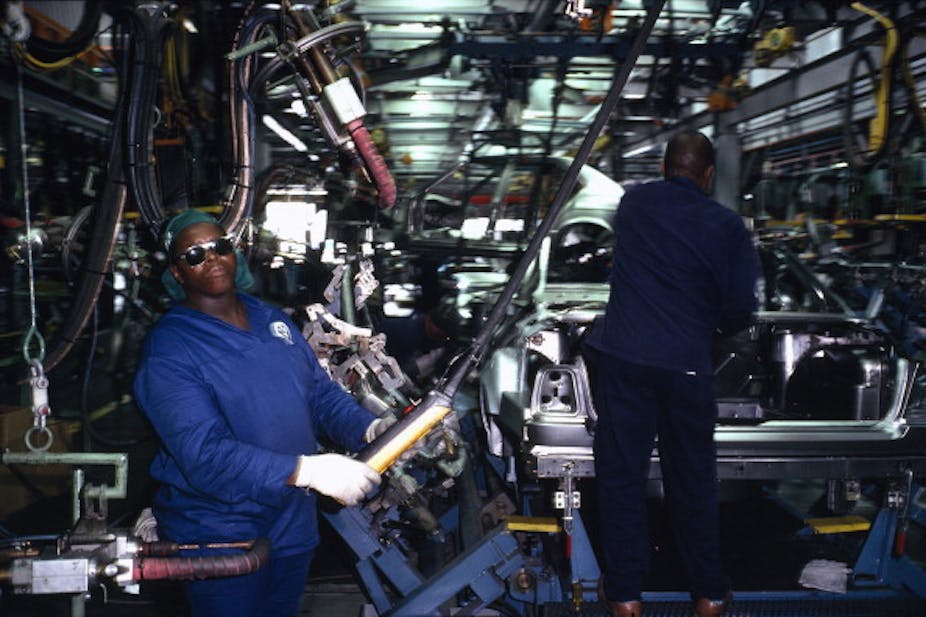
Technological innovation can indeed be beneficial for the working class. Photo by JNS/Gamma-Rapho via Getty Images

Narrative frames are fundamental to unifying ideologies. They frame what is possible and impossible, which ideas can be accepted and which must be rejected. In her book, Digital Democracy, Analogue Politics, storyteller and political analyst Nanjala Nyabola examines the framing of the Fourth Industrial Revolution narrative in this light.

Tiếp tục đọc “The Fourth Industrial Revolution: a seductive idea requiring critical engagement”

Industry 4.0 poses great challenges to ASEAN, including Vietnam

Tuoi Tre News

Updated : 06/11/2017 15:14 GMT + 7

Vu Khoan, former Deputy Prime Minister of Vietnam, speaks at the international conference on ‘geo-political transition in the Asia-Pacific and the half-century road of ASEAN’ in Hanoi, June 9, 2017.

The Fourth Industrial Revolution, or Industry 4.0, was named one of the biggest challenges facing ASEAN at a conference in Hanoi on Friday to review the association’s prospects.

ASEAN, or the Association of Southeast Asian Nations, is a ten-country politico-economic bloc whose members include Brunei, Cambodia, Indonesia, Laos, Malaysia, Myanmar, the Philippines, Singapore, Thailand, and Vietnam. Tiếp tục đọc “Industry 4.0 poses great challenges to ASEAN, including Vietnam”

The Fourth Industrial Revolution: What It Means and How to Respond

foreignaffair – We stand on the brink of a technological revolution that will fundamentally alter the way we live, work, and relate to one another. In its scale, scope, and complexity, the transformation will be unlike anything humankind has experienced before. We do not yet know just how it will unfold, but one thing is clear: the response to it must be integrated and comprehensive, involving all stakeholders of the global polity, from the public and private sectors to academia and civil society.

The First Industrial Revolution used water and steam power to mechanize production. The Second used electric power to create mass production. The Third used electronics and information technology to automate production. Now a Fourth Industrial Revolution is building on the Third, the digital revolution that has been occurring since the middle of the last century. It is characterized by a fusion of technologies that is blurring the lines between the physical, digital, and biological spheres.

There are three reasons why today’s transformations represent not merely a prolongation of the Third Industrial Revolution but rather the arrival of a Fourth and distinct one: velocity, scope, and systems impact. The speed of current breakthroughs has no historical precedent. When compared with previous industrial revolutions, the Fourth is evolving at an exponential rather than a linear pace. Moreover, it is disrupting almost every industry in every country. And the breadth and depth of these changes herald the transformation of entire systems of production, management, and governance. Tiếp tục đọc “The Fourth Industrial Revolution: What It Means and How to Respond”