Time for Vietnam to Resolve Its Renewable Energy Legal Quagmire

fulcrm.sg Published 19 Nov 2025 Le Hong Hiep

In Vietnam, an impasse over feed-in-tariffs for renewable energy producers threatens foreign investors’ confidence in government policies

Afestering legal crisis is threatening to derail Vietnam’s energy development plans. 173 solar and wind projects, representing about US$13 billion in investments, are stuck in limbo due to ongoing disputes regarding their feed-in-tariffs (FITs) – the guaranteed payments that the government would pay for their contribution to the power grid. This situation raises concerns about Vietnam’s business environment and the consistency of its economic policy. If Vietnam does not resolve these disputes promptly, the country could face significant legal, financial, and reputational repercussions.

Between 2018 and 2021, Vietnam experienced a significant boom in renewable energy, primarily fuelled by the government’s commitment to offer attractive 20-year FITs to investors for projects that began commercial operations before designated deadlines. However, in 2023, an investigation by the Government Inspectorate found that many of these projects had not obtained their Construction Completion Acceptance (CCA) certificates before their Commercial Operation Date (COD). Following the inspection, the Ministry of Industry and Trade issued a new circular, effective June 2023, stipulating that renewable energy projects must obtain a CCA certificate before being recognised for COD. This effectively disqualified the affected projects from receiving the original FIT rates.

Tiếp tục đọc “Time for Vietnam to Resolve Its Renewable Energy Legal Quagmire”

The lights dim on Laos’ brief Bitcoin dream

mekoneye.com By Võ Kiều Bảo Uyên 17 November 2025 at 14:50

Four years after it first approved Bitcoin mining projects powered by surplus hydropower, Laos is beginning to rethink whether the energy-hungry industry — now linked to massive transnational cryptocurrency scams — is worth keeping alive

High-rise buildings stand in the Boten Special Economic Zone in northern Laos, near the border with China. The area is suspected to be a hotspot for scam operations, including schemes that store fraudulent money in crypto for later laundering. PHOTO: Thanh Hue

Houaphanh Province, LAOS — Bitcoin is a world far away from 19-year-old Chai, an ethnic Hmong and a college student who has never owned a computer. 

But its shadow has already crept into his mountainous village, where power outages are common—often a side effect of the vast energy demands elsewhere, including cryptocurrency mining.

Despite the national grid being connected to his remote community seven years ago, he and his classmate studied by candlelight, oil lamp, or mobile flashlight at night to prepare for university entrance exams. The blackout worsens during the dry seasons when hydropower drops. 

Tiếp tục đọc “The lights dim on Laos’ brief Bitcoin dream”

Government Debt to GDP by Country in 2025

visualcapitalist

By Niccolo Conte Graphics/Design: Sabrina Lam

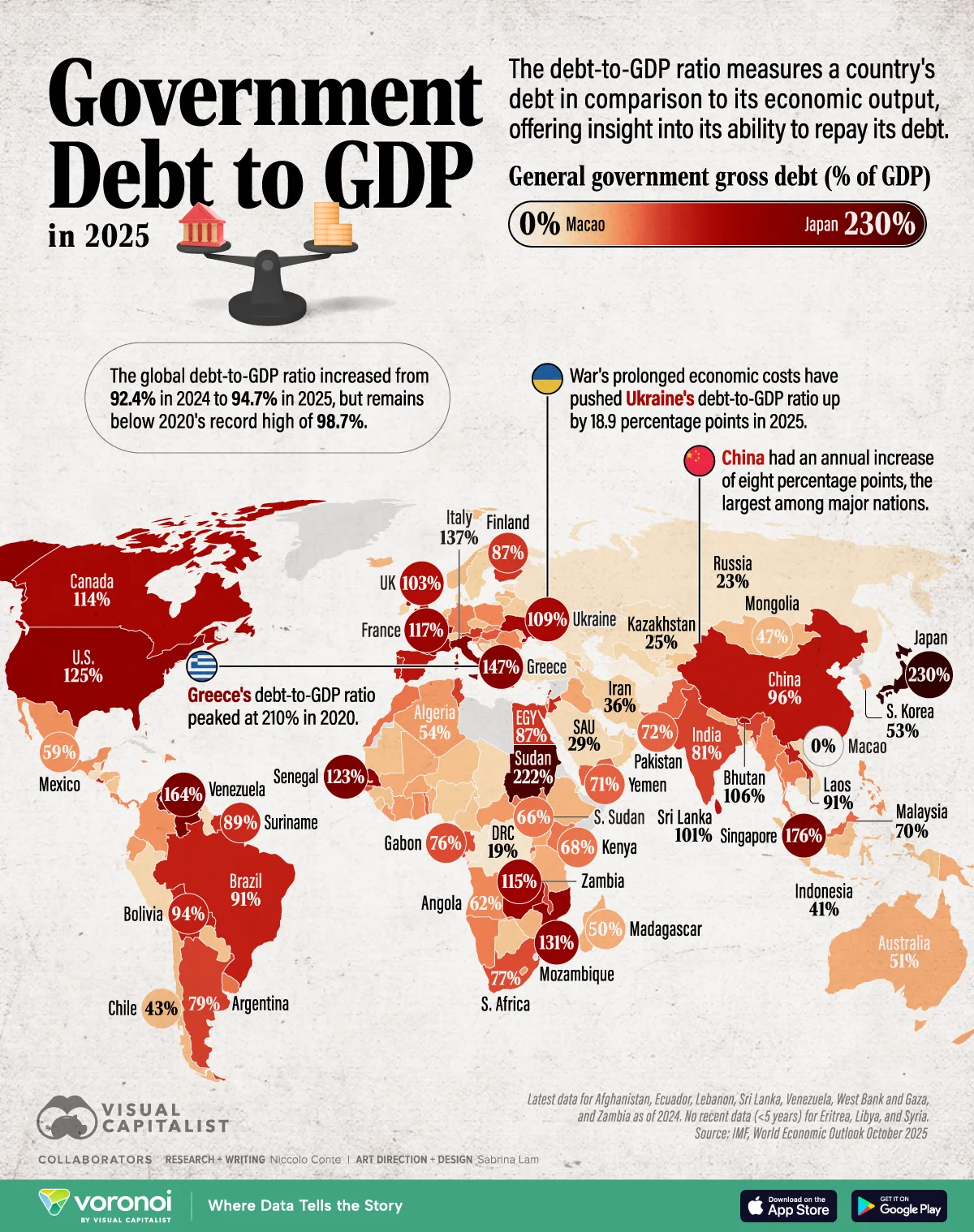
Global map of government debt in 2025 by country

Key Takeaways

  • The global debt-to-GDP ratio rose 2.3 percentage points to 94.7% in 2025, but is still below the pandemic-era peak of 98.7% in 2020.
  • Japan remains the world’s most indebted nation at 230% of GDP, followed by Sudan (222%) and Singapore (176%).

Global debt levels continue to rise, with 2025 marking another year of fiscal strain across both advanced and developing economies.

Tiếp tục đọc “Government Debt to GDP by Country in 2025”

Green energy statecraft and Australia’s clean industry future

lowyinstitute.org Elizabeth Thurbon Oliver Yates

A new policy model that removes the risk in clean commodity innovation will put Australia ahead of the pack.

Australia will need to lead as global supply chains pivot towards low-emissions production (Getty Images)

Australia will need to lead as global supply chains pivot towards low-emissions production (Getty Images)

Published 9 Jul 2025  Australia Australian trade, investment & economy

As global supply chains pivot towards low-emissions production, Australia will need to lead, or risk being left behind. The country’s challenge is not a lack of technology, capital, or ambition. It’s a gap in policy architecture. Without bankable demand, Australia’s most promising clean commodity projects – green iron, sustainable aviation fuel, and clean ammonia – remain stuck at the starting line.

To meet that challenge, we propose a new demand-side policy model: the Clean Commodities Trading Initiative (CCTI) – a flagship example of green energy statecraft. At its heart is a new tool for national transformation: Clean Commodity Credits that reward innovation and emissions savings.

A market-friendly mechanism to kickstart large-scale clean production.

Green energy statecraft is a strategic approach to governance that uses the clean energy transition to simultaneously advance a nation’s economic, environmental, social, and geostrategic goals. Unlike conventional industry policy, which focuses on domestic market corrections, statecraft treats clean energy as key to national security and prosperity – used to build alliances, secure supply chains, boost productivity, and shape global rules.

The European Union, China, Japan, and South Korea are all pursuing variations of green energy statecraft. Australia must do the same – on its own terms, with tools suited to its advantages, institutions, and budget.

Tiếp tục đọc “Green energy statecraft and Australia’s clean industry future”

Ranked: Emerging Markets by FDI Confidence

 visualcapitalist.com June 30, 2025

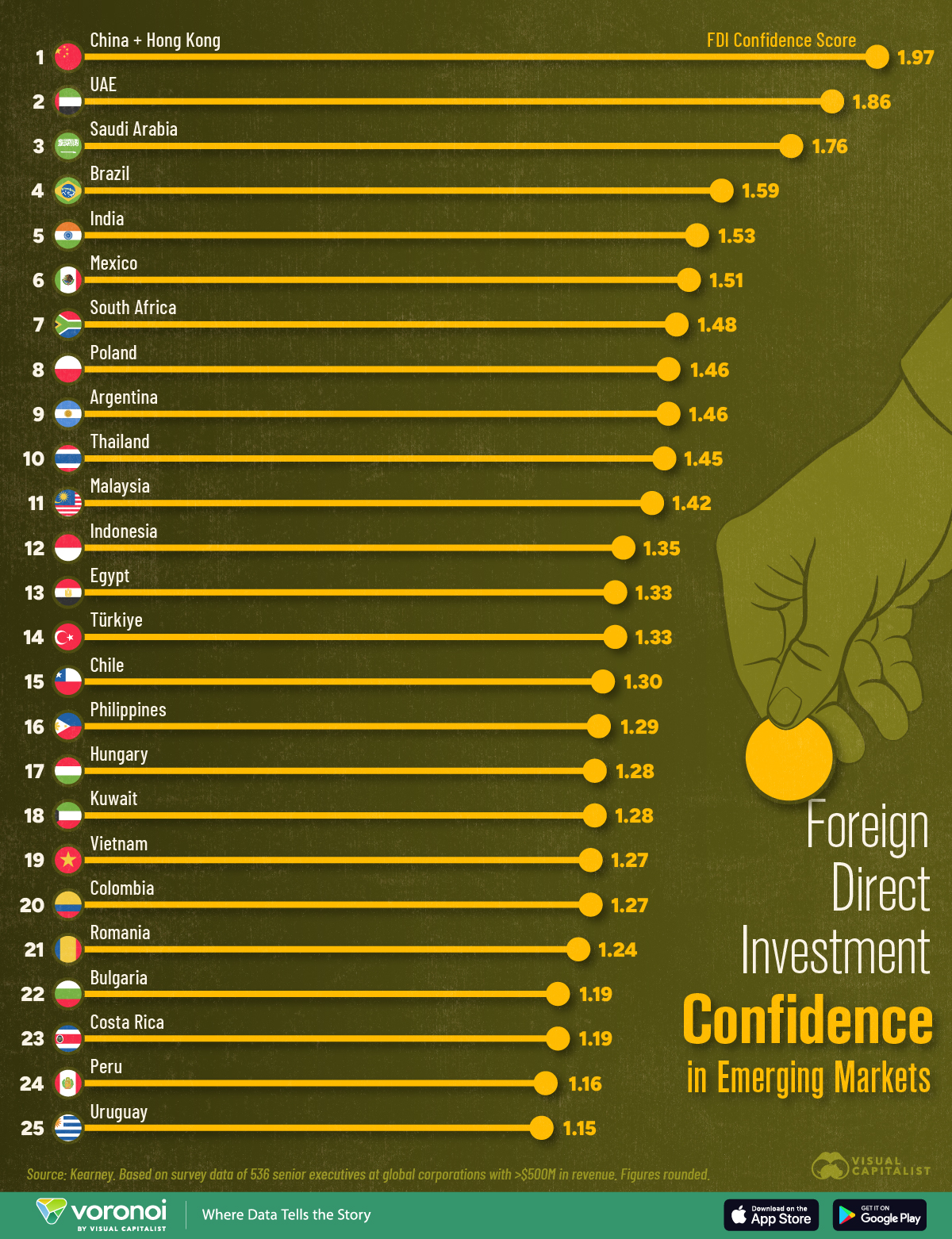
This infographic ranks the top 25 emerging markets by their FDI confidence in 2025, based on a survey of global business leaders.

Key Takeaways

  • China, the UAE, and Saudi Arabia are the top three emerging markets by FDI confidence in 2025
  • Brazil overtook India to take the fourth spot, with both countries making the top five
  • Domestic economic performance and efficiency of legal and regulatory processes were the top two priorities for FDI investors

Emerging markets often attract foreign investors with prospects for higher economic growth and diversification.

Where are global business leaders placing their foreign direct investment (FDI) bets in 2025?

This chart highlights the top 25 emerging markets by FDI confidence score in 2025, based on a survey conducted by Kearney. The rankings are drawn from responses by 536 senior executives at global companies with annual revenues above $500 million.

China Leads in Foreign Investor Sentiment

China (including Hong Kong) remains the top emerging market for foreign investor confidence in 2025. However, FDI inflows have slowed in recent years, hitting multi-year lows in 2023.

Following China, the UAE and Saudi Arabia also retain their places as the second and third-most favored developing economies for FDI.

Here’s a look at the full list of top emerging markets for FDI confidence in 2025:Search:

RankCountryFDI Confidence Score
1China (including Hong Kong) 🇨🇳🇭🇰1.97
2United Arab Emirates 🇦🇪1.86
3Saudi Arabia 🇸🇦1.76
4Brazil 🇧🇷1.59
5India 🇮🇳1.53
6Mexico 🇲🇽1.51
7South Africa 🇿🇦1.48
8Poland 🇵🇱1.46
9Argentina 🇦🇷1.46
10Thailand 🇹🇭1.45

Brazil and India—two of the biggest emerging economies by GDP—round out the top five, with Brazil overtaking India in FDI confidence in the 2025 rankings.

These rankings align with investors’ FDI priorities from the same survey, where the efficiency of legal and regulatory processes and domestic economic performance top the list.

South Africa made the largest upward move in 2025, jumping from 11th to 7th in the rankings. It also recorded FDI inflows of around $661 million in Q1 2025, up 56% from the fourth quarter of 2024.

Overall, 11 of the top 25 emerging markets for FDI confidence are in Asia and the Middle East.

What’s Driving Investor Confidence?

The factors driving FDI confidence vary for each economy.

In China, tech innovation was the leading driver of investor confidence, while economic performance ranked highest for the UAE and Saudi Arabia.

Meanwhile, the talent/skill of the labor pools in India and Mexico were the strongest factors attracting investors.

Shipping data: UNCTAD releases new seaborne trade statistics

UNCTAD.org 23 April 2025

Maritime transport moves over 80% of goods traded worldwide. Country-level seaborne trade data is vital for shaping better transport, trade and investment policies.

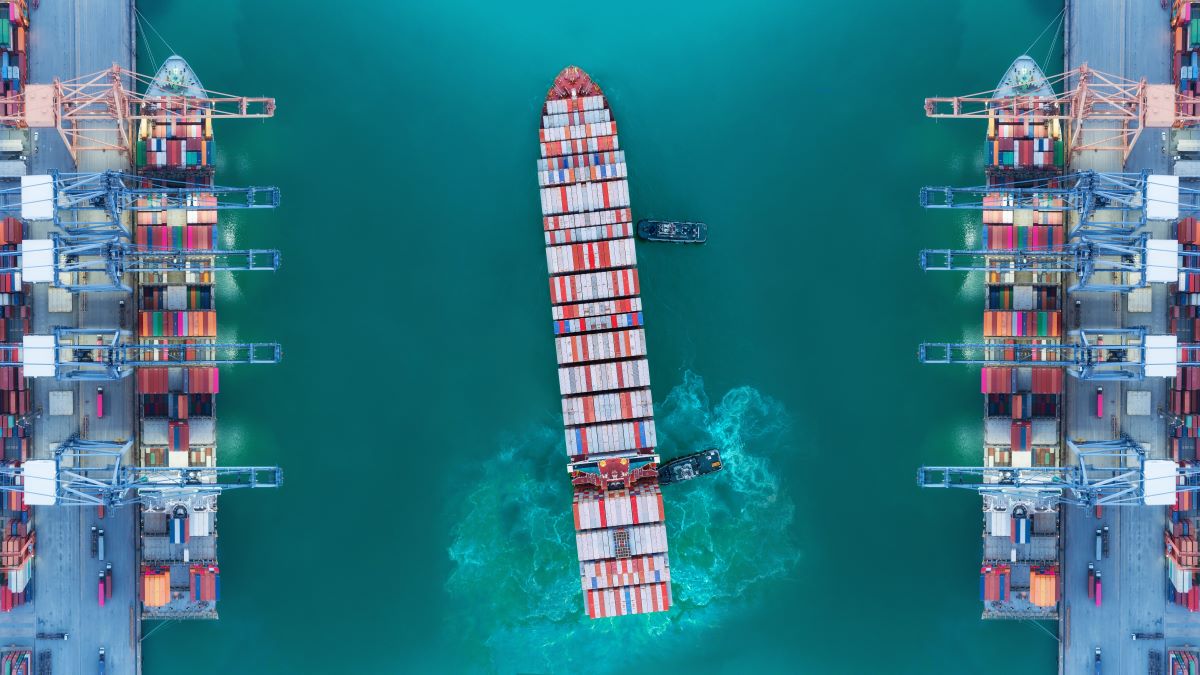
An aerial view of a container vessel leaving port
Default image copyright and description© Shutterstock/Studio conept

UN Trade and Development (UNCTAD) released on 15 April new seaborne trade dataFor the first time, the dataset includes country-level statistics.

Maritime transport is the backbone of global trade, moving over 80% of goods traded worldwide by volume. It connects global value chains, carrying raw materials and semi-processed goods to production hubs and delivering finished products to consumers. These flows are vital for industrialization, economic growth and job creation.

Seaborne trade has evolved over the decades, shaped by containerization, the rise of developing economies and shifting production and consumption patterns. Today, digitalization, geopolitics and the push for sustainability and climate resilience are redefining the sector.

A clearer picture of who ships what – and how much

Reliable, up-to-date country-level data is key to understanding trade flows and guiding better transport and trade policies and investment decisions.

Built from official trade data reported by governments to UN Comtradethe new dataset offers a more accurate and comparable view of global maritime cargo movements, helping countries to:

  • Monitor trade performance and competitiveness.
  • Assess integration into global supply chains and trade networks.
  • Inform port and transport infrastructure investment decisions.
  • Track progress on Sustainable Development Goal 9.1.2 to develop quality, reliable, sustainable and resilient infrastructure – for which maritime freight and port cargo volumes are indicators.

Data highlights developing countries’ rising share of maritime trade

Historically, developing countries served mainly as loading hubs – major exporters of raw materials but marginal importers of manufactured goods. But this has evolved since the 1970s, driven by structural changes such as the oil crises, trade liberalization, increased private sector participation in port operations, the rise of container shipping and reforms to liner shipping alliances.

The shift accelerated in the early 2000s as developing countries increased trade among themselves – including in raw materials, oil and manufactured goods. Their share of global maritime freight rose from 38% in 2000 to 54% in 2023. The surge was led by Asia, with China driving much of the growth.

Read full article here https://unctad.org/news/shipping-data-unctad-releases-new-seaborne-trade-statistics