Vietnam recommended to regulate Minimum Energy Performance Standard for air conditioners

vietnamnet.vn

The cooling sector is a major source of energy consumption and greenhouse gas emissions.
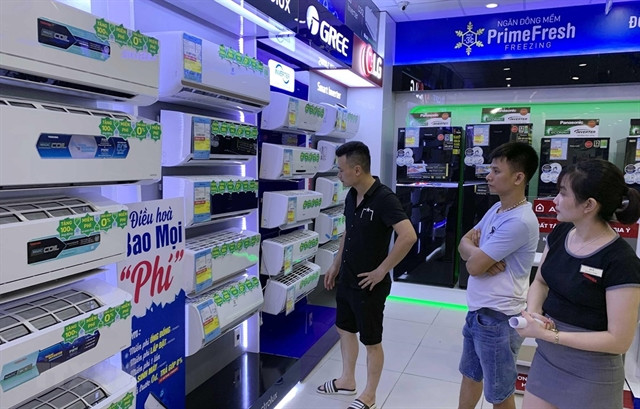
People shop for air conditioners at an electronics supermarket in the northern province of Hưng Yên.—VNA/VNS Photo Phạm Kiên

Việt Nam is recommended to regulate minimum energy performance standard (MEPS) for air conditioners’ seasonal energy efficiency ratio, chillers, variable refrigerant flow, and cars’ mobile air-conditioning systems in the country’s National Green Cooling Programme.

Besides, the country should also switch to greener refrigerants such as R290 or R717, enforce and comply with policies through robust monitoring and verification, Anant Shukla, expert of the Consultancy Consortium, said at a consultation workshop held on Tuesday in Hà Nội.

The workshop was co-organised by the Department of Climate Change under the Ministry of Natural Resources and Environment and the Southeast Asia Energy Transition Partnership to provide technical assistance for the project “In-depth study and survey to develop the National Green Cooling Programme”.

Tiếp tục đọc “Vietnam recommended to regulate Minimum Energy Performance Standard for air conditioners”

Vietnam Building Energy Efficiency Week 2018

If you are interested  in Sustainable Development in Energy, Architecture and Construction, you should save the date for Vietnam Building Energy Efficiency Week 2018.

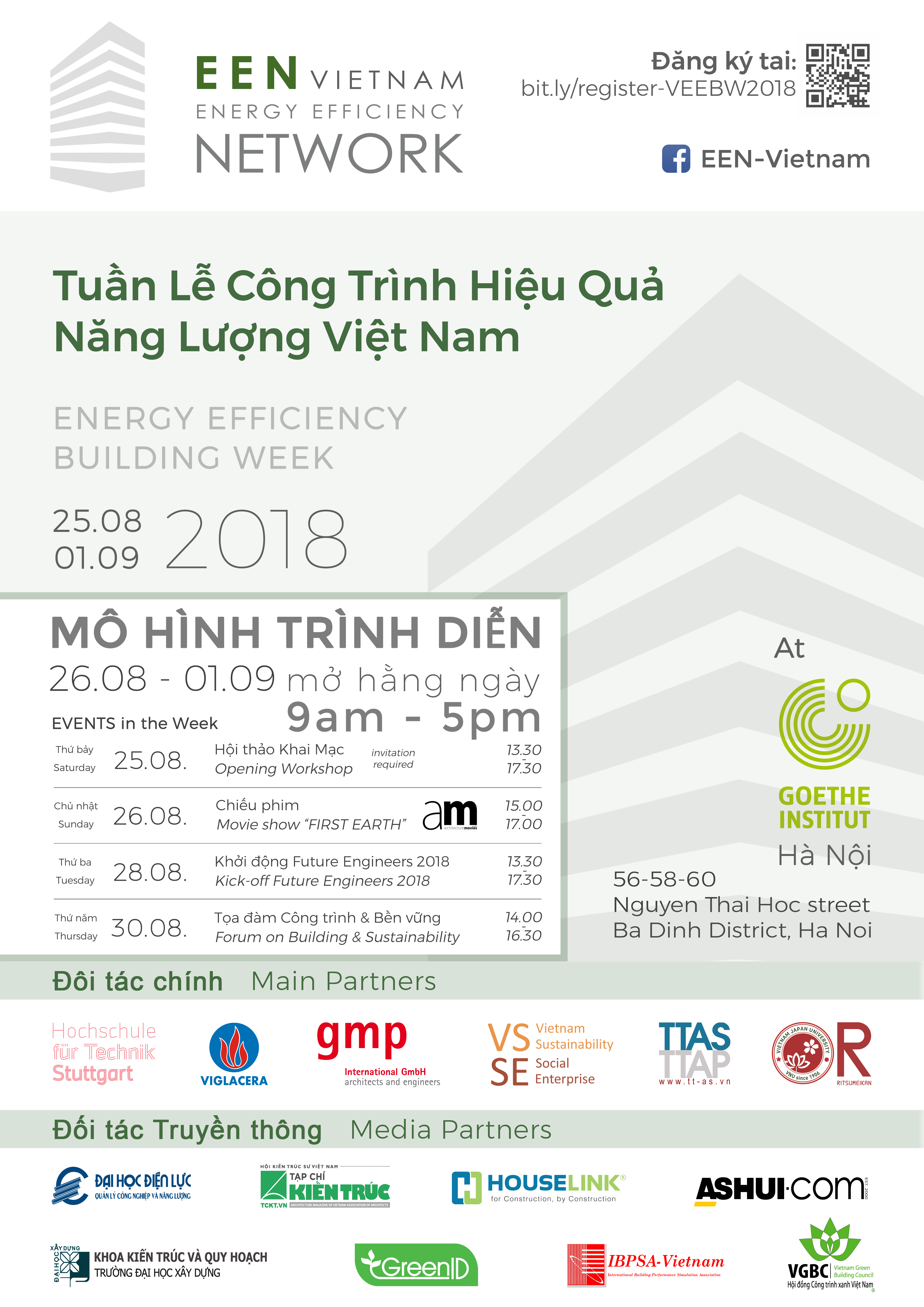
Vietnam Energy Efficiency Network (EEN-Vietnam) collaborates with Goethe Institute to organize Vietnam Energy Efficiency Building Week 2018 (VEEBW2018),with the participation of domestic and overseas organisations and companies in the fields of design, building, technical solutions as well as professional community & universities to showcase outstanding solutions, projects, innovation suitable for local climate and highly applicable for Vietnam market.

Time: 25.08.2018 – 01.09.2018

Venue: Goethe Institute Conference room, 56-58-60 Nguyen Thai Hoc street, Ba Dinh District, Hanoi

For more information and registering (free), please visit: http://bit.ly/register-VEEBW2018 Tiếp tục đọc “Vietnam Building Energy Efficiency Week 2018”

TUẦN LỄ CÔNG TRÌNH HIỆU QUẢ NĂNG LƯỢNG VIỆT NAM 2018

Một chương trình rất tốt, đặc biệt cho các bạn sinh viên tìm hiểu cơ hội thực tập liên quan đến kiến trúc và xây dựng bền vững – ĐTH

Nếu bạn quan tâm đến Phát triển bền vững trong Năng lượng và Kiến trúc Xây dựng thì không thể bỏ qua Tuần lễ Công trình Hiệu quả Năng lượng Việt Nam 2018 sắp tới được diễn ra tại Viện Goethe Hà Nội.

Mạng lưới Hiệu quả Năng lượng Việt Nam (EEN-Vietnam) phối hợp với Viện Goethe tổ chức Tuần lễ Công trình HQNL Việt Nam, với sự hợp tác tham gia từ các tổ chức, doanh nghiệp trong và ngoài nước trong lĩnh vực thiết kế, xây dựng, cung cấp giải pháp kỹ thuật, Hội ngành nghề, trường đại học nhằm
mang đến các dự án trình diễn điển hình, giải pháp, sáng kiến kỹ thuật trong và ngoài nước phù hợp với điều kiện khí hậu, tính ứng dụng cao, phù hợp với thị trường xây dựng Việt Nam.

Thời gian: 25.08.2018 – 01.09.2018
Địa điểm: Phòng Hội thảo, Viện Goethe, 56-58-60 Đường Nguyễn Thái Học, Quận Ba Đình, Hà Nội.

Link Đăng ký tham gia miễn phí và Thông tin chi tiết vui lòng xem tại: http://bit.ly/register-VEEBW2018

#VEEBW2018

TUẦN LỄ CÔNG TRÌNH HIỆU QUẢ NĂNG LƯỢNG VIỆT NAM 2018

VIETNAM ENERGY EFFICIENCY BUILDING WEEK 2018 Tiếp tục đọc “TUẦN LỄ CÔNG TRÌNH HIỆU QUẢ NĂNG LƯỢNG VIỆT NAM 2018”

Cogeneration & Trigeneration – How to Produce Energy Efficiently

A practical Guide for Experts in Emerging and Developing Economies
Energy efficiency is an increasingly important contributor to climate change mitigation while at the same time reducing the cost of energy as well as presenting an opportunity for technological innovation. Cogeneration (or ‘cogen’ for short) is in many cases one of the low hanging fruits of energy efficiency, and also has benefits on the electricity supply side. Cogeneration – the combined production of heat and power (also known as CHP) – encompasses all concepts and technologies by which heat and power are jointly generated in one unit and used by the same consumer, with the option of excess energy being fed into the public grid. The high levels of efficiency achieved in this process result from using waste heat as a co-product of electricity generation. Taking this one step further to include the generation of cooling energy from waste heat is called trigeneration (or ‘trigen’ for short) or combined cooling, heating and power (CCHP).

Study Looks at Renewable Energy in Germany and Texas

Dec 29, 2015

renewablenergyworld – A report published by Stanford’s Steyer-Taylor Center for Energy Policy and Finance looks at three of the world’s largest economies and largest energy jurisdictions in an attempt to compare their approaches to ramping up renewable energy.  Included in the report is a comparison of electricity rates in Germany to those in Texas and California as well a discussion of how renewables contribute to overall costs.

The report compares Germany, the world’s fourth largest economy and an aggressive adopter of renewable energy, with the states of California and Texas.  California and Texas are the world’s 8th and 12th largest economies respectively, and are both leaders in the U.S. with respect to wind and solar deployment. Tiếp tục đọc “Study Looks at Renewable Energy in Germany and Texas”