Why are Vietnam’s schools so good?

economist.com

It understands the value of education and manages its teachers well

Children playing football in a courtyard.
They’re on the ball image: alamy

Jun 29th 2023 | SINGAPORE

Ho chi minh, the founding father of Vietnam, was clear about the route to development. “For the sake of ten years’ benefit, we must plant trees. For the sake of a hundred years’ benefit, we must cultivate the people,” was a bromide he liked to trot out. Yet despite years of rapid economic growth, the country’s gdp per person is still only $3,760, lower than in its regional peers, Malaysia and Thailand, and barely enough to make the average Vietnamese feel well-nurtured. Still, Ho Chi Minh was alluding to a Chinese proverb extolling the benefits of education, and on that front Vietnam’s people can have few complaints.

Their children go through one of the best schooling systems in the world, a status reflected in outstanding performances in international assessments of reading, maths and science. The latest data from the World Bank show that, on aggregate learning scores, Vietnamese students outperform not only their counterparts in Malaysia and Thailand but also those in Britain and Canada, countries more than six times richer. Even in Vietnam itself, student scores do not exhibit the scale of inequality so common elsewhere between the genders and different regions.

A child’s propensity to learn is the result of several factors—many of which begin at home with parents and the environment they grow up in. But that is not enough to explain Vietnam’s stellar performance. Its distinctive secret lies in the classroom: its children learn more at school, especially in the early years.

In a study in 2020, Abhijeet Singh of the Stockholm School of Economics gauged the greater productivity of Vietnam’s schools by examining data from identical tests taken by students in Ethiopia, India, Peru and Vietnam. He showed that between the ages of five and eight Vietnamese children race ahead. One more year of education in Vietnam increases the probability that a child can solve a simple multiplication problem by 21 percentage points; in India the uplift is six points.
Tiếp tục đọc “Why are Vietnam’s schools so good?”

Migration, kids’ education and the future of the Mekong Delta

vnexpress.net

February 7, 2022 | 10:05 am GMT+7 Truong Chi Hung

Bang was my schoolmate back in middle school. After finishing ninth grade he dropped out though his results were the second best in the entire school.

At the time Uncle Sau, his father, said his family had plenty of farmlands, and so there was no need to study, and staying at home and farming was enough for him to live a healthy life.

At the age of 16 Bang just did as he was told by the adults. A few years later he became his family’s breadwinner. He was by himself taking care of two hectares of lands and growing three crops a year, and so there was never a shortage of food.

Then he got married, had children and built a family like all others in my hometown.

People in the Mekong Delta have a saying: “Barrels can be used to measure rice but no one uses barrels to measure letters,” meaning food and clothing are always top priority, but getting an education, while nice, is not an imperative.

Tiếp tục đọc “Migration, kids’ education and the future of the Mekong Delta”

ALMOST 10 MILLION CHILDREN MAY NEVER RETURN TO SCHOOL FOLLOWING COVID-19 LOCKDOWN


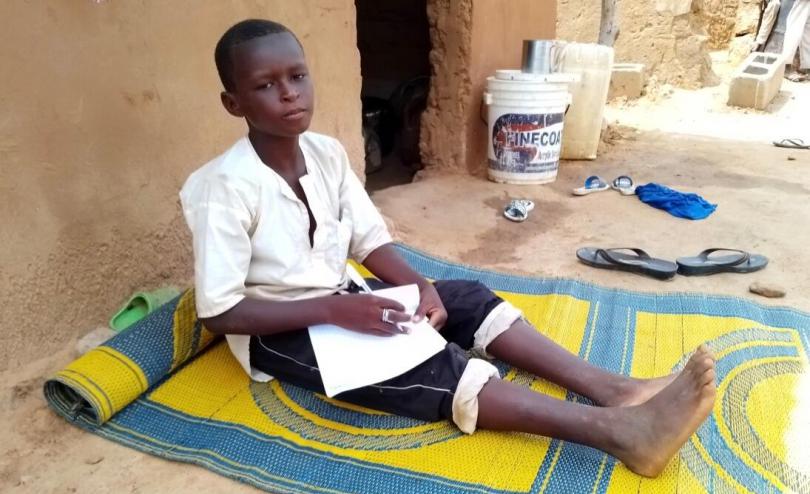
Buba*, 12, Yobe, Nigeria

New report from Save the Children warns of ‘unprecedented global education emergency’.

    • World is facing a hidden education emergency.
    • COVID-19 leaves estimated $77 billion gap in education spending for world’s poorest children.
    • Children in 12 countries are at extremely high risk of dropping out of school forever.
    • In another 28 countries children are at moderate or high risk of not going back to school.
    • Girls are at increased exposure to gender-based violence and risk of child marriage and teen pregnancy during school closures.
    • Save the Children calls for increased funding of education, including conversion of debt liabilities into investment in children.

Tiếp tục đọc “ALMOST 10 MILLION CHILDREN MAY NEVER RETURN TO SCHOOL FOLLOWING COVID-19 LOCKDOWN”

In Rural Tay Ninh, Teach For Vietnam Brings a Jolt of Change to English Teaching

saigoneer.comPublished on Thursday, 05 April 2018 15:39Written by Luca Powell. Photos courtesy of Teach For Vietnam.

Vu Thi Hang’s (not pictured above) teaching style is far from traditional.

In her class, it’s common to find students moving, dancing, acting and singing. In fact, she encourages it.

“I think it helps students to feel the language,” Hang, 25, tells Saigoneer. She describes herself as a theater hobbyist, while also holding a Masters in Asia Pacific Studies. “I like to encourage expression, so the students can try and use the language creatively.”

The kind of creativity and free-play her class fosters is relatively uncommon in most public school English programs in Vietnam. At every rung, from rural county classrooms to top-tier universities, traditional programs have long prioritized reading, writing and grammar as benchmarks for fluency.

Subjects like speaking and listening don’t get enough attention, Hang believes. “When we started teaching our kids, they were scared to speak English. We had to build their confidence.” Tiếp tục đọc “In Rural Tay Ninh, Teach For Vietnam Brings a Jolt of Change to English Teaching”

Unfolding various academic mobility experiences of Southeast Asian women

Pages 1-19 | Received 19 Dec 2016, Accepted 17 Aug 2017, Published online: 08 Nov 2017

http://www.tandfonline.com/

This article draws on data from a qualitative research study undertaken with the main aim of investigating the issue of the gender dimension of the academic mobility of Southeast Asian women. Our research describes Southeast Asian women’s experiences of mobility, narrating why they choose to be mobile, how the experience of going abroad was responded to and/or rejected by their family, how they experienced life in a different country, and what evaluations they make about these experiences in personal, familial, and professional terms. The article stresses the need to improve the understanding of the factors that are still determining the chances of women to be mobile and obtain fruitful gains from these experiences. For this to be attained, the article follows through an intersectional approach to mobility, considering it is of much use as it allows to comprehend that the disadvantages associated with gender are cumulative, multi-layered, resulting from effects of several variables, including of the emotional, social, economic, and political contexts. Tiếp tục đọc “Unfolding various academic mobility experiences of Southeast Asian women”

Can education beat inequality?

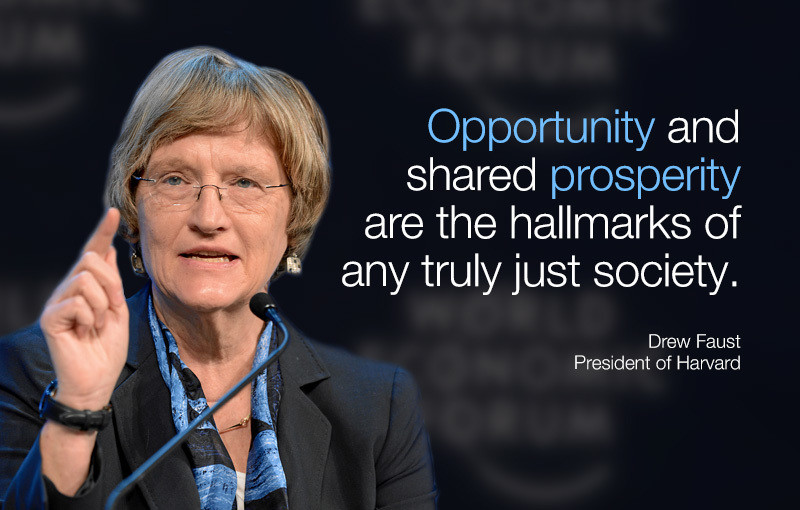
weforum – This year’s World Economic Forum challenges participants to consider and assess the “Fourth Industrial Revolution,” an era of sweeping and rapid technological advances that will disrupt industries and change the future in ways that none of us can predict. What is predictable, however, is that inequality will continue to cast a long shadow on humanity’s progress unless we choose to act.

What role does higher education have to play in ensuring that more individuals are prepared to reap the benefits of the coming age? Knowledge is — and will remain — the most powerful currency, and economic mobility continues to be contingent, in large part, on access to quality education.

Universities expand opportunity and prepare young people for meaningful engagement with their work and with the world. Students encounter points of view and ways of thinking that may be completely foreign to them—and learn to situate their own lives in a broader context as a result. They develop habits of mind that privilege flexibility and resilience, and they graduate with economic advantages that persist throughout their lifetimes.