See What’s Driving Deforestation Alerts on Global Forest Watch

globalforestwatch.org Oct 20, 2025
Screenshot 2025-10-16 184230

Global Forest Watch’s (GFW) deforestation alerts provide information about loss of tree cover in near-real-time, making them a critical tool for those working to combat deforestation. Existing alerts on GFW have been used to help Indigenous and local communities protect their forests, halt and prosecute environmental crimes and protect threatened wildlife.

However, in the past, alerts only let users know there’s been a disturbance without identifying a cause, other than a few limited classes such as fires.

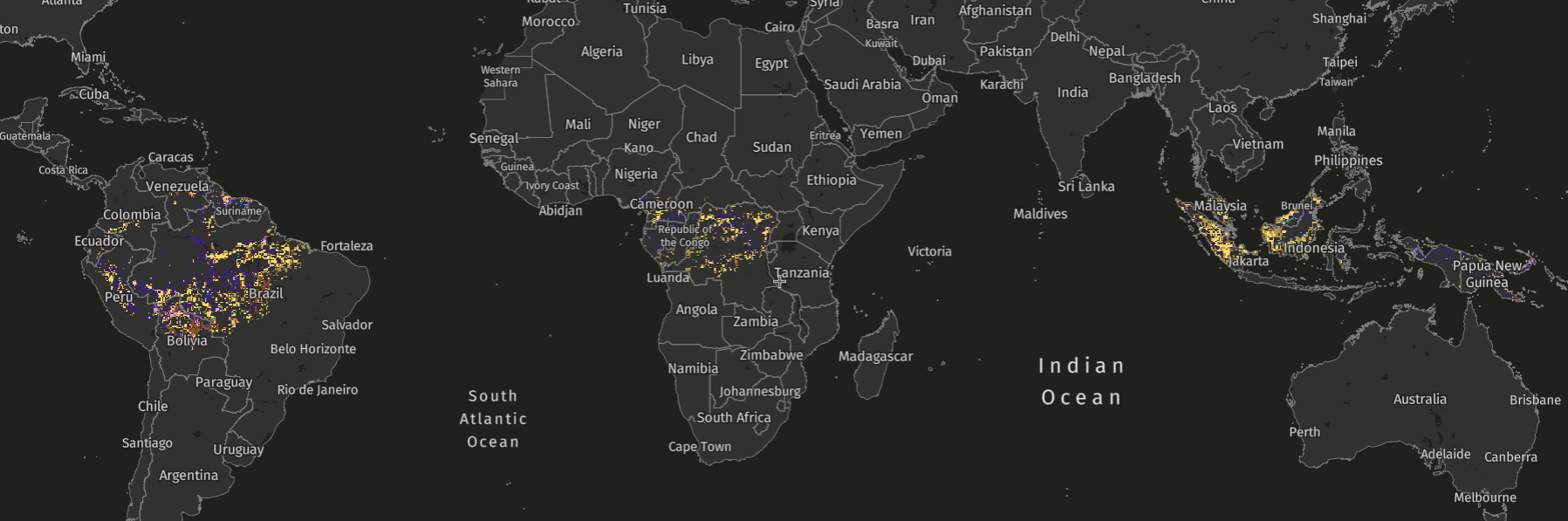
Now, new drivers of deforestation alerts data is available on GFW that shows the causes of alerts across the tropics. This innovative data set uses an AI method to assign drivers to GFW’s integrated deforestation alerts in the three major forested regions in the tropics, allowing users to see what’s driving loss in near-real-time in these regions for the first time.

Critically, this information helps users distinguish between tree cover loss from natural and human causes, enabling more targeted action from those managing forests and reducing the need for costly field visits. Further, the data also provides more rapid information to estimate ecological impacts and supports better understanding of carbon emissions related to forest disturbances.

Tiếp tục đọc “See What’s Driving Deforestation Alerts on Global Forest Watch”

Deforestation can raise local temperatures by up to 4.5°C – and heat untouched areas 6km away

theconversation.com Published: November 15, 2021 7.10pm GMT

Forests directly cool the planet, like natural evaporative air conditioners. So what happens when you cut them down?

In tropical countries such as Indonesia, Brazil and the Congo, rapid deforestation may have accounted for up to 75% of the observed surface warming between 1950 and 2010. Our new research took a closer look at this phenomenon.

Using satellite data over Indonesia, Malaysia and Papua New Guinea, we found deforestation can heat a local area by as much as 4.5°C, and can even raise temperatures in undisturbed forests up to 6km away.

More than 40% of the world’s population live in the tropics and, under climate change, rising heat and humidity could push them into lethal conditions. Keeping forests intact is vital to protect those who live in and around them as the planet warms.

Tiếp tục đọc “Deforestation can raise local temperatures by up to 4.5°C – and heat untouched areas 6km away”

Phá rừng tại Đông Nam Á gây ra nhiều ca tử vong hơn bất kỳ khu vực nhiệt đới nào

vtv.vn 08/10/2025 08:26 GMT+7

VTV.vn – Nghiên cứu mới do Đại học Leeds (Anh) cho biết hoạt động phá rừng ở Đông Nam Á đang gây ra số ca tử vong liên quan đến nắng nóng cao nhất trong các vùng nhiệt đới.

(Ảnh minh họa: The Nation)

(Ảnh minh họa: The Nation)

Theo báo cáo được công bố trên tạp chí Nature Climate Change, mỗi năm có khoảng 15.680 người dân nông thôn ở Đông Nam Á tử vong do các biến chứng liên quan đến nắng nóng trầm trọng hơn bởi phá rừng, so với 9.890 người ở châu Phi nhiệt đới và 2.520 người ở châu Mỹ.

Trong giai đoạn 2001 – 2020, Đông Nam Á đã mất khoảng 490.000 km² thảm thực vật, trong khi khu vực Trung và Nam Mỹ mất tới 760.000 km² rừng nhiệt đới. Tuy nhiên, theo Tiến sĩ Carly Reddington, tác giả chính của nghiên cứu, mật độ dân số cao khiến số ca tử vong do nắng nóng ở Đông Nam Á lớn hơn đáng kể. Mặc dù ở Nam Mỹ, diện tích rừng bị mất nhiều hơn, nhưng ít người sinh sống tại các khu vực này.

Nghiên cứu cũng ghi nhận rằng trong 20 năm qua, biến đổi khí hậu kết hợp với phá rừng đã làm nhiệt độ trung bình ở Đông Nam Á tăng thêm 0,72°C. Các khu rừng không chỉ hấp thụ khí CO₂ mà còn giúp làm mát tự nhiên – tán cây tạo bóng râm, còn lá cây bốc hơi nước, làm giảm nhiệt độ xung quanh. Khi rừng bị chặt hạ, hiệu ứng làm mát này biến mất, khiến mặt đất khô, tối màu và hấp thụ nhiệt mạnh hơn, dẫn tới “nhiệt độ địa phương tăng cao, đôi khi còn vượt cả mức nóng lên toàn cầu”, bà Reddington giải thích.

Phá rừng tại Đông Nam Á gây ra nhiều ca tử vong hơn bất kỳ khu vực nhiệt đới nào- Ảnh 1.
(Ảnh: AFP)

Nhóm nghiên cứu đã kết hợp dữ liệu vệ tinh với hồ sơ y tế để ước tính mối liên hệ giữa phá rừng, nhiệt độ và tử vong do nắng nóng. Họ nhận thấy các cộng đồng nghèo, dân tộc thiểu số và người lao động ngoài trời là những nhóm chịu ảnh hưởng nặng nề nhất, do hạn chế về cơ sở hạ tầng, dịch vụ y tế và khả năng tiếp cận các biện pháp làm mát.

Một nghiên cứu trước đó tại Berau (Đông Kalimantan, Indonesia) cho thấy phá rừng trong giai đoạn 2002 – 2018 đã gây ra hơn 100 ca tử vong do nắng nóng mỗi năm, đồng thời rút ngắn thời gian làm việc an toàn trong ngày tới 20 phút.

Tiến sĩ Reddington nhấn mạnh: “Phá rừng nhiệt đới không chỉ là vấn đề môi trường, nó đang trực tiếp đe dọa sức khỏe con người, đặc biệt ở những cộng đồng ít khả năng thích ứng. Bảo vệ rừng không chỉ cứu hành tinh mà còn cứu mạng sống”.

Các chuyên gia y tế và khí hậu trong khu vực, như Phó giáo sư Kimberly Fornace (Đại học Quốc gia Singapore) và Giáo sư Winston Chow (Đại học Quản lý Singapore), đều đồng tình rằng để giảm thiểu hậu quả do chặt, phá rừng, cần tăng cường nghiên cứu y tế địa phương, cảnh báo sớm nắng nóng và đầu tư vào tái trồng rừng.

Protected areas hit hard as Mekong countries’ forest cover shrank in 2024

mongabay.com Gerald Flynn 6 Oct 2025Asia

  • The five Mekong countries lost nearly 1 million hectares (2.5 million acres) of tree cover in 2024, with nearly a quarter of which was primary forest, and more than 30% of losses occurring inside protected areas.
  • Cambodia and Laos saw some of the highest levels of loss inside protected areas, driven by logging, plantations and hydropower projects, though both countries recorded slight declines from 2023.
  • In Myanmar, conflict has complicated forest governance, with mining and displacement contributing to losses, though overall deforestation fell slightly compared to the previous year.
  • Thailand and Vietnam bucked the regional trend, with relatively low forest losses in protected areas, supported by logging bans, reforestation initiatives, and stricter law enforcement.

See All Key Ideas

BANGKOK — The Mekong countries of Cambodia, Laos, Myanmar, Thailand and Vietnam lost a combined area of tree cover of nearly a million hectares in 2024, or an area almost the size of Lebanon. That’s according to Mongabay’s analysis* of satellite data published by the Global Land Analysis and Discovery (GLAD) laboratory at the University of Maryland, in partnership with Global Forest Watch (GFW).

GFW data show 991,801 hectares (2.45 million acres) of tree cover were lost in 2024, including nearly 220,000 hectares (544,000 acres) of primary forest, across the five Mekong countries. More than 30% of tree cover loss recorded in 2024 occurred inside protected areas, although across the region, the rate of deforestation — both within protected areas and outside of them — slowed slightly from 2023. Despite this, the drivers of deforestation vary somewhat from country to country, and last year’s losses still reflect a grim trajectory for forests in the Mekong region.

The economies of almost all Mekong countries are heavily reliant on agriculture, with forests cleared for both agribusiness-run plantations or subsistence farming plots. But research indicates the conversion of forest to croplands has resulted in increasingly unpredictable weather patterns and subsequently poorer agricultural yields.

Tiếp tục đọc “Protected areas hit hard as Mekong countries’ forest cover shrank in 2024”

High-resolution maps show that rubber causes substantial deforestation (in Southeast Asia)

SEI.org

Researchers used this data and cloud computing to generate powerful, high-resolution maps of rubber and its associated deforestation in Southeast Asia, where over 90% of global rubber is produced…The mapping showed that forest loss associated with rubber production is more than two to three times greater than indicated by previous research has suggested

A multi-partner team of researchers, led by the Royal Botanic Garden Edinburgh, have used new Earth observation satellite data and advanced computer modelling to show that rubber-related deforestation is far higher than previous estimates have suggested

Almost all tropical deforestation is related to the production of global commodities, but mapping this deforestation through satellite imagery is rare (oil palm and soy are the notable exceptions). Natural rubber ranks among these global commodities but its deforestation impact has proved difficult to measure: globally, 85% of natural rubber is produced by smallholders on scattered plantations which have proved difficult to detect through traditional satellite imaging due to their small size. Moreover, these plantations also have a very similar visual appearance to forest when viewed from space. Previous calculations of rubber deforestation have therefore used model-based data.

Due to recent improvements in the visual quality of Earth observation data, in this paper the authors were able to capture the smallholder plantations in their mapping and address the deforestation knowledge gap. Researchers used this data and cloud computing to generate powerful, high-resolution maps of rubber and its associated deforestation in Southeast Asia, where over 90% of global rubber is produced.

Rubber tapping on a plantation in Thailand.Photo: Pavel Muravev / iStock / Getty Images Plus
Tiếp tục đọc “High-resolution maps show that rubber causes substantial deforestation (in Southeast Asia)”

Global supply chains are devouring what’s left of Earth’s unspoilt forests

theconversation.com

While farming continues to drive deforestation around the world, 60% of the destruction of Earth’s large, intact forests is caused by other forces. In particular, our research shows that more than one-third of this destruction can be blamed on the production of commodities for export, particularly timber, minerals and oil and gas.

Increasing global demand for these commodities, which are often exported through globe-spanning supply chains, explains much of the ongoing removal, degradation and fragmentation of intact forests in a handful of countries including Brazil, Canada, the Democratic Republic of Congo and Russia.

We define intact forest landscapes (IFLs) as seamless mosaics of forest and related habitats bigger than 500km² where there is no detectable sign of activities such as logging, mining or energy extraction. Although IFLs made up 20% of the world’s remaining tropical forest in 2020, they stored 40% of all the carbon held in these habitats. Since 2000, the global extent of IFLs has shrunk by 7.2%, a loss of 1.5 million km² – more than quadruple the area of Germany.

Tiếp tục đọc “Global supply chains are devouring what’s left of Earth’s unspoilt forests”

How Peatlands Can Advance Climate Action in Southeast Asia

WRI.org

Topic Forest and Landscape Restoration Region Asia

Southeast Asia is home to over 54% of the world’s peatlands — tropical wetlands which have a major role to play in climate action. But they are being deforested rapidly: Around 25 million hectares of tropical peatlands in Southeast Asia have been deforested and drained over the last three decades alone, and only 6% of peatlands remain untouched.

This is a major blow to the region. These terrestrial wetland ecosystems help regulate water flow by capturing rainwater during the wet season and slowly releasing it during the dry season. They are also key habitats for endangered and rare species of both plants and animals, and are essential for the livelihoods of local communities.

Additionally, they are an important carbon store in the global carbon cycle; more than three-fourths of global peat carbon stocks (52 Gigatons) are stored in Southeast Asian peatlands. Their destruction warrants global attention.

Tiếp tục đọc “How Peatlands Can Advance Climate Action in Southeast Asia”

2019: The year rainforests burned

Mongabay.com

  • 2019 closed out a “lost decade” for the world’s tropical forests, with surging deforestation from Brazil to the Congo Basin, environmental policy roll-backs, assaults on environmental defenders, abandoned conservation commitments, and fires burning through rainforests on four continents.
  • The following review covers some of the biggest rainforest storylines for the year.

2019 closed out a “lost decade” for the world’s tropical forests, with surging deforestation from Brazil to the Congo Basin, environmental policy roll-backs, assaults on environmental defenders, abandoned conservation commitments, and fires burning through rainforests on four continents.

The following covers some of the biggest rainforest storylines for the year. The list isn’t exhaustive, so if there are important things missing, feel free to add them via the comment function at the bottom. Tiếp tục đọc “2019: The year rainforests burned”

Manage Deforestation Risk in Supply Chains

The world lost 12 million hectares of tropical forests in 2018, according to Global Forest Watch, and nearly 40 percent of deforestation is commodity-driven. Why is it so hard for companies to stop deforestation? Commodities like palm oil, cocoa, beef and soy may change hands dozens of times from the moment they’re harvested until they end up in candy bars, toothpaste or baby formula, making it nearly impossible to track deforestation in products. Today, it is finally possible for a company or bank of any size to analyze and manage deforestation risk using GFW Pro.

China, EU, US trading with Brazilian firms fined for Amazon deforestation: report

Conserving Forests Could Cut Carbon Emissions As Much As Getting Rid of Every Car on Earth

Globalforestwatch.org

By Susan MinnemeyerNancy Harris and Octavia Payne

Cantonal Hojancha was once a major cattle ranching region. Most of this area was cleared for pasture only 30 years ago. Now, many of the residents have moved into the service industry, and the pasture land has slowly converted back to forest. Photo by Aaron Minnick (World Resources Institute)

New analysis from The Nature Conservancy, WRI and others estimates that stopping deforestation, restoring forests and improving forestry practices could cost-effectively remove 7 billion metric tons of carbon dioxide annually, or as much as eliminating 1.5 billion cars—more than all of the cars in the world today!

In fact, forests are key to at least six of the study’s 20 “natural climate solutions,” which could collectively reduce 11.3 billion metric tons of greenhouse gas emissions per year. That’s as much as halting global oil consumption, and would get us one-third of the way toward limiting global warming to 2 degrees C (3.6 degrees F) above pre-industrial levels — the threshold for avoiding catastrophic effects of climate change — by 2030.

Stopping Deforestation Offers the Biggest Benefit

Tiếp tục đọc “Conserving Forests Could Cut Carbon Emissions As Much As Getting Rid of Every Car on Earth”

Global Tree Cover Loss Remains High. Emerging Patterns Reveal Shifting Contributors.

Global Forest Watch released new satellite-based data showing how forests around the world changed in the year 2015. The data, produced through the analysis of roughly a million satellite images by the University of Maryland and Google, measures the death or removal of trees at least 5 meters tall within 30×30 meter areas. This can capture any number of sustainable or unsustainable activities, from the clearing of natural forests to the harvest of tree plantations, but when analyzed appropriately with other contextual data and information can serve as a proxy for deforestation (typically defined as the permanent conversion of forest land for another use). Tiếp tục đọc “Global Tree Cover Loss Remains High. Emerging Patterns Reveal Shifting Contributors.”

New Platform Reveals How Much Carbon Is Locked in Tropical Forests – and How Much Was Lost

WRI – Between 2001 and 2013, greenhouse gas emissions from deforestation across the world’s tropical forests were, on average, larger than Russia’s economy-wide emissions in 2012. That’s 2,270 million metric tons (Mt) of carbon dioxide every year.

Emissions from tropical deforestation have significant implications for implementation of the new national climate plans (INDCs), as well as international initiatives like the New York Declaration on Forests, whose signatories aim to cut global deforestation in half by 2020. Tiếp tục đọc “New Platform Reveals How Much Carbon Is Locked in Tropical Forests – and How Much Was Lost”