Financing the Coal Transition

Rocky Mountain Institute

This report aims to contribute to growing conversations about coal finance mechanisms, particularly as they move from concept to reality. RMI believes that financial mechanisms can be a transformational tool in coal transition efforts—but only if implemented well. Ultimately, the devil will be in the detail as to how financial mechanisms are designed and governed to meet the critical needs of all stakeholders and help deliver a rapid and smooth pathway to a climate-safe future.

RMI’s report, Financing the Coal Transition, shows how financial mechanisms can complement policy and regulation to help achieve a rapid, equitable, and smooth coal transition.

The economics of power generation are shifting rapidly in favor of clean energy, challenging coal’s long history as a mainstay of economic development throughout the world. However, much more work needs to be done to transition the existing coal fleet in line with climate and development goals.

The privileged place coal has occupied in power generation for over a century has entrenched complex barriers—from the way that grids have been built to the incentive structures within electricity systems—that prevent markets from catching up to the economic trend toward clean energy. In the absence of solutions to address these barriers, the costs of uneconomic coal will fall largely on local communities through direct costs and unpriced impacts on local health and the environment.

The global community needs new solutions to address the social and economic complexities of the coal transition while responding to the urgency of the climate challenge. One set of solutions currently under development are the innovative financial mechanisms designed to support the transition from coal to clean energy.

This report helps make sense of the various financial mechanisms proposed to date, and models the impacts of using different financial mechanisms to transition existing coal power plants. While it finds that financial mechanisms have the potential to generate wins for both the climate and communities, it also recognizes the risks of using finance to support the coal transition. To manage these risks, RMI proposes five key principles to guide the design of credible financial mechanisms.
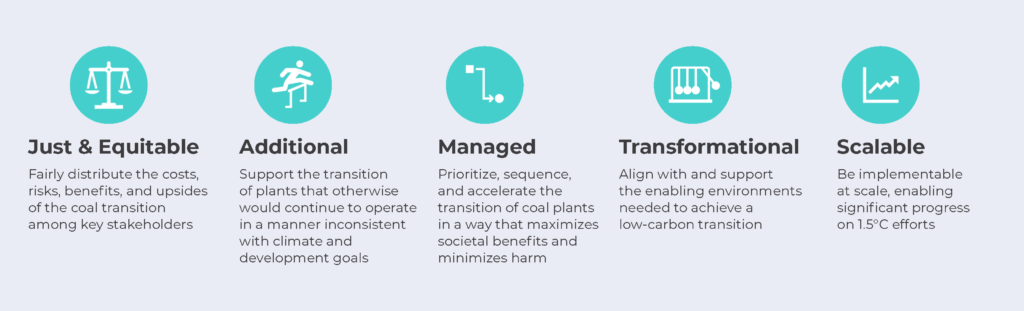
five key principles to guide the design of financial mechanisms for coal transitionFive key principles to guide the design of financial mechanisms for coal transition

Download report here

ASEAN Taxonomy for Sustainable Finance – Version 2

asean.org

ASEAN FINANCE SECTORAL BODIES RELEASE ASEAN TAXONOMY FOR SUSTAINABLE FINANCE
VERSION 2
The ASEAN Taxonomy Board (ATB), representing ASEAN finance sectoral bodies, today took the next
step towards meeting the Paris Agreement commitments, with the release of the ASEAN Taxonomy
for Sustainable Finance Version 2 (Version 2). While the first version laid out the broad framework of
the ASEAN Taxonomy, Version 2 consists of the (a) complete Foundation Framework comprising
detailed methodologies for assessing economic activities; and (b) Technical Screening Criteria (TSC)
for the first focus sector ie Electricity, Gas, Steam and Air Conditioning Supply sector (Energy sector)
under the Plus Standard. TSCs for other focus sectors will be published in the subsequent versions of
the ASEAN Taxonomy. Version 2 builds on the conceptual thinking of the multi-tiered framework
outlined in Version 1. The multi-tiered framework is intended to facilitate transition of ASEAN Member
States (AMS) recognising the diversity in economic development, financial sector, and infrastructure
maturity.
Through the Foundation Framework which adopts a principles-based approach, users are now able to
qualitatively assess economic activities using guiding questions, decision trees and use cases for all
the four environmental objectives(EOs) and three essential criteria (EC). The environmental objectives
and essential criteria, as well as guiding questions that make up the Foundation Framework are
designed to be readily applicable to all AMS as well as stakeholders in the financial sector and business
enterprises. Using the guiding questions, activities are classified as Green, Amber or Red.
The Plus Standard adopts a more advanced assessment and methodology that is based on specific TSC
and science-based thresholds in classifying activities. To further encourage and recognise transition
efforts by businesses, the Plus Standard contains Amber Tier 2 and Amber Tier 3 classifications which
will be retired over time. This is in addition to the Green tier that is aligned with other relevant
international taxonomies and benchmarked to the 1.50C Paris Agreement target.
.
Version 2 also highlights the importance of social aspects in the Taxonomy, by incorporating it as the
ASEAN Taxonomy’s third EC, alongside “Do No Significant Harm” (DNSH) and “Remedial Measures to
Transition” (RMT). In combination with other features such as the expansion of the “Do No Significant
Harm” criteria, common building blocks are established to enable an orderly and just transition and
foster sustainable finance adoption by ASEAN countries.
In considering ASEAN’s specific circumstances, the Taxonomy recognises efforts to the early
retirement of coal-fired power plants. A global first for a regional taxonomy, the ATB has thoroughly
considered how and where coal phase-outs (CPOs) can play a role in decarbonisation in support of the
Paris Agreement goals and when approached correctly, provides a powerful tool for transition.

The ASEAN Taxonomy Version 2 can be found at the following websites: • Association of Southeast Asian Nations – https://asean.org/wpcontent/uploads/2023/03/ASEAN-Taxonomy-Version-2.pdf

EU and international partners launch ground-breaking partnership on just energy transition with Indonesia

ec.europe.eu

Today, the President of Indonesia, Joko Widodo, the President of the European Commission, Ursula von der Leyen , on behalf of the EU, and the leaders of the International Partners Group (IPG), which is jointly led by the United States and Japan and includes Canada, Denmark, France, Germany, Italy, Norway and the United Kingdom, launched a Just Energy Transition Partnership (JETP) with Indonesia . The launch takes place in connection with an event within the framework of the Partnership for Global Infrastructure and Investment (PGII) at the G20 summit, which takes place on 15-16 November 2022 in Bali.

In a joint statement , Indonesia and international partners have announced their commitment to meeting ground-breaking climate targets and related financing. This is done to support the Asian country in an ambitious and fair energy transition, which is in line with the goals of the Paris Agreement and which contributes to keeping the global warming limit of 1.5 °C within reach.

Tiếp tục đọc “EU and international partners launch ground-breaking partnership on just energy transition with Indonesia”