VOV.VN – Việt Nam kiên quyết phản đối hành động của Trung Quốc ở đá Bông Bay, yêu cầu Trung Quốc chấm dứt ngay và không tái diễn những hành động tương tự.
Cấu trúc Trung Quốc xây dựng phi pháp trên đá Bông Bay thuộc quần đảo Hoàng Sa của Việt Nam. Ảnh: AMTI/CSIS.
Ngày 22/11, tại cuộc họp báo thường kỳ của Bộ Ngoại giao, khi được hỏi về phản ứng của Việt Nam trước thông tin Trung Quốc đã lắp đặt một số cấu trúc mới trên đá Bông Bay thuộc quần đảo Hoàng Sa của Việt Nam, phó phát ngôn Bộ Ngoại giao Nguyễn Phương Trà khẳng định:
Vox_Since 2014, China has been building islands in the middle of the South China Sea. What were once underwater reefs are now sandy islands complete with airfields, roads, buildings, and missile systems. In less than two years, China has turned seven reefs into seven military bases in the South China Sea, one of the most contentious bodies of water in the world.
href=””>United Nations Law of the Seas, which says a country’s territory extends 200 miles off its shores, an area called the exclusive economic zone, or EEZ. Any trade or resources that fall in a country’s EEZ belong to that country; they’re its sovereign territory. Any area that is not in an EEZ is considered international waters and subject to UN maritime law, meaning it’s shared by everyone. Every country in the region, which includes Malaysia, the Philippines, Brunei, and Vietnam, bases its claim to the South China Sea on the UN’s EEZ laws — except China.
China argues it has a historical claim to the South China Sea, dating back to naval expeditions in the 15th century. After World War II, the Japanese Empire lost control of the South China Sea, and China took advantage of the moment to reclaim it. On maps, it started drawing a dashed line that encompassed most of the South China Sea. This line became its official claim and is known today as the Nine-Dash Line, because it always has nine dashes. In 1973, when the UN law established EEZs, China reaffirmed its Nine-Dash Line, refusing to clarify the line’s boundaries and rejecting other countries’ claims.
Since then, tensions have built around who rightfully owns the South China Sea. The dispute has centered on the Spratly Islands, an archipelago at the heart of the South China Sea. Currently, China, Malaysia, the Philippines, and Vietnam claim some part of the Spratly Island chain. They’ve asserted their claims by putting small buildings, ports, and even some people on what are essentially rocks in the middle of the ocean.
But the Spratlys are very important, because whichever country can successfully claim themcan extend its EEZ to include them, thus gaining miles of precious sovereign territory. This is why China began building up islands in 2014. By turning these rocks into military bases, the Chinese are now able to support hundreds of ships, bolstering their presence in the region. They are using fishing boats, surveillance ships, and navy destroyers to set up blockades around other countries’ islands and defend their own. This is all done very cautiously and in small steps in order to avoid sparking a wider conflict.
Since China began building islands, the disputes have not become violent.But tensions are building in the region. As China deploys more of its military to the Spratlys, other countries are getting nervous and building up their own islands. It’s a complex situation that will continue to gain international attention, for better or for worse.
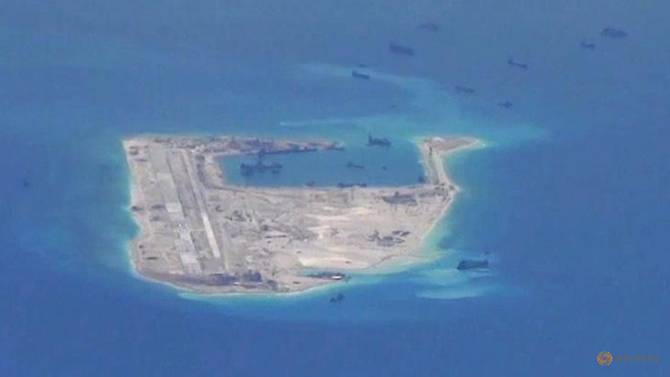
Still image from a United States Navy video purportedly shows Chinese dredging vessels in the waters around Fiery Cross Reef in the disputed Spratly Islands
17 May 2017 01:15PM (Updated: 17 May 2017 05:56PM)
BEIJING: China has installed rocket launchers on a disputed reef in the South China Sea to ward off Vietnamese military combat divers, according to a state-run newspaper, offering new details on China’s ongoing military build-up.
A Chinese J-11 fighter jet is seen on the airstrip at Woody Island in the South China Sea in this March 29 satellite photo. | CSIS AMTI / DIGITALGLOBE / VIA REUTERS
Apr 7, 2017A Chinese fighter jet has been spotted on a Chinese-controlled island in the South China Sea for the first time in a year, a U.S. think tank said Thursday as President Donald Trump met with Chinese leader Xi Jinping.
Association of South East Asian Nations (ASEAN) Foreign Ministers link arms during the ASEAN Foreign Ministers’ Retreat in Boracay, central Philippines February 21, 2017. Malacanang Photo/Handout via Reuters
BORACAY, Philippines: Southeast Asian countries see China’s installation of weapons systems in the South China Sea as “very unsettling” and have urged dialogue to stop an escalation of “recent developments”, the Philippines said on Tuesday.
The region’s foreign ministers were unanimous in their concern over China’s militarisation of its artificial islands, but were confident a framework for a code of maritime conduct could be agreed with Beijing by June, Philippine Foreign Secretary Perfecto Yasay said.
Yasay did not say what developments provoked the concern, but said the 10-member Association of Southeast Asian Nations (ASEAN) hoped China and the United States would ensure peace and stability.
He said demilitarisation would be a key component of any ASEAN-China code of conduct, but it was too soon to say whether Beijing’s dismantling of its weapons installations would be a prerequisite.
“The ASEAN members have been unanimous in their expression of concern about what they see as a militarisation of the region,” Yasay told reporters after a ministers’ retreat on the Philippine island of Boracay.
Referring to China’s manmade islands in the Spratly archipelago, Yasay said ASEAN countries had “noticed, very unsettlingly, that China has installed weapons systems in these facilities that they have established, and they have expressed strong concern about this.”
With the Philippines chairing the bloc this year, Yasay’s comments signal a rare, firm position by a grouping that often struggles to achieve consensus, due to its contrasting opinions on how to respond to China’s assertiveness.
ASEAN’s statements of concern often avoid mentioning China by name. Much is at stake from upsetting China, as ASEAN members, to varying extents, are under its influence and need its trade, investment and tourists.
TRUMP UNCERTAINTY
Regional geopolitics has become more uncertain since the election of U.S. President Donald Trump, particularly over his administration’s role in a region strongly courted by Washington during the “pivot” of predecessor Barack Obama.
Friction between the United States and China over trade and territory under Trump has fuelled worry that the South China Sea could become a flashpoint.
China claims most of the waters, through which about US$5 trillion (£4.02 trillion) in ship-borne trade passes every year. Brunei, Malaysia, the Philippines, Taiwan and Vietnam also have claims.
China on Friday completed war games with an aircraft carrier that unnerved neighbours. A day later the U.S. navy said its aircraft carrier strike group had started routine patrols in the South China Sea, a step China had warned against.
Yasay said ASEAN nations recognised policies under Trump were still evolving, but hoped they could be unveiled within a few months to provide a “more concrete and clearer picture”, especially regarding China.
“We do not know the complete picture of what this foreign policy might be, insofar as its relationship with China is concerned. We’re, however, hopeful that the policy that would come out will be positive.”
Asked if China was committed to a set of rules on the South China Sea, he said Beijing had shown it was keen.
But all parties should ensure that the code, which has made little progress since the idea was agreed in 2002, needed to be legally “binding and enforceable”, Yasay added.
(Additional reporting by Enrico Dela Cruz and Manolo Serapio Jr; Writing by Martin Petty; Editing by Clarence Fernandez)
Satellite images released by the Center for Strategic and International Studies in Washington this week showed “large antiaircraft guns and probable close-in weapons systems” on its outposts in the Spratlys.




 CVD
CVD 