US Defense Secretary James Mattis accused China of “intimidation and coercion” in the Indo-Pacific and declared that the United States does not plan to abandon its role in the region during a speech Saturday in Singapore.
SINGAPORE (CNN) — US Defense Secretary James Mattis accused China of “intimidation and coercion” in the Indo-Pacific and declared that the United States does not plan to abandon its role in the region during a speech Saturday in Singapore.
Defence Minister Marise Payne has issued a coded but clear demand on China not to bully other countries that disagree with it.
In a speech to military and political leaders from Asia and the Pacific region on Saturday, Senator Payne will say that no one country can tear up the system of international rules – which she pointedly notes has let countries such as China grow and prosper peacefully.
Senator Marise Payne listens to Foreign Affairs Secretary Frances Adamson during estimates.Photo: Dominic Lorrimer
In the speech to the Shangri-La dialogue in Singapore, Senator Payne makes it clear Australia will continue calling out behaviour that tries unilaterally to change what Australia and its allies call “the rules-based order”.
While she doesn’t name China, Senator Payne makes thinly veiled references to China’s behaviour, making it apparent the Turnbull government means to keep pressing Beijing over issues such as the South China Sea and foreign interference even as it tries to improve the relationship after a rocky six months. Tiếp tục đọc “Australia won’t bite its tongue, Defence Minister warns in clear signal to China”→
Vox_Since 2014, China has been building islands in the middle of the South China Sea. What were once underwater reefs are now sandy islands complete with airfields, roads, buildings, and missile systems. In less than two years, China has turned seven reefs into seven military bases in the South China Sea, one of the most contentious bodies of water in the world.
href=””>United Nations Law of the Seas, which says a country’s territory extends 200 miles off its shores, an area called the exclusive economic zone, or EEZ. Any trade or resources that fall in a country’s EEZ belong to that country; they’re its sovereign territory. Any area that is not in an EEZ is considered international waters and subject to UN maritime law, meaning it’s shared by everyone. Every country in the region, which includes Malaysia, the Philippines, Brunei, and Vietnam, bases its claim to the South China Sea on the UN’s EEZ laws — except China.
China argues it has a historical claim to the South China Sea, dating back to naval expeditions in the 15th century. After World War II, the Japanese Empire lost control of the South China Sea, and China took advantage of the moment to reclaim it. On maps, it started drawing a dashed line that encompassed most of the South China Sea. This line became its official claim and is known today as the Nine-Dash Line, because it always has nine dashes. In 1973, when the UN law established EEZs, China reaffirmed its Nine-Dash Line, refusing to clarify the line’s boundaries and rejecting other countries’ claims.
Since then, tensions have built around who rightfully owns the South China Sea. The dispute has centered on the Spratly Islands, an archipelago at the heart of the South China Sea. Currently, China, Malaysia, the Philippines, and Vietnam claim some part of the Spratly Island chain. They’ve asserted their claims by putting small buildings, ports, and even some people on what are essentially rocks in the middle of the ocean.
But the Spratlys are very important, because whichever country can successfully claim themcan extend its EEZ to include them, thus gaining miles of precious sovereign territory. This is why China began building up islands in 2014. By turning these rocks into military bases, the Chinese are now able to support hundreds of ships, bolstering their presence in the region. They are using fishing boats, surveillance ships, and navy destroyers to set up blockades around other countries’ islands and defend their own. This is all done very cautiously and in small steps in order to avoid sparking a wider conflict.
Since China began building islands, the disputes have not become violent.But tensions are building in the region. As China deploys more of its military to the Spratlys, other countries are getting nervous and building up their own islands. It’s a complex situation that will continue to gain international attention, for better or for worse.
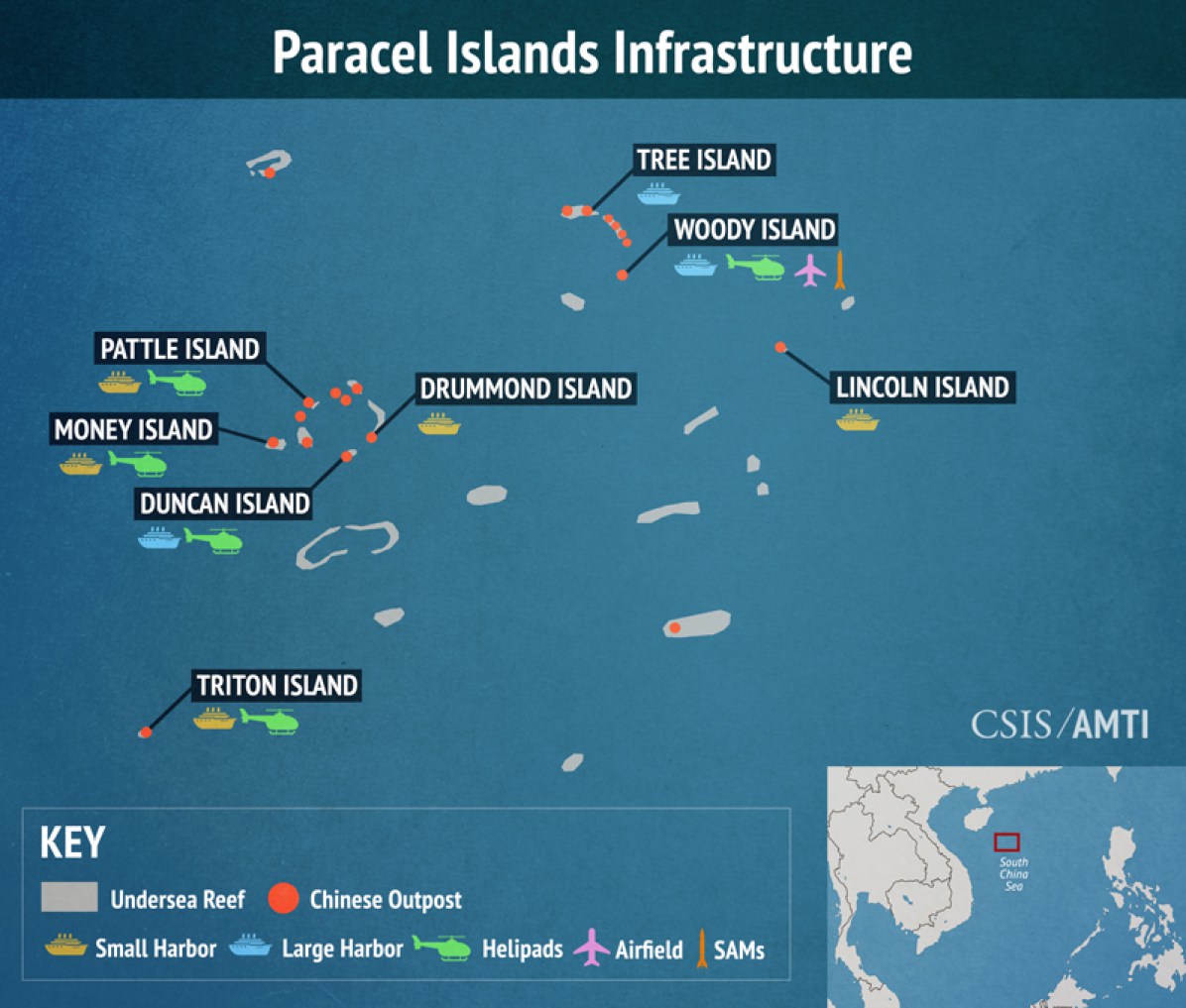
While China’s expansion of its seven outposts in the Spratly Islands has dominated headlines since large-scale dredging began at the end of 2013, efforts to upgrade its capabilities in the Paracels farther north have received relatively little attention. But the island chain plays a key role in China’s goal of establishing surveillance and power projection capabilities throughout the South China Sea. To this end, Beijing has undertaken substantial upgrades of its military infrastructure in the Paracels.
China occupies 20 outposts in the Paracels. As seen in the map above, three of these now have protected harbors capable of hosting large numbers of naval and civilian vessels. Four others boast smaller harbors, with a fifth under construction at Drummond Island. Five of the islands contain helipads, with Duncan Island housing a full helicopter base. And the largest of the Paracels, Woody Island, sports an airstrip, hangars, and a deployment of HQ-9 surface-to-air missile batteries. Tiếp tục đọc “The Paracels: Beijing’s Other South China Sea Buildup”→

 CVD
CVD 