Who Buys the Most Iranian Oil?

visualcapitalist.com

As tensions escalate between Iran, Israel, and the U.S. amid fragile ceasefire negotiations, the Iranian oil market is facing heightened volatility.

Certain Asian economies that rely heavily on Iranian crude and stable passage through the Strait of Hormuz now face some of the greatest exposure.

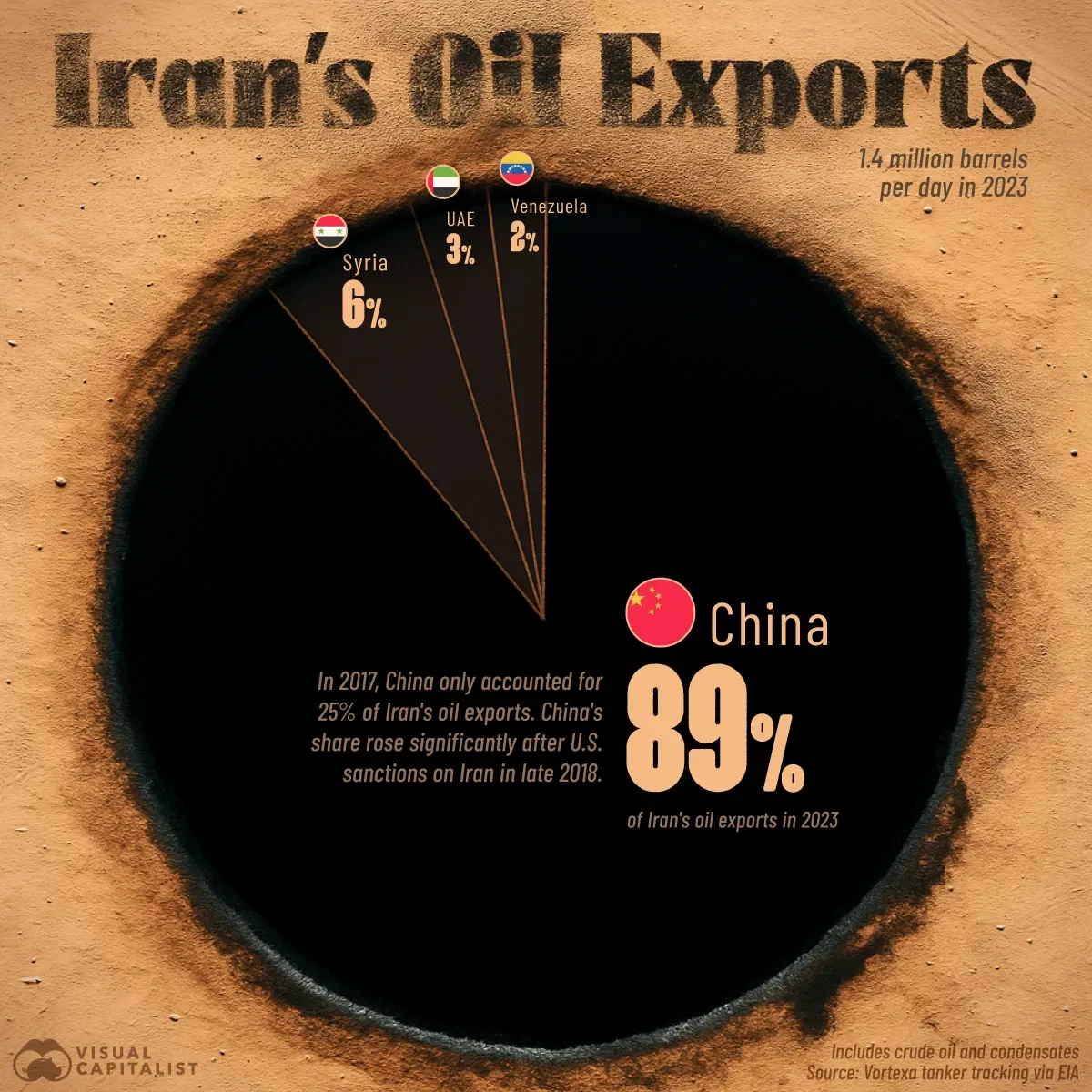
This chart visualizes the breakdown of Iran’s crude oil and condensate exports by destination in 2023.

Data comes from the U.S. Energy Information Administration.

China is the Top Buyer of Iranian Oil

Below, we show the share of Iran’s oil exports by destination.

CountryShare of Iran’s Crude Oil Exports
🇨🇳 China89%
🇸🇾 Syria6%
🇦🇪 United Arab Emirates3%
🇻🇪 Venezuela2%

In 2023, a staggering 89% of Iran’s oil exports went to China, a sharp rise from just 25% in 2017.

This surge followed renewed U.S. sanctions in 2018, which isolated Iran from most global oil buyers.

Iran is among the world’s largest oil producers, and in recent years, China has become its most critical customer both economically and geopolitically.

As hostilities in the region intensify–marked by U.S. attacks on Iranian nuclear infrastructure and Iranian missile strikes on American bases in Qatar and Iraq—China’s access to Iranian oil is increasingly at risk.

This is because the Strait of Hormuz, a critical route for China’s oil imports, could be disrupted by further conflict or Iranian retaliation.

While Iran supplies only about 13% of China’s total oil imports, the relationship is strategically important, offering China discounted crude and reinforcing its broader regional influence amid Western pressure.

China’s role in the Middle East: Can China be a peace mediator between Israel and Hamas?

CNA Insider – 28-3-2024

Over the last twenty years, China’s influence in the Middle East has grown substantially. China has major economic partnerships with Iran, Egypt, Saudi Arabia and also Israel.

How is the war in Gaza impacting these investments? Can China be a peace mediator between Israel and Hamas? And how do the current events in the Middle East impact great power competition between the United States and China? Tiếp tục đọc “China’s role in the Middle East: Can China be a peace mediator between Israel and Hamas?”

Saudi Arabia và Iran: Bán anh em xa…

SÁNG ÁNH 25/03/2023 13:32 GMT+7

TTCTSaudi Arabia làm lành với Iran mở ra hy vọng về một Trung Đông bớt đi những tang thương bom đạn.

4 h sáng 14-9-2019, quân Houthi (thân Iran) từ Yemen bắn qua Saudi 25 máy bay không người lái, có lẽ giá thành là 15.000 USD một chiếc, tức tổng trị giá 375.000 USD. 19 chiếc trúng đích là khu Nhà máy dầu Abqaiq-Khurais, làm tê liệt sản xuất trong hai tuần. 

Khu nhà máy này chiếm 1/2 sản xuất dầu của Saudi (mà dầu của Saudi thì chiếm 5% của thế giới) – khoảng 5,7 triệu thùng/ngày.

Cuộc tấn công khiến Saudi mất 365 triệu đô la một ngày với giá dầu lúc đó là 64 USD/thùng. Tuy dần dà cũng khắc phục được, thị trường chứng khoán Saudi mất ngay 40 tỉ USD. 

Tiếp tục đọc “Saudi Arabia và Iran: Bán anh em xa…”

US Sanctions Continue to Backfire: China Opens $10 Billion Credit Line for Iran

Assisting Tehran with sidestepping an ongoing Washington sanctions regime against the country, China has opened a $10 billion line of credit intended to finance energy, transportation, water and other key Iranian infrastructure projects.

Following the ground-breaking 2015 Joint Comprehensive Plan of Action (JCPOA) between Iran and Russia, the US, China, France, the UK, as well as Germany and the EU, to end its nascent nuclear weapons program, Tehran — in honoring the terms of the unprecedented treaty — has nonetheless seen Washington implement a host of new sanctions against the Middle Eastern country, including asset freezes and limits on global financial transfers. Tiếp tục đọc “US Sanctions Continue to Backfire: China Opens $10 Billion Credit Line for Iran”