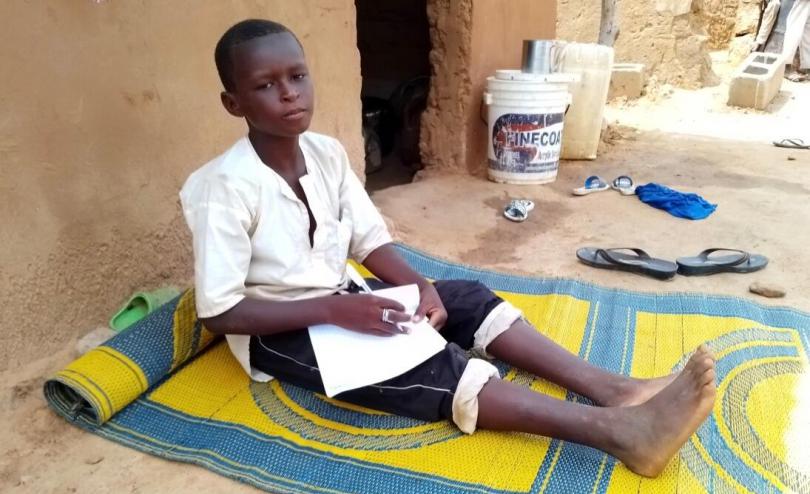
ALMOST 10 MILLION CHILDREN MAY NEVER RETURN TO SCHOOL FOLLOWING COVID-19 LOCKDOWN


Buba*, 12, Yobe, Nigeria

New report from Save the Children warns of ‘unprecedented global education emergency’.

    • World is facing a hidden education emergency.
    • COVID-19 leaves estimated $77 billion gap in education spending for world’s poorest children.
    • Children in 12 countries are at extremely high risk of dropping out of school forever.
    • In another 28 countries children are at moderate or high risk of not going back to school.
    • Girls are at increased exposure to gender-based violence and risk of child marriage and teen pregnancy during school closures.
    • Save the Children calls for increased funding of education, including conversion of debt liabilities into investment in children.

Tiếp tục đọc “ALMOST 10 MILLION CHILDREN MAY NEVER RETURN TO SCHOOL FOLLOWING COVID-19 LOCKDOWN”

‘It’s not that I want to sell my kid. I just need money’: The Philippine mothers who sell their babies

channelnewsasia.com 

In the Philippines, some new mothers who feel they cannot raise their own babies sell them in the illegal trade of child adoption.

A mother hold a baby in a park
A Filipino mother holds her two-month-old baby inside a park near the Port of Manila. She wants to sell him for adoption and use the money to start a new life. (Photo: Pichayada Promchertchoo)

MANILA: Christine holds her baby as she breastfeeds him in a quiet park near the Port of Manila. She has covered his small head with a piece of cloth to shield him from the burning sun. His eyes may be closed but the boy knows his mother is there. He grabs her with his tiny hands as she cradles him in her arms.

The baby is two months old, delicate and defenceless. His father died before he was born and his mother has become his sole protection, his only source of love and security. But he has no idea she wants to sell him as soon as she can. Tiếp tục đọc “‘It’s not that I want to sell my kid. I just need money’: The Philippine mothers who sell their babies”

Information and public health advice: heat and health

Protecting health from rising temperatures and extreme heat

WHO

Key facts

  • Population exposure to heat is increasing due to climate change, and this trend will continue. Globally, extreme temperature events are observed to be increasing in their frequency, duration, and magnitude. Between 2000 and 2016, the number of people exposed to heat waves increased by around 125 million. In 2015 alone, 175 million additional people were exposed to heat waves compared to average years.

Tiếp tục đọc “Information and public health advice: heat and health”

The number of low birthweight babies stayed almost constant in Viet Nam over 15 years.

1 in 7 babies worldwide born with a low birthweight – The Lancet Global Health, UNICEF, WHO

17 May 2019
Lo Van Tuyet, 34 years, and his premature birth baby boy born at the 30th week in the Kangaroo room at Dien Bien General Hospital.
UNICEF Viet Nam\Truong Viet Hung
Lo Van Tuyet, 34 years, and his premature birth baby boy born at the 30th week in the Kangaroo room at Dien Bien General Hospital.

NEW YORK/ LONDON/ GENEVA/HANOI, 16 May 2019 – More than 20 million babies were born with a low birthweight (less than 2500g; 5.5 pounds) in 2015 – around one in seven of all births worldwide, according to the latest research undertaken by the London School of Hygiene & Tropical Medicine, UNICEF, and the World Health Organization (WHO), published in The Lancet Global Health journal. Data from the report showed that Viet Nam has had the lowest low-birthweight rate in South East Asia & Oceania at 8.2 per cent in 2015. “This figure is most encouraging”, said Rana Flowers, UNICEF Representative in Viet Nam, “however as a national average, it does not give us the complete picture and is likely to hide important disparities, for example among the poorest mothers, 28 per cent of whom do not have institutional deliveries, and their newborn’s weight is not usually recorded”, she added. Tiếp tục đọc “The number of low birthweight babies stayed almost constant in Viet Nam over 15 years.”

A phone that says “no” to little kid fingers

technologyreview
An algorithm for detecting who’s swiping the screen could help make phones child-proof.

It may soon be possible for your phone to automatically figure out whether it’s you or your five-year-old who’s swiping the screen—and, if it’s the latter, block apps you want to keep off-limits to kids.

That’s the vision of researchers at the University of South Carolina and China’s Zhejiang University, who’ve created an algorithm that can spot whether your kid is accidentally trying to, say, order from Amazon without your knowing. Tiếp tục đọc “A phone that says “no” to little kid fingers”