Hidden carbon: Fungi and their ‘necromass’ absorb one-third of the carbon emitted by burning fossil fuels every year

theconversation.com

Beneath our feet, remarkable networks of fungal filaments stretch out in all directions. These mycorrhizal fungi live in partnership with plants, offering nutrients, water and protection from pests in exchange for carbon-rich sugars.

Now, new research shows this single group of fungi may quietly be playing a bigger role in storing carbon than we thought.

How much bigger? These microscopic filaments take up the equivalent of more than a third (36%) of the world’s annual carbon emissions from fossil fuels – every year.

As we search for ways to slow or stop the climate crisis, we often look to familiar solutions: cutting fossil fuel use, switching to renewables and restoring forests. This research shows we need to look down too, into our soils.
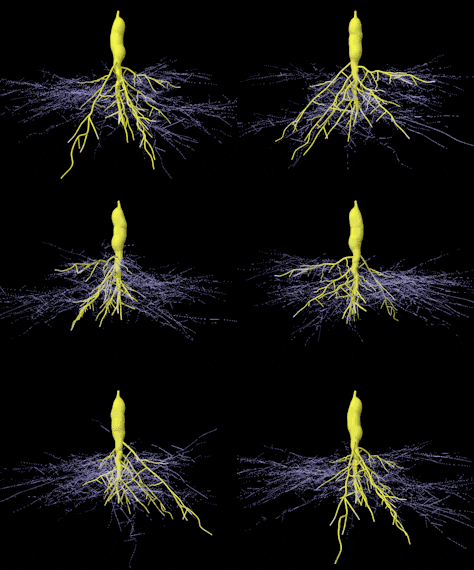
This shows how mycorrhizal fungi (fine white filaments) connect to plant root systems (yellow) and out into the soil. Scivit/Wikipedia

This fungi-plant partnership is 400 million years old

Mycorrhizal fungi are hard to spot, but their effects are startling. They thread networks of microscopic filaments through the soil and into the roots of almost every plant on earth.

But this is no hostile takeover. They’ve been partnering with plants for more than 400 million years. The length of these complex relationships has given them a vital role in our ecosystems.

Tiếp tục đọc “Hidden carbon: Fungi and their ‘necromass’ absorb one-third of the carbon emitted by burning fossil fuels every year”

The Dubious Promise of Bioenergy Plus Carbon Capture

Climate change agreements rest on negative emissions technologies that may be unachievable.

technologyreview – While many scientists and climate change activists hailed December’s Paris agreement as a historic step forward for international efforts to limit global warming, the landmark accord rests on a highly dubious assumption: to achieve the goal of limiting the rise in global average temperature to less than 2 °C (much less the more ambitious goal of 1.5 °C), we don’t just need to reduce emissions of carbon dioxide to essentially zero by the end of this century. We also must remove from the atmosphere huge amounts of carbon dioxide that have already been emitted (see “Paris Climate Agreement Rests on Shaky Technological Foundations”).

Doing so will involve “negative emissions technologies”—systems that capture carbon dioxide and store it, usually deep underground. Such technologies are theoretical at best, but they are considered critical for achieving the Paris goals. Of the 116 scenarios reviewed by the Intergovernmental Panel on Climate Change to achieve stabilization of carbon in the atmosphere at between 430 and 480 parts per million (the level considered necessary for a maximum 2 °C rise in temperature), 101 involve some form of negative emissions. Tiếp tục đọc “The Dubious Promise of Bioenergy Plus Carbon Capture”