The creator of the CRISPR babies has been released from a Chinese prison

He Jiankui created the first gene-edited children. The price was his career. And his freedom.

technologyreview.com

By Antonio Regaladoarchive page April 4, 2022

He Jiankui

MS TECH | AP PHOTO/KIN CHEUNG

The daring Chinese biophysicist who created the world’s first gene-edited children has been set free after three years in a Chinese prison.

He Jiankui created shock waves in 2018 with the stunning claim that he’d altered the genetic makeup of IVF embryos and implanted them into a woman’s uterus, leading to the birth of twin girls. A third child was born the following year.

Following international condemnation of the experiment, He was placed under home arrest and then detained. In December 2019, he was convicted by a Chinese court, which said the researcher had “deliberately violated” medical regulations and had “rashly applied gene editing technology to human assisted reproductive medicine.”

His release from prison was confirmed by people familiar with the situation and He answered his mobile phone when contacted early today. “It’s not convenient to talk right now,” he said before hanging up.

Tiếp tục đọc “The creator of the CRISPR babies has been released from a Chinese prison”
The shifting sands of ‘gain-of-function’ research

nature.com

The mystery of COVID’s origins has reignited a contentious debate about potentially risky studies and the fuzzy terminology that describes them.

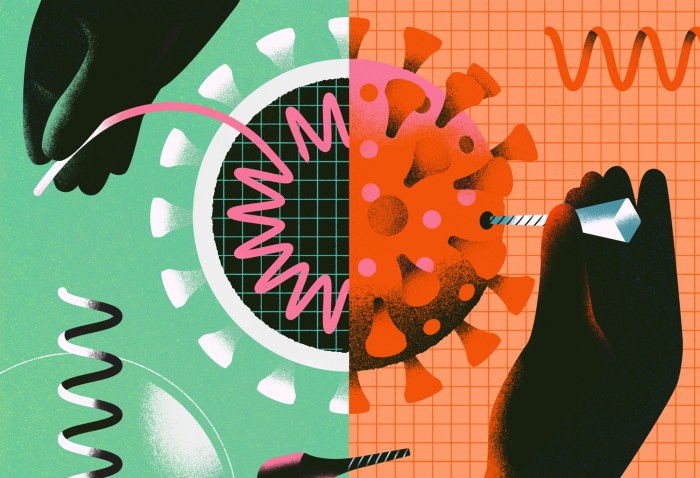
Conceptual illustration showing a virus being edited.
Illustration by Kasia Bojanowska

In Greek mythology, the Chimaera was a fire-breathing monster, a horrifying mishmash of lion, goat and snake that laid waste to the countryside. In 2015, virologists led by Ralph Baric at the University of North Carolina in Chapel Hill reported the creation of their own chimaera. They took a version of the coronavirus responsible for the deadly outbreak of severe acute respiratory syndrome (SARS) in the early 2000s — now known as SARS-CoV — and adorned it with surface proteins from a different coronavirus taken from Chinese horseshoe bats. In the laboratory, this particular mash-up was able to break into human cells and also make mice ill1. This chimaera came with a message: other coronaviruses have the potential to spark a human pandemic. In just a few years’ time, that warning would prove prescient, as a distant cousin of SARS-CoV has now killed more than 4.9 million people worldwide.

Tiếp tục đọc “The shifting sands of ‘gain-of-function’ research”

Chinese scientist who claimed to create gene-edited babies sentenced to 3 years in prison

washingtonpost.com Chinese scientist He Jiankui was heavily criticized by the scientific community after saying he had edited the genes of twins. (Anthony Wallace/AFP )Chinese scientist He Jiankui was heavily criticized by the scientific community after saying he had edited the genes of twins. (Anthony Wallace/AFP )

Dec. 31, 2019 at 4:46 a.m. GMT+7

The Chinese researcher who stunned and alarmed the international scientific community with the announcement that he had created the world’s first gene-edited babies has been sentenced to three years in prison by a court in China.

He Jiankui sparked a bioethical crisis last year when he claimed to have edited the DNA of human embryos, resulting in the birth of twins called Lulu and Nana as well as a possible third pregnancy. The gene editing, which was aimed at making the children immune to HIV, was excoriated by many scientists as a reckless experiment on human subjects that violated basic ethical principles.

Tiếp tục đọc “Chinese scientist who claimed to create gene-edited babies sentenced to 3 years in prison”

Genetic innovation: ‘Nothing that we eat is natural’

A recent judgement from the European Court of Justice in the case of “CRISPR/Cas9 gene editing” is causing debate since July 2018. [igorstevanovic/ Shutterstock]

UN approves declaration banning all forms of human cloning – UN thông qua tuyên bố cấm mọi hình thức nhân bản vô tính người, năm 2005

UN.org

8 March 2005 –The United Nations General Assembly today approved a non-binding declaration calling on all UN Member States to ban all forms of human cloning, including cloning for medical treatment, as incompatible with human dignity and the protection of human life.

By a vote of 84 in favour, 34 against and 37 abstaining, with 36 absent, the Assembly acted on the recommendation of its Legal, or Sixth, Committee to adopt the text, called the United Nations Declaration on Human Cloning. But some delegates said they opposed banning therapeutic cloning.

The Declaration, negotiated by a Working Group last month, also banned “genetic engineering techniques that may be contrary to human dignity.” It called on States “to prevent the exploitation of women in the application of life sciences” and “to protect adequately human life in the application of life sciences.” Tiếp tục đọc “UN approves declaration banning all forms of human cloning – UN thông qua tuyên bố cấm mọi hình thức nhân bản vô tính người, năm 2005”

Chinese scientists break key barrier by cloning monkeys

LONDON (Reuters) – Chinese scientists have cloned monkeys using the same technique that produced Dolly the sheep two decades ago, breaking a technical barrier that could open the door to copying humans.

https://www.reuters.tv


  Zhong Zhong and Hua Hua, two identical long-tailed macaques, were born eight and six weeks ago, making them the first primates — the order of mammals that includes monkeys, apes and humans — to be cloned from a non-embryonic cell.

Tiếp tục đọc “Chinese scientists break key barrier by cloning monkeys”

Three technologies that changed genetics

  • Nature 528, S2–S3 (03 December 2015) doi:10.1038/528S2a
  • Published online
  • 02 December 2015
blished online
02 December 2015

Nature – Genome editing uses enzymes that are targeted to sequences of DNA to make cuts. These cuts are then repaired by the cell’s machinery. This technology allows scientists to disrupt or modify genes with unprecedented precision. By Amy Maxmen, infographic by Denis Mallet.

Double-stranded break

All three of the main genome-editing tools (ZFNs, TALENs and CRISPR–Cas9) create a break across both strands of DNA at a specific location, which is repaired in one of two ways to either ‘knock out’ or ‘knock in’ a gene.