In defense of facts in the South China Sea

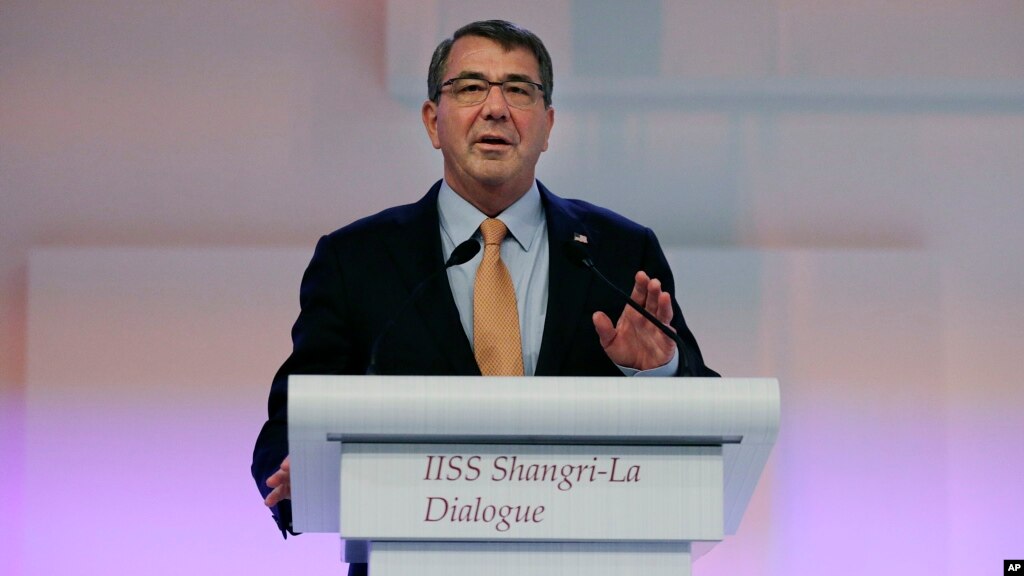
AMTI – Secretary of Defense Ash Carter’s address at this weekend’s Shangri-La Dialogue was generally well received by conference attendees and Asia-security watchers. A few critics have argued that Carter was “just talk.” What none have noted, however, is the fact that the Secretary’s remarks were the latest installation in a series of moves by the administration to articulate a fact-based approach to the South China Sea. This approach is a nuanced one and does not necessarily constitute a “strategy” for countering China’s recent moves. It is, however, a wise way to engage two key audiences to whom Carter was speaking at Shangri-La: other states in the region and China itself. Let me explain.

Tiếp tục đọc “In defense of facts in the South China Sea”

China is using one of the most dangerous conflicts on the planet as a distraction

China navy PLAReutersThe Chinese People’s Liberation Army (PLA) Navy during a commemoration ceremony for Chinese soldiers killed during the First Sino-Japanese War, near Liugong island in Weihai, Shandong province, on August 27.

In an effort to stoke nationalism and distract its people from a slowing economy, the Chinese government has been acting particularly aggressively in the South China Sea, engaging in territorial disputes with neighbors including Japan.

This is one of the most dangerous games in the world. Tiếp tục đọc “China is using one of the most dangerous conflicts on the planet as a distraction”

Beijing Hint: No More Mr. Nice Guy in South China Sea

(WSJ): In position to reclaim its ‘lake,’ China invokes its long tolerance of neighbors’ acts

China’s Adm. Sun Jianguo chats with U.S. Defense Secretary Ash Carter at the Shangri-La Dialogue meeting in Singapore this weekend. Adm. Sun said China has exercised ‘enormous restraint’ in the South China Sea.
China’s Adm. Sun Jianguo chats with U.S. Defense Secretary Ash Carter at the Shangri-La Dialogue meeting in Singapore this weekend. Adm. Sun said China has exercised ‘enormous restraint’ in the South China Sea. Photo: Agence France-Presse/Getty Images

SINGAPORE—The way China looks at the disputes roiling the South China Sea, its forbearance has gone on far too long.

Smaller countries that ring the sea, including Vietnam, the Philippines and Malaysia have tested Beijing’s patience by striking claims to multiple islets, building structures on them and prospecting for energy in the surrounding waters. Indeed, these actions preceded any by China. But leniency has limits.

This sense of righteousness drives China’s massive island-building project in the Spratlys chain, which is now at the center of a gathering crisis in the world’s most economically vibrant region. Tiếp tục đọc “Beijing Hint: No More Mr. Nice Guy in South China Sea”

Vietnam: Don’t tie US weapons sales to human rights issues

Associated Press

U.S. Defense Secretary Ash Carter, right, shakes hands with his Vietnamese counterpart Gen. Phung Quang Thanh before their talks behind closed doors in Hanoi, Vietnam Monday, June 1, 2015. Carter is on a three-day visit to Vietnam to deepen military cooperation between the two former foes. (AP Photo/Tran Van Minh.)
.

HANOI, Vietnam (AP) — Questions about human rights violations by the Vietnamese government should have no bearing on whether the U.S. should fully remove its ban on lethal weapons’ sales to Hanoi, Vietnam’s defense minister said Monday after meeting with U.S. Defense Secretary Ash Carter.

Defense Minister Phung Quang Thanh and Carter said the two nations are expanding their defense cooperation to include plans to conduct military operations together. The U.S. will also help Vietnam prepare to begin participating in U.N. peacekeeping missions.

Tiếp tục đọc “Vietnam: Don’t tie US weapons sales to human rights issues”

Shangri La Dialogue 2015


AMTI

Explore key maritime security developments from the 2015 Dialogue.

Ashton Carter, Secretary of Defense, United States

Secretary of Defense Ash Carter’s Saturday morning address was well-received by the Shangri-La audience. Carter’s speech included a strong stand against China’s building efforts in the South China Sea, and reaffirmed the United States’ intention to “fly, sail, and operate wherever international law allows.” This was, however, embedded in a broader message was that all countries in Asia should have the opportunity to rise peacefully. Carter called for a freeze on land reclamation by all South China Sea claimants, and has reportedly since taken up the issue with Vietnam on a visit to Hanoi.

Tiếp tục đọc “Shangri La Dialogue 2015”

Messages from China’s National Defense White Paper


June 2, 2015
CSIS

“China’s Military Strategy,” released on May 26, 2015, is the 9th Chinese defense white paper since 1998. For the first time, the white paper elaborates comprehensively on the missions and strategic tasks of China’s armed forces in the new political environment and emphasizes the essence of the strategic concept of active defense. There are four critical security domains highlighted in this White Paper: challenges for outer space security; security of strategic SLOCs and overseas interests; maintenance of a minimum nuclear capacity sufficient to meet national security demand; an increased capacity for cyber security.

Tiếp tục đọc “Messages from China’s National Defense White Paper”

China’s missed opportunity at the Shangri-La Dialogue

US Defense Secretary Gives Keynote Address at Shangri-La Dialogue


U.S. Secretary of Defense Ashton Carter delivers his speech about

U.S. Secretary of Defense Ashton Carter delivers his speech about “The United States and Challenges to Asia-Pacific Security” during the 14th International Institute for Strategic Studies Shangri-la Dialogue (IISS) Asia Security Summit, May 30, 2015, in Shangri-la

U.S. Secretary of Defense Ashton Carter delivered the keynote address at the Shangri-La Dialogue in Singapore Saturday.

Here is the text, as delivered: Tiếp tục đọc “US Defense Secretary Gives Keynote Address at Shangri-La Dialogue”

Carter Defends the South China Sea at Shangri-La

On Saturday morning at the Shangri-La defense dialogue in Singapore, U.S. Secretary of Defense Ashton Carter delivered a long-anticipated speech on security issues in Asia.  As tensions have mounted over China’s island building in the South China Sea, Carter has been one of the administration’s strongest voices, calling the militarization of the islands a challenge to international norms and reaffirming the United States’ intention to uphold freedom of navigation and overflight, and to defend international law.  Carter’s Shangri-La speech did not disappoint; he broadened the aperture focusing on wider strategic goals for the region, he called for a regional architecture that gives all countries and people in the Asia-Pacific the right to rise, and spoke at length on the South China Sea disputes. Here are some of the prominent themes from the Secretary’s remarks. Tiếp tục đọc “Carter Defends the South China Sea at Shangri-La”

Riding the Tiger of Anti-U.S. Sentiment in the South China Sea

FP
Beijing’s tough rhetoric over maritime disputes has inflamed nationalist fervor online. That’s not necessarily a good thing for China.

Riding the Tiger of Anti-U.S. Sentiment in the South China Sea

The South China Sea has long been the focus of simmering maritime disputes between China, which claims sovereignty over almost all of the sea, and its neighbors in the Asia-Pacific, each with smaller overlapping claims. But strains between China and the United States have increased since February, when satellite images revealed that Chinese vessels are engaging in a massive reclamation project to turn submerged reefs into small islands capable of supporting airstrips. Now a small but vocal group of nationalist Web users are seizing on what they view as the latest provocations in the region – and with its own harsh rhetoric, Beijing risks painting itself into a corner to appease its strongly nationalist citizenry. Tiếp tục đọc “Riding the Tiger of Anti-U.S. Sentiment in the South China Sea”

White Paper Outlines China’s Ambitions

TAIPEI, Taiwan — China released its first white paper on military strategy Tuesday, just two weeks after the release of the Pentagon’s annual report to the US Congress on China’s military and security developments.

Neither report appears to take blame for the rising tensions in the South China and East China seas. The Chinese report, “China’s Military Strategy,” indicates “some of its offshore neighbors” have taken “provocative actions” and reinforced their military presence on China’s reefs and islands “illegally.” Tiếp tục đọc “White Paper Outlines China’s Ambitions”

Singapore, Indonesia, Mỹ, Úc… đồng loạt tố Trung Quốc

21/05/2015 09:07 GMT+7

TTVấn đề biển Đông bao trùm khu vực Đông Nam Á với những phát ngôn nóng của các quan chức ngoại giao, hải quân các nước.

Đảo nhân tạo Trung Quốc xây trái phép trên Đá Chữ Thập thuộc quần đảo Trường Sa của Việt Nam – Ảnh: Reuters
Trung Quốc cần phải làm sáng tỏ mục đích cuối cùng của việc bồi đắp đảo nhân tạo. Không ai cho rằng họ xây một khu nghỉ dưỡng ở đó cả. Có người đòi được giải thích họ muốn làm gì trên đó
Phó tư lệnh tác chiến hải quân Mỹ Michelle Howard

Tiếp tục đọc “Singapore, Indonesia, Mỹ, Úc… đồng loạt tố Trung Quốc”

China reinstitutes annual moratorium on fishing in part of South China Sea

China on May 16 reinstituted its annual ban on fishing in areas of the South China Sea north of the 12th parallel. The ban runs through August 1 and covers disputed waters around the Paracel Islands as well as part of a joint fishing area in the Gulf of Tonkin that Beijing and Hanoi agreed upon in 2000. Vietnam’s government strongly objected to the unilateral ban, which each year leads to sometimes-violent clashes between Chinese authorities and Vietnamese fishermen.

Biển của ta, ai có quyền cấm!

19/05/2015 23:27

NLDÝ thức rõ càng nhân nhượng thì Trung Quốc càng lấn tới nên ngư dân Việt Nam đồng lòng khẳng định sẽ tiếp tục ra Hoàng Sa, Trường Sa đánh bắt dù sẽ khó khăn, vất vả hơn Tiếp tục đọc “China reinstitutes annual moratorium on fishing in part of South China Sea”

U.S. naval vessel on patrol meets Chinese military vessels in South China Sea

 CSIS
Southeast Asia from Scott Circle – May 28, 2015

The littoral combat ship USS Fort Worth on May 13 completed a weeklong patrol of the South China Sea, including near the disputed Spratly Islands, during which the U.S. Navy said it encountered several Chinese warships and was trailed at least once by a Chinese frigate. The Fort Worth, which is on a rotational deployment to Singapore, used agreed-upon codes for unplanned encounters with the Chinese vessels.