Asia-Pacific freedom tested: US admiral

By Peter Mitchell, AAP US Correspondent Australian Associated Press

One of America’s top military commanders has painted a bleak picture of the Asia-Pacific, declaring freedom, justice and the rules-based international order hang in the balance.

Admiral Harry Harris, head of the US Pacific Command, told a conference in San Diego the path to stability in the region faces four considerable challenges: North Korea, China, Russia and Islamic State.

He warned the US would “co-operate where we can, but we’ll be ready to confront where we must”. Tiếp tục đọc “Asia-Pacific freedom tested: US admiral”

Vietnam Is Getting Closer To Its Rival China Because Neither Side Trusts Trump

Forbes
Ralph Jennings, Contributor
I cover under-reported stories from Taiwan and Asia.

Less than a year ago Vietnam was counting on U.S. support in building up a defense against China. Vietnam and China have clashed over land for centuries. Now the Asian neighbors bitterly dispute much of the sea closest to their shores, with China taking more control as the world’s No. 2 economy and No. 3 military power. U.S. ex-president Barack Obama, probably hoping to contain China, lifted a decades-old ban on arms sales to Vietnam last year and from 2014 to 2016 his government spent $46 million on upgrading Vietnam’s military. Tiếp tục đọc “Vietnam Is Getting Closer To Its Rival China Because Neither Side Trusts Trump”

The Paracels: Beijing’s Other South China Sea Buildup

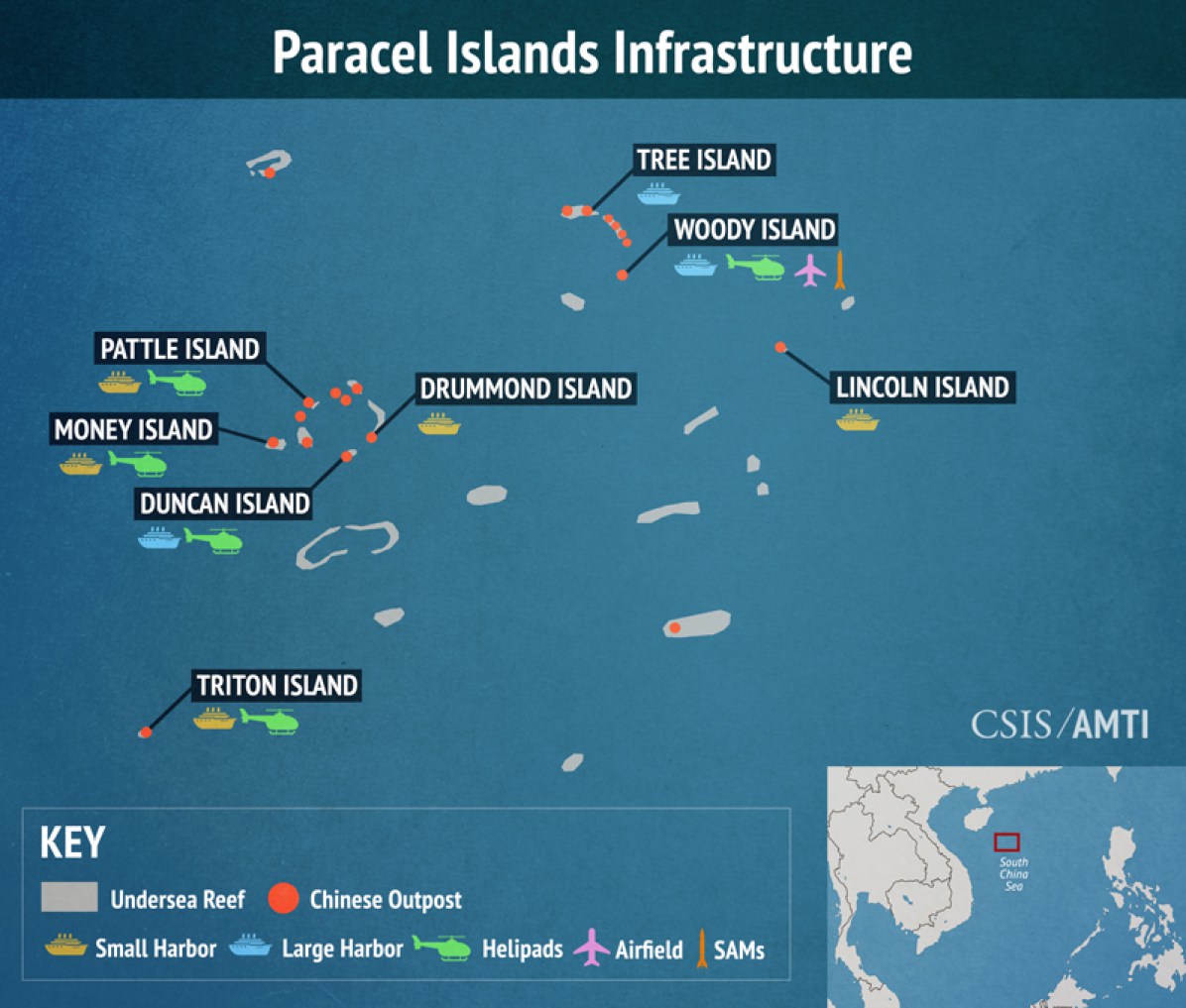
While China’s expansion of its seven outposts in the Spratly Islands has dominated headlines since large-scale dredging began at the end of 2013, efforts to upgrade its capabilities in the Paracels farther north have received relatively little attention. But the island chain plays a key role in China’s goal of establishing surveillance and power projection capabilities throughout the South China Sea. To this end, Beijing has undertaken substantial upgrades of its military infrastructure in the Paracels.

China occupies 20 outposts in the Paracels. As seen in the map above, three of these now have protected harbors capable of hosting large numbers of naval and civilian vessels. Four others boast smaller harbors, with a fifth under construction at Drummond Island. Five of the islands contain helipads, with Duncan Island housing a full helicopter base. And the largest of the Paracels, Woody Island, sports an airstrip, hangars, and a deployment of HQ-9 surface-to-air missile batteries. Tiếp tục đọc “The Paracels: Beijing’s Other South China Sea Buildup”

China opposes US naval patrols in South China Sea

ChannelNewsAsia 21 Feb 2017 17:25

BEIJING: China said on Tuesday it opposed action by other countries under the pretext of freedom of navigation that undermined its sovereignty, after a U.S. aircraft carrier strike group began patrols in the contested South China Sea.

The U.S. navy said the strike group, including the Nimitz-class aircraft carrier the USS Carl Vinson, began “routine operations” in the South China Sea on Saturday amid growing tension with China over control of the disputed waterway.

“China always respects the freedom of navigation and overflight all countries enjoy under international law,” Chinese foreign ministry spokesman Geng Shuang said at a daily news briefing. Tiếp tục đọc “China opposes US naval patrols in South China Sea”

ASEAN unsettled by China weapon systems, tension in South China Sea

The region’s foreign ministers were unanimous in their concern over China’s militarisation of its artificial islands, but were confident a framework for a code of maritime conduct could be agreed with Beijing by June, Philippine Foreign Secretary Perfecto Yasay said.

Yasay did not say what developments provoked the concern, but said the 10-member Association of Southeast Asian Nations (ASEAN) hoped China and the United States would ensure peace and stability.

He said demilitarisation would be a key component of any ASEAN-China code of conduct, but it was too soon to say whether Beijing’s dismantling of its weapons installations would be a prerequisite.

“The ASEAN members have been unanimous in their expression of concern about what they see as a militarisation of the region,” Yasay told reporters after a ministers’ retreat on the Philippine island of Boracay.

Referring to China’s manmade islands in the Spratly archipelago, Yasay said ASEAN countries had “noticed, very unsettlingly, that China has installed weapons systems in these facilities that they have established, and they have expressed strong concern about this.”

With the Philippines chairing the bloc this year, Yasay’s comments signal a rare, firm position by a grouping that often struggles to achieve consensus, due to its contrasting opinions on how to respond to China’s assertiveness.

ASEAN’s statements of concern often avoid mentioning China by name. Much is at stake from upsetting China, as ASEAN members, to varying extents, are under its influence and need its trade, investment and tourists.

TRUMP UNCERTAINTY

Regional geopolitics has become more uncertain since the election of U.S. President Donald Trump, particularly over his administration’s role in a region strongly courted by Washington during the “pivot” of predecessor Barack Obama.

Friction between the United States and China over trade and territory under Trump has fuelled worry that the South China Sea could become a flashpoint.

China claims most of the waters, through which about US$5 trillion (£4.02 trillion) in ship-borne trade passes every year. Brunei, Malaysia, the Philippines, Taiwan and Vietnam also have claims.

China on Friday completed war games with an aircraft carrier that unnerved neighbours. A day later the U.S. navy said its aircraft carrier strike group had started routine patrols in the South China Sea, a step China had warned against.

Yasay said ASEAN nations recognised policies under Trump were still evolving, but hoped they could be unveiled within a few months to provide a “more concrete and clearer picture”, especially regarding China.

“We do not know the complete picture of what this foreign policy might be, insofar as its relationship with China is concerned. We’re, however, hopeful that the policy that would come out will be positive.”

Asked if China was committed to a set of rules on the South China Sea, he said Beijing had shown it was keen.

But all parties should ensure that the code, which has made little progress since the idea was agreed in 2002, needed to be legally “binding and enforceable”, Yasay added.

(Additional reporting by Enrico Dela Cruz and Manolo Serapio Jr; Writing by Martin Petty; Editing by Clarence Fernandez)

China plans to block foreign ships from waters it claims as its own

e.VnExpress   February 17, 2017 | 09:19 pm GMT+7

Foreign submarines passing through these waters would be required to surface and fly national flags.

China has announced plans to revise a 34-year-old maritime safety law and start banning some foreign ships from its territorial waters in 2020.

Chinese state media reported that a revised version of the 1984 Maritime Traffic Safety Law would provide China with the legal firepower to restrict access to waters it claims as its own.

“The draft would empower maritime authorities to prevent foreign ships from entering Chinese waters if it is deemed that the ships could harm traffic safety and order,” the Global Times said in a recent report.

Tiếp tục đọc “China plans to block foreign ships from waters it claims as its own”

US carrier group patrols in tense South China Sea

BANGKOK: A United States aircraft carrier strike group has begun patrols in the South China Sea amid growing tension with China over control of the disputed waterway and concerns it could become a flashpoint under the new U.S. administration.

China’s Foreign Ministry on Wednesday warned Washington against challenging its sovereignty in the South China Sea.

The U.S. navy said the force, including Nimitz-class aircraft carrier USS Carl Vinson, began routine operations in the South China Sea on Saturday. The announcement was posted on the Vinson’s Facebook page.

The strike group’s commander, Rear Admiral James Kilby, said that weeks of training in the Pacific had improved the group’s effectiveness and readiness. Tiếp tục đọc “US carrier group patrols in tense South China Sea”

U.S., Chinese military planes in ‘unsafe’ encounter over disputed South China Sea

Japan Times

The U.S. Navy P-3C was on a “routine mission” over the waters on Wednesday when the encounter with a Chinese military KJ-200 aircraft occurred, Pacific Command said.

The two planes flew within 1,000 feet (300 meters) of each other in the area of the contested Scarborough Shoal, just 230 km (140 miles) from the Philippine coast, CNN reported, citing unnamed U.S. defense officials.

Scarborough Shoal, which is also claimed by Manila, has been known as a potential flashpoint, and rumors of a push by China to build on the collection of rocky outcroppings have stoked concern in the region. Building at Scarborough would create a large “strategic triangle” covering much of the South China Sea that would give it the ability to declare and police an air defense identification zone (ADIZ) there. Tiếp tục đọc “U.S., Chinese military planes in ‘unsafe’ encounter over disputed South China Sea”

China likely to build on reef near Philippines: Minister

In an interview with AFP, Delfin Lorenzana said he believed China would eventually reclaim Scarborough Shoal, just 230 kilometres from the main Philippine island of Luzon.

Beijing has already built up a number of islets and reefs in the Spratly Islands in the South China Sea, installing military facilities on several of them.

Analysts say similar installations on nearby Scarborough Shoal could give China effective military control over the disputed Sea – something the US has said it is not prepared to accept. Tiếp tục đọc “China likely to build on reef near Philippines: Minister”

No Extra Forces Needed in Gulf [and South China Sea] Now, [US] Defense Chief Says

But Mr. Mattis said that the United States did not need to deploy additional military resources to signal its concern. “Right now, I do not think that is necessary,” he said.

Mr. Mattis also signaled restraint on another hot spot: the South China Sea. Mr. Mattis said that China’s territorial claim to almost all of its waters “has shredded the trust of nations in the region.” But he emphasized that he saw no need for more military maneuvers in the area.

“What we have to do is exhaust all diplomatic efforts to try to resolve this properly,” he said.

China warns US after Mattis says Senkaku islands covered by treaty

BEIJING: China warned the United States Saturday (Feb 4) not to destabilise East Asia after Donald Trump’s new defence secretary said an island chain claimed by both Tokyo and Beijing was covered by a US-Japan military accord.

The Senkaku islands, known in China as the Diaoyus, sit in rich fishing grounds and are at the centre of a festering row between Tokyo and Beijing, which claims they have been part of Chinese territory for centuries. Tiếp tục đọc “China warns US after Mattis says Senkaku islands covered by treaty”

China accuses US of putting stability of Asia Pacific at risk

Beijing reacts to defence secretary James Mattis saying that the US would defend Japan in a conflict with China over disputed Senkaku islands

James Mattis reviews the guard of honour prior to a meeting with Japanese defence minister Tomomi Inada in Tokyo on Saturday.
James Mattis reviews the guard of honour prior to a meeting with Japanese defence minister Tomomi Inada in Tokyo on Saturday. Photograph: Franck Robichon/EPA

China has accused the US of putting the stability of the Asia-Pacific at risk after Donald Trump’s defence secretary said Washington would come to Japan’s defence in the event of a conflict with Beijing over the disputed Senkaku islands.

James Mattis, on a two-day visit to Japan, said the islands, which are controlled by Japan but also claimed by China, fell within the scope of the Japan-US security treaty, under which Washington is obliged to defend all areas under Japanese administrative control. Tiếp tục đọc “China accuses US of putting stability of Asia Pacific at risk”

Khủng hoảng tên lửa Cuba và những điều chưa biết – 11 kỳ

  • Kỳ 1: Từ sự kiện Vịnh Con lợn
  • Kỳ 2: Đến những chuyến tầu bí mật trên biển Caribê
  • Kỳ 3: Cuộc đấu vẫn tiếp tục
  • Kỳ 4: Phát hiện kinh hoàng của những chiếc máy bay do thám tầm cao U-2
  • Kỳ 5: Cuộc khủng hoảng bắt đầu ló dạng
  • Kỳ 6: Hành động ngăn chặn của quân đội Mỹ
  • Kỳ 7: Những bức thư qua lại giữa Kennedy và Khrushchev
  • Kỳ 8: Liên hợp quốc vào cuộc
  • Kỳ 9: Xuất hiện dấu hiệu xuống thang
  • Kỳ 10: Lập trường kiên quyết của Cuba
  • Kỳ 11: Hồi kết của cuộc khủng hoảng

Tổng thống Mỹ Kennedy và nhà lãnh đạo Khrushchev của Liên Xô, hai nhân vật chính trong cuộc khủng hoảng tên lửa Cuba 1962.

***

Kỳ 1: Từ sự kiện Vịnh Con lợn

BTT – Khủng hoảng tên lửa Cuba (tháng 10/1962) là sự kiện kịch tính nhất trong thời kỳ Chiến tranh Lạnh, từng đẩy Mátxcơva và Oasinhtơn đến bên bờ của một cuộc chiến tranh hạt nhân. Nhưng rốt cuộc, ít người biết được nguyên nhân sâu xa gây ra nó và nhân loại đã thoát ra khỏi thảm họa hạt nhân nhãn tiền đó như thế nào.

Tiếp tục đọc “Khủng hoảng tên lửa Cuba và những điều chưa biết – 11 kỳ”