
Thẻ: Biển Đông (SCS)
SANSHA CITY AND CORPORATE ACTIVITY IN THE SOUTH CHINA SEA
TĐH: Woody Island, also called Yongxing Island (simplified Chinese: 永兴岛; traditional Chinese: 永興島; pinyin: Yǒngxīng Dǎo; lit.: ‘Eternal Prosperity Island’) in People’s Republic of China (PRC) and Phu Lam Island (Vietnamese: Đảo Phú Lâm) in Vietnam, is the largest of the Paracel Islands in the South China Sea (SCS), with an area of 2.1 square kilometres (0.81 sq mi). Wooddy Island and the rest of Paracels were taken by China’s intrusion forces from The Republic of Vietnam (Việt Nam Cộng Hòa) in the Paracel Battle of Jan. 1974. War of Aggression to take a disputed territory is a violation of the Charter of the United Nations, and cannot constitute a legitimate an legal possession of the territory. See China’s Three Wars of Aggression against the Vietnamese People)
The island has been under the control of the People’s Republic of China since 1956. It is administered by Sansha, a town located on the island.
BY ZACHARY HAVER | SEPTEMBER 22, 2020
AMTI UPDATE CSIS
On August 26, the U.S. Department of Commerce’s Bureau of Industry and Security added 24 Chinese companies to the Entity List for their activities in the South China Sea. The bureau targeted these entities specifically for “their role in helping the Chinese military construct and militarize the internationally condemned artificial islands in the South China Sea.” On the same day, the U.S. Department of State announced visa restrictions on Chinese individuals involved in reclamation, construction, militarization, and coercion in the South China Sea. While these measures come far too late to halt China’s island building campaign in the Spratly Islands, Washington’s latest steps illuminate the influence of companies in these disputes. Corporate activity, particularly the corporate activity associated with Sansha City, supports China’s efforts to exercise administrative control over the South China Sea.
Tiếp tục đọc “SANSHA CITY AND CORPORATE ACTIVITY IN THE SOUTH CHINA SEA”THE CHALLENGES FACING PHILIPPINES–CHINA JOINT DEVELOPMENT IN THE SOUTH CHINA SEA
BY AARON RABENA | OCTOBER 16, 2020
AMTI UPDATE, CSIS
Territorial and maritime disputes in the South China Sea have been a major irritant in Philippines–China relations. When Rodrigo Duterte became president in 2016, a policy decision to underscore pragmatism in relations with China and opt for a moderated approach to dispute settlement in the South China Sea became clear. In November 2018, China and the Philippines signed a Memorandum of Understanding on Cooperation in Oil and Gas Development, raising the prospect of an eventual joint development agreement (JDA) in the South China Sea.
Tiếp tục đọc “THE CHALLENGES FACING PHILIPPINES–CHINA JOINT DEVELOPMENT IN THE SOUTH CHINA SEA”Two Chinese patrol ships enter Japan’s waters
21 hours ago NHK World

Two Chinese patrol ships have temporarily entered Japan’s territorial waters off the Senkaku Islands in the East China Sea. The patrol ships exited the waters after attempting to approach a Japanese fishing boat.
The Japan Coast Guard has been warning the vessels not to reenter Japan’s waters.
The Coast Guard says two of the four Chinese patrol vessels that had been sailing just outside the territorial waters made the intrusion off Taisho Island shortly before 11 a.m. on Thursday. Taisho is one of the Senkaku Islands.
Coast Guard officials say the Chinese ships sailed in Japan’s waters for an hour and a half and left the waters by half past noon.
The Japan Coast Guard says that as of 3 p.m., four Chinese vessels, including the two that had made intrusion on the same day, were sailing just outside Japan’s waters off Taisho Island.
The two vessels, which made intrusion on Thursday, had stayed in Japan’s waters off the Senkaku Islands for more than 57 hours from Sunday morning to Tuesday evening, and attempted to approach a Japanese fishing boat.
It was the longest intrusion since Japan’s government purchased some of the Senkaku Islands from a private Japanese owner in 2012.
Japan controls the islands. China and Taiwan claim them. The Japanese government maintains the islands are an inherent part of Japan’s territory, in terms of history and international law. It says there is no issue of sovereignty to be resolved over them.
Vietnam protests establishment of so-called Sansha city
15/10/2020 23:54 GMT+7 vietnamnet
Vietnam strongly protests the establishment of the so-called Sansha city in Phu Lam Island in Vietnam’s Hoang Sa archipelago and related activities as they seriously violate Vietnam’s sovereignty, Foreign Ministry spokesperson Le Thi Thu Hang said.
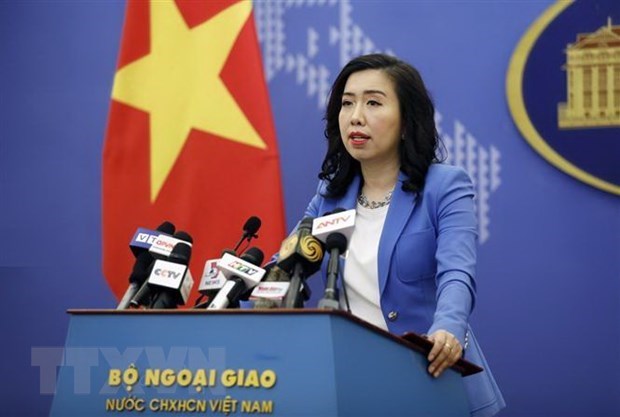 |
| Foreign Ministry spokesperson Le Thi Thu Hang (Photo: VNA) |
Hang made the statement regarding reports that China has more than 400 enterprises at the so-called Sansha city, at a regular press conference of the Foreign Ministry.
“Vietnam has firmly stated many times that it has full historical evidence and legal ground to attest to its sovereignty over the Truong Sa (Spratly) and Hoang Sa archipelagos,” the spokesperson said, underlining Vietnam’s consistent stance on protesting against the establishment of the so-called Sansha city and related activities.
Such activities are neither valid nor recognised, and at the same time they do not benefit the friendship among nations while causing more complications to the situation in the East Sea, the region and the world as a whole, according to Hang.
Commenting on the US Presidential election 2020, Hang noted that Vietnam, as a partner of the US, has always closely followed the situation in the US.
“The Vietnam-US comprehensive partnership has made very positive developments in recent years, and Vietnam wants to work together with the US to continue promoting the bilateral ties in the interest of people of the two countries, thus contributing to peace, stability, cooperation and development in the region and the world,” the spokesperson said.
Also at the press conference, the spokesperson took the occasion to extend thanks to international friends, partners, individuals and organisations for their sympathies to Vietnamese people who have been affected by floods and storms recently./.VNA
Japan Trains with U.S. Navy after Port Call in Vietnam
Drake Long, Washington
2020-10-13
 A Japanese Maritime Self Defense Force SH-60 helicopter lands on the flight deck of the USS John S. McCain in the South China Sea, Oct. 12, 2020.U.S. Navy photo by Mass Communication Specialist 2nd Class Markus Castaneda
Japan joined the U.S. for an exercise in the South China Sea after engaging in a bit of defense diplomacy with Indonesia and Vietnam that was not welcomed by the region’s other key power – China.
Tiếp tục đọc “Japan Trains with U.S. Navy after Port Call in Vietnam”Nghị quyết Chinh phủ Số 26/NQ-CP (2020) Ban hành Kế hoạch tổng thể và kế hoạch 5 năm của Chính phủ thực hiện Nghị quyết số 36-NQ/TW ngày 22 tháng 10 năm 2018 của Ban chấp hành Trung ương Đảnt (khóa XII) về chiến lược phát triển bền vững kinh tế biển
|
CHÍNH PHỦ Số: 26/NQ-CP
|
CỘNG HÒA XÃ HỘI CHỦ NGHĨA VIỆT NAM Độc lập – Tự do – Hạnh phúc —————– Hà Nội, ngày 05 tháng 03 năm 2020 |
NGHỊ QUYẾT
Ban hành Kế hoạch tổng thể và kế hoạch 5 năm của Chính phủ thực hiện Nghị quyết số 36-NQ/TW ngày 22 tháng 10 năm 2018 của Hội nghị lần thứ tám Ban Chấp hành Trung ương Đảng khóa XII về Chiến lược phát triển bền vững kinh tế biển Việt Nam đến năm 2030, tầm nhìn đến năm 2045
——————
CHÍNH PHỦ
Căn cứ Nghị quyết số 36-NQ/TW ngày 22 tháng 10 năm 2018 của Hội nghị lần thứ tám Ban Chấp hành Trung ương Đảng khóa XII về Chiến lược phát triển bền vững kinh tế biển Việt Nam đến năm 2030, tầm nhìn đến năm 2045;
Căn cứ Luật tổ chức Chính phủ ngày 19 tháng 6 năm 2015;
Xét đề nghị của Bộ trưởng Bộ Tài nguyên và Môi trường tại Tờ trình số 26/TTr-BTNMT ngày 29 tháng 05 năm 2019,
QUYẾT NGHỊ:
Ban hành Kế hoạch tổng thể và kế hoạch 5 năm của Chính phủ thực hiện Nghị quyết số 36-NQ/TW ngày 22 tháng 10 năm 2018 của Hội nghị lần thứ tám Ban Chấp hành Trung ương Đảng khóa XII về Chiến lược phát triển bền vững kinh tế biển Việt Nam đến năm 2030, tầm nhìn đến năm 2045 với những nội dung chủ yếu sau đây:
A. MỤC ĐÍCH, YÊU CẦU
I. MỤC ĐÍCH
1. Đối với Kế hoạch tổng thể đến năm 2030, tầm nhìn đến năm 2045
Cụ thể hóa các quan điểm, mục tiêu, chủ trương lớn, khâu đột phá và giải pháp chủ yếu về phát triển bền vững kinh tế biển Việt Nam đến năm 2030, tầm nhìn đến năm 2045 được đề ra trong Nghị quyết số 36-NQ/TW; xác định các nhiệm vụ trọng tâm, lộ trình thực hiện và phân công cụ thể cho các bộ, ngành và địa phương có liên quan.
2. Đối với Kế hoạch 5 năm đến năm 2025
Xác định rõ các nhiệm vụ trọng tâm, cấp bách, cần ưu tiên thực hiện trong giai đoạn đến năm 2025 nhằm triển khai các chủ trương lớn, khâu đột phá, giải pháp chủ yếu về phát triển bền vững kinh tế biển Việt Nam được đề ra trong Nghị quyết số 36-NQ/TW.
Phân công cụ thể cơ quan chủ trì, cơ quan phối hợp triển khai các nhiệm vụ, bảo đảm phù hợp với năng lực và khả năng huy động các nguồn lực của nền kinh tế, bao gồm ngân sách nhà nước, đầu tư tư nhân, đầu tư nước ngoài và viện trợ phát triển. >
Chinese military spokesperson tells U.S. to halt provocative actions
By Reuters Staff
FILE PHOTO: The Arleigh Burke-class guided missile destroyer USS John S. McCain prepares to depart from dry dock at Fleet Activities Yokosuka after an extensive maintenance period in Yokosuka, Japan, November 27, 2018. Mass Communication Specialist 3rd Class Tyra Watson/U.S. Navy/Handout via REUTERS
HONG KONG (Reuters) – A Chinese military spokesperson said on Friday that the U.S. destroyer John McCain had entered waters around the disputed Paracel Islands in the South China Sea claimed by China without China’s permission.
“We demand the U.S. immediately stop such provocative actions, (and) strictly control and restrict military operations in the sea and air,” the spokesperson said in a post on an official WeChat account.
The spokesperson also said it would take all necessary measures to resolutely safeguard national sovereignty and security and to maintain peace and stability in the South China Sea.
Reporting by Beijing newsroom; Editing by Hugh Lawson
Our Standards: The Thomson Reuters Trust Principles.
EU tỉnh giấc
TTCT – Cuộc họp thượng đỉnh trực tuyến hôm 14-9 giữa các lãnh đạo Liên minh châu Âu (EU) và Trung Quốc đã được dư luận châu Âu tóm tắt bằng những câu xoay quanh tính từ “ngờ nghệch”. Tỉ như tựa đề: “Châu Âu vẫn còn quá ngây ngô trong tương quan lực lượng với Trung Quốc” của tờ Huffington Post 14-9. EU đã ngây ngô từ bao giờ, như thế nào, đến đâu, và đã thức tỉnh chưa?
 |
| Quan hệ EU – Trung Quốc đang bước vào giai đoạn nhiều thử thách. Ảnh: scmp.com |
Bài xã luận cùng ngày của tờ Le Monde tái khẳng định nhận xét chua chát trên: “Châu Âu nay phải trả giá cho sự ngây ngô trước Bắc Kinh”. Tờ báo hàng đầu của Pháp giải thích “không son phấn”: “Nhóm 27 nước [tức EU, sau khi Anh đã Brexit] lâu nay mù quáng thèm khát một thị trường khổng lồ, giờ phải rũ bỏ những thỏa hiệp dễ dãi không đi kèm với những điều kiện đủ khắt khe.
Từ giờ châu Âu muốn chấm dứt tình trạng cạnh tranh bất chính của một đối tác mà châu Âu đã ngộ ra rằng cần phải đề cao cảnh giác, và nay sẵn sàng nói ra điều đó”. Tiếp tục đọc “EU tỉnh giấc”
Duterte invokes court ruling against China in UN address
![In his more than four years in office, it was the first time that Duterte addressed the UN body, which marks its 75th anniversary this year [Manuel Elias/UN via AFP]](https://www.aljazeera.com/wp-content/uploads/2020/09/000_8QH6ZN-1.jpg?resize=770%2C513)
23 Sep 2020 Al Jareeza
Philippine President Rodrigo Duterte went on the offensive over the South China Sea on Wednesday, in his first-ever address to the United Nations General Assembly, stressing his country’s legal victory at The Hague in its long-simmering maritime dispute with China.
Tiếp tục đọc “Duterte invokes court ruling against China in UN address”
“Làng chài” bên bờ sông Hàn
Thứ tư, 22/01/2020 21:15 GMT+7
Biên phòng – Nằm sát bên bờ sông Hàn, Khu dân cư làng cá Địa Bảo (phường Nại Hiên Đông, quận Sơn Trà, thành phố Đà Nẵng) là thế giới thu nhỏ của ngư dân Đà Nẵng mà ở đó, mỗi gia đình là một mảnh ghép, phản ánh chân thực đời sống của những người dân vốn sống dựa vào biển. Qua thời gian, thành phố ngày càng phát triển, cuộc sống có nhiều đổi thay, nhưng không vì thế mà làm mất đi tinh thần cộng đồng vốn đã hình thành từ rất lâu của những con người mộc mạc, chân chất này.

Người dân ở Khu dân cư làng cá Địa Bảo gỡ lưới sau mỗi chuyến đi biển về. Ảnh: Trúc Hà Tiếp tục đọc ““Làng chài” bên bờ sông Hàn”
SCIENCE JOURNALS: A NEW FRONTLINE IN THE SOUTH CHINA SEA DISPUTES
BY NGUYEN THUY ANH | JULY 15, 2020
AMTI UPDATE
China has not only attempted to change facts on the ground in the South China Sea, but is also seeking to gradually change the world’s mind regarding its claims there. This battle over perceptions has not received adequate attention.
China’s Mapfare
The nine-dash line is a representation of China’s expansive claims in the South China Sea. The line itself is a collection of arbitrary dashes or dots without specific coordinates. China has not given any official explanations regarding its precise delimitation or legal origin. This claim has been openly rejected by Vietnam, Indonesia, the Philippines, and the United States, and has been criticized by numerous international scholars. More importantly, the claim to historic waters within the line was rejected by the arbitral award of the South China Sea tribunal in July 2016. But China has disregarded the ruling and insists on the nine-dash line claim.
Tiếp tục đọc “SCIENCE JOURNALS: A NEW FRONTLINE IN THE SOUTH CHINA SEA DISPUTES”HOW SIGNIFICANT IS THE NEW U.S. SOUTH CHINA SEA POLICY?
BY GREGORY POLING | JULY 14, 2020
AMTI UPDATE
Yesterday, Secretary of State Mike Pompeo announced an important shift in U.S. declaratory policy on the South China Sea. This morning, Assistant Secretary of State David Stilwell elaborated further during remarks at CSIS’s annual South China Sea Conference. The press statement from Pompeo listed specific Chinese maritime claims the United States considers illegal. The statement marks a significant clarification of prior U.S. positions but not a radical break from past policy. It makes explicit things that had been implied by previous administrations. And in that it sets the stage for more effective diplomatic messaging and stronger responses to China’s harassment of its neighbors. U.S. partners and allies in the region were seemingly briefed in advance—the Philippine defense secretary, for instance, was ready with a positive statement within hours. And the new policy sparked excited, and often hyperbolic, coverage in the press and social media.
Tiếp tục đọc “HOW SIGNIFICANT IS THE NEW U.S. SOUTH CHINA SEA POLICY?”EXPLORING CHINA’S UNMANNED OCEAN NETWORK
PUBLISHED: JUNE 16, 2020 amti.csis
China has deployed a network of sensors and communications capabilities between Hainan Island and the Paracel Islands in the northern South China Sea. These capabilities are part of a “Blue Ocean Information Network” (蓝海信息网络) developed by China Electronics Technology Group Corporation (CETC), a state-owned company, to aid in the exploration and control of the maritime environment using information technology. The network constructed in the northern South China Sea between early 2016 and 2019 is referred to as a demonstration system. However, future plans for the Blue Ocean Information Network involve expanding the sensor and communications network to the rest of the South China Sea, the East China Sea, and other ocean areas far from Chinese territory. While the Blue Ocean Information Network is largely cast as an environmental monitoring and communications system, the military utility of its sensing and communications functions makes its development important to monitor.
Tiếp tục đọc “EXPLORING CHINA’S UNMANNED OCEAN NETWORK”Vietnam reasserts sovereignty over East Sea archipelagos after US embassy map removal
By Viet Anh September 17, 2020 | 08:10 pm GMT+7 vnexpress Satellite image of Woody Island, part of Vietnam’s Paracel Islands, January 2018. Photo courtesy of the Center for Strategic and International Studies.
 CVD
CVD 