The U.S. media has a Palestine problem

AJ+ – 22-5-2021

Israeli occupation of Palestine tends to be a touchy subject for news media, so much so that they break journalistic standards and writing etiquette just to avoid implicating one party over another — which still seems to end up working out in Israel’s favor and never Palestine’s. That’s led to a media environment that can’t clearly call out the ethnic cleansing and apartheid inflicted upon Palestinians, doesn’t point to context when talking about the results of decades-long oppression and displacement, and can’t help but equivocate about two disproportionately affected populations. But maybe that’s starting to change.

Sana Saeed looks at what U.S. media coverage has gotten wrong about recent events in Gaza, Sheikh Jarrah and occupied Palestine, and offers her own media critique.

Why Israel matters to Americans

AJ+ – 4-11-2022

There’s undoubtedly a very special relationship between Israel and the United States. Since the establishment of the State of Israel in the British Mandate of Palestine, the two countries have had deep ideological, political and spiritual ties. This unique relationship between the two has resulted in shielding Israel from criticism and accountability for its occupation, apartheid and ethnic cleansing of Palestinians for over seven decades. Yet can this relationship be explained simply by the role of Zionist lobbying? By U.S. foreign policy objectives? Can American support for Israel be simply explained as continued empathy for the horrors of the Holocaust? Or is the truth closer to home and in the mirror?

In the season finale of Backspace, Sana looks at how the story of Israel has been constructed in the United States — and the very American story at its root, where the indigenous of the land are rendered visible in a very particular way.

Three big questions on the Israel-Gaza war answered


Al Jazeera English
– 19-10- 2023

What’s happening with civilians in Gaza? Why is it so complicated to open Egypt’s border for aid? And where’s this all going? #AJStartHere with Sandra Gathmann answers three big questions on the Israel-Gaza war.

00:55 – What will happen to civilians in Gaza?

01:16 – Israel’s air assault on Gaza

01:56 – Israel’s total blockade on Gaza

02:34 – Half of Gaza’s population has been displaced

02:43 – Why people moved from the north to the south of Gaza

03:58 – Why can’t Egypt send supplies or open the Rafah crossing?

04:06 – The relationship between Egypt and Israel

04:51 – Egypt and Israel say some aid can now cross through Rafah

05:25 – The situation for Palestinian dual nationals in Gaza

06:06 – Why Egypt and Jordan don’t want to take any Palestinian refugees

07:30 – Where’s the Israel-Gaza war going? How will it end?

09:33 – Is Israel’s aim to wipe out Hamas actually possible?

This episode features:

Youmna ElSayed – Al Jazeera correspondent in Gaza

Rami Khouri – American University of Beirut

Elijah Magnier – military analyst

Laila El-Haddad – Palestinian journalist & author

Saving Pangolins from poachers in Cat Tien, Vietnam | The Last Defenders

Saving Pangolins From Poachers In Cat Tien, Vietnam | The Last Defenders | Full Episode

CNA Insider – 15-9-2023

Cat Tien is one of Vietnam’s most biologically diverse and largest national parks. It is home to 40 species of critically endangered wildlife, including the vulnerable pangolin population.

Lam and Julong are anti-poaching officers from Save Vietnam’s Wildlife. Together with the government’s forest rangers, they form a forest protection team to fight against the threats posed by poaching to wildlife. They face the risk of possible violent confrontation with armed poachers and the danger of the unpredictable elements of the forest.

Tan Hoa Village, Vietnam named as Best Tourism Village 2023 by UN World Tourism Organization – Tân Hóa, Quảng Bình được Tổ chức Du lịch thế giới vinh danh “Làng du lịch tốt nhất thế giới” năm 2023.

UNWTO.org

Tân Hoá village is known as the “seasonal flooded zone” of Quang Binh province, where during the rainy season the flood water can submerge the whole village. Tân Hoá used to be one of the poorest villages in Quang Binh province. Since 2011, when tourism activities were adopted by Tân Hoá village, many people have acquired stable jobs and, subsequently, their quality of life has improved significantly. 

The village is situated in the vicinity of Phong Nha-Ke Bang National Park, benefiting from unique natural conditions and a rustic charm. The village has been recognized by the provincial People’s Committee as an ecological and cave tourism area within the Tu Lan cave system. Surrounded by primary forests, limestone mountains, and the tranquil Rao Nan river, Tân Hóa village exhibits a simple and enduring beauty that leaves a lasting impression on visitors. 

Tân Hoá Tourism Village is a pioneering tourism business model that promotes collaboration between enterprises and the local community, aiming for mutual benefits. Oxalis Adventure, as its partner, has implemented a clear and comprehensive business strategy based on three fundamental principles: safety, conservation, and involvement of the local people.

The Village and Oxalis Adventure believe that involving local people in the tourism business is a strategic approach rather than just a responsibility. They have gradually trained the local people to become proficient in serving tourists and transitioned from community involvement into community ownership on services that they deliver. 

HIGHLIGHTS


Tiếp tục đọc “Tan Hoa Village, Vietnam named as Best Tourism Village 2023 by UN World Tourism Organization – Tân Hóa, Quảng Bình được Tổ chức Du lịch thế giới vinh danh “Làng du lịch tốt nhất thế giới” năm 2023.”

The Countries Most in Debt to China

statista.com INTERNATIONAL LOANS by Katharina Buchholz,Mar 29, 2023

Infographic: The Countries Most in Debt to China | Statista

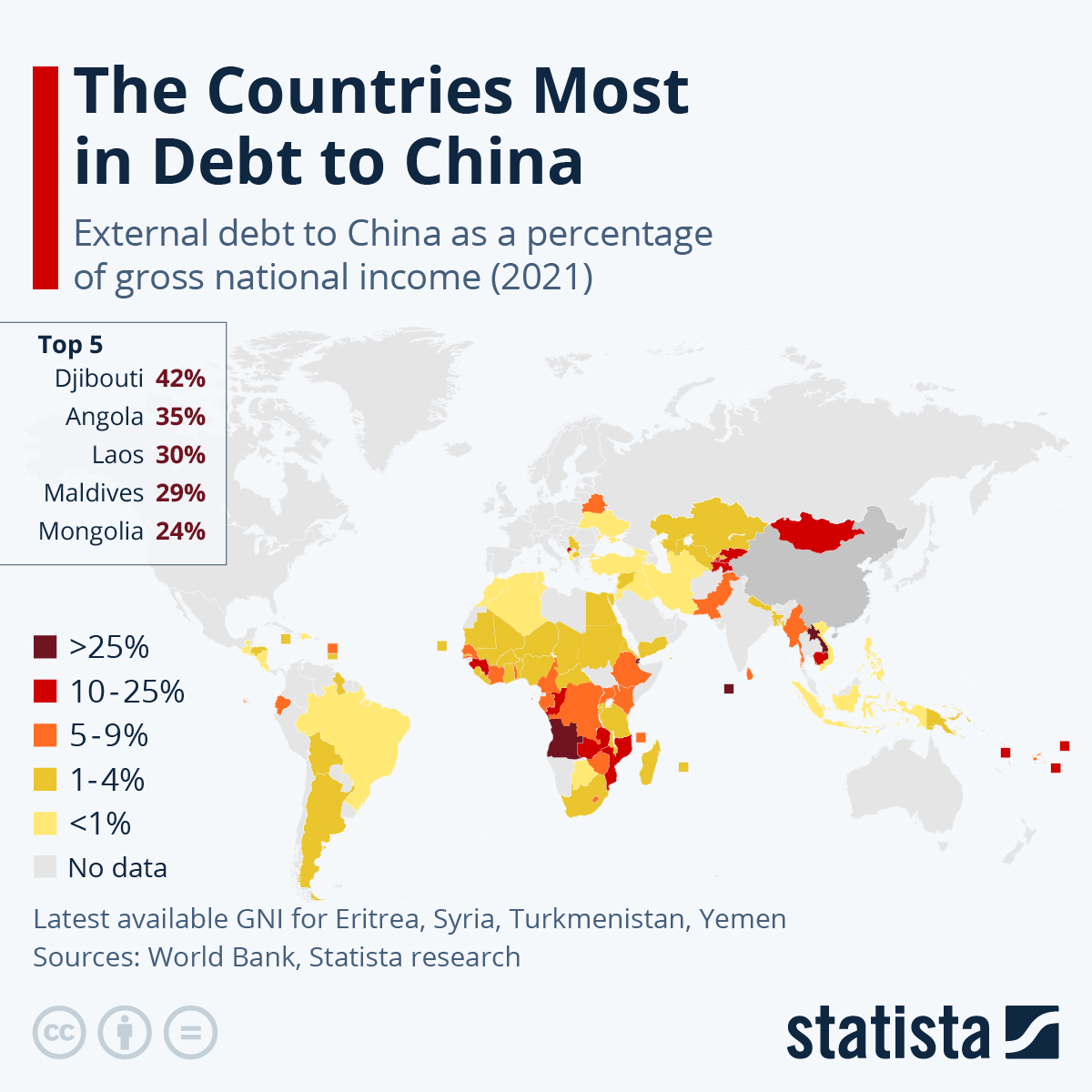
DESCRIPTION This chart shows global debt levels cause by direct loans from China (as percentage of GDP) in 2021.

According to World Bank data analyzed by Statista, countries heavily in debt to China are mostly located in Africa, but can also be found in Central Asia, Southeast Asia and the Pacific. As the new preferred lender to low-income countries, China held 37 percent of these nations’ debt in 2020. Just 24 percent of the countries’ bilateral debt comes from the rest of the world that year.

The “New Silk Road” project, which finances the construction of port, rail and land infrastructure across the globe, has created much debt to China for participating countries. At the end of 2021, of the 98 countries for whom data was available, Pakistan ($27.4 billion of external debt to China), Angola (22.0 billion), Ethiopia (7.4 billion), Kenya (7.4 billion) and Sri Lanka (7.2 billion) held the biggest debts to China. The countries with the biggest debt burdens in relative terms were Djibouti and Angola, followed by the Maldives and Laos, which opened a debt-laden railway line to China last year. The President of the World Bank, David Malpass, has called the level of debt many countries once again hold “unsustainable”.

The Paris Club used to hold the majority of low-income countries’ debt before it was restructured and largely forgiven after the turn of the millennium for qualifying, developing countries. Whether such a process will be available for Chinese debt is unclear. As of 2021, China had officially lent around $180 billion to low and middle-income countries, up from just around $40 billion in 2010.

Chinese loans have higher interest rates than those from international institutions like the International Monetary Fund or The World Bank or bilateral loans from Paris Club countries, and also have shorter repayment windows. Their setup is closer to commercial loans concerning their conditions of repayment, confidentiality as well as their objectives of funding specific infrastructure projects instead of pursuing development goals in general.

The Covid-19 pandemic has complicated the already difficult repayment of Chinese loans even more. According to the Financial Times, the country had to renegotiate loans worth $52 billion in 2020 and 2021 – more than three times the amount that met this fate in the two previous years. One such case was Sri Lanka – also among China’s biggest debtors – which in 2022 was the first Asian country in two decades to default on its debt.

Disinformation surge threatens to fuel Israel-Hamas conflict

reuters.com

By Stephanie BurnettStephen Farrell and Hardik Vyas October 18, 20238:39 PM GMT+7 Updated 10 hours ago

Aftermath of Israeli strikes

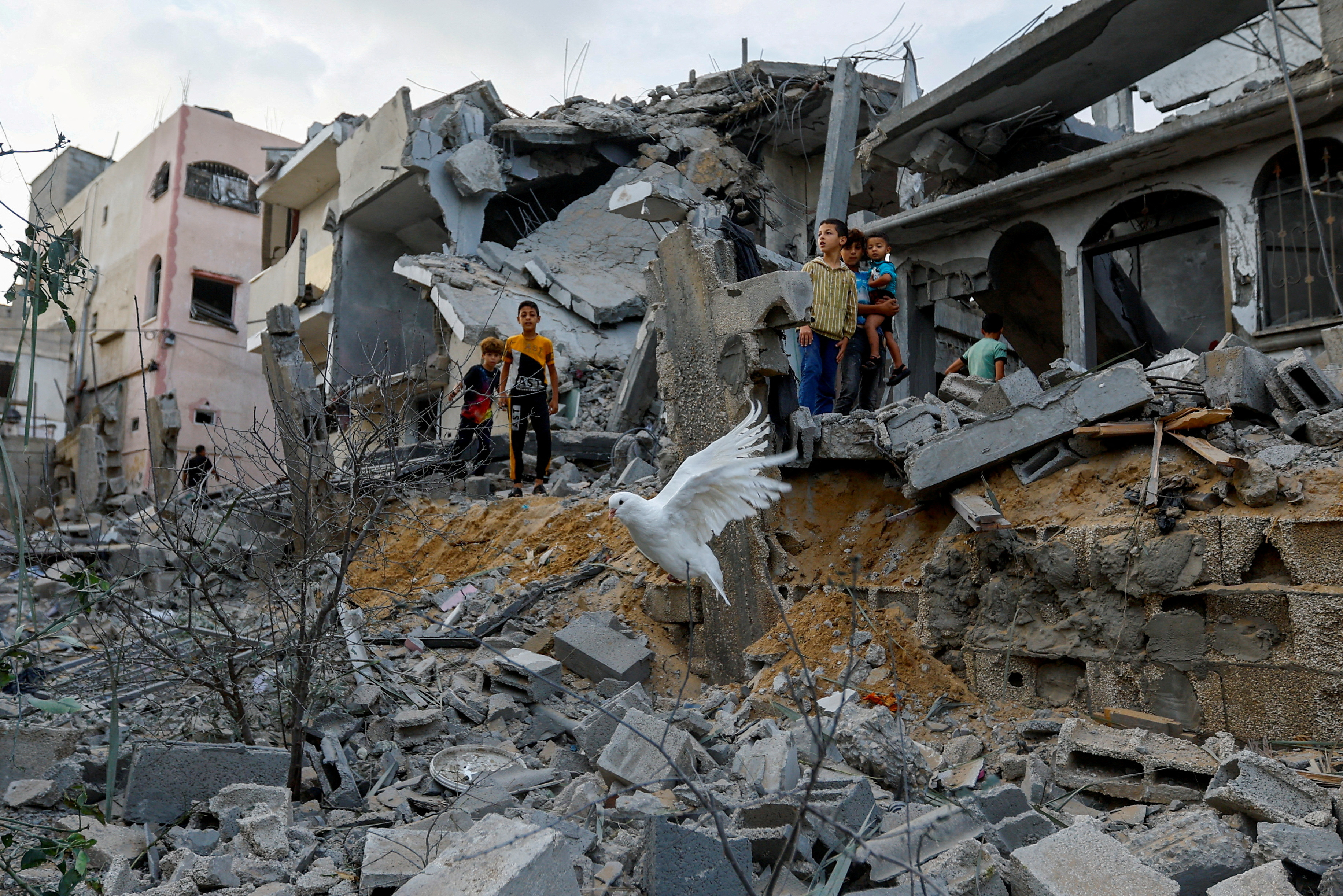
[1/2]A dove flies over the debris of houses destroyed in Israeli strikes, in Khan Younis in the southern Gaza Strip October 11, 2023. REUTERS/Ibraheem Abu Mustafa/File Photo Acquire Licensing Rights

Summary

  • Fake or misleading posts proliferate after Hamas attack
  • Cyber distortions deepen enmity in region and beyond
  • Acrimony online can have real world consequences

AMSTERDAM/LONDON, Oct 18 (Reuters) – As the Israel-Hamas war rages, regulators and analysts say a wave of online disinformation risks further inflaming passions and escalating the conflict in an electronic fog of war.

An explosion at a Gaza hospital that killed hundreds of Palestinians on Tuesday is the latest focus of the surge of activity as supporters of both sides in the battle between Israel and Hamas try to bolster their own side’s narrative and cast doubts on the other’s.

Tiếp tục đọc “Disinformation surge threatens to fuel Israel-Hamas conflict”

Which Countries Receive the Most Foreign Aid from the U.S.?

visualcapitalist.com

Source: US Agency for International Development  Get the data  Embed  Download image  Download SVG

Which Countries Receive the Most Foreign Aid From the U.S.?

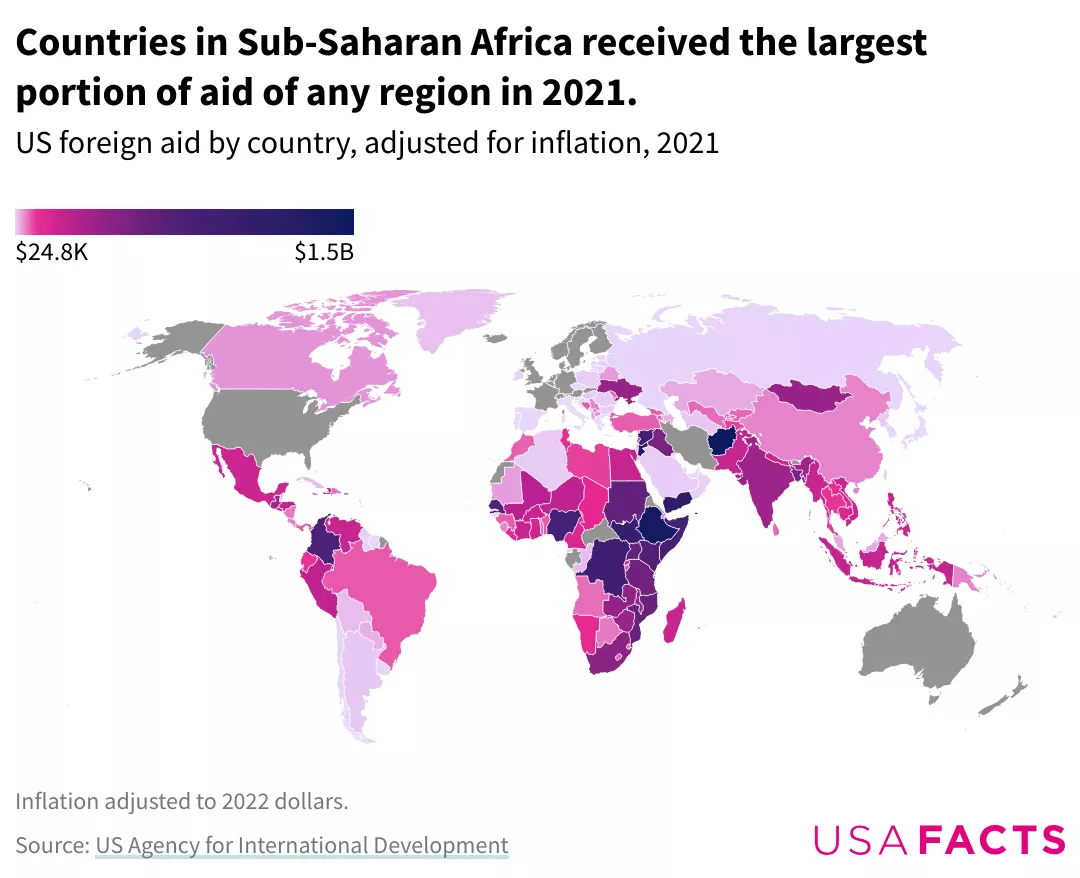
The United States provided more than $50 billion in aid to over 150 countries and territories, regional funds, and NGOs in 2021.

Each year, Congress appropriates foreign assistance based on national security, commercial, and humanitarian interests.

In this map, USAFacts uses data from the U.S. Agency for International Development (USAID) to highlight the countries that received the largest portion of aid.

ADVERTISEMENT

Food Assistance and the War on Drugs

In 2021, the U.S. directed its aid towards nations grappling with internal conflicts and humanitarian crises.

Tiếp tục đọc “Which Countries Receive the Most Foreign Aid from the U.S.?”

Ban on protests supporting Palestinians is disproportionate attack on the right to protest in France

amnesty.org

Following the request from the Minister of the Interior Gerald Darmanin asking the prefects in France to ban all pro-Palestinian demonstrations, Jean-Claude Samouiller, President of Amnesty International France said:

“The ban on all demonstrations in support of the Palestinians in France constitutes a serious and disproportionate attack on the right to demonstrate.

Faced with the atrocities committed by Hamas in southern Israel, and also the blockade and very heavy bombings in the Gaza Strip, it is important that civil society actors can mobilize peacefully and publicly, in particular those calling on those engaged in the conflict to respect the rights of civilian populations. This is why there cannot be a systematic ban on the right to peacefully demonstrate support for the rights of the Palestinian populations.

Under international law, a ban on demonstrations can only be considered as a last resort. Authorities should always seek to protect and facilitate the rights to freedom of expression and peaceful assembly in the first place.Jean-Claude Samouiller, President of Amnesty International France

A ban can only be legal if it is motivated by a specific threat and if it is demonstrated that no other less restrictive measure could guarantee public order.”

China’s Belt and Road Initiative: 10 years of evolution and beyond

China’s Belt And Road Initiative: 10 Years Of Evolution And Beyond | Insight | Full Episode


CNA Insider
– 12 thg 9, 2023

It is the 10th year of the Belt and Road Initiative (BRI). From Central and Southeast Asia to the Middle East and Africa, how has China’s mega infrastructure project changed the world? In this retrospective on the 10th anniversary of the BRI, Insight looks at the developments in Asia and Africa that have sprung from China’s marquee project. From growing trade links to environmental impacts to political influence, the BRI has undeniably changed the region. But with growing economic headwinds and a flagging Chinese economy, will Beijing continue to invest in the BRI? What will the next decade bring?

0:00 Introduction

01:10 Belt and Road Initiative in Central Asia

07:55 How the war in Ukraine is shaping the BRI

12:13 Growing China-ASEAN trade

13:57 How the BRI increased durian exports from Thailand to China

17:54 Dams: Good for energy generation, bad for food supply?

26:28 China’s growing influence in the Middle East

31:21 Why China is investing so much in Africa

35:34 Debt trap diplomacy?

38:40 Rise in non-performing loans on the Belt and Road

40:16 A shift in strategy for the BRI?

===============

ABOUT THE SHOW: Insight investigates and analyses topical issues that impact Asia and the rest of the world.

Keynote Speech by H.E. Xi Jinping, President of the People’s Republic of China, At the Opening Ceremony Of the Third Belt and Road Forum for International Cooperation

Building an Open, Inclusive and Interconnected World For Common Development

2023-10-18 12:42

Keynote Speech by H.E. Xi Jinping

President of the People’s Republic of China

At the Opening Ceremony

Of the Third Belt and Road Forum for International Cooperation

October 18, 2023

Your Excellencies Heads of State and Government,
Heads of International Organizations,
Representatives of Various Countries,
Distinguished Guests,
Ladies and Gentlemen,
Friends,

Today, we are meeting here for the opening ceremony of the Third Belt and Road Forum for International Cooperation (BRF). On behalf of the Chinese government and Chinese people and in my own name, I wish to extend a very warm welcome to you all!

This year marks the 10th anniversary of the Belt and Road Initiative (BRI) I proposed. The BRI, drawing inspiration from the ancient Silk Road and focusing on enhancing connectivity, aims to enhance policy, infrastructure, trade, financial and people-to-people connectivity, inject new impetus into the global economy, create new opportunities for global development, and build a new platform for international economic cooperation.

Tiếp tục đọc “Keynote Speech by H.E. Xi Jinping, President of the People’s Republic of China, At the Opening Ceremony Of the Third Belt and Road Forum for International Cooperation”

After blast kills hundreds at Gaza hospital, Hamas and Israel trade blame as rage spreads in region

APnews.com

Wounded Palestinians wait for treatment in al-Shifa hospital in Gaza City, central Gaza Strip, after arriving from al-Ahli hospital following an explosion there, Tuesday, Oct. 17, 2023. The Hamas-run Health Ministry says an Israeli airstrike caused the explosion that killed hundreds at al-Ahli, but the Israeli military says it was a misfired Palestinian rocket. (AP Photo/Abed Khaled)

“My people are not threatened by silence. They are completely at home in it.”

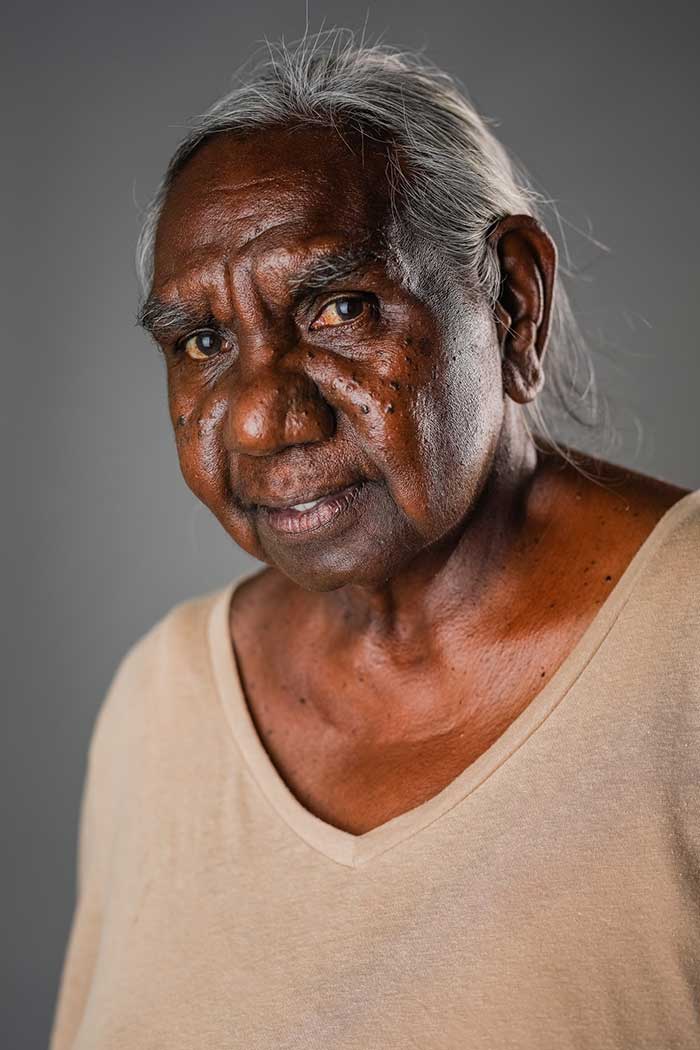
Miriam-Rose Ungunmerr-Baumann (Aboriginal activist, educator, artist and 2021 Senior Australian of the year)

*The Indigenous People of Australia have a depth of spirituality that can enrich our NonIndigenous spirits in so many ways. One of these spiritual gifts is Dadirri. Aboriginal people practice deep listening, an almost spiritual skill, based on respect. ‘Dadirri’ is an Aboriginal word meaning ‘inner deep listening and quiet still awareness and waiting‘*

My people are not threatened by silence. They are completely at home in it. They have lived for thousands of years with Nature’s quietness. My people today recognise and experience in this quietness the great Life-Giving Spirit, the Father of us all. It is easy for me to experience God’s presence. When I am out hunting, when I am in the bush, among the trees, on a hill or by a billabong; these are the times when I can simply be in God’s presence. My people have been so aware of Nature. It is natural that we will feel close to the Creator. Our Aboriginal culture has taught us to be still and to wait. We do not try to hurry things up. We let them follow their natural course – like the seasons. We watch the moon in each of its phases. We wait for the rain to fill our rivers and water the thirsty earth…

When twilight comes, we prepare for the night. At dawn we rise with the sun.

We watch the bush foods and wait for them to ripen before we gather them. We wait for our young people as they grow, stage by stage, through their initiation ceremonies. When a relation dies, we wait a long time with the sorrow. We own our grief and allow it to heal slowly.

We wait for the right time for our ceremonies and our meetings. The right people must be present. Everything must be done in the proper way. Careful preparations must be made. We don’t mind waiting, because we want things to be done with care.

We don’t like to hurry. There is nothing more important than what we are attending to. There is nothing more urgent that we must hurry away for.

We wait on God, too. His time is the right time. We wait for him to make his word clear to us. We don’t worry. We know that in time and in the spirit of dadirri (that deep listening and quiet stillness) his way will be clear.

We are river people. We cannot hurry the river. We have to move with its current and understand its ways.

We hope that the people of Australia will wait. Not so much waiting for us – to catch up – but waiting with us, as we find our pace in this world.

If you stay closely united, you are like a tree, standing in the middle of a bushfire sweeping through the timber. The leaves are scorched and the tough bark is scarred and burnt; but inside the tree the sap is still flowing, and under the ground the roots are still strong. Like that tree, you have endured the flames, and you still have the power to be reborn.

Our culture is different. We are asking our fellow Australians to take time to know us; to be still and to listen to us.–

Miriam-Rose Ungunmerr-Baumann (Aboriginal activist, educator, artist and 2021 Senior Australian of the year)

Full text of the reflection: https://www.dadirri.org.au/wp-content/uploads/2015/03/Dadirri-Inner-Deep-Listening-M-R-Ungunmerr-Bauman-Refl1.pdf?fbclid=IwAR277ZxWsZsLFMb2i8sSmYaSLzrMbBfcrwtDxZPp9eBEWCCADQM1_1yQifI

Learn more about Miriam Rose Foundation: https://www.miriamrosefoundation.org.au/about-miriam-rose-foundation/