
Solar and on-shore wind provide cheapest electricity and nuclear most expensive, CSIRO analysis shows
Estimates show small modular nuclear reactors would provide most expensive power and will not be available until 2030

Graham Readfearn @readfearnWed 20 Dec 2023 19.55 GMT TheGuardian
Electricity generated by solar and on-shore wind is the cheapest in Australia, even after the significant expense of integrating them into the power grid is factored in, according to new analysis from the CSIRO.
Tiếp tục đọc “Solar and on-shore wind provide cheapest electricity and nuclear most expensive, CSIRO analysis shows”[2 articles] Brazil lawsuits allege direct relationship between meatpackers, deforesters on protected land – Cocoa grown illegally in a Nigerian rainforest heads to companies that supply major chocolate makers
Brazil lawsuits allege direct relationship between meatpackers, deforesters on protected land
BY FABIANO MAISONNAVE, ASSOCIATED PRESS AND RUBENS VALENTE, AGENCIA PUBLICAU pdated 6:42 AM GMT+7, December 20, 2023 AP
JACI-PARANA, Brazil (AP) — Meat processing giant JBS SA and three other slaughterhouses are facing lawsuits seeking millions of dollars in environmental damages for allegedly purchasing cattle raised illegally in a protected area in the Brazilian Amazon.
The lawsuits, filed December 5 to 12 by the western Brazilian state of Rondonia, target the exploitation of a protected area known as Jaci-Parana, once rainforest but now mostly transformed into grassland by decades of misuse by land-grabbers, loggers and cattle ranchers. Despite a law forbidding commercial cattle in the reserve, some 216,000 head now graze on pasture there, according to the state animal division.
Tiếp tục đọc “[2 articles] Brazil lawsuits allege direct relationship between meatpackers, deforesters on protected land – Cocoa grown illegally in a Nigerian rainforest heads to companies that supply major chocolate makers”Joint Statement on Higher Airspace Operations (HAO)
US DEPARTMENT OF STATE
MEDIA NOTE
DECEMBER 18, 2023
The text of the following joint statement was released by the Governments of the United States of America, Canada, the European Union and its Member States (Belgium, Bulgaria, Czechia, Denmark, Germany, Estonia, Ireland, Greece, Spain, France, Croatia, Italy, Cyprus, Latvia, Lithuania, Luxembourg, Hungary, Malta, Netherlands, Austria, Poland, Portugal, Romania, Slovenia, Slovakia, Finland, Sweden), Japan, and the United Kingdom expressing support for ICAO’s efforts to address the challenges and opportunities associated with higher airspace operations.
Begin Text:
Tiếp tục đọc “Joint Statement on Higher Airspace Operations (HAO)”Three major gaps in climate-adaptation finance for developing countries
Source(s): Stockholm Environment Institute
In the new Adaptation Finance Gap Update, part of the UN Environment Programme(UNEP) Adaptation Gap Report 2023, we examine recent trends in adaptation funding.
Specifically, we focus on the flow of public adaptation funds from the governments of developed countries to developing countries, since the implementation of the Paris Agreement.
In this article, we identify three major gaps in adaptation finance and explain why these gaps have emerged even as nations commit to scaling up these funds.
Financial shortfall
Adaptation costs for developing countries are estimatedat between $215bn and $387bn annually this decade, according to the latest Adaptation Finance Gap Update report.
Spending from the public funds of developed nations, while not the only source of adaptation finance, remains a crucial source, especially for low-income countries.
As it stands, people in the least developed countries(LDCs) and small-island states are often more exposedto climate hazards and more likelyto be killed by climate-related disasters. This is despite the fact that these nations bear very little responsibilityfor causing climate change.
Tiếp tục đọc “Three major gaps in climate-adaptation finance for developing countries”Senator Bernie Sanders: the humanitarian disaster in Gaza
“I’m furious. Furious that those with power shrug at the humanitarian nightmares unleashed on 1 mil. children.”
Quảng Bình: Lần đầu tiên bán ‘không khí’ thu về hơn 80 tỷ đồng
TP – 18/12/2023 | 06:16
Tin từ Sở NN&PTNT tỉnh Quảng Bình cho biết, lần đầu tiên và bắt đầu từ năm 2023, Quảng Bình cùng 5 tỉnh Bắc Trung Bộ nhận được nguồn tiền từ dịch vụ hấp thụ và lưu giữ carbon của rừng.
Theo đó, căn cứ Nghị định số 107/2022/NĐ-CP về thí điểm chuyển nhượng kết quả giảm phát thải (bán tín chỉ carbon) và quản lý tài chính thỏa thuận chi trả giảm phát thải khí nhà kính vùng Bắc Trung Bộ, Bộ NN&PTNT sẽ chuyển nhượng 10,2 triệu tấn CO2 vùng Bắc Trung Bộ cho Ngân hàng Tái thiết và Phát triển quốc tế (IBRD).

Quảng Bình hiện có tỉ lệ che phủ rừng thuộc tốp cao trong cả nước, hơn 60%.
Từ đó, Quỹ Bảo vệ và Phát triển rừng Trung ương sẽ nhận được 51,5 triệu USD từ Quỹ Carbon thông qua IBRD, sau đó điều phối gần 50 triệu USD đến các tỉnh theo quy định. Trong đó, Quảng Bình chuyển nhượng hơn 2,4 triệu tấn CO2, được chi trả khoảng 235 tỷ đồng trong giai đoạn 2023-2025. Riêng năm 2023, Quảng Bình được nhận 82,4 tỷ đồng (cao thứ 2 trong 6 tỉnh của khu vực).
Tiếp tục đọc “Quảng Bình: Lần đầu tiên bán ‘không khí’ thu về hơn 80 tỷ đồng”Vietnamese fruits struggle with higher standards
VNN – December 18, 2023 – 07:21
In light of the recent incident involving the destruction of two shipments of Vietnamese durians and peppers by the Japanese authorities, the vulnerability of Vietnamese agricultural exporters remains a pressing concern. This risk is particularly pronounced as importing markets tighten their standards for clean and green practices, necessitating a more proactive and comprehensive approach from the sector to keep its buyers and maintain a competitive edge.

Workers checking durians for export in the central highland province of Đắk Lắk. —VNA/VNS Photo
Tiếp tục đọc “Vietnamese fruits struggle with higher standards”
Israel-Gaza war is having a chilling effect on academic freedom
Listen to podcast https://shows.acast.com/60087127b9687759d637bade/65804f3a3c61a300185b8044
“In the UK we’ve seen suspension of students and staff from their universities. We’ve seen cancelling of events … of student activities like protests and sit-ins. We’ve seen a few cases of students that were arrested. We’ve seen students whose visas are threatened to be revoked.“
Across parts of academia, concerns are mounting that the Israel-Gaza war is having a chilling effect on academic freedom. In the second of two episodes of The Conversation Weekly exploring how the war is affecting life at universities, we speak to an Israeli legal scholar, now based in the UK, about the pressures that academics and students are facing to rein in their views about the war.https://embed.acast.com/60087127b9687759d637bade/65804f3a3c61a300185b8044
In the two months since the October 7 Hamas attack on Israel and subsequent Israeli war on Gaza, Neve Gordon is worried that there’s been a major clampdown on academic freedom in the US, Europe and Israel.
After teaching for 17 years in southern Israel, Gordon moved to the UK in 2016 and he’s now a professor of human rights and humanitarian law at Queen Mary University of London. His research looks at the laws of war with a special focus on Israel-Palestine, and on definitions of antisemitism.
He’s also the vice-president at the British Society for Middle Eastern Studies and chair of its committee on academic freedom. In this role, he’s been following the impact of the conflict on free speech at universities, and recently hosted an international webinar on the issue.
In the UK we’ve seen suspension of students and staff from their universities. We’ve seen cancelling of events … of student activities like protests and sit-ins. We’ve seen a few cases of students that were arrested. We’ve seen students whose visas are threatened to be revoked.
In Israel, Gordon told us he was aware of 113 cases in Israel of students and staff who have been suspended or dismissed, and at least ten students who have been arrested for their criticism of Israel’s attack on Gaza. “We have several students sitting behind bars for Facebook or tweets that basically express empathy for the suffering of the Palestinians,” he says.
Read more: American universities in the spotlight over reaction to Israel-Gaza war – podcast
Meanwhile, in Germany, many protests supporting Palestinian rights have been banned and Gordon says colleagues in Germany have told him that “the situation is untenable”.
All this, Gordon says, is having a chilling effect across academia.
I’m getting phone calls from friends in different universities in different countries saying that they want to cancel their Israel-Palestine course for next semester because they’re afraid that things that they will say in class can be interpreted by students as antisemitic.
Listen to the full interview with Neve Gordon on The Conversation Weekly podcast, where you can also listen to the first of our two episodes on the way the Israel-Gaza war is affecting life at universities, focusing on what’s been happening at one American public university.
13 year-old Girl under Gaza rubble asks rescuers to help relatives first
Trapped under the rubble of a 5-storey building in Gaza, a 13-year-old called Alma pleaded for rescuers to help free her relatives first. What happened to her family members is not known.
Outrage after Israeli forces kill Israeli captives in Gaza
Thousands of people have protested in Tel Aviv after Israeli forces killed three Israeli captives in Gaza who were shirtless, waving a white flag and calling for help in Hebrew. Demonstrators are demanding the gov’t reach a deal for the safe return of remaining captives
Antisemite? Really?

People, especially politicians, in the West are afraid of being called antisemite, and they may hang the antisemite label on the neck of their enemies if they get a chance.
What is so powerful about “antisemite” or “antisemitism”? Tiếp tục đọc “Antisemite? Really?”
2023: the year of the migrant crisis
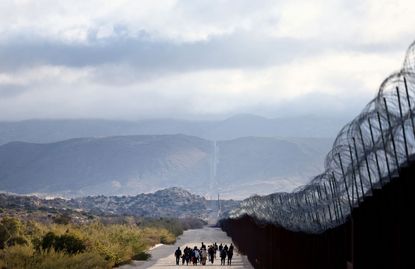
Asylum-seeking migrants walk toward a makeshift camp to await processing by the U.S. Border Patrol after crossing into the United States past a gap in the border barrier Dec. 1, 2023 in Jacumba Hot Springs, CaliforniaPUBLISHED 5 DAYS AGO
Immigration policy has been a hot-button issue for generations, in the United States and around the world. But waves of people fled their homes by land or by sea in 2023, triggering migrant crisis after migrant crisis in multiple regions. Battles over migration policy stoked domestic political feuds and diplomatic clashes.
International Organization for Migration officials told delegates at the United Nations’ COP28 climate conference that more than half of forced “internal displacements,” which totaled 32.6 million people last year, were driven by climate-related events, according to Forbes. Wars, like Russia’s invasion of Ukraine and the conflict between Israel and Hamas, drove more people to seek a better life in a new country, and increased tensions once they got there.
Here are some of the migration routes where the crisis was intense in 2023:
The U.S.-Mexico border
A “growing wave of migration” exploded at the U.S.-Mexico border in 2023, The Wall Street Journal reported recently. It hit especially hard in the small border city of Eagle Pass, Texas, where Mayor Rolando Salinas Jr. declared a state of emergency as the number of migrants entering from Mexico hit 3,000 per day. “We are on pace for this to be the worst of the border crisis yet, and we’ve seen some doozies,” said Rep. Tony Gonzalez (R-Texas), whose district includes Eagle Pass. The migrants included people fleeing turmoil in Venezuela, drug cartel violence in Ecuador and other once-safe countries, gang violence in Haiti, and a broad economic downturn across Latin America blamed on the Covid-19 pandemic.
But the impact wasn’t just felt at the U.S.-Mexico border. New York City Mayor Eric Adams declared a state of emergency as thousands of migrants — more than 146,000 between spring 2022 and November 2023 — arrived from the southern border. Many were sent north by Texas’ Republican governor, Greg Abbott, to cities run by Democrats in a campaign to pressure President Joe Biden to crack down at the border. Adams warned the city was facing a humanitarian crisis that would cost $12 billion over three years, The New York Times reported. City officials said in November their homeless shelters had no room for any more asylum-seekers.
The EU and UK
European nations have faced a huge influx of migrants in recent years. The EU is on track to receive more than one million asylum seekers in 2023, the most since a wave of people in 2015 and 2016, most of them fleeing Syria’s civil war. In Germany — already home to three million refugees, the most since waves of ethnic Germans returned from Eastern Europe after World War II — Chancellor Olaf Scholz is under pressure from overwhelmed states to do something about a more than 70 percent rise in asylum applications in 2023. “I don’t want to use big words,” Scholz told reporters in November, according to Politico, “but I think this is a historic moment.”
Italy and the United Kingdom joined forces in October to lead a European effort to fight “illegal migration.” Italy’s right-wing prime minister, Giorgia Meloni, came to power last year after vowing “to clamp down on unauthorized arrivals from North Africa with harsher immigration laws, restrictions on sea rescue charities, and plans to build migrant reception camps in Albania,” Reuters reported. U.K. Prime Minister Rishi Sunak’s conservative government wants to pay Rwanda to process asylum applications for people arriving illegally in the U.K., which Sunak said would help “break the cycle of tragedy” of people-smuggling using small boats, the BBC reported. The UK also is taking steps to curb legal migration, including a higher minimum salary.
South to South
Migrant waves to Western countries get most of the headlines, but most migration occurs between countries in the same region. “That has put a significant burden on states that border conflict zones, like Uganda, which sits alongside both South Sudan and the Democratic Republic of Congo,” according to the World Politics Review. Fighting between Sudan’s army and paramilitaries has internally displaced three million people, and sent 926,841 people seeking refuge in Egypt, Libya, Chad, the Central African Republic, South Sudan, Ethiopia, and other neighboring countries, according to the United Nations International Organization for Migration.
These crises threaten to only get worse as rising global temperatures fuel mass climate migrations, according to Fortune. Global carbon emissions are rising, and climate scientists say the greenhouse gasses already accumulated in our atmosphere all but guarantee that Earth’s average temperature rise will exceed the tipping point of two degrees Celsius, which it did briefly in November 2023. This, according to Fortune, could make countries like Bolivia or Yemen “vacant states,” as their people leave seeking “fertile” ground, with their leaders unable to give them reason to stay. As Fortune put it: “Solar panels for an Eritrean village won’t keep its boys from fleeing the country’s hopeless economy and austere politics.”
Tranh chấp Venezuela – Guyana và những di sản thực dân
SÁNG ÁNH 17/12/2023 08:23 GMT+7
TTCT – Ngày 3-12, Venezuela mở một cuộc trưng cầu toàn quốc về chủ quyền của Venezuela trên khu vực Essequibo là nơi tranh chấp lãnh thổ với Guyana láng giềng từ 1895.
Đây là một vùng đất mênh mông 160.000km2 (tương đương gần một nửa diện tích Việt Nam) nhưng vắng người, lác đác 125.000 dân cư.

Ảnh: France 24
Kết quả trưng cầu là 95% phiếu thuận, tuy số cử tri tham gia rất thấp. Kết quả này có thể là cơ sở để chính quyền Caracas lấy lại lãnh thổ này bằng võ lực vì ý dân là ý trời – cả nước đã đồng tình.
Tương quan lại rất chênh lệch và thuận lợi cho Venezuela, 28 triệu dân, trong khi Guyana là một tiểu quốc 800.000 người. Hoa Kỳ bèn lên tiếng bênh Guyana. Brazil thì đằng hắng. Nhưng trước hết xin đố bạn đọc là trên thế giới này có bao nhiêu “Guinéa”?
Tiếp tục đọc “Tranh chấp Venezuela – Guyana và những di sản thực dân” CVD
CVD 