Deputy PMs Minh and Đam resign from the Party Central Committee

VNN – December, 30/2022 – 18:13
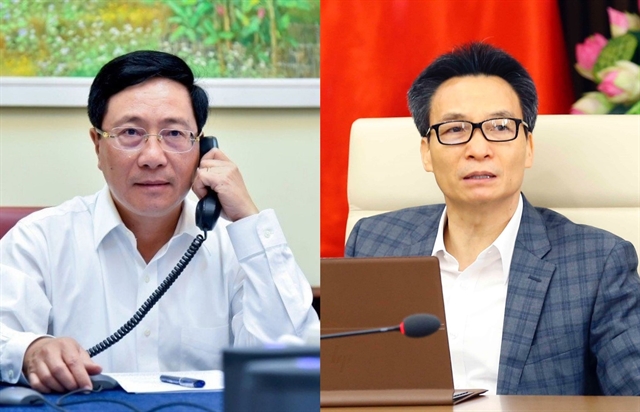
Deputy Prime Ministers Phạm Bình Minh and Vũ Đức Đam (right) are no longer members of the 13th Party Central Committee. VNA/VNS Photos 

HÀ NỘI — Deputy Prime Ministers Phạm Bình Minh and Vũ Đức Đam are no longer members of the 13th Party Central Committee, according to a decision made on Friday.

Phạm Bình Minh’s membership at the Politburo was also removed, according to the decision made at the Central Committee of the Communist Party of Việt Nam’s extraordinary meeting held Friday afternoon.

During the meeting, the Committee also gave opinions on two individuals that the Politburo would recommend to the 15th National Assembly to be approved as deputy prime ministers for the 2021-26 term.

Tiếp tục đọc “Deputy PMs Minh and Đam resign from the Party Central Committee”

2022 PacNet Commentary Index


2022 PacNet Commentary Index

The comprehensive 2022 index includes each PacNet commentary below.  Pacific Forum will continue to publish timely insight and analysis in 2023.
1. The limits of a securitized Japanese FOIP Vision by Stephen Nagy
2. Balancing accessibility and quality in Blue Dot Network infrastructure finance by John Taishu Pitt
3. Abe was key to the Indo-Pacific’s evolution by Brad Glosserman
4. Comparative Connections Summary: January 2022
5. AUKUS’ opportunities and risks for India by Manpreet Sethi
6. What happens in Ukraine will not stay in Ukraine by Sergiy Korsunsky
7. China’s growing confidence in drone warfare by Loro Horta
8. Back to the past: The significance of Russia and China’s joint statement by Yu Bin
9. Biden struggles as China advances in Southeast Asia by Robert Sutter
10. Is the US capable of shaping a rules-based international order?’ by Robert A. Manning
11. Nuclear submarines for our Pacific allies: When to say yes by Henry Sokolski
12. Ukraine: China’s latest strategic blunder by Ralph A. Cossa
13.What the Indo-Pacific sees in Ukraine by Stephen Nagy
134. What the war in Ukraine means for Taiwan by Denny Roy
15.Ukraine: A turning point in Japanese foreign policy? by Kristi Govella
16. South Korea’s presidential election aftermath: Ukraine as test for a “global pivotal state” by Mason Richey
17. Ukraine: After invasion, what? by David Santoro
18. Ukraine and the decoupling of space cooperation with Russia by Philip Citowicki
19. Myanmar: Words like “genocide” have consequences by David I. Steinberg
20. After Ukraine – Enacting a realistic Japanese diplomatic security policy by Hideshi Futori
21. India’s strategic autonomy: A lesson for Japan by Tomoko Kiyota
22. Feminist foreign policy and Ukraine: For now, Japan leads the way by Hannah Cole, Maryruth Belsey-Priebe and Tevvi Bullock
23. May is a major opportunity for US relations with Asia—especially economically by James A. Kelly
24. Why it’s so hard to quit Chinese steel by Akash Sahu
25. A Black Sea humanitarian food corridor to Odessa by Charles E. Morrison
26. Why South Koreans see little difference in Biden’s North Korea policy by Timothy S. Rich, Ian Milden and Mallory Hardesty
27. What Yoon Suk Yeol’s election means for minority rights in South Korea by Eun A Jo
28. Comparative Connections Summary: May 2022
29. Hints of a new North Korea nuclear strategy by Brad Glosserman
30. Australia’s election: Quad continuity and climate alignment, with nuclear disagreements by Graeme Dobell
31. Should the United States acknowledge mutual vulnerability with China? by David Santoro
32. Scholarships in the Pacific Islands are an urgent US national security issue by Kimery Lynch
33. China cannot hinder international navigation through Taiwan Strait by Tran Đinh Hoanh
34. Why ASEAN should heed the distant tolling of bells by Patrick O’Connor
35. Abe Shinzo and the Japan-South Korea relationship: Near- and long-term legacies by Jada Fraser
36. Post-Abe Indo-Pacific regional dynamics: A legacy beyond the man by Stephen Nagy
37. Abe’s death creates a void in Japan by Brad Glosserman
38. China’s “containment” policy against America by Denny Roy
39. Abe Shinzo’s legacy in Southeast Asia by Kei Koga
40. Abe Shinzo: How to handle an unpredictable America by Rob York
41. Another “hotline” with China isn’t the answer by Lyle J. Morris and Colonel Kyle Macrum
42. Their money our way: Influencing highly capable allies and partners by Lieutenant Colonel Jason Kim
43. Post-Abe India-Japan ties: Does Kishida have what it takes? by Jagannath Panda
44. “Hybrid multilateralism” and the Yoon pursuit of middle power strategy by Shin-wha Lee
45. The prescience of Abe’s vision for Taiwan by Shihoko Goto
46. Correcting the Narrative on China’s “New Era-gance”: Taipei, Washington, and many are angry at Beijing’s bullying by Shirley Kan
47. Time for difficult choices on Myanmar by Gregory B. Poling
48. Are small modular reactors the solution to growing energy and climate problems? by David Santoro
49. Continued evolutions in the regional architecture of the Indo-Pacific by Thomas Wilkins
50. China’s new (old) Taiwan white paper: What’s the point? by Jake Steiner
51. Five years after the Rohingya exodus, no significant development by Mufassir Rashid
52.The first year of Japan’s Digital Agency: In pursuit of coherence and identity by Raymond Yamamoto
53. How the United States can build a chip alliance in Northeast Asia without decoupling by Major Jessica Taylor and Jonathan Corrado
54. Comparative Connections Summary: September 2022
55. Understanding Japan’s defense debate by Brad Glosserman
56. Employing “smart power” to counter PRC efforts in Oceania by Peter C. Oleson
57. What Indo-Pacific countries should do about Taiwan by Huynh Tam Sang
58. The strategic importance of the Pacific Islands to Taiwan by Michael Walsh and John Hemmings
59. How the new National Security Strategy transforms US China policy by Brad Glosserman
60.The Myth of Taiwan as a Pacific Nation by Michael Walsh, Wen-Chi Yang, Adam Morrow
61.The new National Security Strategy in the context of an unstated “cold war” by John Hemmings
62. Myanmar’s emerging national identity could change everything by Wayland Blue
63. AUKUS: Stepping boldly into space by Philip Citowicki
64. The Biden-Xi summit: Not revolutionary, but still necessary by Daniel R. DePetris
65. To change Taiwan’s conscription system, change the culture by Claire Tiunn (Chang)
66. Finally at the table, not on the menu: Canada launches its Indo-Pacific strategy by Stephen Nagy
67. After Ukraine, the need for a collectively framed new order by Ron Huisken
68. South Korea’s role in a Taiwan contingency: Indirect but essential by Sungmin Cho

PacNet commentaries and responses represent the views of the respective authors. Alternative viewpoints are always welcomed and encouraged. Click here to request a PacNet subscription.ShareTweetForward

Browse through the September 2022 issue of Comparative Connections.

Understanding Sharia: The Intersection of Islam and the Law

cfr.org

Sharia guides the personal religious practices of Muslims worldwide, but whether it should influence modern legal systems remains a subject of intense debate.

Friday prayers at the Wazir Khan mosque in Lahore, Pakistan.
Friday prayers at the Wazir Khan mosque in Lahore, Pakistan. Damir Sagolj/Reuters

WRITTEN BY Kali Robinson Last updated December 17, 2021 2:00 pm (EST)

Summary

  • Sharia is the ideal form of divine guidance that Muslims follow to live a righteous life. Human interpretations of sharia, or fiqh, are the basis of Islamic law today.
  • About half the world’s Muslim-majority countries have sharia-based laws, and most Muslims worldwide follow aspects of sharia in their private religious practices.
  • Debate continues to flare over sharia’s place in the modern world, particularly with regard to its teachings relating to criminal justice, democracy, and social equality.

What is sharia?

Why is it so controversial?

How much room is there for reform?

How do governments in the Muslim world use sharia?

How do extremist groups interpret sharia?How do Muslim-minority countries approach sharia?

Recommended Resources

Introduction

Most of the world’s nearly fifty Muslim-majority countries have laws that reference sharia, the guidance Muslims believe God provided them on a range of spiritual and worldly matters. Some of these nations have laws that call for what critics say are cruel criminal punishments, or place undue restrictions on the lives of women and minority groups. However, there is great diversity in how governments interpret and apply sharia, and people often misunderstand the role it plays in legal systems and the lives of individuals.

What is sharia?

Sharia means “the correct path” in Arabic. In Islam, it refers to the divine counsel that Muslims follow to live moral lives and grow close to God. Sharia is derived from two main sources: the Quran, which is considered the direct word of God, and hadith—thousands of sayings and practices attributed to the Prophet Mohammed that collectively form the Sunna. Some of the traditions and narratives included in these sources evolved from those in Judaism and Christianity, the other major Abrahamic religions. Shiite Muslims include the words and deeds of some of the prophet’s family in the Sunna. However, sharia largely comprises the interpretive tradition of Muslim scholars.

Tiếp tục đọc “Understanding Sharia: The Intersection of Islam and the Law”

Rule of Law and Development

UN.org

In the Declaration of the High-level Meeting on the Rule of Law, Member States noted that “the rule of law and development are strongly interrelated and mutually reinforcing, that the advancement of the rule of law at the national and international levels is essential for sustained and inclusive economic growth, sustainable development, the eradication of poverty and hunger and the full realization of all human rights and fundamental freedoms, including the right to development, all of which in turn reinforce the rule of law”. They therefore called for consideration of that interrelationship in the post-2015 international development agenda. At the international level, the body of international instruments, including those concerning international trade and finance, climate change and protection of the environment and the right to development, establishes internationally agreed standards which support sustainable development.

At the national level, the rule of law is necessary to create an environment for providing sustainable livelihoods and eradicating poverty. Poverty often stems from disempowerment, exclusion and discrimination. The rule of law fosters development through strengthening the voices of individuals and communities, by providing access to justice , ensuring due process and establishing remedies for the violation of rights . Security of livelihoods, shelter, tenure and contracts can enable and empower the poor to defend themselves against violations of their rights. Legal empowerment goes beyond the provision of legal remedies and supports better economic opportunities.

Tiếp tục đọc “Rule of Law and Development”

Hmong-American Sheng Thao, mayor-elect of Oakland, California

Oakland’s Next Mayor Highlights Political Rise of Hmong Americans

new york timesSheng Thao, the daughter of refugees, will become the most prominent Hmong American politician when she leads the California city of 440,000 residents.

Sheng Thao at Joaquin Miller Park in Oakland last month. Carolyn Fong for The New York Times

Amy Qin

By Amy Qin – Dec. 28, 2022

Over platters of fried rice, egg rolls and crab rangoon, Sheng Thao took the microphone and asked for support in June from several dozen people gathered at a Hmong restaurant in Wisconsin.

Ms. Thao, 37, was running to become the mayor of Oakland, Calif., but she took a detour to the Upper Midwest because it has some of the nation’s largest communities of Hmong Americans.

When Ms. Thao spoke, Zongcheng Moua, 60, found himself nodding along, never mind that he lived 2,000 miles away from California. Like Ms. Thao’s parents, Mr. Moua landed in a refugee camp in Thailand after fleeing the war in Laos nearly 50 years ago. His siblings, like Ms. Thao’s parents, struggled to adapt to life in the United States after arriving with no money, formal education or language skills.

Tiếp tục đọc “Hmong-American Sheng Thao, mayor-elect of Oakland, California”

Council on Foreign Relations – Daily news brief Dec. 29, 2022

Editor’s note: There will be no Daily Brief until Tuesday, January 3, in observance of New Year’s Day.
Top of the Agenda

Russia Rejects Ukraine’s Peace Conditions, Bombards Its Power Grid

Russia fired nearly seventy missiles (WaPo) at Kyiv and other Ukrainian cities today in what appeared to be one of its biggest strikes on Ukraine’s energy grid. Ukraine’s military said it shot down fifty-four of the missiles. The attack came hours after Russian Foreign Minister Sergei Lavrov reiterated Moscow’s rejection (Al Jazeera) of Ukrainian President Volodymyr Zelenskyy’s conditions for peace. 
In recent weeks, Zelenskyy has promoted a peace plan in which Russia would face a war crimes tribunal and give up occupied territories in eastern Ukraine. A Kremlin spokesperson yesterday rejected the possibility (NYT) of ceding the territories, while Lavrov said today that Kyiv’s plans to drive Russia out of eastern Ukraine were an “illusion.” 
Tiếp tục đọc “Council on Foreign Relations – Daily news brief Dec. 29, 2022”

Pictures of the Year

December 29, 2022
By the staff of The Morning
Good morning. Today we look at some of the most memorable photos published in The Times this year.
Photographers for The New York Times trod around the globe in 2022 to document news, history and everyday life, whether embedded alongside troops on the front lines in Ukraine, chronicling lawmakers in the halls of Congress or reporting from floods and wildfires on several continents.
Near the end of the year, The Times publishes its annual Year in Pictures feature. This edition of The Morning is a tribute to the work of The Times’s photographers.
The photos
Millions of people fled Ukraine in the early weeks of Russia’s invasion, seeking refuge in other countries. Desperate families shoved their way onto a train leaving the capital, Kyiv, in early March:

Tiếp tục đọc “Pictures of the Year”

Opinion: Energy importers must consider true ‘sustainability’ of Laos hydropower

Proponents describe regional power grids as a way to promote economic growth, energy security and renewables in Southeast Asia, but this might come at a heavy cost

Lat Tha Hae temple in Luang Prabang province, Laos, half submerged by the Nam Ou 1 hydropower dam (Image: Ton Ka/China Dialogue)

Ming Li Yong

the third pole – August 23, 2022

On 23 June 2022, the import of 100 megawatts (MW) of hydropower from Laos to Singapore through Thailand and Malaysia was hailed as a historic milestone. Part of a pilot project known as the Lao PDR-Thailand-Malaysia-Singapore Power Integration Project (LTMS-PIP), this event represented Singapore’s first ever import of renewable energy, and also the first instance of cross-border electricity trade involving four countries from the Association of Southeast Asian Nations (ASEAN).

However, this development takes place amid rising concerns for the ecological future of the transboundary Mekong River and the millions of people who depend on it. A 2018 study by the Mekong River Commission concluded that further hydropower development on the river would negatively affect ecosystems, and would reduce soil fertility, rice production, fish yields and food security, while increasing poverty in the river basin.

Tiếp tục đọc “Opinion: Energy importers must consider true ‘sustainability’ of Laos hydropower”

In the Mekong Basin, an ‘unnecessary’ dam poses an outsized threat

  • A dam being built in Laos near the border with Cambodia imperils downstream communities and the Mekong ecosystem as a whole, experts and affected community members say.
  • The Sekong A dam will close off the Sekong River by the end of this year, restricting its water flow, blocking vital sediment from reaching the Mekong Delta in Vietnam, and cutting off migration routes for a range of fish species.
  • Experts say the energy to be generated by the dam — 86 megawatts — doesn’t justify the negative impacts, calling it “an absolutely unnecessary project.”
  • This story was supported by the Pulitzer Center’s Rainforest Investigations Network where Gerald Flynn is a fellow.

Tiếp tục đọc “In the Mekong Basin, an ‘unnecessary’ dam poses an outsized threat”

Vietnam loses sacred cranes after habitat change

In 2020 and 2022, no sarus cranes were spotted in Cham Trim National Park. PHOTO: Nguyen Van Hung

mekongeye – By Tran Nguyen

19 September 2022 at 8:05 (Updated on 22 September 2022 at 17:13)

A vulnerable bird that usually migrated to the wetlands of the Mekong Delta has become a rare visitor to the area

DONG THAP, VIETNAM – Twenty years ago, Nguyen Van Liet took scientists to the wetlands near his hometown of Tram Chim on Vietnam’s Mekong Delta to find sarus cranes, a vulnerable bird species according to the IUCN Red List, native to Southeast Asia, South Asia and Australia.

“We had to go very early so the cranes wouldn’t know it,” Liet said of the expedition, which aimed to study the crane’s movements using a navigation device. “After sedating them, attaching tracking devices to their legs, the crew found shelter to wait for them to wake up and leave safely.”

Memories of those trips will forever be a source of pride for the 58-year-old. His efforts, no matter how humble, have contributed to helping Tram Chim become known worldwide as a place to preserve this rare crane species, which are world’s tallest flying birds.

Tiếp tục đọc “Vietnam loses sacred cranes after habitat change”

Hợp tác cấp vùng về thương mại điện năng

IUCN – 06 Th12, 2022

Trong lúc việc phát triển và mở rộng năng lượng mặt trời và gió sẽ là yếu tố quan trọng giúp Việt Nam giảm tiêu thụ than và đáp ứng yêu cầu trong lộ trình thực hiện các cam kết tại COP26, thì việc tăng cường nhập khẩu điện từ các nước láng giềng là một giải pháp bổ sung. Trong Kế hoạch Phát triển Điện lực 8 của Việt Nam (PDP 8) ban hành tháng 4 năm 2022 đã đưa ra dự đoán lượng điện nhập khẩu sẽ tăng từ 572 MW vào năm 2020 lên khoảng 4.000 MW vào năm 2025.

content hero image

Photo: A solar project invested by Trung Nam Group © Trung Nam Group

Tương lai thì nguồn điện nhập khẩu vào Việt Nam phần lớn sẽ đến từ CHDCND Lào và có thể từ Campuchia. Tuy nhiên, cách thức Việt Nam tham gia thương mại điện năng với các nước láng giềng này sẽ có ảnh hưởng trực tiếp đến việc phát triển các dự án phát điện ở các quốc gia này. Phần lớn nguồn điện năng mà Việt Nam nhập khẩu từ CHDCND Lào đến từ các đập thủy điện và các đập này có thể có tác động tiêu cực đáng kể cho Việt Nam.

Tiếp tục đọc “Hợp tác cấp vùng về thương mại điện năng”

Council on Foreign Relations – Daily News Brief Dec. 27, 2022

Top of the Agenda

China Makes Sweeping Changes to COVID-19 Travel Restrictions

From January 8, China will no longer require (Nikkei) passengers to undergo mandatory testing and quarantines upon arrival and will relax limits on the number of flights entering the country, authorities announced yesterday. The policy shift follows the easing (NYT) of domestic pandemic restrictions in the wake of mass protests over the country’s harsh zero-COVID strategy.
Beijing also said that citizens will regain permission to go abroad “in an orderly manner” after almost three years of what was effectively a ban on nonessential travel. Amid the reopening, COVID-19 has strained health-care facilities across the country and Beijing has limited official reporting on the number of cases and deaths. In response, Japan announced that it will require negative tests upon arrival (SCMP) from travelers from mainland China.
Tiếp tục đọc “Council on Foreign Relations – Daily News Brief Dec. 27, 2022”

A Vietnamese deaf teacher’s story sheds light on overcoming barriers to integrate into society

World Bank Group – APRIL 13, 2021

[The clip Ngoc Anh say about her story here]


Born deaf, growing up with linguistic barriers, and as a result, a sense of isolation and loneliness, Nguyen Thi Ngoc Anh didn’t give up. Instead she rose to the challenge and became a primary education teacher – and a fighter for a future without language barriers where deaf children can develop equally to those who can hear.

Tiếp tục đọc “A Vietnamese deaf teacher’s story sheds light on overcoming barriers to integrate into society”

Ước mơ lặng câm

ngay nay -13/09/2020 | 14:35

Một dàn đồng ca hát không thành lời. Một ước nguyện có mái nhà chung mãi không được lắng nghe. Có một nhóm những người câm điếc ở Sài Gòn loay hoay trong căn nhà hơn 10 mét vuông và mơ về một ngày những gì mình nghĩ, bật ra được thành tiếng.

_____________

Tiếp tục đọc “Ước mơ lặng câm”