The gap in global standards – World Development Report 2025

STANDARDS FOR DEVELOPMENT

worldbank.org

Rising Standards Reshape the Global Economy

International standards are proliferating, delivering major benefits to wealthy nations and big multinationals while leaving many developing countries behind, a new World Bank report shows. 

Main Messages

  • Standards are the hidden foundations of prosperity. They are the shared rules that make plugs fit sockets, medicines work safely, and digital systems connect seamlessly. Standards embody collective knowledge, build trust, and enable economies to function efficiently. When they fail, markets fragment; when they work, prosperity follows.
  • For low- and middle-income countries, standards have never mattered more. Nearly 90 percent of world trade is now shaped by nontariff measures, most linked to standards. From digital systems for payment to charging stations for electric vehicles, new technologies can deliver economywide benefits only when standards exist. Mastering them can enhance national competitiveness and protect against technological, financial, and environmental risks.
  • Standards are a versatile tool of economic policy.Governments can use voluntary standards to drive innovation and give technical guidance on compliance with regulations. They can also make them mandatory when uniform compliance is necessary to protect health, safety, or the environment. In addition, governments can deploy standards as an instrument of industrial policy without reference to specific technologies or firms.
  • Ambition must match capacity.Countries should follow a trajectory that takes into account their stage of economic development, first adapting international standards to local realities when needed, then aligning with them as institutions mature, and actively participating in authoring standards in priority areas as capabilities grow. Rwanda’s Zamukana Ubuziranenge (“Grow with Standards”) program exemplifies this path, helping micro, small, and medium enterprises progress step by step towards compliance with international standards.
  • Investing in quality-enhancing infrastructure makes standards work well. The system of testing, certification, metrology, and accreditation in a country is what makes standards effective. Such systems are expensive to build and easy to neglect. Countries should start with public provision of quality-enhancing services in key sectors, then gradually open these services up to private participation. In many places, capacity gaps are stark: Ethiopia has fewer than 100 accredited auditors for compliance with standards of the International Organization for Standardization (ISO), compared with 12,000 in Germany.
  • To make standards a springboard for development, countries should do the following:
    • Create incentives for firms to upgrade the quality of their exports rather than imposing unrealistic mandates.
    • Adapt and sequence standards to align with the national capacity to enforce them.
    • Participate actively in international forums for setting standards.
    • Invest in and share quality infrastructure resources regionally.
  • The global community, for its part, must do the following:
    • Support participation by low- and middle-income countries in developing international standards and design tiered standards that reflect diverse capacities among countries.
    • Deepen regulatory cooperation and reduce fragmentation.
    • Develop credible standards for emerging technologies and actions to prevent or mitigate climate change.
    • Expand research and data on the economic and social impacts of standards.
  • Standards matter for development. Countries that take them seriously are getting ahead. Countries that ignore them risk falling behind.

➜ Download Main Messages: English | عربي | Español | Français | Português | Pусский | 中文

Government Debt to GDP by Country in 2025

visualcapitalist

By Niccolo Conte Graphics/Design: Sabrina Lam

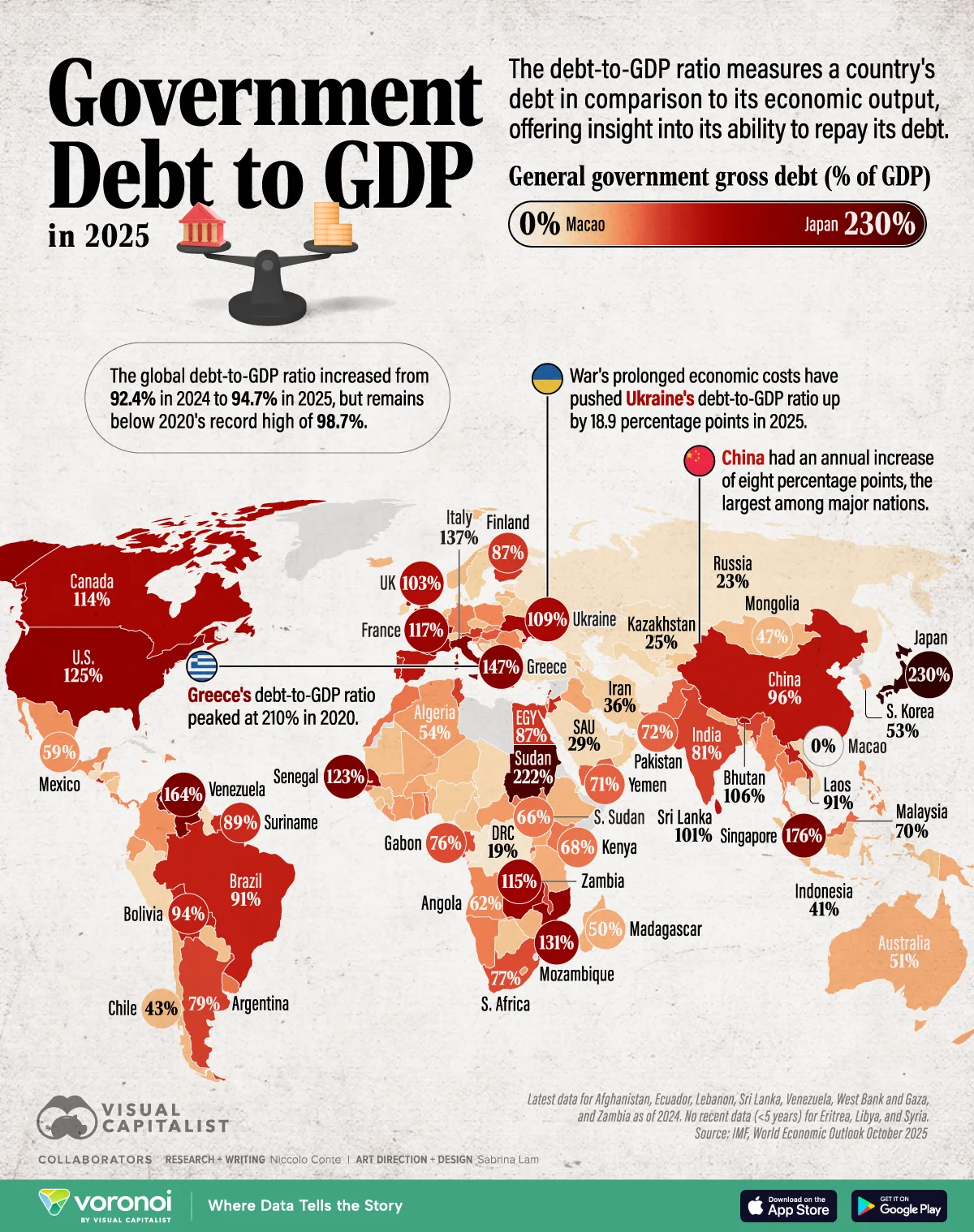
Global map of government debt in 2025 by country

Key Takeaways

  • The global debt-to-GDP ratio rose 2.3 percentage points to 94.7% in 2025, but is still below the pandemic-era peak of 98.7% in 2020.
  • Japan remains the world’s most indebted nation at 230% of GDP, followed by Sudan (222%) and Singapore (176%).

Global debt levels continue to rise, with 2025 marking another year of fiscal strain across both advanced and developing economies.

Tiếp tục đọc “Government Debt to GDP by Country in 2025”

Global Risks Report 2025: Conflict, Environment and Disinformation Top Threats

Reliefweb.int

Full report https://www.weforum.org/publications/global-risks-report-2025/

World Economic Forum, public.affairs@weforum.org

  • State-based armed conflict emerges as the top immediate risk for 2025, identified by nearly a quarter of respondents, reflecting heightened geopolitical tensions and fragmentation globally.
  • Misinformation and disinformation lead the short-term risks and may fuel instability and undermine trust in governance, complicating the urgent need for cooperation to address shared crises.
  • Environmental risks dominate the 10-year horizon, led by extreme weather events, biodiversity loss and ecosystem collapse.
  • Read the Global Risks Report 2025 here and join the conversation using #Risks25. Follow the Annual Meeting here and on social media using #WEF25

Geneva, Switzerland, 15 January 2025 – The 20th edition of the World Economic Forum’s Global Risks Report, released today, reveals an increasingly fractured global landscape, where escalating geopolitical, environmental, societal and technological challenges threaten stability and progress. While economic risks have less immediate prominence in this year’s survey results, they remain a concern, interconnected with societal and geopolitical tensions.

State-based armed conflict is identified as the most pressing immediate global risk for 2025, with nearly one-quarter of respondents ranking it as the most severe concern for the year ahead.

Misinformation and disinformation remain top short-term risks for the second consecutive year, underlining their persistent threat to societal cohesion and governance by eroding trust and exacerbating divisions within and between nations. Other leading short-term risks include extreme weather events, societal polarization, cyber-espionage and warfare.

Environmental risks dominate the longer-term outlook, with extreme weather events, biodiversity loss and ecosystem collapse, critical change to Earth systems and natural resources shortages leading the 10-year risk rankings. The fifth environmental risk in the top 10 is pollution, which is also perceived as a leading risk in the short term. Its sixth-place ranking in the short term reflects a growing recognition of the serious health and ecosystem impacts of a wide range of pollutants across air, water and land. Overall, extreme weather events were identified prominently as immediate, short-term and long-term risks.

The long-term landscape is also clouded by technological risks related to misinformation, disinformation and adverse outcomes of AI technologies.

“Rising geopolitical tensions and a fracturing of trust are driving the global risk landscape” said Mirek Dušek, Managing Director, World Economic Forum. “In this complex and dynamic context, leaders have a choice: to find ways to foster collaboration and resilience, or face compounding vulnerabilities.”

Fractured systems, fragile futures

The report, which draws on the views of over 900 global risks experts, policy-makers and industry leaders surveyed in September and October 2024, paints a stark picture of the decade ahead. Respondents are far less optimistic about the outlook for the world over the longer term than the short term. Nearly two-thirds of respondents anticipate a turbulent or stormy global landscape by 2035, driven in particular by intensifying environmental, technological and societal challenges.

Over half of respondents expect some instability within two years, reflecting the widespread fracturing of international cooperation. Long-term projections signal even greater challenges as mechanisms for collaboration are expected to face mounting pressure. Societal risks such as inequality and societal polarization feature prominently in both short- and long-term risk rankings. Rising concerns about illicit economic activity, mounting debt burdens and the concentration of strategic resources highlight vulnerabilities that could destabilize the global economy in the coming years. All these issues risk exacerbating domestic instability and eroding trust in governance, further complicating efforts to address global challenges.

All 33 risks in the ranking increase in severity score over the longer term, reflecting respondents’ concerns about the heightened frequency or intensity of these risks as the next decade unfolds.

“From conflicts to climate change, we are facing interconnected crises that demand coordinated, collective action,” says Mark Elsner, Head of the Global Risks Initiative, World Economic Forum. “Renewed efforts to rebuild trust and foster cooperation are urgently needed. The consequences of inaction could be felt for generations to come.”

A decisive decade: Collaboration as the key to stability

As divisions deepen and fragmentation reshapes geopolitical and economic landscapes, the need for effective global cooperation has never been more urgent. Yet, with 64% of experts anticipating a fragmented global order marked by competition among middle and great powers, multilateralism faces significant strain.

However, turning inward is not a viable solution. The decade ahead presents a pivotal moment for leaders to navigate complex, interconnected risks and address the limitations of existing governance structures. To prevent a downward spiral of instability – and instead rebuild trust, enhance resilience, and secure a sustainable and inclusive future for all – nations should prioritize dialogue, strengthen international ties and foster conditions for renewed collaboration.

Links to other visuals and graphics

– Current Risk Landscape – 2025

– Global risks ranked by severity- 2 years

– Global Risks ranked by severity – 10 years

– Short and long-term global outlook

– Global risks landscape an interconnections map

About the Global Risks Report
The Global Risks Report is the World Economic Forum’s flagship publication on global risks, now in its 20th edition. Produced by the Global Risks Initiative at the Forum’s Centre for the New Economy and Society, the report leverages insights from the Global Risks Perception Survey, which draws on the views of over 900 global leaders across business, government, academia and civil society. The report identifies and analyses the most pressing risks across immediate, short- and long-term horizons, aiming to equip leaders with foresight to address emerging challenges. It serves as a key resource for understanding the evolving global risk landscape and fostering collective action to build a more resilient future.

For more information, visit the Global Risks Initiative and read the full report here.

Trump’s tariffs are a $1.4 trillion gamble with the economy and prices

Analysis by Matt Egan, CNN

 5 minute read 

Updated 9:02 AM EST, Sun February 2, 2025

New York CNN — 

President Donald Trump is on the verge of hitting America’s three biggest trading partners with sweeping tariffs, a far more aggressive use of his favorite economic weapon than anything he did during his first term.

The looming import taxes on Mexico, Canada and China will be a major test of Trump’s unorthodox use of tariffs, which he’s described as “the greatest thing ever invented.”

It’s an enormous gamble, arguably a bigger one than any economic policy Trump enacted during his four-plus years in the White House. And this strategy has the potential to upend the thing many voters care about the most: the economy and the cost of living.

But Trump’s tariffs pose a big risk: They could backfire, lifting already-high consumer prices at the grocery store, rocking the shaky stock market or killing jobs in a full-blown trade war.

Tiếp tục đọc “Trump’s tariffs are a $1.4 trillion gamble with the economy and prices”

The Anti-Globalization Backlash

Anti-globalism sentiment is on the rise.

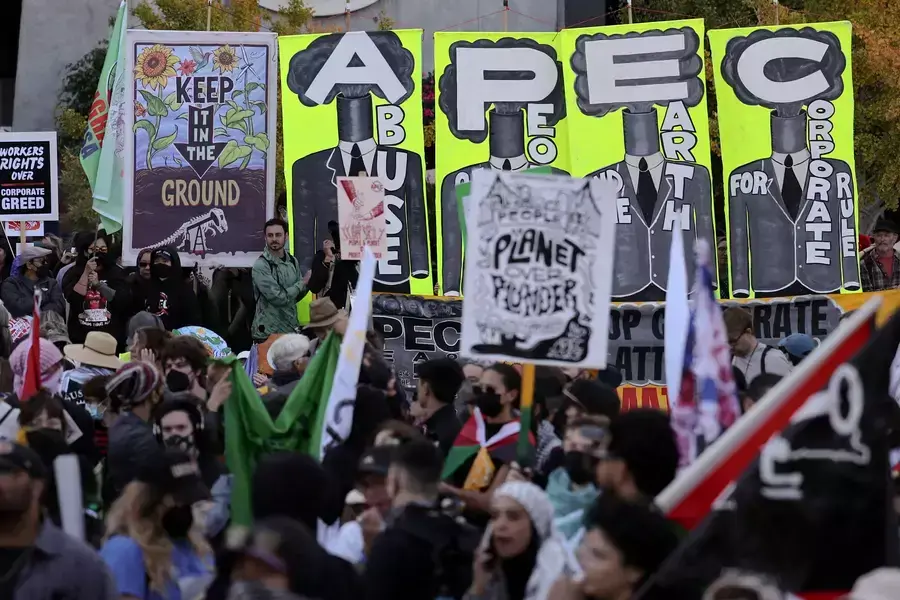
Demonstrators protest the Asia-Pacific Economic Cooperation Summit in San Francisco on November 12, 2023.
Demonstrators protest the Asia-Pacific Economic Cooperation Summit in San Francisco on November 12, 2023. Carlos Barria/REUTERS

Blog Post by Michelle Kurilla

November 30, 2023 3:17 pm (EST) CFR

The latest episode of The President’s Inbox is live! Last week, Jim sat down with Peter Trubowitz, a professor of international relations and director of the Phelan U.S. Center at the London School of Economics. They discussed the rise of anti-globalization in the West and what it means for world order.The President’s Inbox

The Anti-Globalization Backlash, With Peter Trubowitz

Peter Trubowitz, a professor of international relations and director of the Phelan U.S. Center at the London School of Economics and an associate fellow at Chatham House, sits down with James M. Lindsay to discuss the reasons for the rise of anti-globalism in Western countries and its consequences for world order.

November 20, 2023 — 33:25 min

Here are three highlights from their conversation:

1.) The liberal international order—which took form in the early 1950s—is inherently linked to domestic politics. Peter noted that it “rested on assumptions and domestic institutional arrangements that helped ensure support for policies like free trade and institutionalized cooperation in the form of things like NATO or the IMF and the World Bank in Western democracies.” In short, domestic policies provided social and economic protections for workers, which in turn shored up political support for multilateralism.

Tiếp tục đọc “The Anti-Globalization Backlash”

Russia’s Ukraine invasion could be a global economic ‘game changer’

Soaring gas prices and rapidly shifting trade decisions suggest events of the past two weeks will be felt everywhere for years

Listen to article – 9 min

Washingtonpost – By David J. Lynch – March 5, 2022 at 7:00 a.m. EST

People stand in line to withdraw U.S. dollars and euros from an ATM in St. Petersburg on Feb. 25. (Dmitri Lovetsky/AP)

Russia’s invasion of Ukraine and the financial reckoningimposed on Moscow in response are proof that the triumphant globalization campaignthat began more than 30 years ago has reached a dead end.

Tiếp tục đọc “Russia’s Ukraine invasion could be a global economic ‘game changer’”

China is still the ultimate prize that Western banks can’t resist

edition.cnn.com

Analysis by Laura HeCNN Business

Updated 1041 GMT (1841 HKT) January 14, 2022

Jamie Dimon on China joke: 'I regret and should not have made that comment'

A version of this story appeared in CNN’s Meanwhile in China newsletter, a three-times-a-week update exploring what you need to know about the country’s rise and how it impacts the world. Sign up here.

Hong Kong (CNN Business)For many companies, doing business in China is getting trickier by the day. But Western banks and asset managers are more than willing to up their bets on the world’s second biggest economy, convinced that the opportunities remain too good to pass up.Major banks in recent weeks have inked deals to expand their footprint in China — or are otherwise attempting to take greater control of their businesses there — after years of being forced to enter the market via joint ventures. That’s despite fraught geopolitics, a slowing economy and an increasingly hostile environment for private business.Late last month, HSBC (HBCYF) received approval from Chinese regulators to take full control of its life insurance joint venture, which was created in 2009 in equal partnership with a Chinese company under rules that were rolled back in 2020. The bank said the move underscored its “commitment to expanding business in China.”

Tiếp tục đọc “China is still the ultimate prize that Western banks can’t resist”

Nền kinh tế thế giới và thái độ “xóa bài làm lại”

XÊ NHO 23/11/2021 14:10 GMT+7

TTCTĐôi lúc chúng ta phải tự hỏi liệu thế giới này có tự điều chỉnh được không, để xóa đi các sai lầm từng mắc phải? Câu trả lời của người lạc quan là có, dù cơ chế “xóa bài làm lại” này chưa hiện rõ.

 Minh họa

Nguyên nhân thực của đứt gãy chuỗi cung ứng

Lấy ví dụ chuyện nhiều nước đang thiếu hàng hóa đủ loại, nếu chỉ đọc các lập luận giải thích trấn an đăng trên các báo thì chúng ta sẽ thấy chúng rất hợp lý nhưng không đủ. Tình hình đứt gãy chuỗi cung ứng dẫn đến thiếu hụt hàng hóa quả thực là đang trầm trọng ở nhiều nước.

Tiếp tục đọc “Nền kinh tế thế giới và thái độ “xóa bài làm lại””

“Giải pháp lắm chân” cho cái đói

CHỦNG HẠNH 14/10/2021 9:05 GMT+7

TTCTBánh mì kẹp sâu cho bữa sáng, sữa gián và sữa ruồi đen luôn sẵn có ở căngtin, và món cháo dế sẽ sưởi ấm những đêm mưa rét. Đây là những loại thực phẩm thân thiện với môi trường, hứa hẹn sẽ cách tân chế độ ăn uống “xấu xí” của loài người trong tương lai.

 Ảnh: Shutterstock

Tiếp tục đọc ““Giải pháp lắm chân” cho cái đói”

A tale of 2020 in 20 McKinsey charts

Mckinsey.cim

See the story of this unique year through data visualizations from our Charting the Path to the Next Normal series.
This year, we launched a new series to highlight our best charts and data visualizations—the ones that deserved lives of their own outside the articles they were originally created for. Every weekday, we post a selection from one of our highly skilled data-visualization editors to our collection page, Charting the Path to the Next Normal. As we look back at the year that was, these daily charts tell a story about our changing world, from the early days of lockdowns and a tumultuous summer to ending the year on a hopeful note. While uncertainty remains, and each chart in isolation offers but one lens on the landscape, the themes emerging from the collection as a whole provide unique insight into the many disruptions 2020 visited on us.

Trade, deglobalization and the new mercantilism

Author Photo

Razeen Sally

SHARE

Deglobalization And New Mercantilism Hinrich Foundation

hinrichfoundation Published 24 September 2020 | 10 minute read

The COVID-19 pandemic is accelerating shifts underway since the last global financial crisis (GFC). It ushers in a new era of deglobalisation and protectionism, indeed a new mercantilist world order.

Three global shifts will shape international trade. They will probably last beyond the immediate crisis to the “post-vaccine” future. The first is an accelerated shift from Market to State: more government interventions will further restrict markets. The second is to national unilateralism – governments acting on their own, often against each other – at the expense of global cooperation. The third is to more contested and unstable geopolitics, centred on US-China rivalry. Taken together, they herald a new mercantilism, whose main precedents are Europe and its colonial expansion in the seventeenth and eighteenth centuries, and the period between the two world wars in the first half of the twentieth century.

Tiếp tục đọc “Trade, deglobalization and the new mercantilism”

Europe has kept down pandemic unemployment — and the U.S. hasn’t. Here’s why.

A closed sign is posted in the window of a store because of the coronavirus, in an outdoor mall, in Dedham, Mass. (AP Photo/Steven Senne)
A closed sign is posted in the window of a store because of the coronavirus, in an outdoor mall, in Dedham, Mass. (Steven Senne)
April 24, 2020 at 6:00 p.m. GMT+7

For the first time, the U.S. government is subsidizing companies to hold on to their workers. However, the Paycheck Protection Program (PPP) that Congress passed to fight unemployment in the coronavirus economic crisis is having trouble delivering benefits. Its first round of funds was quickly exhausted.

Tiếp tục đọc “Europe has kept down pandemic unemployment — and the U.S. hasn’t. Here’s why.”

Forecasting the world in 2020

FT.com

Brexit was not stopped, populists made smaller gains than expected in May’s European parliament elections, and the S&P 500 beat our — and most other people’s — expectations. Along with Brazilian growth falling below the year before, the FT’s forecasting team got those predictions wrong for 2019, though Philip Stephens last year admitted he offered his forecast that Brexit would be reversed “as much in hope as expectation”.

Though the world may seem ever more unpredictable, four wrong answers was an improvement on our dismal eight the year before. And aside from Brexit, readers in our annual competition generally made the same mistakes we did — more than 70 per cent of you got the same three questions wrong. For a third straight year, though, the top-scoring readers beat the FT. Three tied on 19 correct answers out of 20. Tiếp tục đọc “Forecasting the world in 2020”