FILE PHOTO: Flags of Taiwan and US are placed for a meeting In Taipei, Taiwan on Mar 27, 2018. (File photo: REUTERS/Tyrone Siu)
23 Nov 2020 08:56AM(Updated: 23 Nov 2020 09:52AM) CNA
Bookmark
TAIPEI: A two-star Navy admiral overseeing US military intelligence in the Asia-Pacific region has made an unannounced visit to Taiwan, two sources told Reuters on Sunday (Nov 22), in a high-level trip that could vex China.
Hong Kong (CNN) China was one of two countries, along with Russia, named in a 2018 Pentagon report as posing the most significant military challenge to the United States. Two years on and that challenge has only grown.Beijing’s program of rapid modernization has seen its military transformed into a true global power, capable of comfortably projecting its forces throughout the Indo-Pacific region and beyond.This year alone has seen China engage in deadly border clashes with Indian troops; China’s People’s Liberation Army aircraft have repeatedly buzzed Taiwanese and Japanese air defenses; and Chinese ships have been involved in multiple incidents in the disputed waters of the South China Sea.<img alt=”The USS Nimitz and USS Ronald Reagan Carrier Strike Groups conduct dual carrier operations in the Indo-Pacific earlier this year.” -=””>
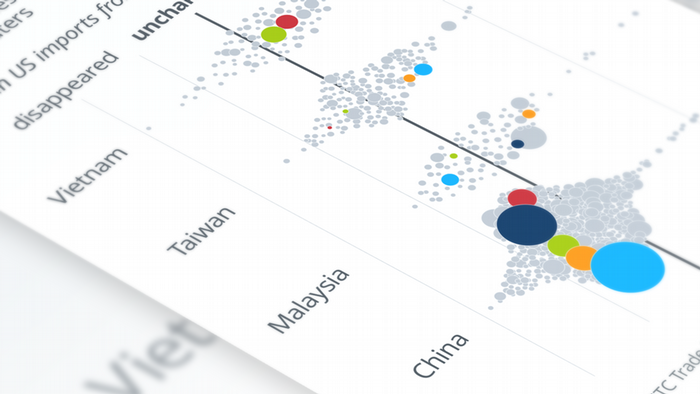
With tariffs on Chinese products high, US importers are turning to other countries. A DW analysis shows where Americans are now buying their cell phones, computers, furniture and clothing from instead.
Dung Trans’ business is booming: “Last year, we added a second floor to our factory. And now I’m looking at a new site four times larger than the current one.” For his company, the ongoing trade dispute between China and the United States has been a boon. And he is not alone.
(CNN)The Unites States has charged eight people, including six Chinese citizens, over a three-year plot to intimidate a US resident into returning to China to face criminal charges.The case is believed to be part of the ruling Communist Party’s Operation Fox Hunt, an international anti-corruption campaign targeting Chinese fugitives — often former officials or rich individuals suspected of economic crimes.The US Department of Justice said Wednesday the charges included “conspiring to act in the US as illegal agents of the People’s Republic of China.” Five people have been arrested, while three are believed to be at large in China.In 2016, the group — which includes an American-licensed private investigator — is alleged to have embarked on an illegal campaign targeting a former Chinese government official, who has lived in the US since 2010. They are accused of recording and harassing his daughter, taping a threatening note to his front door and flying his elderly father from China — allegedly against his will — in 2017 to pressure his son to return to China.The note on the target’s New Jersey home said in Chinese: “If you are willing to go back to the mainland and spend 10 years in prison, your wife and children will be all right. That’s the end of this matter!”Speaking at a press conference Wednesday, US Assistant Attorney General John C. Demers said the arrests sent a message that the US “will not tolerate this type of flagrant conduct on our shores.”close dialog
Get daily analysis on the historic 2020 US election delivered to your inbox.Sign Me UpNo ThanksBy subscribing you agree to ourprivacy policy.“Without coordination with our government, China’s repatriation squads enter the United States, surveil and locate the alleged fugitives, and deploy intimidation and other tactics to force them back into China where they would face certain imprisonment or worse following illegitimate trials,” he said.Speaking at a press conference Thursday, Chinese Foreign Ministry spokesman Wang Wenbin said that Chinese law enforcement agencies “conduct foreign cooperation in strict accordance with international law, fully respect foreign laws and judicial sovereignty.””The United States ignores the basic facts and uses ulterior motives to smear China’s work in pursuit of escaped and stolen goods. China firmly opposes this. We urge the US to immediately correct its mistakes,” he said.
Operation Fox Hunt
The Chinese government launched Operation Fox Hunt in 2014 to target wealthy citizens who were accused of corruption and had fled the country with large amounts of money.Beijing authorities said at least 150 corrupt officials had fled to the US, and provided American counterparts with a list of “priority cases.”Demers said such operations — regardless of whether the targets were guilty or not — were “a clear violation of the rule of law and international norms.””Rather than work with US authorities for assistance with recognized criminal cases as responsible nations do, China resorts to extralegal means and unauthorized, often covert, law enforcement activity,” he said.FBI Director Christopher Wray said at a news conference Wednesday that in a different Operation Fox Hunt case, the Chinese government had sent an “emissary” to the target’s US-based family warning that the person should “return to China promptly or commit suicide.”Wray said that when Operation Fox Hunt targets refuse to return to China, family members in their home country “have even been arrested for leverage.””These are not the actions we would expect from a responsible nation state. Instead they’re more like something we would expect from an organized criminal syndicate,” Wray said.
China says decision was ‘necessary’ after the US declared several more Chinese media outlets to be ‘foreign missions’
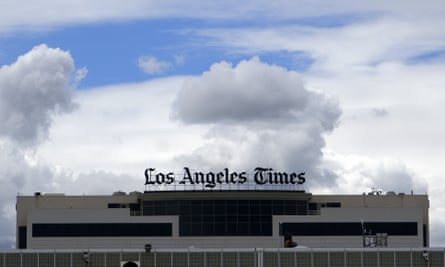
The US media firms affected are the American Broadcasting Corporation (ABC), the Los Angeles Times, Newsweek, Feature Story News, the Bureau of National Affairs and Minnesota Public Radio Photograph: Richard Vogel/APStaff and agencies
Mon 26 Oct 2020 16.42 GMT
China has tightened the rules on a number of US media outlets, in a move it said was “necessary and reciprocal” after Chinese journalists in America were hit with restrictions last week.
The US media firms affected are the American Broadcasting Corporation (ABC), the Los Angeles Times, Newsweek, Feature Story News, the Bureau of National Affairs and Minnesota Public Radio.
A foreign ministry spokesman, Zhao Lijian, said in a statement that the requirements were “legitimate and justified self-defense in every sense”.
“What the United States has done is exclusively targeting Chinese media organizations driven by the cold war mentality and ideological basis,” Zhao added.
The moves are the latest in a series of tit-for-tat measures between Beijing and Washington.
Last week the US designated a further six Chinese media organisations as propaganda outlets that answer to the state.
The department earlier imposed rules on nine outlets including the official Xinhua news agency and China Global Television Network.
China has denounced the regulations and retaliated by expelling US citizens who work for major news organisations, including the New York Times, the Washington Post and the Wall Street Journal.
In May the US shortened the visa for Chinese journalists in America to 90 days, and last month the Foreign Correspondents’ Club of China said Beijing was no longer renewing press credentials for US media employees in the country.
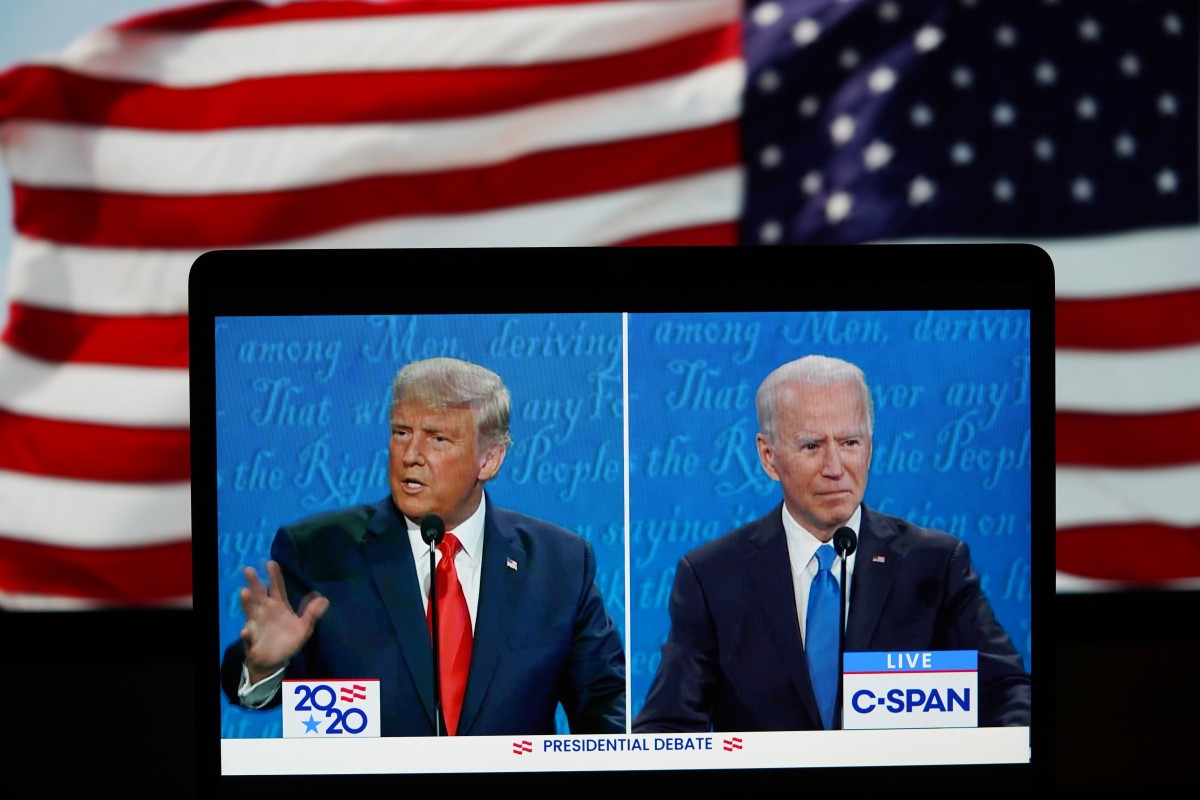
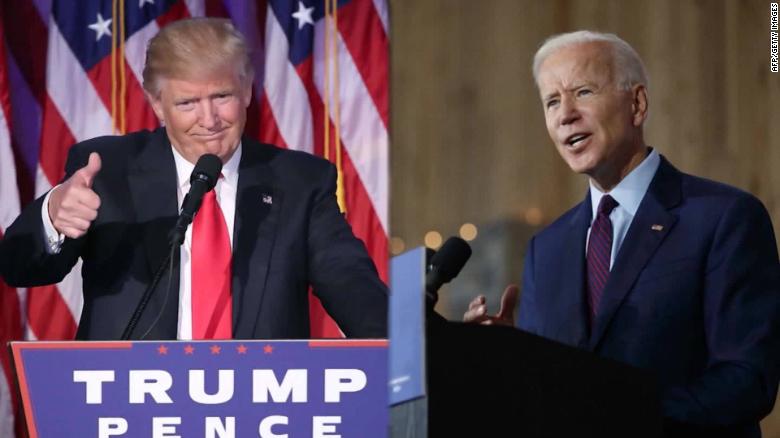
Both Donald Trump and Joe Biden have promised to take a tough stance on China. Photo: Xinhua
As the US presidential candidates sparred over how to counter China, the country’s leader Xi Jinping was making clear that a newly emboldened country would not back down from a fight.
In a speech marking the 70th anniversary of China’s entry into the Korean war – the only military conflict between Chinese and American forces – Xi outlined in no uncertain terms that the “century of humiliation” Beijing said it suffered at the hands of Western aggressors was long gone.
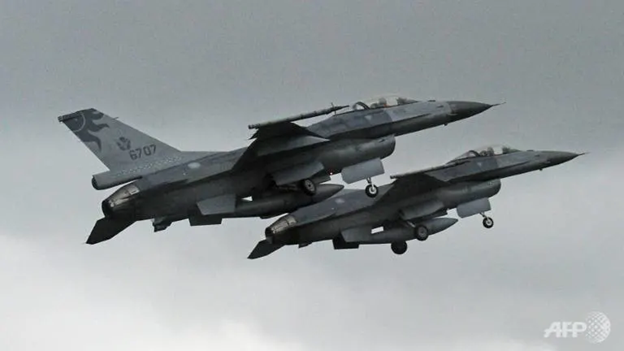
File photo of two US-made Taiwanese F-16 fighter jets. (Photo: AFP/Sam Yeh)
22 Oct 2020 05:44PM
BEIJING: China threatened on Thursday (Oct 22) to retaliate against the latest US arms sale to Taiwan, as the island welcomed the weapons package but said it was not looking to get into an arms race with Beijing.
The Trump administration has ramped up support for Taiwan through arms sales and visits by senior US officials, adding to tensions between Beijing and Washington, already heightened by disagreements over the South China Sea, Hong Kong, human rights and trade.
(CNN Business) The United States government has labeled six more Chinese media companies operating in the US as foreign missions in the latest round of tit-for-tat between Beijing and Washington over restrictions on journalists.US Secretary of State Mike Pompeo announced the decision at a press briefing on Wednesday, saying that the six media companies were “substantially or effectively controlled by a foreign government.””We’re not placing any restrictions on what these outlets can publish in the United States,” Pompeo said. “We simply want to ensure that American people, consumers of information, can differentiate between news written by a free press and propaganda distributed by the Chinese Communist Party itself. They’re not the same thing.”The US operations of Yicai Global, Jiefang Daily, Xinmin Evening News, Social Sciences in China Press, Beijing Review and Economic Daily will all be affected by the decision, according to a release from State Department spokesperson Morgan Ortagus.
Alan Crawford, DebWu, Colum Murphy and Ian KingFri, October 23, 2020, 12:42 AM GMT+7·11 mins read. Yahoo!Finance
The U.S.-China Conflict Over Chips Is About to Get Uglier
(Bloomberg) — On a scorching hot day in late August, representatives of Taiwan’s government and industry crowded into the clinical cool of a state-of-the-art semiconductor facility for a symbolic moment in the global tech conflict.
Get daily analysis on the historic 2020 US election delivered to your inbox.Sign Me UpNo ThanksBy subscribing you agree to ourprivacy policy.In a lengthy front-page commentary in the People’s Liberation Army Daily, the official newspaper of China’s military, the author hailed the “glorious victory” which “left the Americans with the deepest impression that what Chinese people say counts,” and to respect “China’s red lines.”
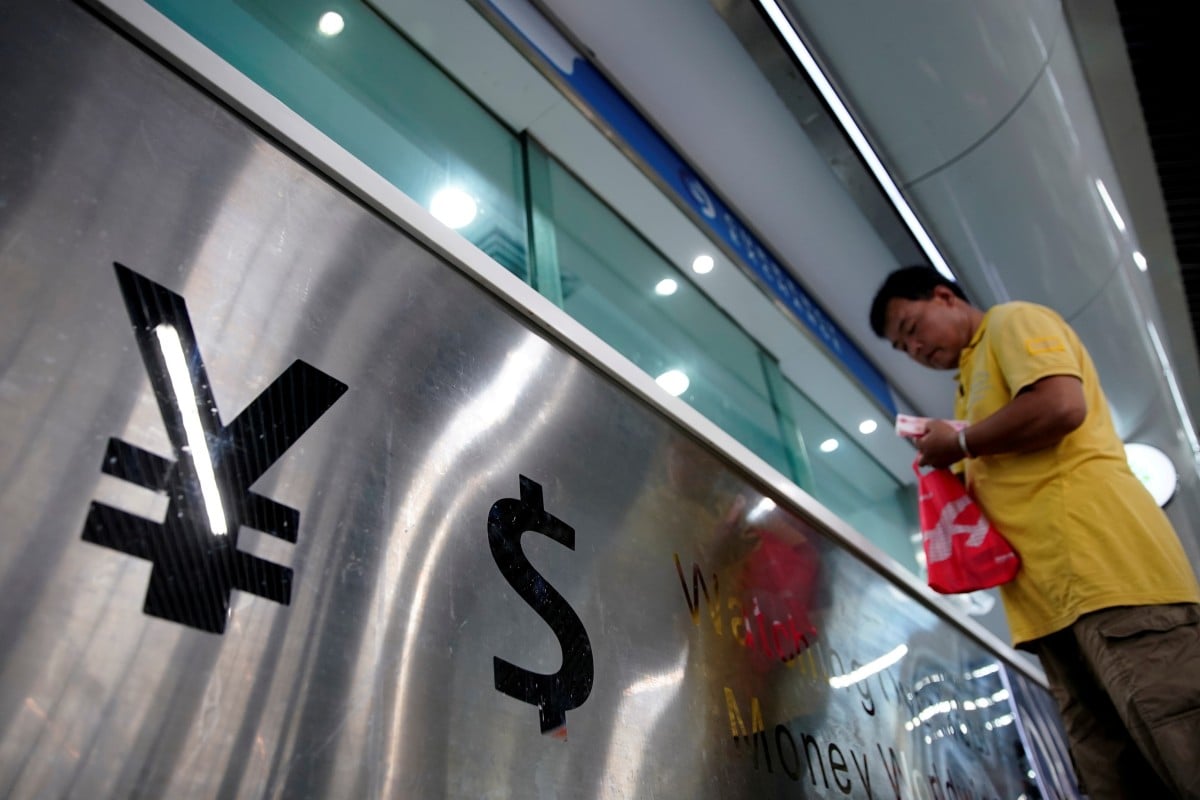
US-China frictions and the threat of American financial sanctions have renewed debate in Beijing about reducing dependence on the US dollarChina cut its holdings of US government debt to US$1.07 trillion in late August, the lowest level since March 2017, the US Department of Treasury says
China has long tried to undermine the US dollar’s dominant role in the international monetary system, despite the fact that the bulk of its reserves are in dollar-denominated assets. Photo: Reuters
China may be speeding up the diversification of its foreign exchange reserves away from US dollar assets in response to potential American financial sanctions, but there are clear limits on how far it can go in its de-dollarisation push, according to analysts.China has long tried to undermine the US dollar’s dominant role in the international monetary system, despite the fact that the bulk of its reserves are in dollar-denominated assets.
Lobsang Sangay, the president of the Tibetan Central Administration (CTA), met the new US special coordinator on Tibet last week. Sangay said it was the first time that the head of the CTA had been received at the State Department.Advertisement
“China will take all necessary measures to protect its interests,” foreign ministry spokesman Zhao Lijian said during a daily news conference in Beijing on Tuesday (Oct 20).
China’s irritation with the United States over Tibet comes at a time when relations between the two world powers are at their lowest point in decades over a range of issues, including trade, Taiwan, human rights, the South China Sea and COVID-19.
Describing Sangay as an anti-China separatist, Zhao said the United States should cease any official contact with him.
The meeting “sent a seriously wrong signal to Tibetan independence forces”, he said.Advertisement
“The US should immediately stop using the Tibet issue to interfere in China’s internal affairs.”
China seized control over Tibet in 1950 in what it describes as a “peaceful liberation”. International human rights groups and exiles routinely condemn what they call China’s oppressive rule in Tibetan areas.
Since its formation in 1959, the Tibetan government-in-exile has been based in Dharamshala in northern India. China’s relations with India became fraught in recent months following a bloody clash between troops stationed on the disputed Himalayan border. Source: Reuters/jt
‘There is only one China in the world, and Taiwan is an inalienable part of Chinese territory,’ says Chinese foreign ministry spokesman Zhao Lijian
The comments come against the backdrop of tensions between India and China along their common border in Ladakh
NEW DELHI: China on Tuesday warned India against launching any talks with Taiwan on trade saying such a move would be violative of the one China policy New Delhi has so far supported.
Hong Kong (CNN)Chinese President Xi Jinping has called on troops to “put all (their) minds and energy on preparing for war” in a visit to a military base in the southern province of Guangdong on Tuesday, according to state news agency Xinhua.
During an inspection of the People’s Liberation Army Marine Corps in Chaozhou City, Xinhua said Xi told the soldiers to “maintain a state of high alert” and called on them to be “absolutely loyal, absolutely pure, and absolutely reliable.”
Taiwan is one of those flash points that has never flashed. The dispute over the island’s fate has had the potential to erupt into conflict between China and the United States for decades. But the feared Chinese invasion has never come. The situation has remained deadlocked for so long that Taiwan’s quandary often drifts into the background of Asian affairs, overshadowed by seemingly more-pressing concerns, such as North Korea’s nuclear ambitions and inflamed tensions between India and Pakistan in Kashmir.












 CVD
CVD 