Beijing hit back with tariffs ranging from 5% to 25% on US goods.
What’s next?
Under the so-called “phase one” deal signed in January, China pledged to boost US imports by $200bn above 2017 levels and strengthen intellectual property rules.
The US agreed to halve some of the new tariffs it had imposed on China.
The White House said it will tackle additional issues in a second, “phase two” deal but analysts said they didn’t expect anything concrete anytime soon
TĐH: See notes verbales by Malaysia, UK & Northern Ireland, France, Germany, and China to United Nations Commission on the Limits of the Continental Shelfhere >>
20/09/2020 17:30 GMT+7 vietnamnet
France, the United Kingdom and Germany has submitted a joint note verbale expressing their views against the seven notes the Chinese mission had proposed for circulation at the United Nations.
VietNamNet introduces an article by Ambassador Nguyen Hong Thao on this issue:
This joint note verbale shows the view against the seven diplomatic notes China proposed for circulation at the United Nations relating to Malaysia’s submission on continental expansion submitted to the UN Commission on the Limits of the Continental Shelf (CLCS).
This was the first time that these three powerful countries had submitted a joint note verbale related to the East Sea and the 1982 UN Convention on the Law of the Sea (UNCLOS) to the UN Secretary-General.
The consistency of the three major European countries
The joint note verbale expresses the consistency of the three countries with the biggest economic and legal political influence in Europe in rejecting China’s unilateral interpretation of a series of related issues, which cause instability, and affect peace and legal order in the East Sea.
Tiếp tục đọc “Joint Note Verbale of France, UK, Germany and the legal war in the East Sea”→
WASHINGTON: Secretary of Defense Mark Esper announced on Wednesday (Sep 16) an ambitious plan to expand the US Navy with a range of unmanned and autonomous ships, submarines and aircraft to confront the growing maritime challenge from China.
File photo of a H-6 bomber of the Chinese People’s Liberation Army Air Force flying near a Taiwan F-16 in this Feb 10, 2020 handout photo. (Photo: Reuters)
The measure is unlikely to have much of an immediate effect because of the city’s coronavirus restrictions, but it could worsen fraying U.S.-China ties.
Police officers confronting protesters in Hong Kong this month. Dozens of people in the city have been arrested under a new security law.Credit…Lam Yik Fei for The New York Times
The State Department advisory warned that the security law, which came into force in June, could subject Americans who have been publicly critical of China “to a heightened risk of arrest, detention, expulsion, or prosecution.”
The security law targets what it deems acts of secession, subversion, terrorism and collusion with foreign elements, but critics say the broad wording also gives the authorities wide-ranging powers to target voices of dissent. Dozens of people in Hong Kong have already been arrested under the law, including Jimmy Lai, a prominent pro-democracy media tycoon.
The State Department has previously warned about the risk of arbitrary detention in mainland China and about the use of exit bans that cannot be readily challenged in court to keep Americans in the country.
Hong Kong, a semiautonomous territory of China, has its own legal system that is more independent and transparent than the Communist Party-controlled courts in the mainland. But the U.S. travel advisory suggests the risk of arbitrary enforcement is increasing in Hong Kong as well.
Americans traveling in mainland China or Hong Kong “may be detained without access to U.S. consular services or information about their alleged crime,” the advisory said. “U.S. citizens may be subjected to prolonged interrogations and extended detention without due process of law.”
Wang Wenbin, a spokesman for the Chinese Ministry of Foreign Affairs, criticized the new travel warning on Tuesday, saying China was one of the safest places on earth and the mainland had recorded no local transmission of the coronavirus for a month.
Last year, the State Department warned of the risk of “confrontational” demonstrations in Hong Kong, as mass pro-democracy rallies evolved into an increasingly violent push against Chinese rule. Several other countries issued similar warnings.
The United States has penalized Hong Kong and Chinese officials, and Beijing has responded with similar measures against American lawmakers and heads of nongovernmental organizations.
The warning on Hong Kong came as the United States improved its assessment of the coronavirus risk in China, where the spread of the virus is largely controlled, by changing its advisory level to “reconsider travel” from “do not travel.”
Austin Ramzy is a Hong Kong reporter, focusing on coverage of the city and also of regional and breaking news. He previously covered major events around Asia from Taipei and Beijing. @austinramzy
Donald Trump is making rivalry with China a key platform in his re-election campaign as relations between the two countries continue to deteriorate. Photo composite: AFP
China is introducing countermeasures ‘to urge the US to repeal its wrong decisions’.
The unspecified countermeasures will apply to all US embassy and consulate staff and the consulate-general in Hong Kong, a ministry statement said [Carlos Garcia Rawlins/Reuters]
Beijing will impose “reciprocal restrictions” on all American diplomats in China in response to earlier curbs on the activities of its embassy staff in the United States, China’s Ministry of Foreign Affairs has said.
By David Lawder Reuters Posted September 9, 2020 12:55 am Updated September 9, 2020 12:56 am
U.S. impose sanctions on senior Chinese official over alleged Uighur rights abuse
U.S. Customs and Border Protection officials have prepared orders to block imports of cotton and tomato products from western China’sXinjiang region over allegations they are produced with forced labor, although a formal announcement has been delayed.
The Trump administration announcement of the actions, initially expected on Tuesday, has been put off until later this week because of “scheduling issues,” a CBP spokesman said.
The cotton and tomato bans along with five other import bans over alleged Xinjiang forced-labor abuses would be an unprecedented move by CBP and likely stoke tensions between the world’s two largest economies.
The “Withhold Release Orders” allow the CBP to detain shipments based on suspicion of forced-labor involvement under long-standing U.S. laws aimed at combating human trafficking, child labor and other human rights abuses.STORY CONTINUES BELOW ADVERTISEMENT
President Donald Trump’s administration is ratcheting up pressure on China over its treatment of Xinjiang’s Uighur Muslims. The United Nations has said it has credible reports that 1 million Muslims have been detained in camps in the region, where they are put to work.1:46China warns U.S. over Uighur bill, raising doubts over early trade dealChina warns U.S. over Uighur bill, raising doubts over early trade deal
China denies mistreatment of the Uighurs and says the camps are vocational training centers needed to fight extremism.
CBP Executive Assistant Commissioner Brenda Smith told Reuters that the effective import bans would apply to the entire supply chains involving cotton, including cotton yarn, textiles and apparel, as well as tomatoes, tomato paste and other products exported from the region.
“We have reasonable but not conclusive evidence that there is a risk of forced labor in supply chains related to cotton textiles and tomatoes coming out of Xinjiang,” Smith said in an interview. “We will continue to work our investigations to fill in those gaps.”STORY CONTINUES BELOW ADVERTISEMENT
U.S. law requires the agency to detain shipments when there is an allegation of forced labor, such as from non-governmental organizations, she said.
The bans could have far-reaching effects for U.S. retailers and apparel producers, as well as food manufacturers. China produces about 20% of the world’s cotton and most of it comes from Xinjiang. China also is the world’s largest importer of cotton, including from the United States.
The China Cotton Association, a trade body, declined to comment on Wednesday.
A Beijing-based cotton trader said the impact may be limited as China brings in about 2 million tonnes of cotton and 2 million tonnes of cotton yarn from abroad each year, which may be sufficient to produce textiles for the United States. Xinjiang’s output is about 5 million tonnes.
“If Xinjiang cotton goes to the domestic industry and non-Western markets, the impact may be limited, it can probably still be digested,” he said.
In the short-term, it could also boost cotton imports into China, he added.STORY CONTINUES BELOW ADVERTISEMENThttps://df7719edd330f16da50a98d8c70a9d62.safeframe.googlesyndication.com/safeframe/1-0-37/html/container.html0:40Teen’s TikTok tutorial turns into a plea for Uighurs in ChinaTeen’s TikTok tutorial turns into a plea for Uighurs in China
‘Abusive working and living conditions’
In March, U.S. lawmakers proposed legislation that would effectively assume that all goods produced in Xinjiang are made with forced labor and would require certification that they are not.
In July, Washington issued an advisory saying companies doing business in Xinjiang or with entities using Xinjiang labor could be exposed to “reputational, economic, and legal risks.”
The State Department also said it sent a letter to top American companies including Walmart Inc, Apple Inc and Amazon.com Inc warning them over risks faced from maintaining supply chains associated with human rights abuses in Xinjiang region.
In a draft announcement seen by Reuters, the CBP said it identified forced-labor indicators involving the cotton, textile and tomato supply chains “including debt bondage, unfree movement, isolation, intimidation and threats, withholding of wages, and abusive working and living conditions.”STORY CONTINUES BELOW ADVERTISEMENT
The agency’s orders would block cotton produced by the Xinjiang Production and Construction Corps, and apparel produced by Yili Zhuowan Garment Manufacturing Co Ltd and Baoding LYSZD Trade and Business Co Ltd. It says those entities use prison labor from Chinese government administered “re-education” internment camps.2:18Leaked documents reveal China’s surveillance of minority UighursLeaked documents reveal China’s surveillance of minority Uighurs
In addition, the proposed CBP orders would block imports of products made at the Lop County Industrial Park as well as the Lop County No. 4 Vocational Skills Education and Training Center. The moves follow the detention on July 1 of hair extensions and other goods from the Lop County Meixin Hair Product Co..
The CBP orders would also block imports of computer parts made by the Hefei Bitland Information Technology Co Ltd, based in Anhui, China.
WASHINGTON/BEIJING (Reuters) – The United States has revoked visas for more than 1,000 Chinese nationals under a May 29 presidential proclamation to suspend entry from China of students and researchers deemed security risks, a State Department spokeswoman said on Wednesday.
TTO – Bộ Ngoại giao Mỹ ngày 9-9 xác nhận đã hủy thị thực của hơn 1.000 công dân Trung Quốc trong nỗ lực chặn đứng những người “có liên quan quân đội Trung Quốc” tới Mỹ du học và nghiên cứu.
Bộ An ninh nội địa Mỹ ngày 9-9 tuyên bố sẽ tiếp tục chiến dịch ngăn chặn những người Trung Quốc có dính líu quân đội tới Mỹ ăn cắp sở hữu trí tuệ – Ảnh: AFP
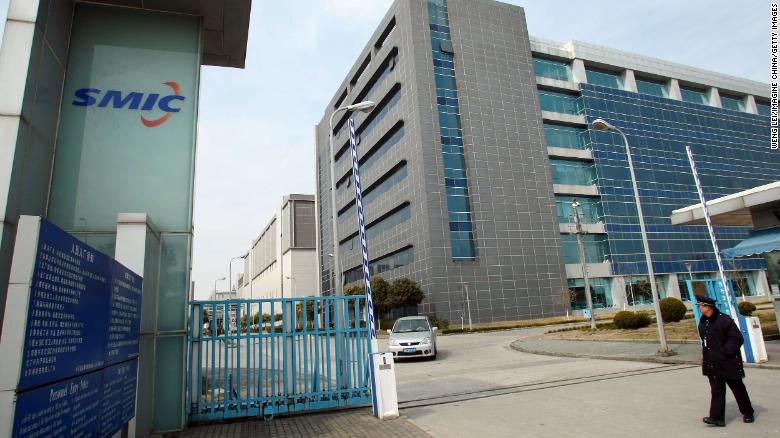
Hong Kong (CNN Business)Shares in Chinese chipmaker SMIC plummeted nearly 23% in Hong Kong on Monday on fears that it could become the latest casualty of the US-China tech war.The US Department of Defense and other US agencies are reportedly considering banning exports to Semiconductor Manufacturing International Corp., according to Reuters and other news outlets. The chipmaker could be added to a list of companies that the US government considers to be undermining American interests.SMIC’s relationship to the Chinese military is under scrutiny, according to the Reuters report, which cited an unnamed US official and two former officials briefed on the matter. The plunge in SMIC stock wiped 31 billion Hong Kong dollars ($4 billion) off its market value.Companies on the US list face significant challenges obtaining vital technology because American firms are banned from selling to them without first obtaining a license to do so. Escalating restrictions on Chinese tech firm Huawei, which was added to the list last year, threaten to cripple its global business, for example.
The situation has grown fraught since the onset of Covid-19, with Indonesia, Malaysia, the Philippines and Vietnam also hardening their stanceBut China is unlikely to terraform further land features, while Vietnam will also refrain from legally challenging Beijing’s claims or actions
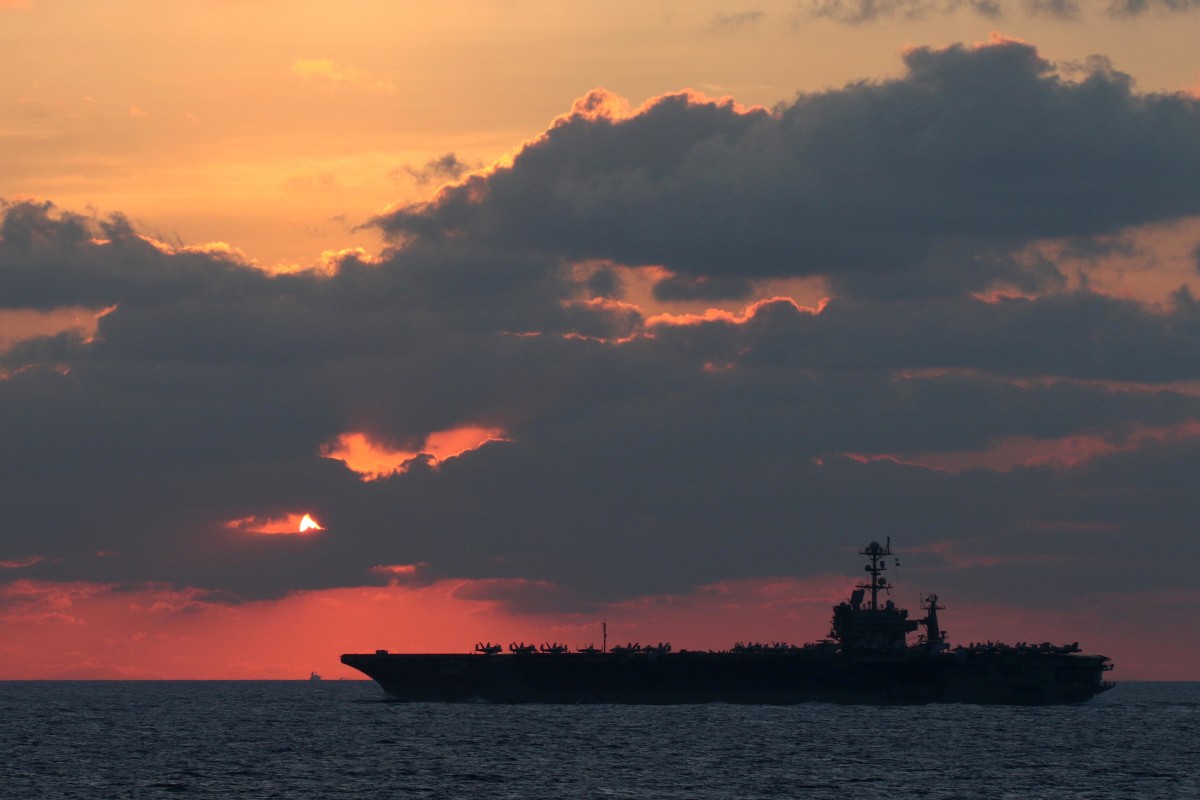
The US Navy aircraft carrier USS John C. Stennis transits the South China Sea in 2019. Photo: Reuters
Since the onset of the Covid-19 pandemic in March, tensions in the South China Sea have surged. This is mainly the result of China’s continued assertiveness coupled with the sharp deterioration in US-China relations over a variety of issues including the South China Sea itself.
TOKYO — Antagonism between the U.S. and China has moved beyond trade and technology and is now intensifying in the financial sector as well.
Global attention has been drawn to the Hong Kong Autonomy Act, signed into law by U.S. President Donald Trump. It imposes sanctions, including seizure of assets and exclusion from dollar-denominated account settlements, on officials and entities in the city and mainland China that are deemed to aid in the violation of the former British colony’s guaranteed autonomy.




![The unspecified countermeasures will apply to all US embassy and consulate staff and the consulate-general in Hong Kong, a ministry statement said [Carlos Garcia Rawlins/Reuters]](https://www.aljazeera.com/mritems/imagecache/mbdxxlarge/mritems/Images/2020/9/11/e060e7920ca14e3cbcbe65d3513e6964_18.jpg "Beijing to impose restrictions on all US diplomats in China")

 1:46China warns U.S. over Uighur bill, raising doubts over early trade dealChina warns U.S. over Uighur bill, raising doubts over early trade deal
 0:40Teen’s TikTok tutorial turns into a plea for Uighurs in ChinaTeen’s TikTok tutorial turns into a plea for Uighurs in China
 2:18Leaked documents reveal China’s surveillance of minority UighursLeaked documents reveal China’s surveillance of minority Uighurs

 CVD
CVD 