US deploys missile defence system to South Korea

Al Jazeera

China is warning it will take measures against a US missile defence system deployed in South Korea, with the stated objective of countering threats from North Korea.

The equipment needed to set up Terminal High-Altitude Area Defence system (THAAD), a missile defence system, have arrived in South Korea, according to American and South Korean defence forces.

The deployment announcement was made on Tuesday, a day after North Korea test-launched four ballistic missiles into the sea near Japan.

Admiral Harry Harris, head of the US Pacific Command, said in the statement that “continued provocative actions by North Korea, to include yesterday’s launch of multiple missiles, only confirm the prudence of our alliance decision last year to deploy THAAD to South Korea”. Tiếp tục đọc “US deploys missile defence system to South Korea”

China hits back at Donald Trump’s ‘champion of currency manipulation’ jibe

US president risks ratcheting up tensions with latest currency claims and repetition of desire for nuclear supremacy

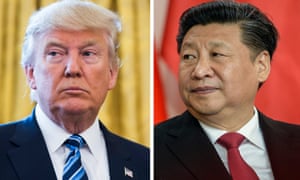
Donald Trump (left) and Xi Jinping
Strained relations between Donald Trump (left) and Xi Jinping appeared to have settled after their phone call a fortnight ago. Photograph: EPA

Beijing has hit back at Donald Trump after the US president risked reigniting a simmering feud with China by accusing it of being the “grand champion” of currency manipulation.

After months of turbulence and uncertainty between the world’s two biggest economies, relations appeared to settle two weeks ago after the US president and his Chinese counterpart, Xi Jinping, held their first phone conversation since the billionaire’s inauguration.

However, in an interview with Reuters on Thursday that also saw Trump reiterate his desire for American nuclear supremacy, the US president, who has attacked China over trade, Taiwan, North Korea and the South China Sea, threatened to undermine the tentative rapprochement with a fresh verbal assault.

Why China is building islands in the South China Sea

Vox – 17 thg 2, 2017

China claims they aren’t military bases, but their actions say otherwise.

China is building islands in the South China sea and its causing disputes among the other nations in the region; Malaysia, the Philippines, Brunei, Vietnam, and Indonesia. The US has many allies in the region and uses its massive Navy to patrol international waters, keeping shipping lanes open for trade.

Asia-Pacific freedom tested: US admiral

By Peter Mitchell, AAP US Correspondent Australian Associated Press

One of America’s top military commanders has painted a bleak picture of the Asia-Pacific, declaring freedom, justice and the rules-based international order hang in the balance.

Admiral Harry Harris, head of the US Pacific Command, told a conference in San Diego the path to stability in the region faces four considerable challenges: North Korea, China, Russia and Islamic State.

He warned the US would “co-operate where we can, but we’ll be ready to confront where we must”. Tiếp tục đọc “Asia-Pacific freedom tested: US admiral”

U.S., Chinese military planes in ‘unsafe’ encounter over disputed South China Sea

Japan Times

The U.S. Navy P-3C was on a “routine mission” over the waters on Wednesday when the encounter with a Chinese military KJ-200 aircraft occurred, Pacific Command said.

The two planes flew within 1,000 feet (300 meters) of each other in the area of the contested Scarborough Shoal, just 230 km (140 miles) from the Philippine coast, CNN reported, citing unnamed U.S. defense officials.

Scarborough Shoal, which is also claimed by Manila, has been known as a potential flashpoint, and rumors of a push by China to build on the collection of rocky outcroppings have stoked concern in the region. Building at Scarborough would create a large “strategic triangle” covering much of the South China Sea that would give it the ability to declare and police an air defense identification zone (ADIZ) there. Tiếp tục đọc “U.S., Chinese military planes in ‘unsafe’ encounter over disputed South China Sea”

Trump và Tập: chiến tranh thương mại?

Vũ Quang Việt Thứ Năm,  9/2/2017, 23:10 (GMT+7)

(TBKTSG) – Tổng thống Mỹ Donald Trump đã ký sắc lệnh quyết định rút Mỹ khỏi Hiệp định Đối tác xuyên Thái Bình Dương (TPP), thảo luận lại Hiệp định Thương mại tự do bắc Mỹ (Nafta), xác định từng vi phạm hiệp định thương mại với từng nước để có biện pháp thích hợp.  Còn với Trung Quốc (TQ), Trump tuyên bố đó là nước thao túng hối suất, trợ cấp hàng hóa, ăn cắp công nghệ  và hứa hẹn sẽ  cứng rắn với TQ, sẽ làm “nước Mỹ vĩ đại trở lại”.  TQ dưới sự lãnh đạo của Tập Cận Bình đang làm gì và Trump có thể đối sách như thế nào? Tiếp tục đọc “Trump và Tập: chiến tranh thương mại?”

Backing away from a fight, Trump to honor one-China policy


February 10 at 5:54 AM Wasjington Post
President Trump just backed down from what could have been a serious fight with China.

On Thursday evening in Washington, he appeared to shy away from confrontation with Beijing by agreeing to honor the one-China policy, during a lengthy telephone call with China’s President Xi Jinping.

The move is set to ease tensions between the world’s two most powerful nations: relations had been inflamed after Trump suggested he would only commit to the one-China policy if Beijing addressed his concerns about trade and currency issues.

Continue reading of Washington Post

In Letter to China, Trump Says He Wants ‘Constructive Relationship’

President Xi Jinping of China in Lima, Peru, last year. The fact that President Trump and Mr. Xi have not talked since Mr. Trump took office in January has drawn increasing scrutiny. Credit Cris Bouroncle/Agence France-Presse — Getty Images

HONG KONG — President Trump has sent a letter to his Chinese counterpart saying he looked forward to developing a “constructive relationship” with Beijing, the latest in a series of conciliatory signals by the new administration after months of heated rhetoric aimed at America’s largest trading partner.

The letter, dated Wednesday, also thanked China’s president, Xi Jinping, for a message he sent congratulating Mr. Trump on his inauguration and conveyed wishes to the Chinese people for the Lunar New Year, the White House said in a two-sentence statement.

It is unclear whether the letter was meant as a substitute for an anticipated phone conversation between the two leaders or as an ice-breaking prelude to such a call. Before his inauguration, Mr. Trump and his cabinet appointees made comments and took actions that alarmed Beijing and pointed to rocky ties between the world’s two biggest economies.

Since his inauguration, Mr. Trump has spoken by phone with about 20 foreign leaders. Usually highly scripted affairs, many of those calls have been anything but. The president’s conversation last month with Malcolm Turnbull, the prime minister of Australia, turned contentious when Mr. Turnbull urged Mr. Trump to honor an agreement made under President Barack Obama to accept 1,250 refugees from an offshore detention center.

Continue reading on  New York Times

But arguably no bilateral relationship is more important than the one between Beijing and Washington, and the fact that Mr. Trump and Mr. Xi have not talked since Mr. Trump took office in January has drawn increasing scrutiny.

Donald Trump and China on dangerous collision course, say experts

The Guardian

Report says ties between the two nuclear-armed countries could deteriorate into an economic or military confrontation

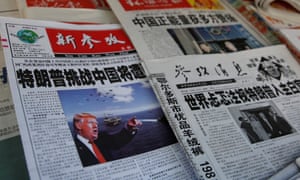
Chinese news papers showing US president Donald Trump at a newsstand in Shanghai.
Chinese news papers showing US president Donald Trump at a newsstand in Shanghai. Photograph: Aly Song/Reuters

A highly combustible cocktail of Donald Trump’s volatility and Xi Jinping’s increasingly aggressive and autocratic rule threatens to plunge already precarious US-China relations into a dangerous new era, some of the world’s leading China specialists say in a new report.

For the last 18 months a taskforce of prominent China experts, some of whom have dealt with Beijing for more than 50 years, hahes been formulating a series of recommendations on how the incoming White House should conduct relations with the world’s second largest economy.

The group’s report, which was handed to the White House on Sunday and will be published in Washington DC on Tuesday, says ties between the two nuclear-armed countries could rapidly deteriorate into an economic or even military confrontation if compromise on issues including trade, Taiwan and the South China Sea cannot be found.

Continue reading on The Guardian

China warns US after Mattis says Senkaku islands covered by treaty

BEIJING: China warned the United States Saturday (Feb 4) not to destabilise East Asia after Donald Trump’s new defence secretary said an island chain claimed by both Tokyo and Beijing was covered by a US-Japan military accord.

The Senkaku islands, known in China as the Diaoyus, sit in rich fishing grounds and are at the centre of a festering row between Tokyo and Beijing, which claims they have been part of Chinese territory for centuries. Tiếp tục đọc “China warns US after Mattis says Senkaku islands covered by treaty”

Chinese official says U.S. should stop using Dalai Lama to stir up trouble

Reuters Feb 4, 2017 Japan Times

The United States should stop using the Dalai Lama to create trouble for China, a senior Chinese official in charge of Tibet affairs told an influential state-run newspaper.

The U.S. is damaging ties with China, said Zhu Weiqun, head of the ethnic and religious affairs committee of the top advisory body to China’s parliament, according to the Global Times.

The Global Times, a tabloid known for writing strongly worded, hawkish and nationalist editorials, is published by the Communist Party’s flagship paper. Tiếp tục đọc “Chinese official says U.S. should stop using Dalai Lama to stir up trouble”

China accuses US of putting stability of Asia Pacific at risk

Beijing reacts to defence secretary James Mattis saying that the US would defend Japan in a conflict with China over disputed Senkaku islands

James Mattis reviews the guard of honour prior to a meeting with Japanese defence minister Tomomi Inada in Tokyo on Saturday.
James Mattis reviews the guard of honour prior to a meeting with Japanese defence minister Tomomi Inada in Tokyo on Saturday. Photograph: Franck Robichon/EPA

China has accused the US of putting the stability of the Asia-Pacific at risk after Donald Trump’s defence secretary said Washington would come to Japan’s defence in the event of a conflict with Beijing over the disputed Senkaku islands.

James Mattis, on a two-day visit to Japan, said the islands, which are controlled by Japan but also claimed by China, fell within the scope of the Japan-US security treaty, under which Washington is obliged to defend all areas under Japanese administrative control. Tiếp tục đọc “China accuses US of putting stability of Asia Pacific at risk”

China Won’t Run From a Fight With Trump

China Won’t Run From a Fight With Trump

Watching warily as Donald Trump takes office, China’s leaders are contemplating the prospect of a more assertive U.S. president willing to upend decades of Sino-U.S. relations. Trump’s Asia policy represents the first major reshaping of U.S. policy toward China since the normalization of diplomatic relations in 1979, and, from Beijing’s perspective, it is currently on a worst-case trajectory, heading toward a trade war and a military standoff over China’s basic interests in Asia, including Taiwan. Tiếp tục đọc “China Won’t Run From a Fight With Trump”

White House warns China on trade, South China Sea

At his first formal daily briefing, President Donald Trump’s press secretary Sean Spicer defended the incoming administration’s wary stance on ties with Beijing.

Spicer was asked about a suggestion by Trump’s nominee for secretary of state, Rex Tillerson, that Washington should prevent China from building islands in disputed waters. Tiếp tục đọc “White House warns China on trade, South China Sea”