What a difference two months can make. In May, Taiwan Semiconductor Manufacturing Co. (TSMC), the world’s largest chipmaker, lost the business of Huawei Technologies—its biggest Chinese customer and the source of 13% of its revenue—as a casualty of geopolitical jockeying between superpowers. But TSMC shareholders took the loss in stride. And by late July, after a stumble by rivalIntel, TSMC’s stock had risen almost 50% since May, making it one of the world’s 10 most valuable companies.
May’s low and July’s high have something in common: They both reflect TSMC’s distinctive role in the global tech economy. Although far from a household name, TSMC controls roughly half of the world’s contract chip manufacturing. Brand-name companies that design their own chips—most notably Apple—rely on TSMC’s world-class production so they don’t have to spend tens of billions to build their own factories. Crack open your iPhone and you’ll find a chip from TSMC. If you could crack open an American guided missile, you’d likely find one there too. Its prowess has elevated TSMC to No. 362 on the Global 500, with $35 billion in revenue. Today it gets 60% of sales from the U.S. and about 20% from mainland China.
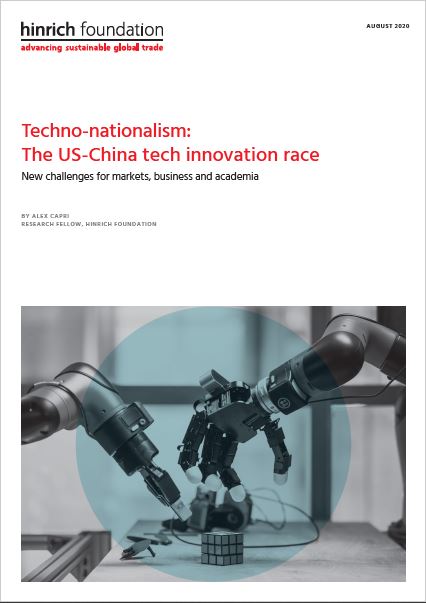
Techno-nationalism: The US-China tech innovation race New challenges for markets, business and academia BY ALEX CAPRI RESEARCH FELLOW, HINRICH FOUNDATION, 20202
The US-China tech innovation race is challenging the laissez-faire economic model. State interventionism, techno-nationalism and US tech funding initiatives are increasing. This paper outlines the implications for markets, academia, research organizations, and governments of the US-China competition to achieve innovation advantage.
A US-China tech innovation race has sparked a paradigm shift in global trade and commerce that is challenging the long-standing primacy of the world’s open trading system.
Current thinking is tilting towards increased state activism and interventionism, not only in the technology landscape but in many of the industries of the future.
Driving this change is techno-nationalism: a mercantilist-like behavior that links tech innovation and enterprise directly to the national security, economic prosperity and social stability of a nation.
In response to decades of Beijing’s innovation-mercantilism, the US has embarked on its own innovation offensive. Washington’s future tech funding initiatives could surpass the scale of the “moonshot” projects last seen during the space race with the former Soviet Union.
Download “Techno-nationalism: The US-China tech innovation race” by Alex Capri
The innovation race involves a broad range of emerging and foundational technologies that will define the industries of the future, including:
Artificial Intelligence (AI) and machine learning
Quantum computing and information systems
Robotics
Energy storage
Semiconductors
Next generation communication (including 5G and 6G)
Hypersonics.
Underlying themes: US techno-nationalism and innovation
As Washington and its allies ramp up techno-nationalist initiatives, core themes will drive the paradigm shift.
Public-private partnerships (PPP) – Technology alliances and government-funded initiatives will play an increasingly important role in advancing long-term innovation in the US, the EU and other traditionally open markets.
Avoiding the China innovation model – The US and EU innovation agendas will not seek to emulate China’s centralized, authoritarian system of techno-nationalism, but, rather, to turbo-charge markets and leverage entrepreneurial ecosystems, as well as academic and defense establishments.
Balancing tensions between MNEs, markets and techno-nationalism – Multinational enterprises (MNEs) will remain the primary drivers of R&D and innovation in free markets and play a vital role in PPP initiatives. They will be pulled into the US-China technology war in a variety of ways which will require a careful balancing of market forces, the interests of MNEs and the needs of state actors.
Multilateral technology alliances – US techno-nationalist policy will increasingly align with the security, economic and ideological objectives of the EU and other historic allies. This will produce more cooperation between the US and its partners.
Section I – The US-China innovation race: The role of the state
This section examines trends for public-spending in R&D and innovation and reviews a series of techno-nationalist funding initiatives from the US government.
It analyzes state activism in free markets and why governments are uniquely qualified to promote innovation and “blue-sky” technologies in ways that the private sector cannot.
Finally, Section I spotlights a historic example of techno-nationalism: SEMATECH and the US semiconductor public-private partnership, which led to a technological leapfrog by the US semiconductor industry, past Japan, in the 1990s.
Section II – MNEs, markets and governments: Navigating new complexities
Section II focuses on non-state actors and their increasingly complex role in public-private partnerships. It explores the tensions between open market forces, multinational companies, and techno-nationalist state activism.
To highlight these tensions, the report analyzes Facebook’s “Libra initiative and Beijing’s efforts to reduce dependency on the US dollar via the digital Yuan, and the challenges those create for MNEs. A US semiconductor sector case study illustrates how state activism can have detrimental effects on markets and backfire on the very parties it is looking to protect.
Section II concludes with an analysis of how open-sourced innovation could be a game-changer in the US-China technology war, particularly regarding future 5G wireless competition.
Section III – Academia and techno-nationalism: Open versus closed systems
Universities, research organizations and academia have become hot zones in the US-China innovation race. Human capital development is key to conducting leading-edge R&D and driving innovation.
Section III looks at how US export controls are affecting R&D activities at universities. It highlights the rules-based frameworks that universities must build to handle increasing government funding into academia.
The section showcases China’s Thousand Talents program and highlights its challenges for public-private partnerships involving academia. It also discusses why the US, in particular, should keep its human capital and innovation pipeline open as it pertains to foreign students, fundamental research programs and, ultimately, why an open system (despite China’s exploitation of it) is better than a closed one.
Finally, section III looks at how some inevitable strategic decoupling between Chinese and US entities will result in the ring-fencing of more “sensitive” R&D activities within the US defense establishment.
Listen to a summary of the report in this podcast featuring Alex Capri and Andrew Staples, Director of Research and Outreach.
Alex Capri is a Research Fellow at the Hinrich Foundation with over 20 years of experience in value chains, logistics and global trade management, both as an academic and a professional consultant.
Điện đàm với người đồng cấp Trung Quốc, Bộ trưởng Quốc phòng Mỹ đã bày tỏ quan ngại về hoạt động ‘gây bất ổn’ của Bắc Kinh ở Biển Đông và gần Đài Loan.
Theo hãng tin Reuters, thông tin trên được Lầu Năm Góc công bố hôm 6/8. Đây là cuộc điện đàm đầu tiên giữa ông Esper và Bộ trưởng Quốc phòng Trung Quốc Ngụy Phượng Hòa kể từ tháng 3 tới nay. Cuộc điện đàm diễn ra trong lúc quan hệ hai bên đang ở mức thấp nhất trong hàng chục năm qua.
President Trump signed an executive order on Thursday that will prohibit Americans from doing business with ByteDance, the company that owns TikTok, and a similar order that bans transactions involving WeChat, a social messaging app, with its owner, Tencent, beginning September 20, in an effort to bar the China-owned social media platforms from the U.S. due to national security concerns.
Prime minister also says stronger Indo-Pacific alliance with like-minded nations is a ‘critical priority’ for Australia.
Australia’s Scott Morrison, standing, walks past China’s Xi Jinping during the G20 leaders’ meeting in Japan last year [File: Lukas Coch via EPA]
Australia’s Prime Minister Scott Morrison has said his government held a less dramatic view of US-China strategic tensions than a predecessor who warned of a potential “hot war” before US presidential elections in November, but added that a conflict is no longer inconceivable.
Republican senators line up in favor of Microsoft purchase
Mnuchin says Democratic leaders agree new approach needed
The Trump administration will announce measures shortly against “a broad array” of Chinese-owned software deemed to pose national-security risks, U.S. Secretary of State Michael Pompeo said.
The comments suggest a possible widening of U.S. measures beyond TikTok, the popular music-video app owned by ByteDance Ltd., one of China’s biggest tech companies. President Donald Trump told reporters Friday that he plans to ban TikTok from the U.S., but his decision hasn’t been announced. Pompeo signaled he expects a Trump announcement “shortly.” Chinese newspapers slammed a potential ban on TikTok.
Fears are rising on both sides of the Pacific that the U.S. and China could be headed for a total breakdown of relations and even outright conflict within the next few months.
As the two powers ordered the closure of each other’s consulates in Houston and Chengdu last week amid allegations of espionage, Secretary of State Michael R. Pompeo called for the end of “engagement,” a policy that has defined U.S.-China relations for nearly five decades — and is considered one of the Republican establishment’s most important foreign-policy achievements in recent history.
“We, the freedom-loving nations of the world, must induce China to change,” Pompeo said in a speech delivered Thursday at a pointedly chosen site, the Richard Nixon Presidential Library and Museum in Yorba Linda. Nixon was the first president to reach out to China, in 1972.
The Chinese flag flies behind barbed wire at the Chinese Consulate General in San Francisco. Photo: AFP
A Singapore national on Friday pleaded guilty to using his political consultancy in the United States as a front to collect information for Chinese intelligence, the US Justice Department announced.
Yeo Jun Wei, also known as Dickson Yeo, entered his plea in federal court in Washington to one charge of operating illegally as a foreign agent.
Michael D. Swaine argued in 2019 that:The U.S.-China relationship is confronting its most daunting challenge in the forty years since the two countries established diplomatic ties. Current trends portend steadily worsening relations over the long term, with increasingly adverse consequences for all actors involved. Specifically, Beijing and Washington are transitioning from a sometimes contentious yet mutually beneficial relationship to an increasingly antagonistic, mutually destructive set of interactions. The often positive and optimistic forces, interests, and beliefs that sustained bilateral ties for decades are giving way to undue pessimism, hostility, and a zero-sum mindset in almost every area of engagement.[200]
Washington (CNN)Senior US government officials said Friday that a Chinese scientist who had been hiding in the country’s San Francisco consulate after accusations of visa fraud is now in US custody and also charged that Beijing has been using its diplomatic outposts to run an espionage network to steal intellectual property from US businesses, universities and research centers.Tang Juan, a researcher who said she was focusing on biology, “was a fugitive from justice until last night,” a senior Justice Department official said, but has now been charged in Sacramento.
The circumstances of Tang’s arrest were not clear, but she has not been charged with espionage.US officials made the announcement just hours before Washington’s deadline for Beijing to shutter its consulate in Houston, a move that triggered China to retaliate Friday by demanding the US close its consulate in Chengdu.Prosecutors earlier this week said that Tang concealed her connection to China’s military in order to enter the US, lied to federal investigators about those links and subsequently tried to avoid arrest by taking refuge in the San Francisco consulate.During an interview with FBI agents on June 20, “Tang denied serving in the Chinese military, claimed she did not know the meaning of the insignia on her uniform, and that wearing a military uniform was required for attendance at FMMU because it was a military school,” attorneys wrote in a July 20 court filing.



![Australia's Scott Morrison, standing, walks past China's Xi Jinping during the G20 leaders' meeting in Japan last year [File: Lukas Coch via EPA]](https://www.aljazeera.com/mritems/imagecache/mbdxxlarge/mritems/Images/2020/8/5/abeee44e48264f8a84ffe7b27ef8499c_18.jpg "Australia's Morrison says US-China war no longer inconceivable")





![Wang Wenbin says 'malicious slander' is behind US order to close Chinese consulate in Houston, Texas [Ng Han Guan/ AP Photo]](https://www.aljazeera.com/mritems/imagecache/mbdxxlarge/mritems/Images/2020/7/24/a4e742b193d747f5b0ab15870a1ab14f_18.jpg "China orders closure of US consulate in Chengdu")
 CVD
CVD 