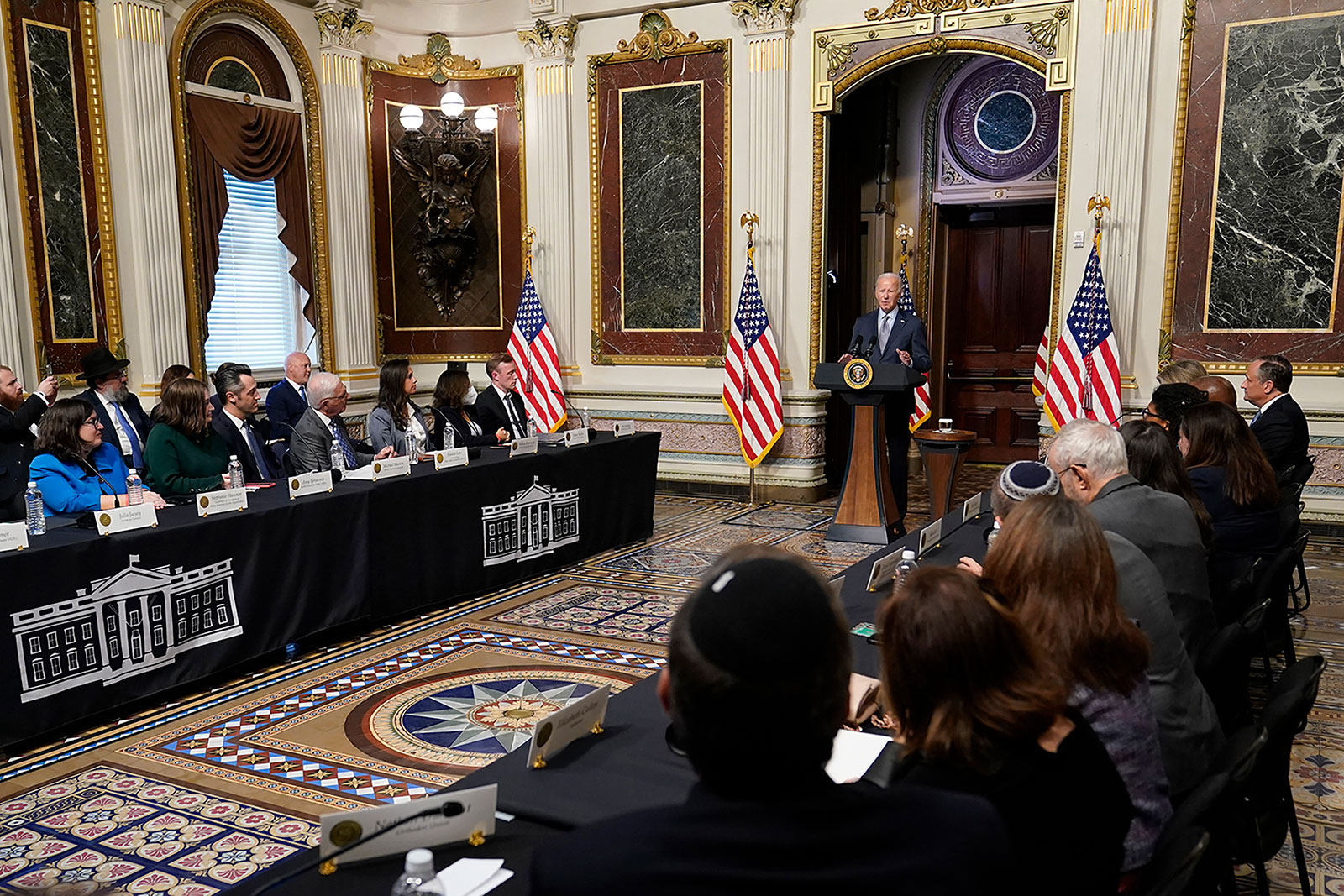
Biden speaks during a roundtable with Jewish community at the White House on Wednesday, October 11, 2023. Susan Walsh/AP
President Joe Biden’s promise for the US to “stand with Israel” continues a special relationship that dates back to 1948, when President Harry Truman became the first world leader to recognize the Jewish state, moments after its creation.
There’s now a kibbutz named after Truman in Israel, and the US provides billions in military support to Israel each year.
There will be only one winner in the war that has broken out between Israel and the Palestinian militant group Hamas. And it is neither Israel nor Hamas.
In an operation coined “the Al-Aqsa Storm,” Hamas, whose formal name is the Islamic Resistance Movement, fired thousands of rockets into Israel on Oct. 7, 2023. Hamas and Palestinian Islamic Jihad fighters infiltrated Israel by land, sea and air. Hundreds of Israelis have been killed, more than 2,000 injured, and many taken hostage.
The Vietnamese People’s Air Force currently maintains a fleet of ten Su-27 Flanker combat aircraft, complemented by 35 Su-30s and 34 Su-22s. In a surprising twist, there’s speculation of a possible addition of American aircraft to Vietnam’s arsenal soon.
The first indication of this evolution came in 2021, as Vietnam placed an order for at least three T-6 Texan II trainers from American manufacturer Beechcraft. The delivery of these aircraft is still pending. This apparent shift is concurrent with the thawing of relations between Vietnam and the United States, a development largely driven by shared concerns regarding China. Tiếp tục đọc “F-16 Viper could fly alongside Su-30 in Vietnam People’s Air Force”→
This winter marks 50 years since U.S. and Vietnamese diplomats in Paris ceremoniously signed “peace accords” that did not end the Vietnam War, but that achieved America’s withdrawal from it. Thus, the accords permitted, a half-century later, what is now a durable American-Vietnamese reconciliation. In the face of seemingly intractable wars — in Ukraine, Afghanistan, the eastern Congo basin, Yemen or elsewhere — the growing U.S.-Vietnamese relationship shows that even a peace that seems impossible today can indeed be built for our children.
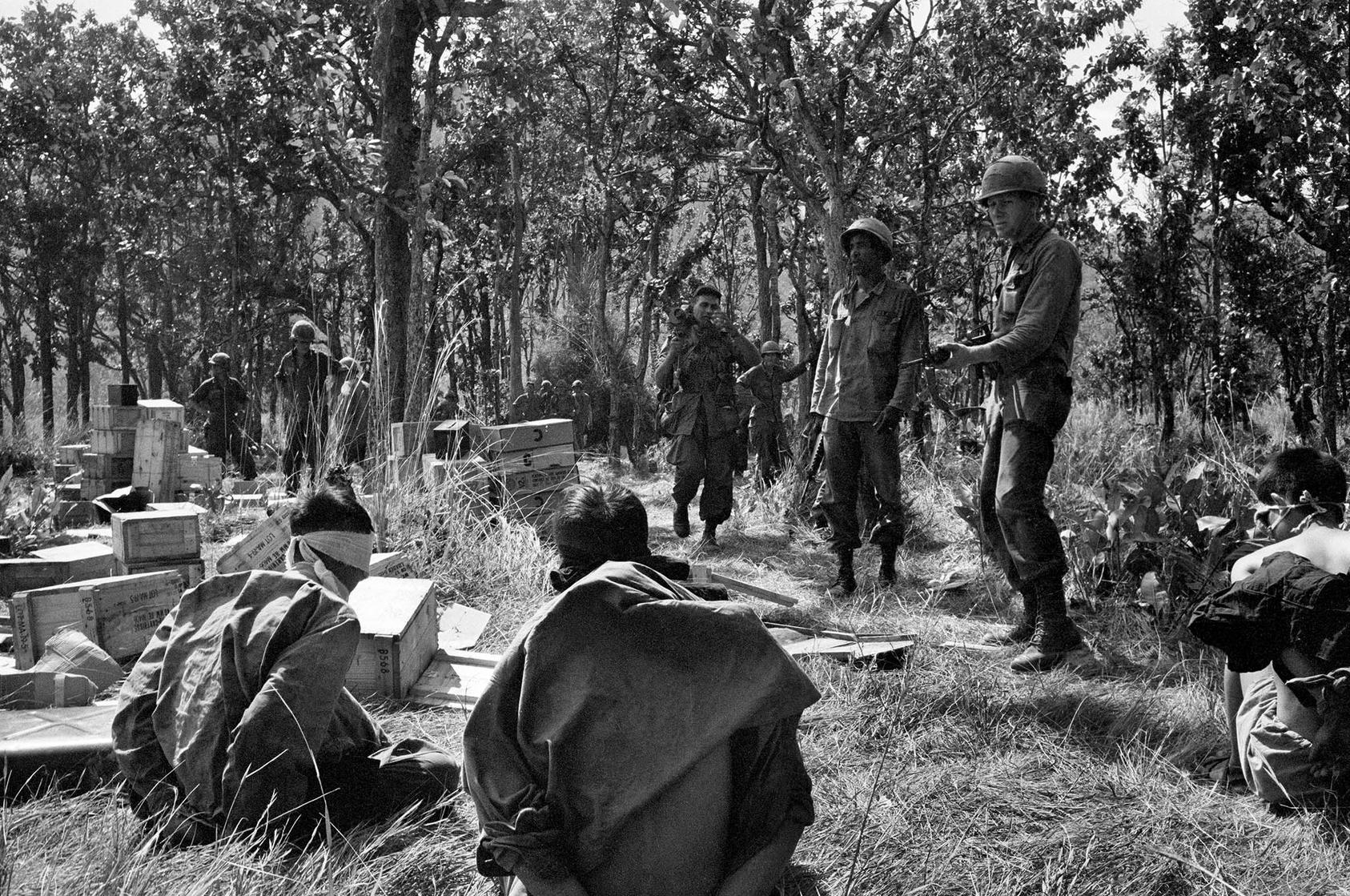
U.S. troops guard North Vietnamese prisoners in 1965, early in the Vietnam War. U.S. and Vietnamese veterans have led reconciliation work in decades since, notably in searching for remains of those killed in the war. (Neil Sheehan/The New York Times)Tiếp tục đọc “We Can Heal War’s Traumas; U.S. and Vietnam Show How”→
The below is attributable to Spokesperson Matthew Miller:
Secretary of State Antony J. Blinken, Japanese Foreign Minister Kamikawa Yoko, and Philippine Secretary of Foreign Affairs Enrique Manalo held a trilateral meeting today in New York during the UN General Assembly High-Level Week.
In 1945, members of the American “Deer Team,” part of the OSS, worked with Vietnamese guerrilla fighters to throw Japanese troops out of Indochina. As the war ended, the people of Vietnam looked to the United States to support their dreams of independence.
For most of World War II, the United States considered Vietnam to be a relatively unimportant French colony to someday be reclaimed from the Japanese; but America showed little interest in enlisting Vietnamese aid in that effort. All this changed rapidly in March 1945. Though the Japanese had invaded Vietnam in 1940, they allowed French colonial authorities to retain power so long as they controlled the Vietnamese and maintained the colony as a supply base for the Emperor’s army fighting in China. However, this also allowed the French to maintain covert Allied intelligence networks that supplied information to Allied personnel aiding the Chinese in their war against Japan. By early 1945, however, the war in the Pacific had shifted in favor of the Allies and the Japanese became increasingly suspicious of French activities in Vietnam. As a result, on March 10, 1945, Japanese forces launched Operation Meigo, a swift military takeover that effectively ended French colonial rule of Vietnam.
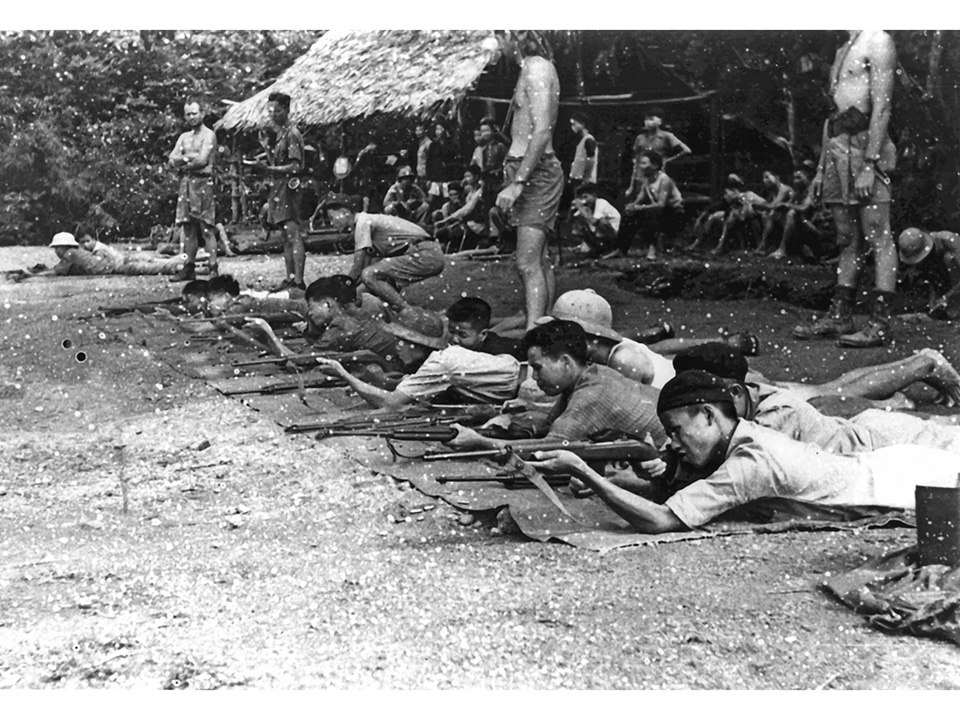
Members of the Deer Team providing instruction to the Vietnamese on use of the M-1 carbine, August 16, 1945. Photo by the National Archives and Records Administration.
With the loss of French control over the colony during Meigo, Allied intelligence networks operating in Vietnam collapsed. One such group, known as the “GBT,” had been providing information on weather conditions, the movement of Japanese troop trains and naval vessels, and on escape routes for downed Allied airmen to the 14th US Air Force stationed in China. Up to this point the GBT refused to employ Vietnamese as agents because the French claimed they were untrustworthy and were only interested in acquiring weapons to fight the French, not the Japanese. With their normally busy wires now silent, native agents became necessary.
Both the GBT and the US Office of Strategic Services (the OSS) reached out to a Vietnamese man who had drawn positive attention from the 14th Air Force the previous year when he escorted a downed American pilot out of Vietnam and into China. OSS agent Charles Fenn tracked down the man in question—Ho Chi Minh—describing him as articulate and charismatic, and both open and friendly to Americans. Fenn was convinced Ho would be an excellent intelligence agent and the group he represented, the Viet Minh, would also be valuable assets in the war against Japan. Soon thereafter, Ho Chi Minh became OSS agent “Lucius.”
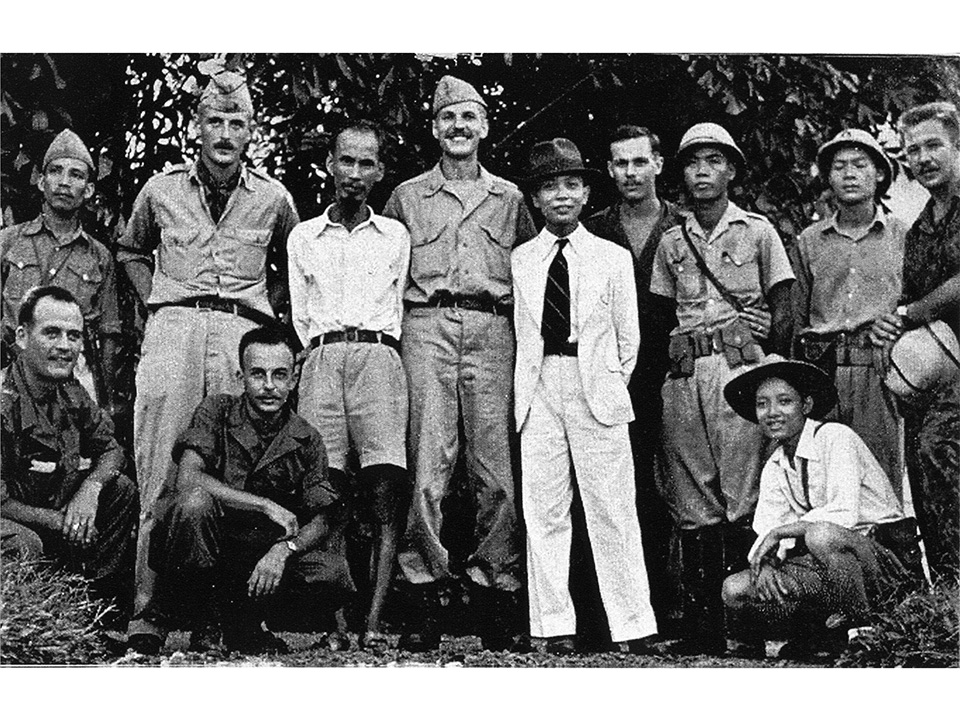
Members of the Deer Team and Viet Minh at training camp. Allison Thomas stands in the center and is flanked on his left by Vo Nguyen Giap and on his right by Ho Chi Minh. Photo by the National Archives and Records Administration.
Central Office of Communist Party of Vietnam Hanoi, Vietnam
6:33 P.M. ICT
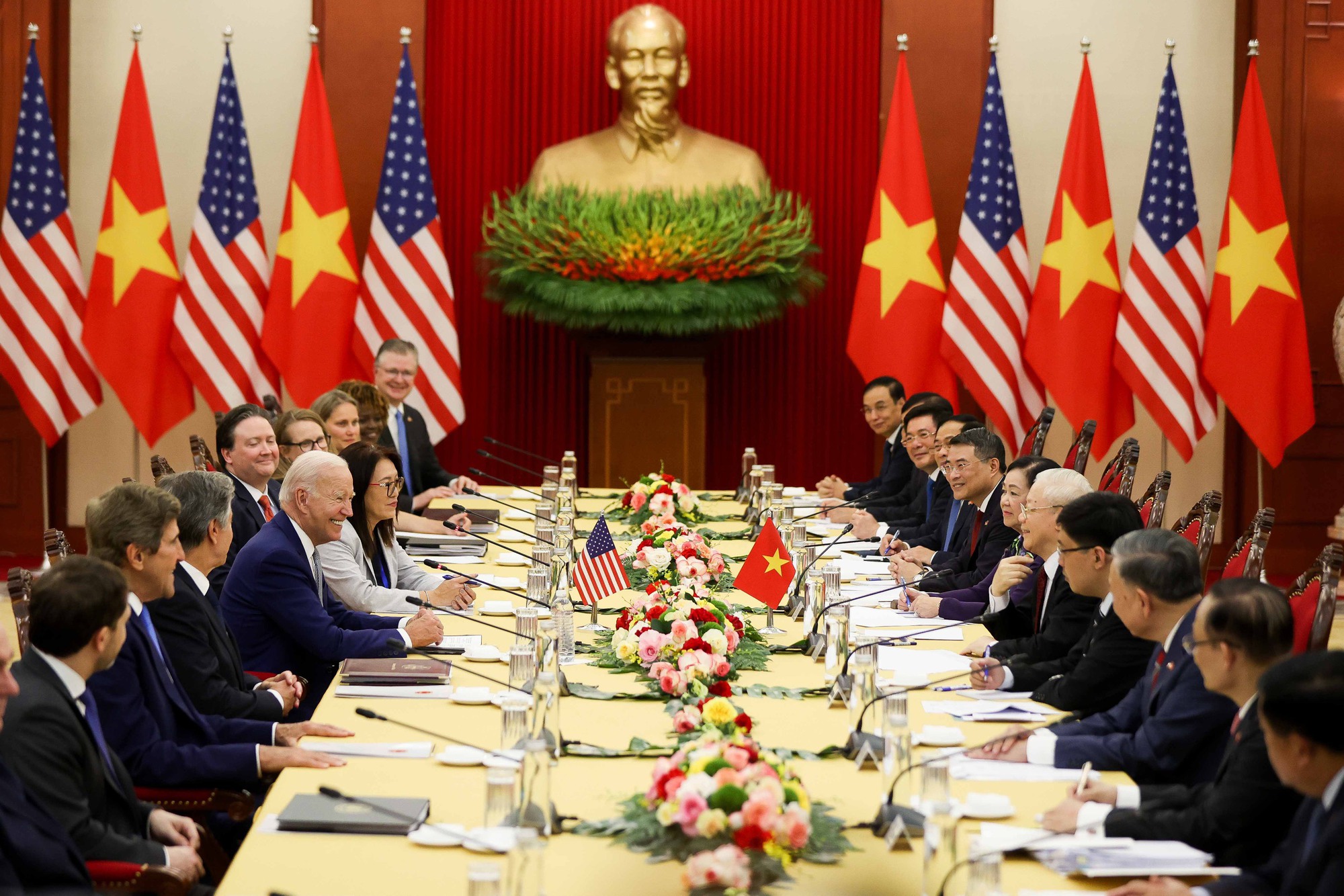
GENERAL SECRETARY TRỌNG: (As interpreted.) Your Honorable Joe Biden, President of the United States of America, distinguished delegates, on behalf of the leaders of the party, state, and people of Vietnam, I’d like to extend my warmest welcome to his Honorable President Joe Biden, who has great affection for the country and people of Vietnam, and for his various contributions to the strengthening of the friendship and cooperation between Vietnam and the U.S. in different capacities.
His visit to Vietnam on this occasion is of great significance, for it coincides with the celebration of the 10th anniversary of the Comprehensive Partnership between the two countries.
Tổng Bí thư Nguyễn Phú Trọng và Tổng thống Mỹ Joe Biden thông báo Việt Nam – Mỹ thống nhất nâng cấp quan hệ lên đối tác chiến lược toàn diện.
Chiều 10.9, tại trụ sở Văn phòng T.Ư Đảng, ngay sau khi kết thúc hội đàm, Tổng Bí thư Nguyễn Phú Trọng và Tổng thống Mỹ Joe Biden thông báo Việt Nam – Mỹ thống nhất nâng cấp quan hệ từ đối tác toàn diện lên đối tác chiến lược toàn diện – cấp cao nhất trong quan hệ ngoại giao nhà nước.
A vital regional river can be a route for U.S. diplomacy.
By Brian Eyler, the director of the Stimson Center’s Southeast Asia Program.
My FP: Follow topics and authors to get straight to what you like. Exclusively for FP subscribers. Subscribe Now | Log In
SEPTEMBER 8, 2023, 4:38 PM
On Sept. 10, Joe Biden pays his first visit to Vietnam as U.S. president, where he is expected to ink a deal to elevate the U.S.-Vietnam relationship from “comprehensive” to “comprehensive strategic”—the highest level of Vietnam’s diplomatic hierarchy. Biden is forgoing this week’s twin summits in Indonesia—the Association of Southeast Asian Nations summit and the East Asia Summit—to show the value Washington places on key bilateral partners, such as Vietnam, in the Indo-Pacific.
Some critics worry that China and Russia, two of Vietnam’s other comprehensive strategic partners, could punish Vietnam for its choice to upgrade relations with the United States. But Vietnam can come out of this complicated diplomatic competition a clear winner by centering the U.S.-Vietnam collaboration on the Mekong—the mighty river that keeps both Vietnam and much of the rest of the world fed.
1. Prime Minister Narendra Modi welcomed United States President Joseph R. Biden, Jr., to India today, reaffirming the close and enduring partnership between India and the United States. The leaders expressed their appreciation for the substantial progress underway to implement the ground breaking achievements of Prime Minister Modi’s historic, June 2023, visit to Washington.
2. The leaders called on their governments to continue the work of transforming the India-U.S. Strategic Partnership across all dimensions of our multifaceted global agenda, based on trust and mutual understanding. The leaders re-emphasized that the shared values of freedom, democracy, human rights, inclusion, pluralism, and equal opportunities for all citizens are critical to the success our countries enjoy and that these values strengthen our relationship. Tiếp tục đọc “Joint Statement from India and the United States”→
The United States and Vietnam are poised to significantly enhance their economic and technological ties, bringing the former foes closer at a time of increased Chinese assertiveness in the region.
The deal, expected to be announced when President Biden makes a state visit to Vietnam next weekend, is the latest step by the Biden administration to deepen relations in Asia. For Hanoi, the closer relationship with Washington serves as a counterweight to Beijing’s influence.





 CVD
CVD 