The Pentagon said it wouldn’t use depleted uranium rounds against ISIS. Months later, it did — thousands of times.

February 16 at 7:00 AM

Months after the Pentagon said it wouldn’t use a controversial type of armor-piercing ammunition that has been blamed for long-term health complications, U.S. aircraft fired thousands of the rounds during two high-profile air raids in Syria in November 2015, the Pentagon acknowledged Wednesday.

The use of the ammunition, a 30mm depleted-uranium bullet called PGU-14, was first reported by a joint Air Wars-Foreign Policy investigation on Tuesday. The roughly 5,265 rounds of the munition were fired from multiple A-10 ground attack aircraft on Nov 16, 2015, and Nov. 22, 2015, in airstrikes in Syria’s eastern desert that targeted the Islamic State’s oil supply during Operation Tidal Wave II, said Maj. Josh Jacques, a U.S. Central Command spokesman.

When loaded with depleted-uranium bullets, the A-10s fired what is called a “combat-mix,” meaning the aircraft’s cannon fires five depleted-uranium rounds to one high explosive incendiary bullet.

Xin lỗi và bồi thường chiến tranh trong quan hệ quốc tế ; Kinh nghiệm lịch sử trong quan hệ Việt – Mỹ

  • VHNA –  NGUYỄN THÁI YÊN HƯƠNG
  • Thứ ba, 26 Tháng 5 2015 21:26

                                                                Hòa giải và giảng hòa một cách chân tình không có nghĩa là chúng ta quên quá khứ

Nelson Maldela

Trong quan hệ quốc tế nói chung, vấn đề xin lỗi và bồi thường chiến tranh là một vấn đề luôn song hành với quan hệ giữa các nước trong quá trình hàn gắn vết thương để đến bình thường hóa quan hệ ngoại giao. Đây là vấn đề đã được nhiều nhà nghiên cứu quan hệ quốc tế đề cập theo góc độ xã hội, lịch sử. Tiếp tục đọc “Xin lỗi và bồi thường chiến tranh trong quan hệ quốc tế ; Kinh nghiệm lịch sử trong quan hệ Việt – Mỹ”

Head of U.S. Pacific Command urges democracy in Thailand

Japan times

AP Feb 14, 2017

The highest-ranking U.S. military official to visit Thailand since a 2014 coup urged the country to restore democracy, saying Tuesday that America needs “a strong and stable ally” in Southeast Asia.

Adm. Harry Harris, the head of the U.S. Pacific Command, spoke at the start of the annual Cobra Gold joint military exercises, the largest in the Asia-Pacific region.

The U.S. is vying with an increasingly powerful China for influence in Asia.

“We look forward to Thailand’s reemergence as a flourishing democracy because we need Thailand as a strong and stable ally,” Harris said. “We need Thailand to get back to being the regional and global leader that it always has been.”

Twenty-nine countries, including China, India and Malaysia, are participating in or observing the exercises.

continue reading on Japan times

US, Japan, S Korea request UN Security Council meeting on N Korea

WASHINGTON: The United States, Japan and South Korea on Sunday (Feb 12) requested an urgent UN Security Council meeting to discuss North Korea’s latest missile test.

“The United States, along with Japan and the Republic of Korea, have requested urgent consultations on the DPRK’s launch of a ballistic missile on February 12,” said a US mission spokesperson.

The test was seen as a challenge to Donald Trump’s young presidency.

The request comes after North Korea’s state media quoted officials as saying the ballistic missile test was a “success”.

North Korean leader Kim Jong-un “guided” the test, the KCNA report said, adding it was carried out in a way that took the “security of the neighbouring countries into consideration”. Tiếp tục đọc “US, Japan, S Korea request UN Security Council meeting on N Korea”

U.S., Chinese military planes in ‘unsafe’ encounter over disputed South China Sea

Japan Times

The U.S. Navy P-3C was on a “routine mission” over the waters on Wednesday when the encounter with a Chinese military KJ-200 aircraft occurred, Pacific Command said.

The two planes flew within 1,000 feet (300 meters) of each other in the area of the contested Scarborough Shoal, just 230 km (140 miles) from the Philippine coast, CNN reported, citing unnamed U.S. defense officials.

Scarborough Shoal, which is also claimed by Manila, has been known as a potential flashpoint, and rumors of a push by China to build on the collection of rocky outcroppings have stoked concern in the region. Building at Scarborough would create a large “strategic triangle” covering much of the South China Sea that would give it the ability to declare and police an air defense identification zone (ADIZ) there. Tiếp tục đọc “U.S., Chinese military planes in ‘unsafe’ encounter over disputed South China Sea”

Trump và Tập: chiến tranh thương mại?

Vũ Quang Việt Thứ Năm,  9/2/2017, 23:10 (GMT+7)

(TBKTSG) – Tổng thống Mỹ Donald Trump đã ký sắc lệnh quyết định rút Mỹ khỏi Hiệp định Đối tác xuyên Thái Bình Dương (TPP), thảo luận lại Hiệp định Thương mại tự do bắc Mỹ (Nafta), xác định từng vi phạm hiệp định thương mại với từng nước để có biện pháp thích hợp.  Còn với Trung Quốc (TQ), Trump tuyên bố đó là nước thao túng hối suất, trợ cấp hàng hóa, ăn cắp công nghệ  và hứa hẹn sẽ  cứng rắn với TQ, sẽ làm “nước Mỹ vĩ đại trở lại”.  TQ dưới sự lãnh đạo của Tập Cận Bình đang làm gì và Trump có thể đối sách như thế nào? Tiếp tục đọc “Trump và Tập: chiến tranh thương mại?”

Backing away from a fight, Trump to honor one-China policy


February 10 at 5:54 AM Wasjington Post
President Trump just backed down from what could have been a serious fight with China.

On Thursday evening in Washington, he appeared to shy away from confrontation with Beijing by agreeing to honor the one-China policy, during a lengthy telephone call with China’s President Xi Jinping.

The move is set to ease tensions between the world’s two most powerful nations: relations had been inflamed after Trump suggested he would only commit to the one-China policy if Beijing addressed his concerns about trade and currency issues.

Continue reading of Washington Post

Federal appeals court rules 3 to 0 against Trump on travel ban

Washington Post

A federal appeals court upheld a lower court ruling suspending President Trump’s controversial immigration order barring refugees and citizens from seven Muslim-majority countries from entering the U.S. on Feb. 9. (Peter Stevenson/The Washington Post)

February 9 at 9:26 PM
A federal appeals panel has maintained the freeze on President Trump’s controversial immigration order, meaning previously barred refugees and citizens from seven majority-Muslim countries can continue entering the United States.In a unanimous 29-page opinion, three judges from the U.S. Court of Appeals for the 9th Circuit flatly rejected the government’s argument that suspension of the order should be lifted immediately for national security reasons, and they forcefully asserted their ability to serve as a check on the president’s power.The judges wrote that any suggestion that they could not “runs contrary to the fundamental structure of our constitutional democracy.”

The judges did not declare outright that the ban was meant to disfavor Muslims — essentially saying it was too early for them to render a judgment on that question. But their ruling is undeniably a blow to the government and means the travel ban will remain off for the foreseeable future.

Audio: Trump reacts to federal appeals court decision


Play Video1:12
President Trump said on Feb. 9 that he looked forward to seeing the judges “in court” after a federal appeals court upheld the suspension of his controversial immigration order. (Editor’s note: Audio only.) (The Washington Post)

Trump reacted angrily on Twitter, posting just minutes after the ruling, “SEE YOU IN COURT, THE SECURITY OF OUR NATION IS AT STAKE!” He later said to reporters that the judges had made “a political decision.”

“We have a situation where the security of our country is at stake, and it’s a very, very serious situation, so we look forward, as I just said, to seeing them in court,” he said.

The Justice Department, which was defending the administration’s position, said in a statement it was “reviewing the decision and considering its options.” Tiếp tục đọc “Federal appeals court rules 3 to 0 against Trump on travel ban”

U.S. General Seeks ‘a Few Thousand’ More Troops in Afghanistan

Gen. John W. Nicholson Jr. testified before the Senate Armed Services Committee on Thursday. Credit Alex Wong/Getty Images

WASHINGTON — The commander of the American-led international military force in Afghanistan told Congress on Thursday that he needed a few thousand additional troops to more effectively train and advise Afghan soldiers.

“I have a shortfall of a few thousand,” Gen. John W. Nicholson Jr. said in a sober assessment of the United States’ longest-running war, during testimony to the Senate Armed Services Committee.

President Trump has said little about Afghanistan, speaking mainly instead of the need to defeat the Islamic State in Iraq and Syria. The American-led international force that is helping the Afghans has about 13,300 troops today, 8,400 of which are American.

Continue reading on New York Times

Trump and Abe to Talk: Why They Are Meeting and What They’ll Discuss

Prime Minister Shinzo Abe of Japan during a ceremony at a base north of Tokyo last year. He will meet with President Trump on Friday in the Oval Office. Credit Eugene Hoshiko/Associated Press

HONG KONG — Prime Minister Shinzo Abe of Japan, the first world leader to meet Donald J. Trump after the election in November, plans to meet with the president in Washington on Friday in the Oval Office. Mr. Abe is then planning to fly to Mr. Trump’s Mar-a-Lago resort in Palm Beach, Fla., to play golf with the president.

Why are they meeting?

Mr. Abe wants to talk to Mr. Trump about trade and economic issues, which have already been the subject of some critical Twitter postings and remarks from the president.

Mr. Abe is also eager to pursue a closer personal relationship with Mr. Trump, with whom he shares some ideological leanings, including a resistance to immigration.

In Letter to China, Trump Says He Wants ‘Constructive Relationship’

President Xi Jinping of China in Lima, Peru, last year. The fact that President Trump and Mr. Xi have not talked since Mr. Trump took office in January has drawn increasing scrutiny. Credit Cris Bouroncle/Agence France-Presse — Getty Images

HONG KONG — President Trump has sent a letter to his Chinese counterpart saying he looked forward to developing a “constructive relationship” with Beijing, the latest in a series of conciliatory signals by the new administration after months of heated rhetoric aimed at America’s largest trading partner.

The letter, dated Wednesday, also thanked China’s president, Xi Jinping, for a message he sent congratulating Mr. Trump on his inauguration and conveyed wishes to the Chinese people for the Lunar New Year, the White House said in a two-sentence statement.

It is unclear whether the letter was meant as a substitute for an anticipated phone conversation between the two leaders or as an ice-breaking prelude to such a call. Before his inauguration, Mr. Trump and his cabinet appointees made comments and took actions that alarmed Beijing and pointed to rocky ties between the world’s two biggest economies.

Since his inauguration, Mr. Trump has spoken by phone with about 20 foreign leaders. Usually highly scripted affairs, many of those calls have been anything but. The president’s conversation last month with Malcolm Turnbull, the prime minister of Australia, turned contentious when Mr. Turnbull urged Mr. Trump to honor an agreement made under President Barack Obama to accept 1,250 refugees from an offshore detention center.

Continue reading on  New York Times

But arguably no bilateral relationship is more important than the one between Beijing and Washington, and the fact that Mr. Trump and Mr. Xi have not talked since Mr. Trump took office in January has drawn increasing scrutiny.

Donald Trump and China on dangerous collision course, say experts

The Guardian

Report says ties between the two nuclear-armed countries could deteriorate into an economic or military confrontation

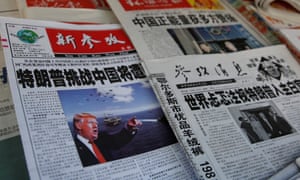
Chinese news papers showing US president Donald Trump at a newsstand in Shanghai.
Chinese news papers showing US president Donald Trump at a newsstand in Shanghai. Photograph: Aly Song/Reuters

A highly combustible cocktail of Donald Trump’s volatility and Xi Jinping’s increasingly aggressive and autocratic rule threatens to plunge already precarious US-China relations into a dangerous new era, some of the world’s leading China specialists say in a new report.

For the last 18 months a taskforce of prominent China experts, some of whom have dealt with Beijing for more than 50 years, hahes been formulating a series of recommendations on how the incoming White House should conduct relations with the world’s second largest economy.

The group’s report, which was handed to the White House on Sunday and will be published in Washington DC on Tuesday, says ties between the two nuclear-armed countries could rapidly deteriorate into an economic or even military confrontation if compromise on issues including trade, Taiwan and the South China Sea cannot be found.

Continue reading on The Guardian

The 30-Years War in Vietnam

Viet Minh in battle in Dien Bien Phu, Vietnam. Credit Collection Jean-Claude Labbe/Gamma-Rapho, via Getty Images

It should go without saying that the Vietnam War is remembered by different people in very different ways. Most Americans remember it as a war fought between 1965 and 1975 that bogged down their military in a struggle to prevent the Communists from marching into Southeast Asia, deeply dividing Americans as it did. The French remember their loss there as a decade-long conflict, fought from 1945 to 1954, when they tried to hold on to the Asian pearl of their colonial empire until losing it in a place called Dien Bien Phu.

The Vietnamese, in contrast, see the war as a national liberation struggle, or as a civil conflict, depending on which side they were on, ending in victory in 1975 for one side and tragedy for the other. For the Vietnamese, it was above all a 30-year conflict transforming direct and indirect forms of fighting into a brutal conflagration, one that would end up claiming over three million Vietnamese lives.

The point is not that one perspective is better or more accurate than the other. What’s important, rather, is to understand how the colonial war, the civil war and the Cold War intertwined to produce such a deadly conflagration by 1967.

Continue reading on New York Times

US, Japan conduct test of joint missile

The two nations have been working together since 2006 to develop a variant of the Standard Missile-3, a ship-launched missile that operates as part of the Aegis Ballistic Missile Defence System.

Friday’s test off Kauai in Hawaii saw the Standard Missile-3 “Block IIA” successfully hit its target in space, the US Missile Defence Agency said.

According to the MDA, America has so far spent about US$2.2 billion on the system and Japan about US$1 billion.

“We are both deeply concerned about North Korea’s capabilities, and we are constantly working to improve our defense capabilities,” MDA spokesman Chris Johnson said Monday.

“It makes sense for the US and Japan to share some of that burden.”

Mitsubishi and Raytheon both make parts of the missiles, which are assembled in the United States, and which are designed to defeat medium- and intermediate-range missiles.

The test occurred as Pentagon chief Jim Mattis was in East Asia on his first overseas trip as defence secretary.

He said on Friday that any nuclear attack by North Korea would trigger an “effective and overwhelming” response, as he sought to reassure Asian allies rattled by President Donald Trump’s isolationist rhetoric.

South Korea is working with the United States to install another system, the Terminal High Altitude Area Defence (THAAD) system, this year to prevent against any missiles from the North.