
.
Chuyên mục: US-VN Relationship – Quan hệ Việt Mỹ
F-16 Viper could fly alongside Su-30 in Vietnam People’s Air Force

Indo-Pacific News – Geo-Politics & Defense News
The Vietnamese People’s Air Force currently maintains a fleet of ten Su-27 Flanker combat aircraft, complemented by 35 Su-30s and 34 Su-22s. In a surprising twist, there’s speculation of a possible addition of American aircraft to Vietnam’s arsenal soon.
The first indication of this evolution came in 2021, as Vietnam placed an order for at least three T-6 Texan II trainers from American manufacturer Beechcraft. The delivery of these aircraft is still pending. This apparent shift is concurrent with the thawing of relations between Vietnam and the United States, a development largely driven by shared concerns regarding China. Tiếp tục đọc “F-16 Viper could fly alongside Su-30 in Vietnam People’s Air Force”
We Can Heal War’s Traumas; U.S. and Vietnam Show How
US Institute of Peace 50 years after a peace accord that wasn’t, one-time enemies salve a long war’s wounds.
Wednesday, March 1, 2023 / BY: USIP Staff PUBLICATION TYPE: Analysis and Commentary
This winter marks 50 years since U.S. and Vietnamese diplomats in Paris ceremoniously signed “peace accords” that did not end the Vietnam War, but that achieved America’s withdrawal from it. Thus, the accords permitted, a half-century later, what is now a durable American-Vietnamese reconciliation. In the face of seemingly intractable wars — in Ukraine, Afghanistan, the eastern Congo basin, Yemen or elsewhere — the growing U.S.-Vietnamese relationship shows that even a peace that seems impossible today can indeed be built for our children.
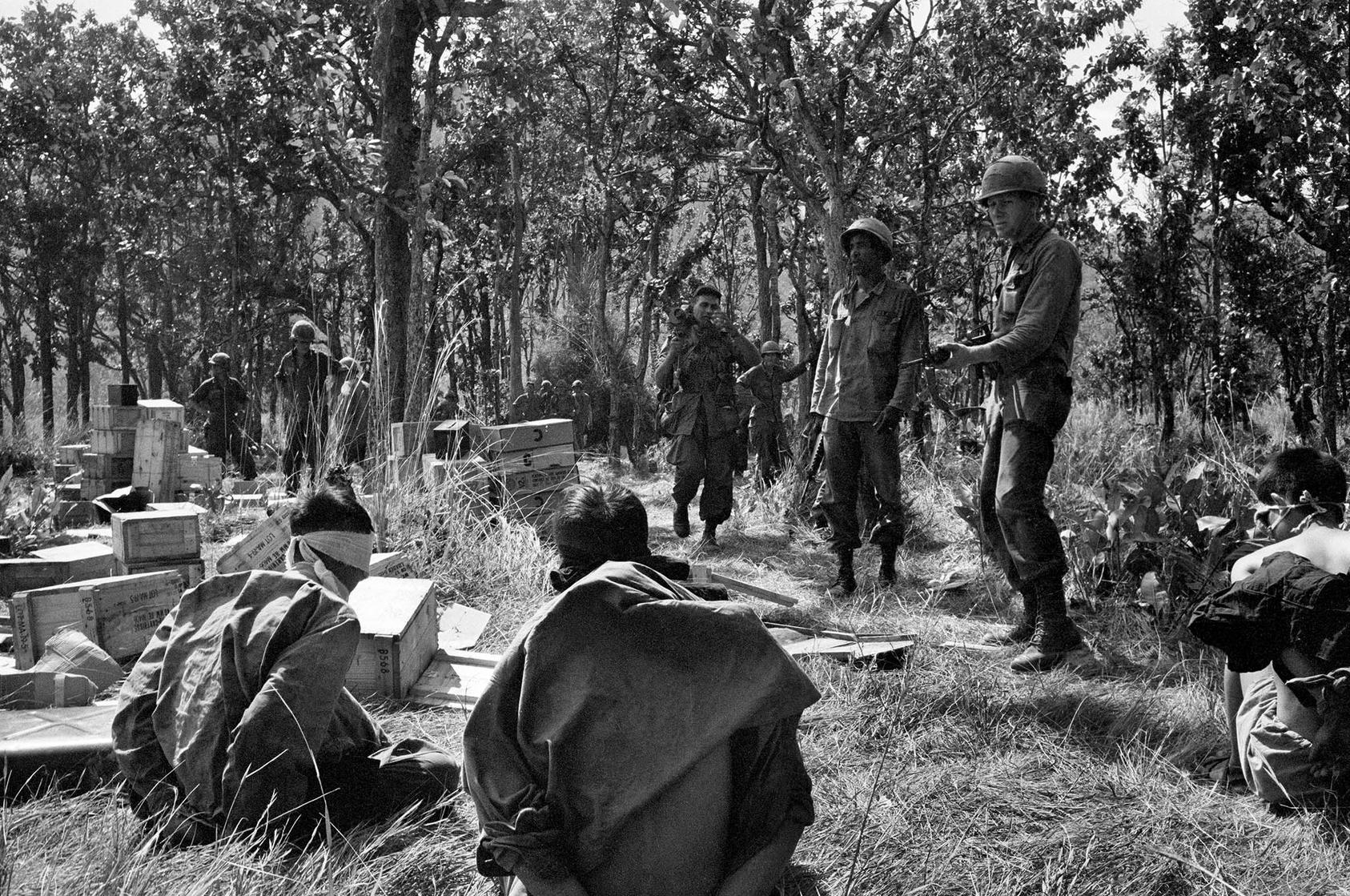
The US Office of Strategic Services (OSS) in Vietnam
1945: A War of Missed Opportunities
The National WWII Museum July 15, 2020
In 1945, members of the American “Deer Team,” part of the OSS, worked with Vietnamese guerrilla fighters to throw Japanese troops out of Indochina. As the war ended, the people of Vietnam looked to the United States to support their dreams of independence.
For most of World War II, the United States considered Vietnam to be a relatively unimportant French colony to someday be reclaimed from the Japanese; but America showed little interest in enlisting Vietnamese aid in that effort. All this changed rapidly in March 1945. Though the Japanese had invaded Vietnam in 1940, they allowed French colonial authorities to retain power so long as they controlled the Vietnamese and maintained the colony as a supply base for the Emperor’s army fighting in China. However, this also allowed the French to maintain covert Allied intelligence networks that supplied information to Allied personnel aiding the Chinese in their war against Japan. By early 1945, however, the war in the Pacific had shifted in favor of the Allies and the Japanese became increasingly suspicious of French activities in Vietnam. As a result, on March 10, 1945, Japanese forces launched Operation Meigo, a swift military takeover that effectively ended French colonial rule of Vietnam.
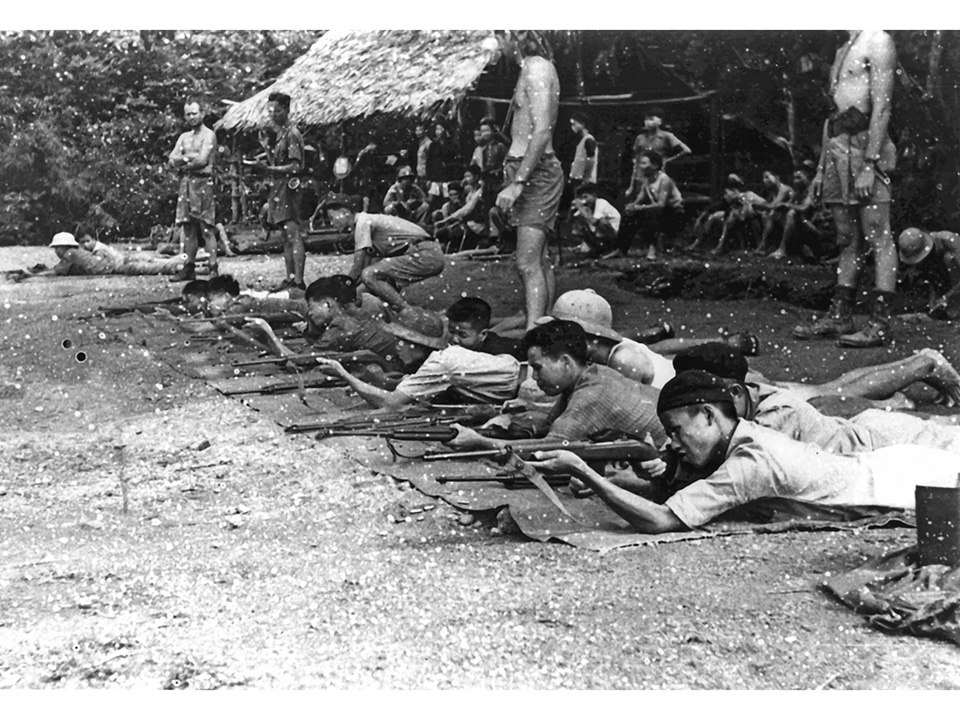
Members of the Deer Team providing instruction to the Vietnamese on use of the M-1 carbine, August 16, 1945. Photo by the National Archives and Records Administration.
With the loss of French control over the colony during Meigo, Allied intelligence networks operating in Vietnam collapsed. One such group, known as the “GBT,” had been providing information on weather conditions, the movement of Japanese troop trains and naval vessels, and on escape routes for downed Allied airmen to the 14th US Air Force stationed in China. Up to this point the GBT refused to employ Vietnamese as agents because the French claimed they were untrustworthy and were only interested in acquiring weapons to fight the French, not the Japanese. With their normally busy wires now silent, native agents became necessary.
Both the GBT and the US Office of Strategic Services (the OSS) reached out to a Vietnamese man who had drawn positive attention from the 14th Air Force the previous year when he escorted a downed American pilot out of Vietnam and into China. OSS agent Charles Fenn tracked down the man in question—Ho Chi Minh—describing him as articulate and charismatic, and both open and friendly to Americans. Fenn was convinced Ho would be an excellent intelligence agent and the group he represented, the Viet Minh, would also be valuable assets in the war against Japan. Soon thereafter, Ho Chi Minh became OSS agent “Lucius.”
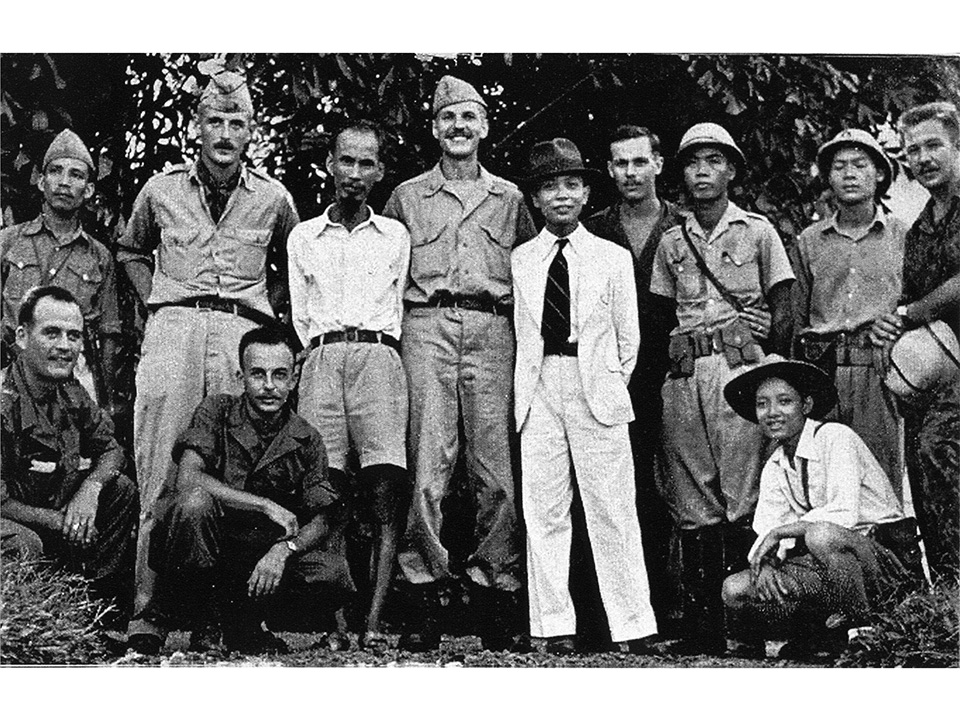
Members of the Deer Team and Viet Minh at training camp. Allison Thomas stands in the center and is flanked on his left by Vo Nguyen Giap and on his right by Ho Chi Minh. Photo by the National Archives and Records Administration.
Tiếp tục đọc “The US Office of Strategic Services (OSS) in Vietnam”
Remarks by President Biden and General Secretary Nguyễn Phú Trọng of the Communist Party of Vietnam in Joint Press Statements [on Comprehensive Strategic Partnership]

SEPTEMBER 10, 2023
Central Office of Communist Party of Vietnam
Hanoi, Vietnam
6:33 P.M. ICT
GENERAL SECRETARY TRỌNG: (As interpreted.) Your Honorable Joe Biden, President of the United States of America, distinguished delegates, on behalf of the leaders of the party, state, and people of Vietnam, I’d like to extend my warmest welcome to his Honorable President Joe Biden, who has great affection for the country and people of Vietnam, and for his various contributions to the strengthening of the friendship and cooperation between Vietnam and the U.S. in different capacities.
His visit to Vietnam on this occasion is of great significance, for it coincides with the celebration of the 10th anniversary of the Comprehensive Partnership between the two countries.
Tiếp tục đọc “Remarks by President Biden and General Secretary Nguyễn Phú Trọng of the Communist Party of Vietnam in Joint Press Statements [on Comprehensive Strategic Partnership]”Biden opens Vietnam visit by saying the two countries are ‘critical partners’ at a ‘critical time’
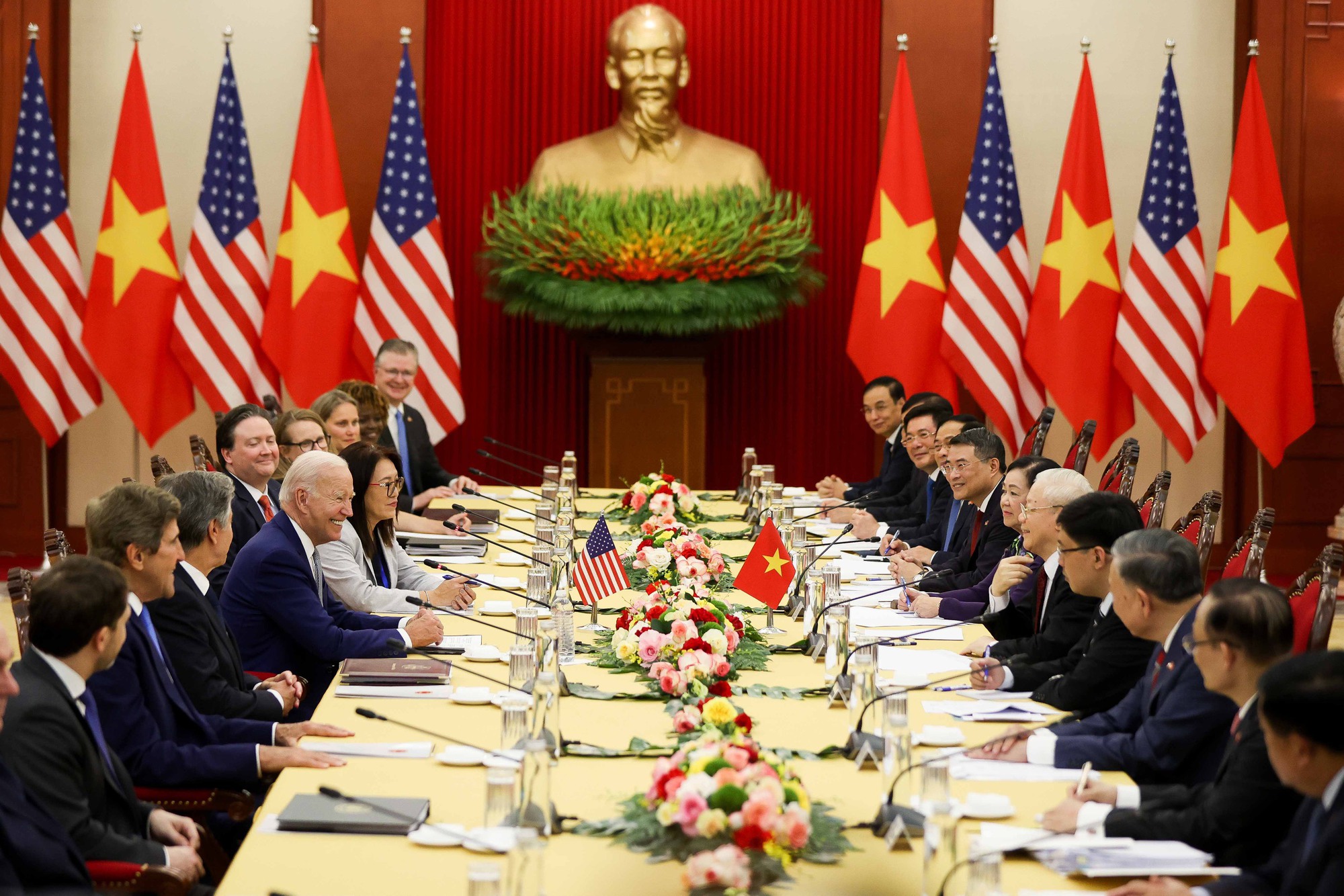
1 of 12 | U.S. President Joe Biden and Vietnam’s General Secretary Nguyen Phu Trong, unseen, deliver remarks at the Communist Party of Vietnam Headquarters, in Hanoi, Vietnam, Sunday, Sept. 10, 2023. (AP Photo/Evan Vucci) Tiếp tục đọc “Biden opens Vietnam visit by saying the two countries are ‘critical partners’ at a ‘critical time’”
Việt Nam – Mỹ trở thành đối tác chiến lược toàn diện
Lê Hiệp– lehiepthanhnien@gmail.com
10/09/2023 19:06 GMT+7 Thanh Niên
Tổng Bí thư Nguyễn Phú Trọng và Tổng thống Mỹ Joe Biden thông báo Việt Nam – Mỹ thống nhất nâng cấp quan hệ lên đối tác chiến lược toàn diện.
Chiều 10.9, tại trụ sở Văn phòng T.Ư Đảng, ngay sau khi kết thúc hội đàm, Tổng Bí thư Nguyễn Phú Trọng và Tổng thống Mỹ Joe Biden thông báo Việt Nam – Mỹ thống nhất nâng cấp quan hệ từ đối tác toàn diện lên đối tác chiến lược toàn diện – cấp cao nhất trong quan hệ ngoại giao nhà nước.
Biden’s Vietnam Deals Should Center on the Mekong
A vital regional river can be a route for U.S. diplomacy.
By Brian Eyler, the director of the Stimson Center’s Southeast Asia Program.

My FP: Follow topics and authors to get straight to what you like. Exclusively for FP subscribers. Subscribe Now | Log In
SEPTEMBER 8, 2023, 4:38 PM
On Sept. 10, Joe Biden pays his first visit to Vietnam as U.S. president, where he is expected to ink a deal to elevate the U.S.-Vietnam relationship from “comprehensive” to “comprehensive strategic”—the highest level of Vietnam’s diplomatic hierarchy. Biden is forgoing this week’s twin summits in Indonesia—the Association of Southeast Asian Nations summit and the East Asia Summit—to show the value Washington places on key bilateral partners, such as Vietnam, in the Indo-Pacific.
Some critics worry that China and Russia, two of Vietnam’s other comprehensive strategic partners, could punish Vietnam for its choice to upgrade relations with the United States. But Vietnam can come out of this complicated diplomatic competition a clear winner by centering the U.S.-Vietnam collaboration on the Mekong—the mighty river that keeps both Vietnam and much of the rest of the world fed.
Tiếp tục đọc “Biden’s Vietnam Deals Should Center on the Mekong”With wary eye on China, U.S. moves closer to former foe Vietnam
The two countries are boosting economic and tech ties as Beijing increases its assertiveness in the region
By Ellen Nakashima and Rebecca Tan, Washington Post
September 1, 2023 at 11:34 a.m. EDT
The United States and Vietnam are poised to significantly enhance their economic and technological ties, bringing the former foes closer at a time of increased Chinese assertiveness in the region.
The deal, expected to be announced when President Biden makes a state visit to Vietnam next weekend, is the latest step by the Biden administration to deepen relations in Asia. For Hanoi, the closer relationship with Washington serves as a counterweight to Beijing’s influence.
Tiếp tục đọc “With wary eye on China, U.S. moves closer to former foe Vietnam”Why Hanoi May Agree to a Vietnam-U.S. Comprehensive Strategic Partnership
Fulcrum.sg PUBLISHED 28 AUG 2023 LE HONG HIEP
If Hanoi agrees to a comprehensive strategic partnership with the U.S., it would represent a remarkable breakthrough in bilateral ties. Still, such a partnership would not represent a significant shift in Hanoi’s foreign policy.
United States President Joe Biden recently announced that he would be visiting Vietnam “shortly”, likely on his return trip from the G20 Summit in India on 9-10 September. While the specifics of the trip have not been confirmed, international media have speculated that the visit may result in an upgrade of bilateral relations. Unofficial reports suggest that the two countries, which are currently in a “comprehensive partnership”, may skip the “strategic partnership” level to move directly to the “comprehensive strategic partnership” (CSP) level.
If true, this will represent a remarkable breakthrough in bilateral ties, as the CSP is the highest level of partnership in Vietnam’s diplomatic hierarchy. The country only forms such partnerships with those that it views as of great importance for its security, prosperity, and international standing. So far, Vietnam has only established CSPs with four countries: China, India, Russia and South Korea.
Tiếp tục đọc “Why Hanoi May Agree to a Vietnam-U.S. Comprehensive Strategic Partnership”
Laos struggles with unexploded bombs 50 years after Paris Accords
Hidden dangers from another era hinder economic development

An unexploded cluster bomb dropped by the U.S. military half a century ago is unearthed in Kasi, northern Laos.
KOSUKE INOUE, Nikkei staff writerJanuary 28, 2023 11:01 JST
KASI, Laos — Five decades have elapsed since the signing of the Paris Peace Accords on Jan. 27, 1973 that led to the end of the Vietnam War. The long conflict devastated all of Indochina, and its aftermath continues to stymie the region’s economic development.
Early this month, specialists of the Laotian military detected unexploded ordnance (UXO) in the northern town of Kasi. The team of about 10 found one cluster bomb the size of a tennis ball and used a loudspeaker to warn residents while cordoning off nearby roads before disposing of the device.
Operations of this type continue.
Tiếp tục đọc “Laos struggles with unexploded bombs 50 years after Paris Accords”Biden to sign strategic partnership deal with Vietnam in latest bid to counter China in the region
The new strategic partnership agreement opens the door to closer diplomatic, economic and technological cooperation with former foe — and China’s neighbor — Hanoi.

The deal adds to President Joe Biden’s string of successful diplomatic initiatives aimed to reassert U.S. influence in Asia in the face of China’s growing economic, diplomatic and military muscle in the region. | Alex Brandon/AP Photo
By PHELIM KINE08/18/2023 05:42 PM EDT
President Joe Biden will chalk up a fresh victory in his campaign to boost U.S. influence in the Indo-Pacific by sealing a deal with Vietnam next month aimed to draw Hanoi closer to Washington at a time of rising tensions with Beijing.
Biden will sign a strategic partnership agreement with Vietnam during a state visit to the Southeast Asian country in mid-September, according to three people with knowledge of the deal’s planning. They were granted anonymity because they weren’t authorized to speak on the record about the agreement.
The agreement will allow for new bilateral collaboration that will boost Vietnam’s efforts to develop its high technology sector in areas including semiconductor production and artificial intelligence.
Tiếp tục đọc “Biden to sign strategic partnership deal with Vietnam in latest bid to counter China in the region”Vietnam sees US among top partners: State President Vo Van Thuong
Tuesday, June 06, 2023, 15:02 GMT+7 tuoitre
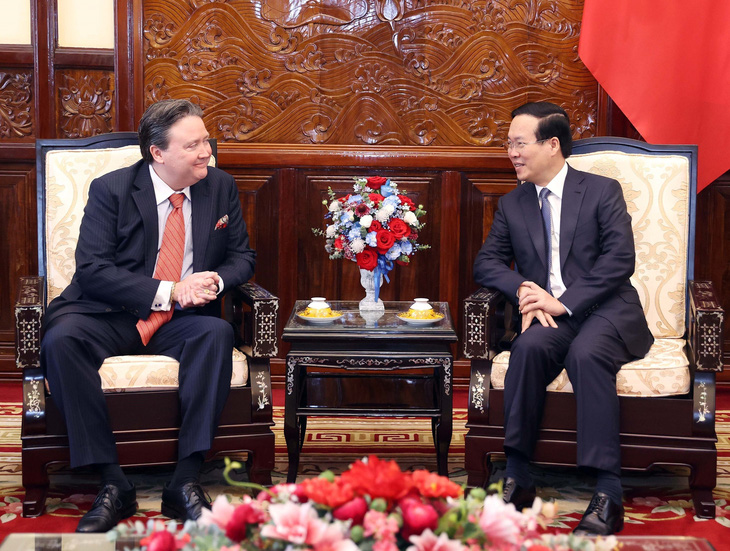
Vietnam always attaches significance to developing its comprehensive cooperation with the U.S., one of its most important partners in the world, State President Vo Van Thuong told Ambassador Marc Knapper.
President Thuong was speaking at his meeting with the ambassador at the Presidential Palace in Hanoi on Monday, during which he also brought forward some suggestions for further promoting the Vietnam – U.S. comprehensive partnership that was set up in 2013, the Vietnam News Agency reported.
Tiếp tục đọc “Vietnam sees US among top partners: State President Vo Van Thuong”Biden Hopes for Vietnam Breakthrough
COMMENTARY
(Foreign Policy) RAND Corporation 
U.S. Secretary of State Antony Blinken meets with Vietnam’s Communist Party General Secretary Nguyen Phu Trong in Hanoi, Vietnam, April 15, 2023
Photo by Andrew Harnik/Pool via REUTERS
May 12, 2023
During a ceremony held in Washington to commemorate the Lunar New Year in 2011, then–Vietnamese Ambassador to the United States Le Cong Phung surprised the audience by announcing that the two countries would raise their ties to the level of “strategic partnership.” Phrases describing partnerships can be nebulous, of course. But from what we know about Vietnamese diplomacy, Hanoi’s definition of strategic partnership is not just boilerplate, but signifies concrete, mutual, long-term strategic interests.
Vietnamese officials, however, never followed up on Phung’s newsworthy announcement. Instead, Washington and Hanoi announced a comprehensive partnership in 2013—a relationship that implies a less-serious geopolitical alignment for Vietnam. The United States has been left wondering why.
Tiếp tục đọc “Biden Hopes for Vietnam Breakthrough”US, Japan to help Vietnam with bomb, mine clearance
TT – Wednesday, April 05, 2023, 17:36 GMT+7
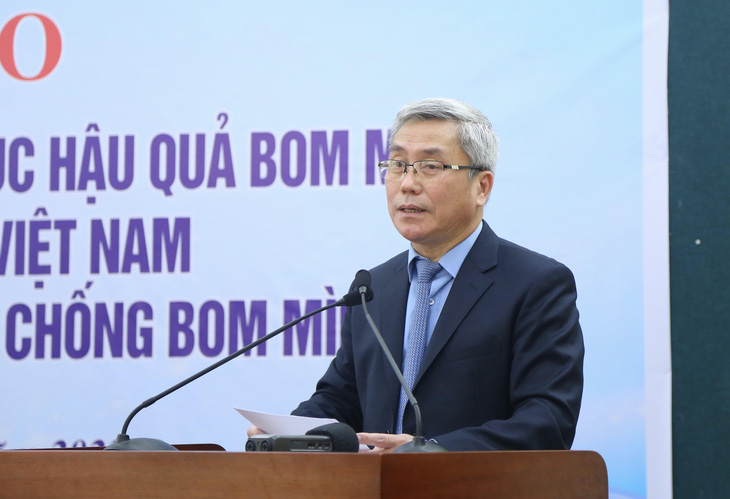
The United States Department of Defense expressed its desire to send experts to Vietnam to help the Southeast Asian country conduct bomb and mine detection and clearance work, while Japan might donate special equipment worth over VND93 billion (US$4 million) to Vietnam.
Colonel Nguyen Hanh Phuc, deputy general director of the Vietnam National Mine Action Center, made this announcement at a press briefing on tackling post-war bomb and mine consequences in Hanoi on Tuesday.
Tiếp tục đọc “US, Japan to help Vietnam with bomb, mine clearance”
 CVD
CVD 