Medicines and cosmetics use substances derived from nature. But Bioprospecting can turn into biopiracy. More and more companies are patenting natural ingredients making billions. It can come at a cost to the environment and traditional communities living in biodiversity-rich regions.
Tảo hôn vẫn diễn ra dai dẳng ở nhiều nhóm dân tộc thiểu số tại Việt Nam. Để giải quyết tình trạng này, Nhà nước cần tạo mọi điều kiện nhằm giúp trẻ em DTTS, đặc biệt là trẻ em gái, được dễ dàng tiếp cận các cơ hội học tập và tìm kiếm việc làm. Khi thấy tương lai rộng mở phía trước, các em gái DTTS sẽ thêm vững tin trên con đường học tập và tự chủ kinh tế. Từ đó, các em có thể làm chủ cuộc đời mình và góp phần nâng cao nhận thức cộng đồng để đẩy lùi nạn tảo hôn.
(vhds.baothanhhoa.vn) – Tảo hôn. Học sinh bỏ trường, bỏ lớp đi… “lấy chồng”, rồi lại làm bố, làm mẹ ở cái tuổi “ăn chưa no, lo chưa tới”. Giấc mơ đời, vì thế cứ quẩn quanh…
Thứ 6, 27/06/2025 | 08:00 GMT+7
Trường PTDT Bán trú THCS Trung Lý (Mường Lát) tổ chức cho học sinh thi bóng chuyền.
LĐO – Huy Tuấn – Chủ nhật, 14/12/2025 08:48 (GMT+7)
Nghề làm tranh dân gian Đông Hồ của tỉnh Bắc Ninh đã chính thức được UNESCO ghi danh vào danh sách Di sản văn hóa phi vật thể cần bảo vệ khẩn cấp.
Đây là dấu mốc lịch sử, mở ra cơ hội mới trong hành trình bảo tồn và phát huy giá trị một di sản truyền thống đang đứng trước nguy cơ mai một.
Phóng viên Báo Lao Động đã có cuộc trao đổi với ông Mai Sơn – Ủy viên Ban Thường vụ Tỉnh ủy, Phó Chủ tịch Thường trực UBND tỉnh Bắc Ninh, Trưởng Đoàn công tác của tỉnh Bắc Ninh tham dự kỳ họp của UNESCO diễn ra tại New Delhi (Ấn Độ) về quá trình tỉnh Bắc Ninh phối hợp xây dựng và hoàn thiện hồ sơ đề cử trong thời gian qua, chương trình hành động để bảo vệ và phát huy giá trị của di sản trong tình hình mới.
In November, 115 states voted in favor, eight voted against, and 44 abstained from voting on a resolution adopted by the General Assembly’s First Committee that examines the possible risks of integrating AI into nuclear weapons systems. Image: depositphotos
The United Nations rarely moves fast on disarmament. This year, though, it did something unusual. On November 6, the General Assembly’s First Committee, where states debate over questions of disarmament and international security, adopted a resolution that directly looks at the possible risks of integrating artificial intelligence into nuclear weapons systems, especially in nuclear command, control, and communications, known as NC3. Austria, El Salvador, Kazakhstan, Kiribati, Malta, and Mexico pushed the text, bringing into a formal setting a problem that has mostly lived in expert circles and informal dialogues.
With 115 states voting in favor, eight voting against, and 44 abstaining, support was broad. Nuclear-armed states and many of their allies voted against the resolution or chose to abstain. In contrast, the Global South and most non-nuclear-weapon states expressed strong support. This split reflects how each group views threats and what policies they prioritize. It also reveals how early and unsettled global thinking on AI in the nuclear field still is. Rather than seeing the outcome of the vote as a clear-cut failure or success, it may be best read as an initial test case. In other words, the resolution was an early attempt to translate a fast-moving technical debate into diplomatic language.
“We did not stop the holocaust. We did not stop the genocide in Ruanda. We did not stop the genocide in Srebrenica. We must stop the genocide in Gaza. There are no excuses any more. None.”
Ireland – PM Addresses United Nations “We have recognised the State of Palestine.”
Viet Nam – State President Addresses United Nations “Viet Nam welcomes the recent recognition of the State of Palestine by more countries, and urges the international community to act swiftly to end the humanitarian crisis faced by the Palestinian people.”
UNITED NATIONS, Aug 1 (Reuters) – A United Nations report seeking ways to improve efficiency and cut costs has revealed: U.N. reports are not widely read.
U.N. Secretary-General Antonio Guterres briefed countries on Friday on the report, produced by his UN80 reform that focused on how U.N. staff implement thousands of mandates given to them by bodies like the General Assembly or Security Council.
The Reuters Daily Briefing newsletter provides all the news you need to start your day. Sign up here.
He said last year that the U.N. system supported 27,000 meetings involving 240 bodies, and the U.N. secretariat produced 1,100 reports, a 20% increase since 1990.
Advertisement · Scroll to continueReport This Ad
“The sheer number of meetings and reports is pushing the system – and all of us – to the breaking point,” Guterres said.
“Many of these reports are not widely read,” he said. “The top 5% of reports are downloaded over 5,500 times, while one in five reports receives fewer than 1,000 downloads. And downloading doesn’t necessarily mean reading.”
Guterres launched the UN80 taskforce in March as the U.N. – which turns 80 this year – faces a liquidity crisis for at least the seventh year in a row because not all 193 U.N. member states pay their mandatory regular dues in full or on time.
The report issued by the taskforce late on Thursday covers just one of several reform angles being pursued.
Advertisement · Scroll to continueReport This Ad
Among the suggestions Guterres put forward on Friday: “Fewer meetings. Fewer reports, but ones that are able to fully meet the requirements of all mandates.”
(This story has been corrected to clarify that not all countries pay in full or on time, in paragraph 6)
Reporting by Michelle Nichols; editing by Diane Craft
– 83.4 million people were living in internal displacement at the end of 2024, more than twice as many as only six years ago (2018).
– 90 per cent had fled conflict and violence. In Sudan, conflict led to 11.6 million internally displaced people (IDPs), the most ever for one country. Nearly the entire population of the Gaza Strip remained displaced at the end of the year.
– Disasters triggered nearly twice as many movements in 2024 as the annual average over the past decade. The 11 million disaster displacements in the United States were the most ever recorded for a single country.
GENEVA, Switzerland – The number of internally displaced people (IDPs) reached 83.4 million at the end of 2024, the highest figure ever recorded, according to the Global Report on Internal Displacement 2025 published today by the Internal Displacement Monitoring Centre (IDMC). This is equivalent to the population of Germany, and more than double the number from just six years ago.
“Internal displacement is where conflict, poverty and climate collide, hitting the most vulnerable the hardest,” said Alexandra Bilak, IDMC director. “These latest numbers prove that internal displacement is not just a humanitarian crisis; it’s a clear development and political challenge that requires far more attention than it currently receives.”
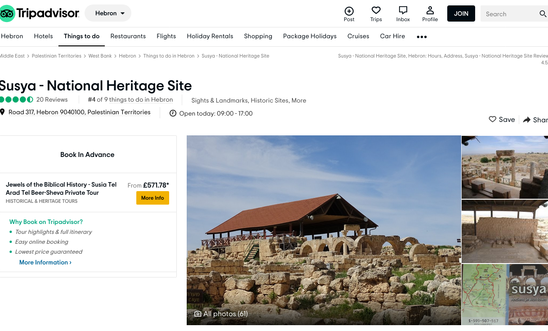
TripAdvisor listing of settler-managed historical sight on Palestinian land
The image above is a TripAdvisor listing of a heritage site managed by settlers in the village of Susiya – on Palestinian land. The UN has released a list of over 100 other companies that also have business interests in Israeli settlements built on Palestinian land.
But why is this a problem?
Illegal Settlements
In 1967, Israel began the process of building settlements on occupied Palestinian territory.
Firstly, what is a settlement?
It is Israel’s building of villages, towns and cities on occupied Palestinian territory.
What makes them illegal?
The transfer of Israeli civilians to these settlements is illegal under international law. In fact it is a war crime according to the Rome Statute of the International Criminal Court.
Hundreds of thousands Displaced
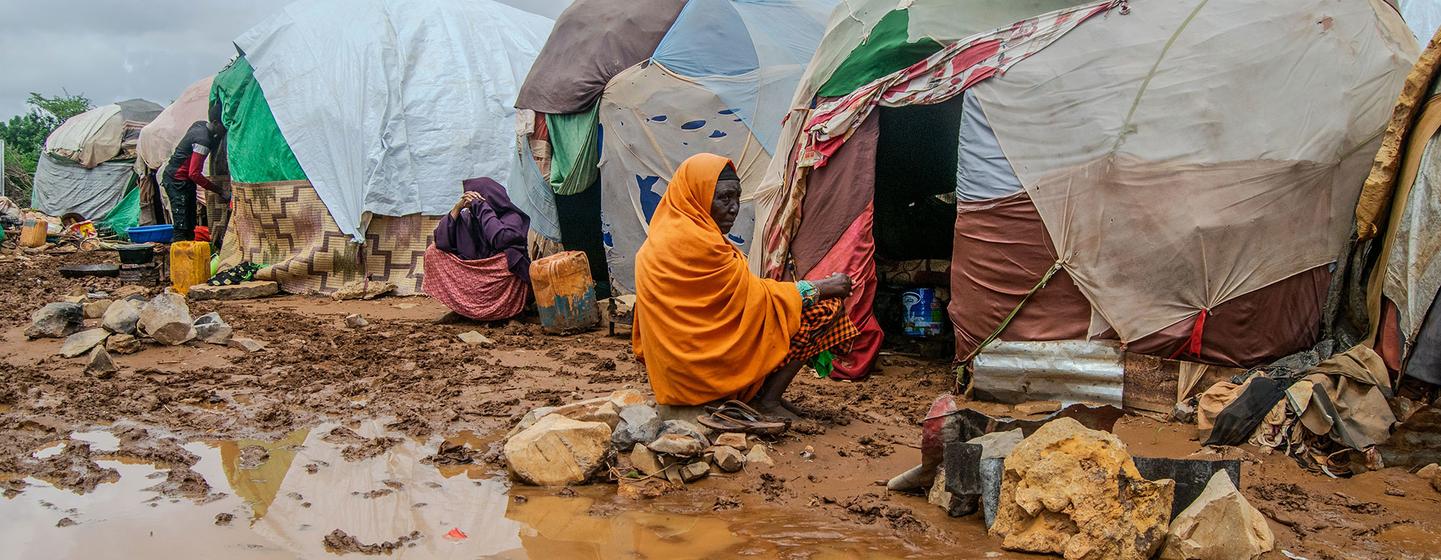
Since 1948, hundreds of thousands of Palestinians had to flee their homes to escape violence or were forcibly removed. Not just their they lost their land and businesses too. Many are remain in refugee camps till this day. Here they have become parents and even grand parents.
Suffocating laws
Some Palestinians stayed behind and refused to give up their land. Their lives have been made impossible as consecutive governments have introduced discriminatory laws and policies, in the hope they will eventually leave. But as the settlements continue to expand some are still standing their ground.
What TripAdvisor doesn’t show you
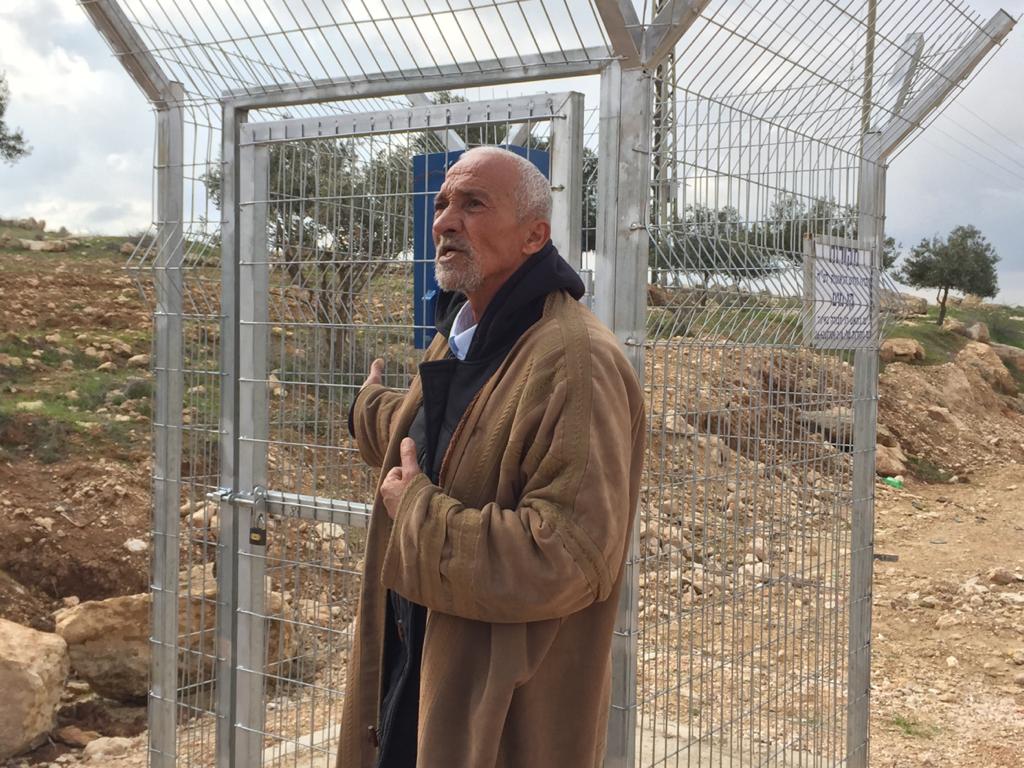
(A resident of Susiya shows us a water system installed on his land for the sole benefite of the nearby settlement)
The Palestinian village of Susiya, in the occupied West Bank is home to around 300 Palestinians. The village has a few tents and shacks, a couple of water cisterns and some sheep. There is no access to electricity or running water.
Mapped: The Countries with the Most Stateless People
Mapped: The Countries with the Most Stateless People
This was originally posted on our Voronoi app. Download the app for free on iOS or Android and discover incredible data-driven charts from a variety of trusted sources.
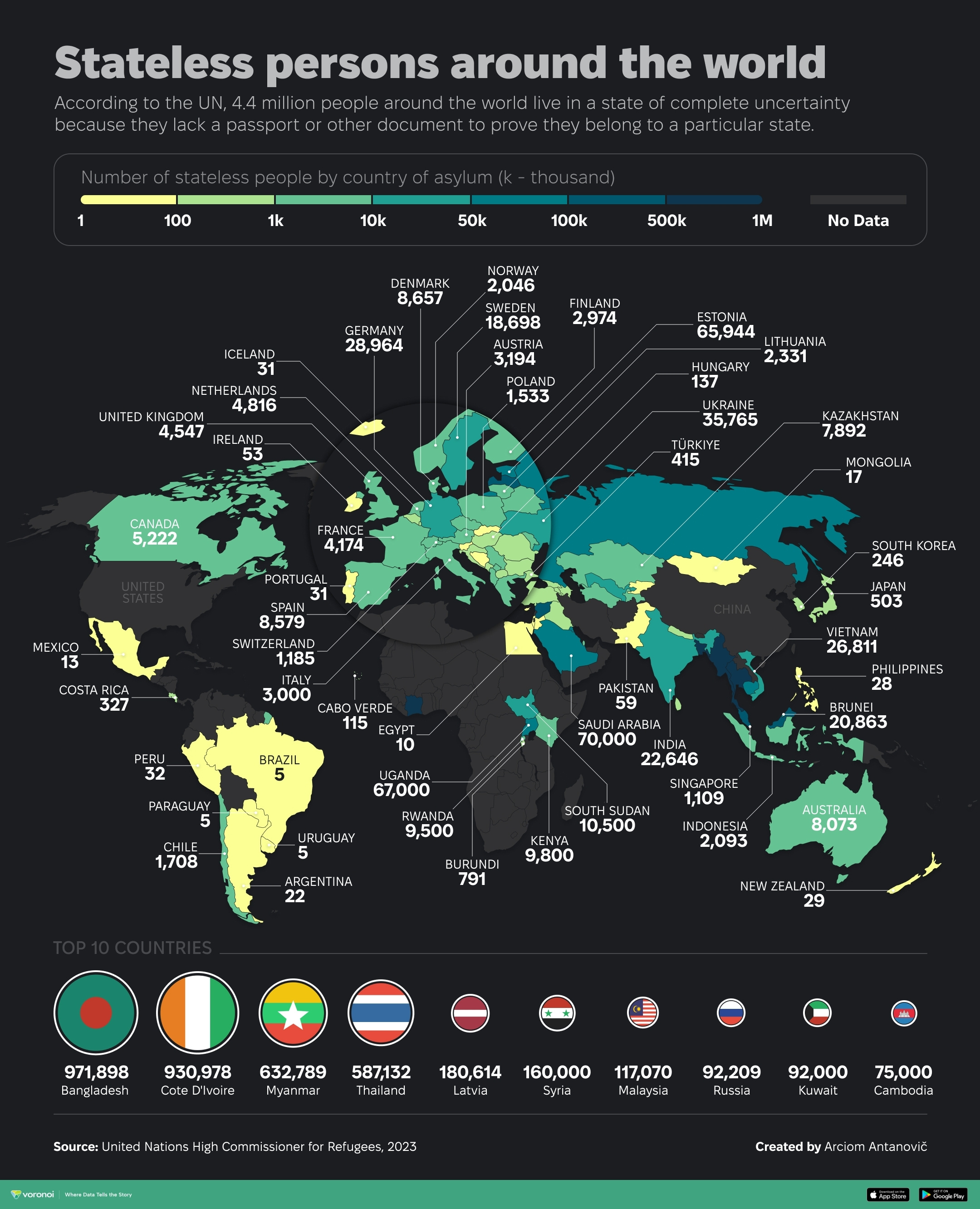
The United Nations High Commissioner for Refugees (UNHCR) officially recognizes over 4.4 million people worldwide as stateless or of undetermined nationality. However, the actual number is likely much higher due to data collection challenges.
Stateless persons—those not recognized as citizens of any country—are deprived of fundamental rights such as education, healthcare, and employment, leaving them highly vulnerable to exploitation and discrimination. But which countries have the most?
This map, created by Arciom Antanovič, uses data from the United Nations High Commissioner for Refugees to show the countries with the most stateless persons in 2023.
Bangladesh Tops the List
Certain countries are home to a disproportionate share of the world’s stateless people, often due to historical, social, and legal complexities.
Bangladesh comes in first with 971,898, followed by Côte d’Ivoire with 930,978, while Myanmar comes in third with 632,789.Search:
Country of Asylum
Stateless Persons
🇦🇱 Albania
2,018
🇦🇷 Argentina
22
🇦🇲 Armenia
520
🇦🇺 Australia
8,073
🇦🇹 Austria
3,194
🇦🇿 Azerbaijan
513
🇧🇩 Bangladesh
971,898
🇧🇾 Belarus
5,567
🇧🇪 Belgium
936
🇧🇦 Bosnia and Herzegovina
21
‹12345…10›
The raw number drops significantly after the fourth-placed Thailand with 587,132, as the fifth-placed Latvia only has 180,614.
The Causes of Statelessness
One of the primary drivers of statelessness is that in some countries, nationality can only be inherited through the father. When fathers are absent, the children may be left without a recognized nationality. This issue is particularly harmful for single mothers and families separated by conflict or migration.
Another significant cause of statelessness is racial and ethnic discrimination. Some governments use citizenship laws to exclude specific minority groups. In Myanmar, the Rohingya are a well-known example of such discrimination.
Geopolitical changes, such as shifting borders and citizenship revocation, also contribute to the issue. Governments sometimes strip individuals of their nationality as a punitive measure.
Cambodia’s Angkor Wat, or “City of Temples”, is the largest religious structure in the world.
A truly spectacular place, it is deeply revered across Cambodia and depicted on its flag as the defining image of the nation.
In 1992, UNESCO designated Angkor as a World Heritage Site.
The UN agency also affirmed it as a “living” site whose traditional communities were as important as the stones.
But now, locals accuse the Cambodian government of the mass forced eviction of thousands of people from those communities, while the government claims each one has voluntarily moved after settling illegally in Angkor. It also says the relocations are at UNESCO’s behest.
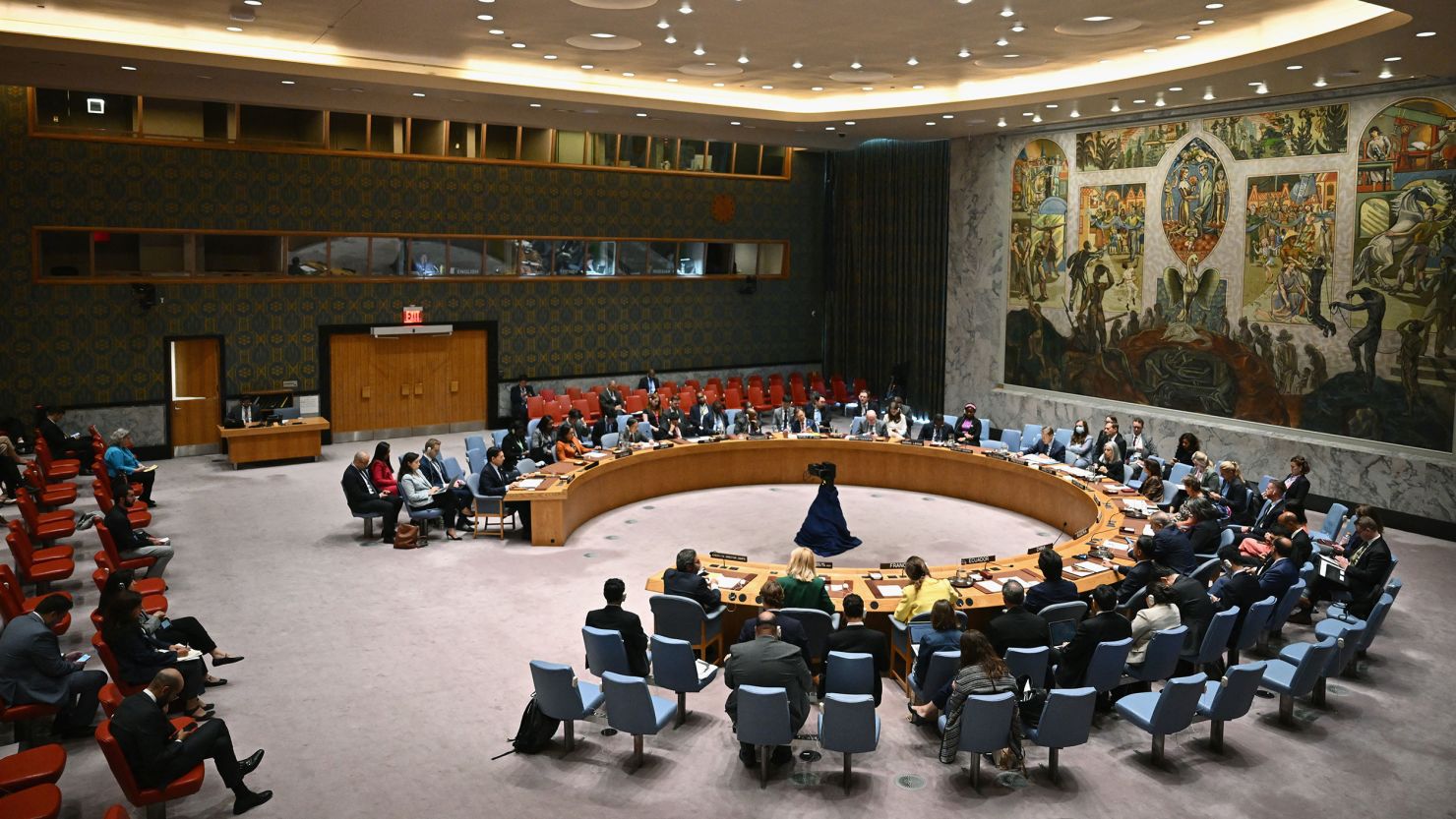
View of the UN Security Council as they meet on the situation in the Middle East on September 16, 2024 in New York City. Angela Weiss/AFP/Getty ImagesUnited NationsCNN —
It’s time for UNGA 79!
Quick explanation: the United Nations General Assembly is an annual world leaders’ summit that has gone on for nearly eight decades since the international body’s founding in San Francisco. It’s a place for long speeches, private country-to-country whisper sessions, and group meetings on everything from regulating artificial intelligence to global conflicts.
This year features a UN once again caught in a debate over its relevancy while attempting to stem wars in Gaza, Ukraine and Sudan. All of which its Secretary General Antonio Guterres is keen to remedy.
UNESCO said the dossier meets all technical requirements outlined in the World Heritage Convention.
Chùa Đồng (Bronze Temple), a temple in the complex, is situated atop the highest peak of the Yên Tử Mountain and is cast entirely from bronze. — VNA/VNS Photo
HÀ NỘI – UNESCO has responded to the dossier seeking its recognition of the Yên Tử – Vĩnh Nghiêm – Côn Sơn, Kiếp Bạc Monuments and Landscapes Complex as a world heritage site, according to the Cultural Heritage Department under the Ministry of Culture, Sports and Tourism.
UNESCO said the dossier meets all technical requirements outlined in the World Heritage Convention.
The UN is tasked with tackling many urgent issues of global importance, from humanitarian crises to peacekeeping operations and the climate crisis. This all comes at a cost, but not as much as you might think. With the 2024 budget recently approved, we crunch the numbers.
Just before Christmas, the 193 Member States that make up the UN General Assembly signed off a $3.59 billion budget to cover the expenses of the UN Secretariat in 2024. That’s a lot of money but, as UN Deputy Spokesperson Farhan Haq explained to UN News, there’s plenty of bang for each buck spent.
Farhan Haq: When you add up the regular UN Secretariat and peacekeeping budgets, the annual average cost of the UN for each person on the planet is about $1.25; that’s about the cost of a bag of chips in New York.
Aside from the U.N. Secretariat, the United Nations also comprises a vast range of agencies, funds, programmes and peacekeeping missions to deal with all kinds of issues, which are funded separately, and which are not included in the $3.59 billion budget.
At the high end you have agencies such as the World Food Programme, the refugee agency (UNHCR) and the children’s fund (UNICEF), which have budgets in the billions of dollars. Smaller agencies deal with, for example, maritime affairs, world tourism or civil aviation, and have budgets set accordingly. Member States join and pay dues for these agencies on a voluntary basis.
“2023 has been a year of enormous suffering, violence, and climate chaos. Humanity is in pain.
Our planet is in peril. 2023 is the hottest year on record.
People are getting crushed by growing poverty and hunger. Wars are growing in number and ferocity. And trust is in short supply.
But pointing fingers and pointing guns lead nowhere.
Humanity is strongest when we stand together.
2024 must be a year for rebuilding trust and restoring hope. We must come together across divides for shared solutions. For climate action.
For economic opportunity and a fairer global financial system that delivers for all.
Together, we must stand up against the discrimination and hatred that are poisoning relations between countries and communities. And we must make sure new technologies such as artificial intelligence are a force for good.
The United Nations will keep rallying the world for peace, sustainable development and human rights.
Let’s resolve to make 2024 a year of building trust and hope in all that we can accomplish together.

 Trường PTDT Bán trú THCS Trung Lý (Mường Lát) tổ chức cho học sinh thi bóng chuyền.
 In November, 115 states voted in favor, eight voted against, and 44 abstained from voting on a resolution adopted by the General Assembly’s First Committee that examines the possible risks of integrating AI into nuclear weapons systems. Image: depositphotos


 CVD
CVD 