Among Gaza’s population of 2.2 million people, 1 in 4 are women and girls of reproductive age – around 572,000 – who need access to reproductive health services. An estimated 50,000 pregnant women are caught up in the conflict, with around 5,500 due to give birth within the next 30 days – more than 160 deliveries every day. An estimated 840 women may experience pregnancy or birth-related complications. Many of these women have been cut off from safe delivery services, as hospitals, which are overwhelmed with casualties, run out of fuel for generators, medicines and basic supplies – including for the management of obstetric emergencies.
Around 73,000 women are currently pregnant in the West Bank, with more than 8,120 expected to give birth in the next month as the violence threatens to spill over.
UNFPA is dispatching life-saving reproductive health medicines and supplies to Egypt for stockpiling and transportation across the border into Gaza when possible. As of 26 October, UNFPA has 3,000 dignity kits containing hygiene supplies in Egypt, ready to go into Gaza, as well as life-saving reproductive health supplies, prepositioned and ready to be sent through Egypt. These health kits and supplies save the lives of pregnant women – they are as vital as food, water, shelter.
Among other initiatives, a UNFPA-supported helpline is available for women, youth and other people requiring assistance in Gaza and the West Bank
In the West Bank, the Ministry of Health has redeployed midwives from hospitals to Safe Motherhood Emergency Centres supported by UNFPA, ensuring that midwives are accessible in every community. In addition, online support systems and referral services are helping to ensure women’s continued access to sexual and reproductive health care.
With more than half of Gaza’s population displaced, the risk of gender-based violence has also increased exponentially for women and girls who are on the move, seeking refuge in overcrowded shelters, which lack privacy and sanitation facilities.
UNFPA condemns the violence in Israel and the occupied Palestinian territories and echoes the UN Secretary-General’s call for an immediate ceasefire, for the immediate and unconditional release of hostages by Hamas, and for unimpeded access for humanitarian aid and workers within Gaza.
“I just want the bombardment to stop so I can go back to school.” The daughter of Al Jazeera correspondent Youmna ElSayed describes what Israeli bombardment is like in Gaza, in a conversation with her mother.
Gaza is a virtual prison with hardly any way in or out. And it has been so since ten years ago when Al Jazeera entered Gaza to talk to the grandchildren of Fatima al Najar, who had recently achieved a strange kind of fame as the oldest Palestinian suicide bomber.
These children, whose lives had been shaped by the oppressive conditions imposed on the territory by Israel, spoke frankly about the hopes, and fear, for their future. Tehal was just ten at the time, and wanted to be the first female president of Palestine.
She said she had three priorities; to clean up the mess left behind by the Israeli bulldozers, to give children their rights, and “to build a new Gaza”. In contrast, another young girl – Rana – hoped to become a journalist, “So I can tell the people how we suffer here. I am a child, I know what death means, I know what war means, I know what blood means.”
These and other children opened their hearts in a moving show of optimism in the face of the dire conditions in which they lived.
Now, a decade on, Rewind returns to Gaza in search of the children featured in Children of Conflict, now young adults.Once again they speak to Al Jazeera’s cameras contrasting their aspirations of ten years ago with the reality of today.
UNICEF OCTOBER 26, 2023 by UNICEF Executive Director Catherine Russell
The true cost of the violence in Gaza and Israel will be measured in children’s lives—those lost to the violence and those forever changed by it.
Less than three weeks on from the horrific attack inside Israel and the start of daily bombings of the Gaza Strip, the devastating tally in Israel and Gaza is quickly adding up. More than 2,700 Palestinian children have been killed and nearly 6,000 injured, according to Gaza’s Ministry of Health, for a shocking average of more than 480 child casualties per day.
More than 30 Israeli children have reportedly been killed, while at least 20 remain hostage in the Gaza Strip, their fates unknown.
Sadly, more suffering and death is on the horizon.
Gaza is one of the most densely populated places on Earth—home to more than 2 million people, nearly half of whom are children. More than 1 million people in the north have been warned to move south, ahead of what is expected to be a wide-scale military operation. But with near-constant shelling, closed borders, and little room for movement, they have nowhere truly safe to go.
Meanwhile, what clean water remains is quickly running out, leaving many Gazans with little choice but to rely on polluted wells. This dramatically increases the risk of waterborne-disease outbreaks. Unless access to safe drinking water is restored, people will die from severe dehydration and illness, with children the most vulnerable.
TTCT – Israel đang triển khai một sách lược rất kiểu “tát nước bắt cá” có nguy cơ gây ra một thảm họa nhân đạo tại Dải Gaza trong cuộc chiến Trung Đông hiện giờ.
Trẻ em Palestine trên xe cứu thương, ngay sau vụ tấn công bệnh viện Al-Ahly ở Gaza ngày 17-10. Ảnh: Reuters
Sau hai tuần chiến tranh, ngày 21-10, 20 xe tải, tức 400 tấn hàng cứu trợ, được cho phép vào Dải Gaza bị Israel vây hãm. Đây là kết quả sau khi thương thuyết, thảo luận tới lui và Israel lúc thuận lúc không.
Nguyên tắc của Israel là nếu Hamas buông súng đầu hàng thì Gaza sẽ được tiếp tế. Trừng trị tập thể, như ta biết, là vi phạm quy ước quốc tế. Không thể vì 2.000 du kích mà đánh bom và bỏ đói tập thể hơn 2 triệu người dân tại Gaza.
Đây chẳng phải là việc lén lút, mà là chính sách công khai của Israel mang tên “Sách lược Dahiya”, do tham mưu trưởng Gadi Eizenkot (2015-2019) chủ trương từ lúc ông là tư lệnh mặt trận miền bắc đối diện Lebanon. Trong chiến tranh với Hezbollah tại Lebanon (2006), Dahiya là khu ngoại ô Beirut do Hezbollah quản lý.
Cenk Uygur, a Turkish-American political commentator and media host. He is the creator of The Young Turks
“We have to have two state solution immediately. I’m asking Israeli not out of hate….So many of my friends I grew up with are Jewish. This is not good for them. This is not good for any body. Please look into your hearts. Look. Be the moral that I know you can be. I’ve been to the Passover dinner where you pray for your oppressors. Now I breaks my heart. But I have to tell you, you have to pray for those you’re oppressing. And saying you’re not oppressing them after brutalizing them for 56-long years. You’re kidding yourself. And as a friend and an ally, I’m trying to get you wake up. You can not keep doing this.
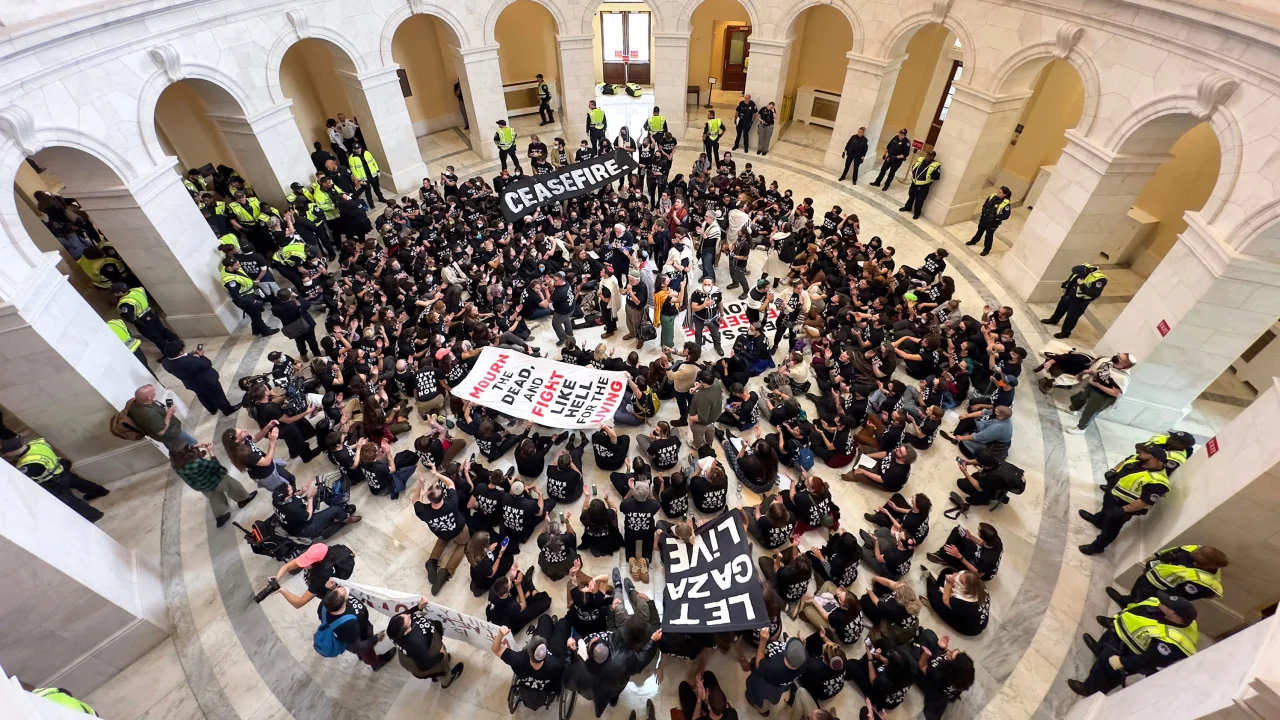
Jewish peace activists staged a sit-in on Capitol Hill, where they called for an immediate ceasefire in the Israel-Gaza war on October 18.Jim Lo Scalzo/EPA-EFE/ShutterstockCNN —
As Rabbi Alissa Wise scrolls through social media, her feed is littered with videos of dead Palestinian children, parents holding their lifeless bodies with screams caught in their throats and eyes sunken with grief.
Like millions around the world, she has been haunted by the gruesome scenes flooding out of Gaza, where civilians have endured more than two weeks of an Israeli siege and bombing campaign that has collapsed homes, destroyed vital infrastructure and sparked a humanitarian crisis.
The airstrikes have killed more than 4,600 Palestinians so far, including an estimated 1,900 children, and wounded at least 14,000 others, according to the Palestinian Ministry of Health in Gaza. Another 1.4 million people have been internally displaced, the United Nations Office for the Coordination of Humanitarian Affairs said.
Click here for the PDF version Puede encontrar aquí los números de “Noticias de Acción de las ONG” en español. Priere de trouver ci-joint les bulletins “NGO Action News” en français. للحصول على الترجمة العربية لأنباء عن أعمال المنظمات غير الحكومية،يرجى زيارة هنا
Middle East On 25 October, the Institute for Palestine Studies published an article titled “Real Names of Stolen Villages, Illegal Settlements of the Gaza Perimeter,” noting the violent history of the farming communities surrounding Gaza.
On 25 October, the BADIL Resource Center for Palestinian Residency and Refugee Rights published an open letter to the UN General Assembly and its member states, calling on them to enforce an unconditional ceasefire, provide unrestricted and unconditional humanitarian aid, prevent additional displacement, and end the blockade on the Gaza Strip.
On 24 October, Addameer Prisoner Support and Human Rights Association shared a letter sent by the Palestinian Human Rights Organizations Council to the International Committee of the Red Cross (ICRC), expressing alarm over the recent deaths of two Palestinian prisoners in Israeli detention, and calling on the ICRC to ensure the safety and well-being of Palestinian prisoners and detainees.
Gaza Teen Describes What Life For Her & Other Children Is Like Right Now. Sara Besasio, a 16-year-old who grew up in Gaza. Sara said she’s lived through 7 major Israeli military operations in her lifetime. She called on the global community to answer why kids like her have to suffer so much merely for growing up in Gaza.
Palestinian teenager Dima Allamdani lost 13 family members in an Israeli air attack after following the military’s orders to flee northern Gaza.
This 18-year-old girl had a message for the world before her and her family fled their home in Gaza.
Both sides are guilty of invoking the Holocaust, but the Palestinians do it defensively, the Israelis offensively.
In truth, the Palestinians have been so impacted by the implications of the Holocaust, albeit indirectly, that they have never truly understood its essence or comprehended its evil. Arabs are no strangers to colonial, imperial or ethnic violence, but nothing like the industrial-scale crimes perpetrated by Nazi Germany.
Aggrieved and angry, the Palestinians have long believed that it was they who paid the price for the horrors inflicted upon Jews in Europe…
…After all, the early Zionists chose to settle and build a homeland for Jews in Palestine nearly half a century before the Holocaust, knowing all too well that it is the homeland of another people. They wished it cleansed of its non-Jewish inhabitants.
Click here for the PDF version Puede encontrar aquí los números de “Noticias de Acción de las ONG” en español. Priere de trouver ci-joint les bulletins “NGO Action News” en français.للحصول على الترجمة العربية لأنباء عن أعمال المنظمات غير الحكومية،يرجى زيارة هنا
Israeli occupation of Palestine tends to be a touchy subject for news media, so much so that they break journalistic standards and writing etiquette just to avoid implicating one party over another — which still seems to end up working out in Israel’s favor and never Palestine’s. That’s led to a media environment that can’t clearly call out the ethnic cleansing and apartheid inflicted upon Palestinians, doesn’t point to context when talking about the results of decades-long oppression and displacement, and can’t help but equivocate about two disproportionately affected populations. But maybe that’s starting to change.
Sana Saeed looks at what U.S. media coverage has gotten wrong about recent events in Gaza, Sheikh Jarrah and occupied Palestine, and offers her own media critique.


 CVD
CVD 
