Giá cho thuê mặt biển của Việt Nam còn thấp

(TBTCVN) – Trao đổi với phóng viên TBTCVN, TS. Dư Văn Toán – Viện Nghiên cứu Biển và Hải đảo Việt Nam cho rằng, đơn giá cho thuê biển theo quy định tại Thông tư liên tịch số 198/2015/TTLT-BTC-BTNMT là quá thấp. Giá thấp sẽ khiến ngân sách nhà nước bị thất thu khoản này.
trang 3
Mỗi năm 1 triệu km2 biển Việt Nam có giá trị kinh tế tự nhiên khoảng 1.571 tỷ USD.

* PV: Thông tư liên tịch 198/2015/TTLT-BTC-TNMT có quy định về giá thuê mặt biển, trong đó giá cao nhất là 7,5 triệu đồng/ha. Ông có nhận định gì về đơn giá này?
Tiếp tục đọc “Giá cho thuê mặt biển của Việt Nam còn thấp”

Fear? Cost? Fame? What’s turning on Asian businesses to renewable energy?

eco-business.com

What is the main the reason corporations are buying renewable energy? Cost saving? Compliance? The goodness of their hearts?

The first is obvious—savings. I have never seen any company adopt renewables purely out of altruism. There’s always a commercial angle. Owners of large real estate portfolios try to monetise their “rooftop assets”, other companies want to diversify their energy source, or simply adopt solar to hedge against rising energy costs.

Businesses hardly ever adopt renewable energy for altruistic reasons, but does that matter? In this interview with Eco-Business, Lionel Steinitz, CEO of LYS Energy, talks about why firms go green, and how Southeast Asia can unlock its solar potential.

Lionel Steinitz, the founder and chief executive of Singapore-based renewable energy firm LYS Energy Group, came to Singapore nearly 20 years ago and spent his first year in the city-state serving the French army.
Tiếp tục đọc “Fear? Cost? Fame? What’s turning on Asian businesses to renewable energy?”

Bộ Công Thương Việt Nam và Bộ Ngoại giao Hoa Kỳ ký kết Bản ghi nhớ hợp tác (MOU) đối tác hợp tác năng lượng toàn diện

ERAV.vn

Chiều ngày 30/9/2019, tại trụ sở Bộ Ngoại giao, thủ đô Washington D.C., Hoa Kỳ, Bộ Công Thương Việt Nam và Bộ Ngoại giao Hoa Kỳ đã trao đổi Biên bản ghi nhớ Hợp tác (MOU) đối tác hợp tác năng lượng toàn diện. Buổi lễ diễn ra trước sự chứng kiến của Lãnh đạo các Bộ Ngoại giao, Bộ Năng lượng, Bộ Thương mại Hoa Kỳ và Bộ Công Thương Việt Nam, cũng như đại diện của nhiều Tập đoàn lớn của hai nước.

Với việc ký kết Biên bản ghi nhớ này, Việt Nam và Hoa Kỳ đã chính thức trở thành đối tác hợp tác năng lượng toàn diện. Đây cũng được kỳ vọng sẽ là dấu mốc quan trọng trong hợp tác năng lượng giữa Việt Nam và Hoa Kỳ, giúp mở ra một trang hợp tác mới, sâu sắc hơn và toàn diện hơn. Tiếp tục đọc “Bộ Công Thương Việt Nam và Bộ Ngoại giao Hoa Kỳ ký kết Bản ghi nhớ hợp tác (MOU) đối tác hợp tác năng lượng toàn diện”

Offshore wind farms could power much of coastal China

Sciencedaily.com

February 21, 2020

Source: Harvard John A. Paulson School of Engineering and Applied Sciences

Summary:If China is to meet and exceed its Paris Climate Agreement goal by 2030, it’s going to need to find a way to increase its wind capacity. Researchers found that offshore wind could be a big part of the solution.

Under the Paris Climate Agreement, China committed to rely on renewable resources for 20 percent of its energy needs by 2030. Currently, the country is on track to double that commitment, aiming to hit 40 percent by the next decade. Wind power is critical to achieving that goal. Over the past 20 years, China’s wind power capacity has exploded from 0.3 gigawatts to 161 gigawatts.

But, in recent years, that growth has slowed and the hopes for China’s wind-powered future have dampened.

Why? Location, location, location. Tiếp tục đọc “Offshore wind farms could power much of coastal China”

Khơi nguồn năng lượng biển Việt Nam

Bộ TNMT

Việt Nam còn rất nhiều tiềm năng năng lượng biển chưa khai phá, cho một tương lai môi trường ít phát thải, giảm ô nhiễm…

Quyết tâm khơi nguồn năng lượng biển

Biến đổi khí hậu, phát thải nhà kính từ các hoạt động sản xuất đang khiến cho Việt Nam khó khăn hơn khi tiếp cận mục tiêu thiên niên kỷ là đảm bảo phát triển kinh tế trong môi trường mang tính bền vững. Một giải pháp hoàn hảo được không ít các chuyên gia, nhà khoa học khuyến nghị hiện nay chính là hãy tận dụng nguồn năng lượng tái tạo.
Tiếp tục đọc “Khơi nguồn năng lượng biển Việt Nam”

Nghị quyết số 55-NQ/TW về định hướng Chiến lược phát triển năng lượng quốc gia

Battery Storage – Cost Projections for Utility-Scale

NREL

Battery storage costs have evolved rapidly over the past several years, necessitating an update to storage cost projections used in long-term planning models and other activities. This work documents the development of these projections, which are based on recent publications of storage costs. The projections show a wide range of storage costs, both in terms of current costs as well as future costs. Although the range in projections is considerable, all projections do show a decline in capital costs, with cost reductions by 2025 of 10-52%. The cost projections developed in this work utilize the normalized cost reductions across the literature, and result in 21-67% capital cost reductions by 2030 and 31-80% cost reductions by 2050. The cost projections are also accompanied by assumed operations and maintenance costs, lifetimes, and round-trip efficiencies, and these performance metrics are benchmarked against other published values.


Download full report https://www.nrel.gov/docs/fy19osti/73222.pdf


Điều gì cản trở các doanh nghiệp lớn chuyển sang năng lượng sạch tại Việt Nam?

English: What’s stopping corporates from switching to clean energy in Vietnam?

by Evan Scandling, Clean Energy Investment Accelerator

Nhu cầu năng lượng mặt trời quy mô lớn đang tăng ở Việt Nam, nhưng các rào cản vẫn tồn tại ở một thị trường phát triển mạnh về năng lượng tái tạo cho các doanh nghiệp lớn. Làm thế nào Việt Nam có thể dịch chuyển nhanh hơn để thực hiện tham vọng năng lượng sạch của mình?

Một cánh đồng điện gió ở tỉnh Ninh Thuận, miền Nam Việt Nam. AEON, nhà phát triển trung tâm mua sắm Nhật Bản và Anheuser-Busch InBev, nhà máy bia lớn nhất thế giới, có sự hiện diện lớn ở Việt Nam và cam kết chỉ mua năng lượng sạch.

Thị trường Việt Nam cho năng lượng tái tạo quy mô  lớn đang trên đà .

Chưa đầy một năm từ khi chưa có trang trại năng lượng mặt trời quy mô lớn nào, thì Việt Nam dự kiến ​​sẽ có hơn 4.200 megawatt (MW) năng lượng mặt trời được triển khai và cung cấp điện cho lưới điện quốc gia vào cuối tháng 6 năm 2019 khi Chương trình giá bán điện năng sản xuất từ nguồn năng lượng tái tạo (FIT) hết hạn. Thúc đẩy FIT trong và ngoài nước gần đây đã tăng lên, thu hút quan tâm của các nhà đầu tư và ước tính rằng hơn 4.600 MW dự án điện gió có thể được hoàn thành vào năm 2021. Bằng nhiều biện pháp nào, việc Việt Nam bổ sung hơn 8.000 MW điện mặt trời và gió mới vào mạng lưới chung trong một vài năm là rất ấn tượng, đặc biệt là khi Việt Nam nỗ lực giảm phát thải tới 25% trong khi vẫn đáp ứng nhu cầu về điện dự kiến ​​sẽ tăng trung bình 8% mỗi năm vào năm 2035. Tiếp tục đọc “Điều gì cản trở các doanh nghiệp lớn chuyển sang năng lượng sạch tại Việt Nam?”

APPLY NOW FOR THE 2020 ENERGY JOURNALISM INITIATIVE

COLUMBIA CENTER FOR ENERGY POLICY

We’re excited to announce  an open call for applications for the 2020 Energy Journalism Initiative, which will be held June 16-19, 2020, in New York at Columbia University. To apply, please complete our online application, and submit three samples of your work along with a letter of recommendation from your direct supervisor. Applications are due at 11:59 p.m. on Sunday, February 16, 2020.

APPLY NOW

Rapid changes are underway in the energy sector, we’re approaching a presidential election in the U.S., and climate change is getting more attention than ever before. It is imperative that journalists are equipped with the knowledge to report on the energy sector with insight and nuance. They are key to improving the dialogue around energy and environmental issues, creating a well-informed public and helping public and private sector leaders make good choices about our energy future. Tiếp tục đọc “APPLY NOW FOR THE 2020 ENERGY JOURNALISM INITIATIVE”

13 Facts About the Controversial Massive Chinese Dam That Slowed the Earth’s Rotation

interestingengineering.com

The Three Gorges Dam is one of the most ambitious and equally controversial projects on the planet.

How much do you know about the Three Gorges Dam? You have probably come across dams through your travels, or there may even be a dam near your home town.

SEE ALSO: 12 OF THE WORLD’S MOST FASCINATING DAMS

Dams can be awe-inspiring, human-made feats of engineering, powering the lives of the surrounding communities.

Yet, in the same breath dams are the subject of notable and significant national, regional or international controversy. And, no dam has garnered as much notoriety as the 3 Gorges Dam; a dam that is so massive in scale that it has actually slowed down the earth’s rotation.

For the uninitiated, a dam is a large barrier built across rivers and streams to confine and utilize the flow of water for human purposes such as irrigation and the generation of hydroelectricity.

So, if you have always wanted to hear the story behind the Three Gorges Dam and what makes it so controversial, it is your lucky day. An efficient man-made monument to innovation, or a destructive monstrosity? Today you will decide. Here are thirteen facts about Three Gorges Dam.

The Dam Was Originally Sun Yat-Sen’s Idea

Often considered the father of modern China, Sun Yat-sen originally proposed the idea of the Three Gorges Dam all the way back in early 1919. Overthrowing China’s Manchu dynasty in 1922,  Sun Yat-sen sparked the revolution that would plant the seeds of what would eventually become the Republic of China.

In an article titled, “A Plan to Development Industry”, Sun Yat-Sen proposed the idea of constructing a dam that not only would help control the flooding of the Yangtze River, but also embody China’s “new might.”  However, it would be a while before the project would come into fruition.

Three Gorges Is Massive

Though some claim the Three Gorges Dam is viewable from space, this is not true. Nevertheless, the dam is massive.  Made of steel and concrete, the steel dam is 7,661 feet long, almost 600 feet high.

Engineers needed 510,000 tons of steel to construct the massive dam. To put that in perspective, with the same resources you could build sixty different Eiffel Towers.

Tiếp tục đọc “13 Facts About the Controversial Massive Chinese Dam That Slowed the Earth’s Rotation”

A clean energy world would support millions of new jobs

Tiếp tục đọc “A clean energy world would support millions of new jobs”

Japanese Environment Minister opposes Vietnam coal-fired project involving Japan firm

Japanese Environment Minister Shinjiro Koizumi speaks to reporters at the venue of the 25th Conference of the Parties (COP25) to the U.N. Framework Convention on Climate Change, in Madrid, on Dec. 15, 2019. (Kyodo)

TOKYO (Kyodo) — Japanese Environment Minister Shinjiro Koizumi expressed opposition Tuesday to the planned construction of a coal-fired power plant in Vietnam involving a major Japanese trading firm, saying it is at odds with measures to mitigate global warming and subject to international criticism.

“This (project) is not something we can get the understanding of Japanese citizens or the international community for,” Koizumi said at a press conference, although he has no power to stop the plan.

Tiếp tục đọc “Japanese Environment Minister opposes Vietnam coal-fired project involving Japan firm”

In the Race to Power Vietnam, Green Energy Grows Faster Than Policies Can Catch Up

For a few months earlier this year, it seemed like there was no stopping the wave of renewable energy projects coming online in Vietnam.

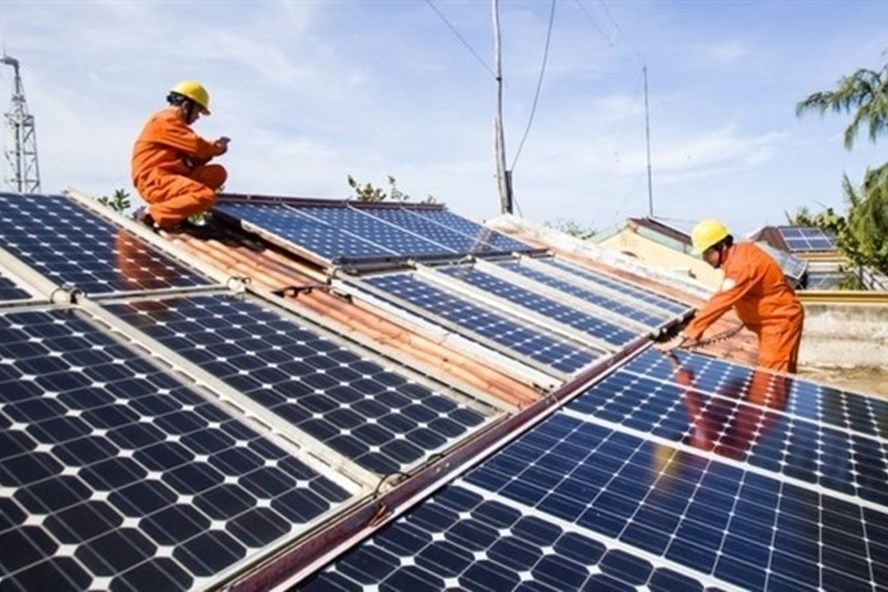
In March, the Srepok 1-Quang Minh solar power plant, Vietnam’s largest at the time, opened in Dak Lak Province. In September, it was surpassed by the Dau Tieng Solar Power Complex in Tay Ninh Province, which is Southeast Asia’s largest solar farm. The following month, the Asia Development Bank agreed to help fund the country’s first floating solar power facility on a reservoir in Binh Thuan Province. If built, it will be the region’s largest such facility. And in October, Vietnam Electricity (EVN) announced that 12,765 rooftop solar systems are selling power to the grid nationwide.

Wind power is expected to grow dramatically as well, with installed capacity forecast to more than triple by 2021, launching Vietnam toward the top of Southeast Asia in this sector. These projects were far from the only ones to come online recently. In the second quarter of this year, 81 new solar facilities were added to Vietnam’s power grid, compared to just five in the first quarter of 2019.

The Dau Tieng Solar Power Complex in Tay Ninh. Photo via VnExpress/Quynh Tran.

This growth in renewable power generation is vital, as in July, the Ministry of Industry and Trade (MOIT) admitted that the country is likely to face severe power shortages starting in 2021. Power generation capacity will need to increase from the current 48.6 gigawatts (GW) to 60 GW in 2020 and 130 GW by 2030. This is due to rapidly rising electricity demand as Vietnam continues its impressive economic growth, and delays on major thermal- and gas-fired power stations. Such an expansion of capacity is expected to cost nearly US$7 billion a year.

The explosion of solar projects in particular was spurred by a feed-in tariff (FiT) introduced by the Vietnamese government in 2017. A FiT is the rate paid by a power utility, in this case the government-owned Vietnam Electricity (EVN), to the company which operates a solar plant. The 9.35 US cents per kilowatt hour (kWh) tariff established by MOIT was very generous, and developers flooded in. A wind energy FiT was initiated in September 2018 as well, though growth hasn’t been quite as robust as solar.

Too much of a good thing?

The sheer numbers behind this solar surge are incredible, and Vietnam has become the darling of investment in the region, easily eclipsing its neighbors. The 86 new projects completed in the first half of this year added 4.5 gigawatts (GW) of capacity to the national grid, equaling about 10% of Vietnam’s total power capacity. EVN reportedly set up special teams working three shifts a day just to connect new plants.

The government had aimed to have 850 megawatts (MW) of solar online by 2020, while the 4.5 GW installed thus far has already reached their 2025 goal. Tiếp tục đọc “In the Race to Power Vietnam, Green Energy Grows Faster Than Policies Can Catch Up”

Vietnam faces growing threat to energy security, environment

By Nguyen Dang Anh Thi   January 11, 2020 | 02:00 pm GMT+7 VNExpress

Your family’s electricity bills might zoom this year as Vietnam is set to buy 1.5 billion kWh of power from Laos.

Nguyen Dang Anh Thi

Nguyen Dang Anh Thi

It has become necessary since a shortage is forecast for several years starting in 2020.

With the seventh National Power Development Plan (2011-2020) focusing primarily on traditional energy sources like thermal and hydropower, 47 out of 62 power projects, the majority being thermal, are behind schedule due to lack of funding and local resentment against thermal plants.

Tiếp tục đọc “Vietnam faces growing threat to energy security, environment”

Mười sự kiện nổi bật của ngành Năng lượng Việt Nam năm 2019

09:13 |31/12/2019

Năng lượng Việt Nam

Song hành với những thành tựu phát triển kinh tế ngoạn mục, trong năm qua ngành Năng lượng Việt Nam cũng có những điểm nổi bật cả về chính sách mới của Chính phủ, những thành công đáng ghi nhận ở tầm khu vực và cả những mối quan tâm lớn về đảm bảo an ninh cung cấp năng lượng trong dài hạn, khi mà lượng nhập khẩu than, dầu thô cùng tăng cao. Hành trình bước vào năm mới – 2020, sau khi phân tích, cân nhắc dữ liệu từ các chuyên ngành (điện, than, dầu khí, năng lượng tái tạo…), các chuyên gia Tạp chí Năng lượng Việt Nam đã bình chọn 10 sự kiện nổi bật, quan trọng của ngành Năng lượng Việt Nam năm 2019 để bạn đọc cùng tham khảo. Tiếp tục đọc “Mười sự kiện nổi bật của ngành Năng lượng Việt Nam năm 2019”