DEA and MOIT jointly launch Vietnam Energy Outlook Report 2017

Danish Energy Egency

News   •   Sep 20, 2017 20:24 CEST

Today Mr. Thomas Egebo, Permanent Secretary of State, Danish Ministry of Energy, Utilities and Climate and Mr. Hoang Quoc Vuong, Vice Minister of the Ministry of Industry and Trade (MOIT) in Vietnam signed the Programme Document of the Energy Partnership Programme between Viet Nam and Denmark. The signing marks the beginning of another three years of close cooperation between the Danish Energy Agency and Ministry of Industry and Trade with a total budget of 21.6m DKK. Tiếp tục đọc “DEA and MOIT jointly launch Vietnam Energy Outlook Report 2017”

What happens when the coal and nuclear plants close?

Updated 2:11 pm, Tuesday, September 19, 2017

 
When future policy makers go back and study the U.S. energy industry in the 2010s, one of the defining trends will be the sudden decline of coal and nuclear plants.

Whether this is the beginning of a great new era of American energy or a disaster in the making is the subject of much debate.

And now add another voice to the mix, as the research firm IHS Markit warned in a report released Tuesday that the shift away from coal and nuclear is likely to leave the U.S. grid overly reliant on natural gas and renewable forms of energy and prone to more expensive and volatile electricity prices than we currently enjoy. Tiếp tục đọc “What happens when the coal and nuclear plants close?”

Legal framework, roadmap needed for Việt Nam’s wind power

vietnamnews

Update: July, 29/2017 – 12:40

Việt Nam needs to develop a legal framework and feasible roadmap to turn its wind energy potential into reality, which will help to meet the country’s rapidly rising electricity demand. – Photo qdnd.com.vn

HÀ NỘI – Việt Nam needs to develop a legal framework and feasible roadmap to turn its wind energy potential into reality, which will help to meet the country’s rapidly rising electricity demand, experts have said.

Tobias Cossen, head of GIZ’s project on supporting the up-scaling of wind power said that Việt Nam has great potential to develop wind power as the country possesses around 3,000 km of coastline with excellent wind conditions. Tiếp tục đọc “Legal framework, roadmap needed for Việt Nam’s wind power”

Bến Tre thu hút 7 dự án điện gió

Trung Chánh Thứ Năm,  20/7/2017, 10:20 (GMT+7)
Bến Tre đã trao quyết định chủ trương đầu tư cho 7 dự án năng lượng sạch. Trong ảnh là một dự án điện gió ở ĐBSCL. Ảnh minh họa: Trung Chánh

(TBKTSG Online) – UBND tỉnh Bến Tre đã trao quyết định chủ trương đầu tư cho 7 dự án điện gió với tổng vốn đầu tư là 16.371 tỉ đồng và 180 triệu đô la Mỹ.

Thông tin nêu trên được công bố tại hội nghị “Xúc tiến đầu tư tỉnh Bến Tre năm 2017” diễn ra tại tỉnh vào hôm nay (20-7).

Tiếp tục đọc “Bến Tre thu hút 7 dự án điện gió”

Tiềm năng phát triển năng lượng gió biển ở Việt Nam

DTMN – 09:17, 12/07/2017


Cần sớm xây dựng Chiến lược chính sách phát triển điện gió biển Việt Nam. Ảnh minh họa: nangluongvietnam.vn

 Hiện than đá, dầu mỏ, khí đốt trong tương lai gần sẽ cạn kiệt, nên nhiều nước tập trung phát triển tài nguyên năng lượng gió. Giá của điện khai thác từ năng lượng gió đã xấp xỉ với giá điện từ các nguồn nhiên liệu hóa thạch truyền thống. Tài nguyên năng lượng gió là nguồn năng lượng mới và phát triển mạnh nhất trên thế giới trong thời đại ngày nay. Năng lượng gió trên biển được chuyển đổi thành điện năng nhờ các tuốc bin gió và được chế tạo với tuổi thọ cao hơn phù hợp với điều kiện khắc nghiệt trên biển. Vì vậy, phát triển năng lượng gió biển Việt Nam hướng tới mục tiêu giảm thiểu tác động biến đổi khí hậu, là một trong những giải pháp được đánh giá là khả thi hiện nay.

Tiếp tục đọc “Tiềm năng phát triển năng lượng gió biển ở Việt Nam”

Việt Nam có thể đạt 100% năng lượng tái tạo vào năm 2050

G.S Nguyễn Khắc Nhẫn ĐH Grenoble

A. Cách mạng năng lượng

Thế giới, vốn quen với nguồn dầu mỏ dồi dào và giá rẻ, chỉ bừng tỉnh sau cơn khủng hoảng dầu mỏ đầu tiên vào năm 1973. Trong suốt nhiều thập niên, các công ty công nghiệp nhiệt, im lặng trước sự lạm dụng quá mức năng lượng hóa thạch đầy carbon, đã đi vào con đường hủy diệt hệ sinh thái ở mức độ toàn cầu.

Hệ thống năng lượng khắp mọi nơi hiện nay, vẫn còn dựa trên các nguồn năng lượng lưu trữ (than, dầu mỏ, khí, uranium), đang chuyển biến mạnh mẽ.

Trên đường hướng đến một nền kinh tế xanh và số hóa, thế giới đang tiến sâu vào một cuộc cách mạng năng lượng. Ta chứng kiến những đột phá và thay đổi lớn lao. Công nghệ số và Internet cũng đóng một vai trò quan trọng trong lĩnh vực năng lượng. Các nguồn thông lượng (thủy điện, mặt trời, gió, sinh khối, năng lượng biển…), miễn phí và có mặt trên toàn cầu, sẽ chiếm lĩnh thị trường. Không nên quên rằng năng lượng mặt trời có thể cung cấp ít nhất là 20 lần tổng lượng điện tiêu thụ hiện nay của thế giới. Mặt trời, cũng như gió, sẽ cho phép 1.5 tỉ người chưa hề biết năng lượng là gì nhanh chóng có điện để sử dụng hàng ngày. Tiếp tục đọc “Việt Nam có thể đạt 100% năng lượng tái tạo vào năm 2050”

Cần có bước đột phá trong chiến lược phát triển năng lượng tái tạo

21:25 |08/04/2012

nangluongvietnam_Ngành công nghiệp điện trên thế giới hiện nay chủ yếu dựa trên công nghệ nhiệt điện và thủy điện đã mang đến cho nhân loại nền văn minh điện, nhưng cũng đã bộc lộ mặt trái của nó đối với môi trường trái đất. Với việc đốt cháy nhiên liệu gốc hóa thạch, đã trở thành nguồn phát thải khí nhà kính lớn nhất gây ra biến đổi khí hậu trên toàn cầu. Còn công nghệ điện hạt nhân lại không an toàn và gây ra những hiểm họa phóng xạ như Checnobưn, Fukishima và để lại tác hại lâu dài cho môi trường.

Phát triển “năng lượng xanh” là xu thế tất yếu

Vì vậy, Thế kỷ 21 với chiến lược phát triển bền vững trên toàn cầu, đặc biệt là thời kỳ phát triển “kinh tế xanh”, “năng lượng xanh” đã bắt đầu chứng kiến những công nghệ mới để sản xuất điện, nhiên liệu “sạch hơn”, trong đó có sản xuất điện từ các nguồn năng lượng tái tạo vô tận trong tự nhiên, hay luôn phát sinh cùng đời sống con người. Ðó là những công nghệ sản xuất điện từ nguồn năng lượng tái tạo có sẵn trong tự nhiên như: mặt trời, gió, sinh khối, sóng biển, thủy triều, địa nhiệt và nhiệt biển. Tiếp tục đọc “Cần có bước đột phá trong chiến lược phát triển năng lượng tái tạo”

Renewables 2017 Global Status Report 

Renewables 2017 Global Status Report 
Launched today  – 7 June

Another Record Breaking Year for Renewable Energy:  More renewable energy capacity for less money

Additions in installed renewable power capacity set new records in 2016, with 161 gigawatts (GW) installed, increasing total global capacity by almost 9% over 2015, to nearly 2,017 GW. Solar PV accounted for around 47% of the capacity added, followed by wind power at 34% and hydropower at 15.5%.

Renewables are becoming the least cost option. Recent deals in Denmark, Egypt, India, Mexico, Peru and the United Arab Emirates saw renewable electricity being delivered at USD 0.05 per kilowatt-hour or less. This is well below equivalent costs for fossil fuel and nuclear generating capacity in each of these countries. Winners of two recent auctions for offshore wind in Germany have done so relying only on the wholesale price of power without the need for government support, demonstrating that renewables can be the least cost option.
Tiếp tục đọc “Renewables 2017 Global Status Report “

Lazard’s Levelized Cost of Energy Analysis – December 2016

Summary Considerations

Lazard has conducted this study comparing the levelized cost of energy for various conventional and Alternative Energy generation technologies in order to understand which Alternative Energy generation technologies may be cost – competitive with conventional generation technologies, either now or in the future, and under various operating assumptions, as well as to understand which technologies are best suited for various applications based on locational requirements, dispatch characteristics and other factors. We find that Alternative Energy technologies are complementary to conventional generation
technologies, and believe that their use will be increasingly prevalent for a variety of reasons, including RPS requirements, carbon regulations, continually improving economics as underlying technologies improve and production volumes increase, and government subsidies in certain regions.

In this study, Lazard’s approach was to determine the levelized cost of energy, on a $/MWh basis, that would provide an after – tax IRR to equity holders equal to an assumed cost of equity capital. Certain assumptions (e.g., required debt and equity returns, capital structure, etc.) were identical for all technologies, in order to isolate the effects of key differentiated inputs such as investment costs, capacity factors, operating costs, fuel costs (where relevant) and other important metrics on the levelized cost of energy. These inputs were originally developed with a leading consulting and engineering firm to the Power & Energy Industry, augmented with Lazard’s commercial knowledge where relevant. This study (as well as previous versions) has benefited from additional input from a wide variety of industry participants.

Lazard has not manipulated capital costs or capital structure for various technologies, as the goal of the study was to compare the current state of various generation technologies, rather than the benefits of financial engineering. The results contained in this study would be altered by different assumptions regarding capital structure (e.g., increased use of leverage) or capital costs (e.g., a willingness to accept lower returns than those assumed herein).

Key sensitivities examined included fuel costs and tax subsidies. Other factors would also have a potentially significant effect on the results contained herein, but have not been examined in the scope of this current analysis. These additional factors, among others, could include: capacity value vs. energy value; stranded costs related to distributed generation or otherwise; network upgrade, transmission or congestion costs; integration costs; and costs of complying with various environmental
regulations (e.g., carbon emissions offsets, emissions control systems).

The analysis also does not address potential social and environmental externalities, including, for example, the social costs and rate consequences for those who cannot afford distribution generation solutions, as well as the long-term residual and societal consequences of various conventional
generation technologies that are difficult to measure (e.g., nuclear waste disposal, environmental impacts, etc.).

Download: L A Z A R D ‘ S L E V E L I Z E D C O S T O F E N E R G Y A N A L Y S I S

Hydro vs. Wind vs. Solar Power?

Linkedin

 Introduction

Electricity is energy produced by behavior of electrons and protons. Electrical energy or power is not actually or potentially supplied by nature; it has to be produced or generated by various secondary means, converting one form of energy into another. In the modern world, there is an unending need for energy to power electrical appliances, such as fans, lights, communication infrastructures, machines and computing systems, and other devices operated by electrical energy. Nowadays, power can be generated from several renewable and non-renewable energy sources, including fossil fuels, nuclear, geothermal, solar, wind, hydro, wood, biomass, and more.

Tiếp tục đọc “Hydro vs. Wind vs. Solar Power?”

Low Costs of Solar Power & Wind Power Crush Coal, Crush Nuclear, & Beat Natural Gas

Cleantechnica

December 25th, 2016 by

 We already published a great article from Nexus Media regarding Lazard’s new report showing the extremely low (and falling) costs of solar power and wind power. However, I’ve been wanting to highlight these awesome new findings since Larmion shared the updated report with us earlier this month, and I want to break out the amazing news in 5 specific ways.

Tiếp tục đọc “Low Costs of Solar Power & Wind Power Crush Coal, Crush Nuclear, & Beat Natural Gas”

5 nghề phát triển nhanh nhất trong ngành năng lượng sạch

English: 5 of the Fastest Growing Jobs in Clean Energy

Tìm được một công việc mới có thể rất khó. Một cách để tối đa hóa cơ hội của bạn là tìm kiếm các cơ hội trong ngành năng lượng sạch. Đây là một trong những ngành phát triển nhanh nhất, đổi mới nhất trong nền kinh tế.

Một báo cáo mới đây của Cơ quan năng lượng Mỹ (DOE) về các nghề nghiệp trong nền kinh tế cho biết có 6,4 triệu người Mỹ làm việc trong ngành năng lượng, với 300,000 công việc được tao ra mỗi năm. Một phần lớn trong số các công việc mới này thuộc về lĩnh vực năng lượng  hiệu quả và năng lượng tái tạo

Hãy cùng xem một số nghề phát triển nhanh nhất trong ngành này.

Kỹ thuật viên tua-bin gió – Wind Turbine Technician

Với 25,000 công việc tăng thêm trong năm ngoài, ngành điện gió Mỹ giờ có 102,000 lao động. Kỹ thuật viên tua-bin gió không chỉ là một trong những công việc phát triển nhanh nhất trong ngành năng lượng sạch – nó còn là nghề phát triển nhanh nhất ở Mỹ. Theo Cục thống kê lao động, nhân sự của nghề này tăng 108% đến năm 2024..

Xem một kỹ thuật viên điện gió đang làm việc!

Để tìm hiểu thêm về các cơ hội trong ngành điện gió, xin mời xem Bản đồ Nghề điện gió của DOE.

Nhân viên lắp pin năng lượng mặt trời – Solar Installer Tiếp tục đọc “5 nghề phát triển nhanh nhất trong ngành năng lượng sạch”

Wind plant in Quảng Trị starts generating power

vietnamnews

Update: May, 24/2017 – 16:00

The wind turbines at Hướng Linh 2 plant. — Photo tienphong.vn
QUẢNG TRỊ — The first wind power plant in the central province of Quảng Trị has begun contributing electricity to the national power grid, a positive sign for the future of green energy development.This is the first wind power plant in the northern part of the central region of Việt Nam.

An official from Hướng Linh 2 plant said the plant started operating earlier this week at a capacity of 30MW, which is being transferred to the national grid. Tiếp tục đọc “Wind plant in Quảng Trị starts generating power”

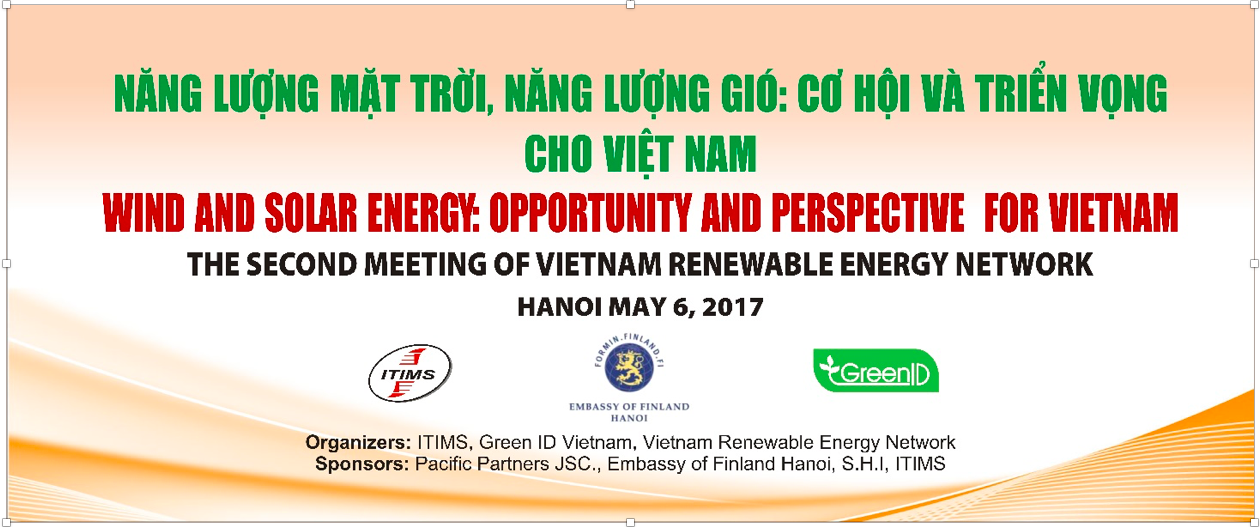
Năng lượng Gió và Mặt trời: Cơ hội và triển vọng cho Việt Nam

Renewable Energy Network – Wind and Solar Energy: opportunities and perspectives for Vietnam

Gặp gỡ lần thứ 2 của Cộng đồng Năng lượng Tái tạo

Ngày 6/5 tại Hà Nội, đã diễn ra cuộc Gặp gỡ lần thứ 2 của cộng đồng năng lượng tái tạo Việt Nam (The second Meeting of Vietnam Renewable Energy Network). Sự kiện này có sự góp mặt của các nhà hoạch định chính sách, nhà sản xuất, lắp đặt, vận hành, cung cấp và các nhà khoa học. Cuộc gặp gỡ được tổ chức nhằm 01) làm rõ một số chính sách, định hướng của cơ quan quản lý về năng lượng tái tạo nói chung, năng lượng mặt trời nói riêng, những tác động của chính sách này tới sản xuất, nghiên cứu khoa học và nguồn nhân lực trình độ cao; 02) tìm kiếm đối tác đầu tư, triển khai lắp đặt, vận hành và bảo hành bảo trì; 03) cập nhật thông tin về tình hình công nghệ và khoa học trên thế giới và trong nước; 04) thảo luận về cơ hội nghề nghiêp, về khả năng tổ chức khóa học ngắn hạn về năng lượng tái tạo nói chung cho các bên có nhu cầu tại Việt Nam.

Chính sách mới được ban hành đang theo hướng có lợi cho NLTT

Tiếp tục đọc “Năng lượng Gió và Mặt trời: Cơ hội và triển vọng cho Việt Nam”

Tiêu điểm kinh tế – Gỡ rào cản để năng lượng tái tạo phát triển

Chính phủ đặt mục tiêu ưu tiên phát triển năng lượng tái tạo nhằm đa dạng hóa cơ cấu nguồn điện cũng như hướng tới một nền kinh tế xanh và sạch hơn. Tuy nhiên, việc khai thác nguồn năng lượng tái tạo đến nay vẫn chưa phát huy được hết lợi thế sẵn có từ thiên nhiên. Vậy đâu là mấu chốt cần tháo gỡ để phát triển mạnh hơn nữa nguồn năng lượng xanh tại Việt Nam?