Rác thải công nghệ tại Việt Nam đang tăng rất nhanh, đặc biệt là rác điện tử (điện thoại, laptop, thiết bị gia dụng) và rác thải mới như tấm pin năng lượng mặt trời. Các loại rác này chứa nhiều kim loại nặng và hóa chất độc hại, gây nguy cơ lớn cho môi trường và sức khỏe cộng đồng.
Mặc dù Việt Nam đã có quy định như Luật Bảo vệ môi trường 2020 và cơ chế trách nhiệm mở rộng của nhà sản xuất (EPR), việc thực hiện vẫn còn nhiều hạn chế do hạ tầng thu gom – tái chế chưa đồng bộ, công nghệ xử lý còn lạc hậu và doanh nghiệp chưa thực hiện nghiêm túc. Trong tương lai, lượng rác thải công nghệ và tấm pin mặt trời sẽ tăng mạnh (dự báo hàng trăm nghìn tấn), vì vậy cần hoàn thiện chính sách, tăng đầu tư công nghệ tái chế hiện đại, xây dựng hệ thống thu gom hiệu quả và nâng cao ý thức người dân, doanh nghiệp.
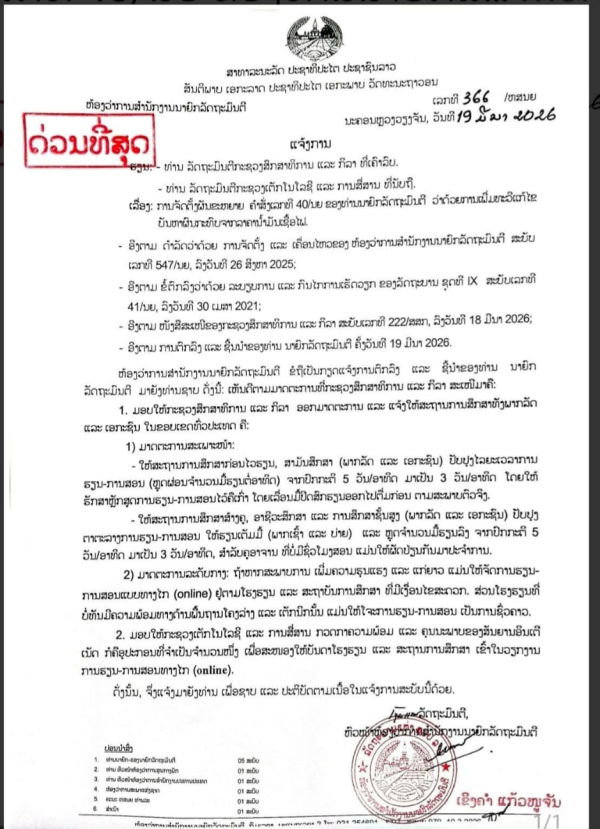
On March 19, 2026, the Prime Minister’s Office of the Lao PDR issued Notice No. 366/PMO mandating nationwide adjustments to school operations, as part of emergency measures to ease the financial strain on families amid continued fuel price volatility.
The directive, addressed to the Ministry of Education and Sports, introduces immediate changes to learning schedules while preserving academic standards and signaling further contingency steps if economic conditions worsen.
Under the order, all general education institutions—public and private—are required to scale back in-person instruction from five days to three days per week. Schools must continue delivering the full curriculum, with the academic calendar extended to compensate for reduced classroom time.
For teacher training institutes, vocational schools, and higher education institutions, schedules will be restructured into full-day sessions, combining morning and afternoon classes, while similarly reducing attendance to three days per week. Teaching personnel without assigned classes are instructed to report for duty on a rotating basis.
Officials said the policy is aimed at lowering transportation-related expenses for households while ensuring continuity in education delivery.
The government also outlined escalation measures should fuel-related pressures persist. Institutions with adequate digital infrastructure will transition to remote learning, while those lacking technical readiness may be required to temporarily suspend operations.
To support potential online learning, the Ministry of Technology and Communications has been tasked with verifying internet reliability nationwide and assessing the availability of essential equipment.
Authorities stressed that parents, teachers, and students must prepare for immediate implementation, highlighting the government’s broader effort to balance economic relief with uninterrupted access to education during a period of heightened cost pressures.
13 March 2026, London: Military tensions in West Asia are beginning to disrupt maritime traffic through the Strait of Hormuz, raising serious concerns for global energy markets, fertilizer supplies and vulnerable economies. In a rapid assessment titled “Strait of Hormuz disruptions: Implications for global trade and development,” UN Trade and Development (UNCTAD) has highlighted the potential risks posed by interruptions in one of the world’s most critical trade corridors.
The Strait of Hormuz carries nearly one quarter of global seaborne oil trade, along with large volumes of liquefied natural gas and fertilizers. Any disruption in this narrow passage therefore has immediate consequences for global energy prices, maritime transport costs and agricultural input supply chains.
Imagine the escalating conflict between the US, Israel and Iran unfolding in a world powered mostly by wind, solar and batteries rather than oil and gas.
In today’s fossil-fuelled economy, markets react to Iran’s attacks on oil and gas facilities in the Gulf and the threat to close the strait of Hormuz. Oil prices jump. Governments brace for inflation. Around a fifth of the world’s traded oil passes through the narrow corridor, linking the Gulf states to the wider world. When tensions rise there, energy markets react instantly.
But in a world where most energy is generated domestically from renewables, would the same threat trigger the same global shock? Would instability in the Gulf still lead to more expensive food and fuel across the world? Or would the economic aftershocks look very different?
To understand what’s at stake, we need to first look at how today’s energy system is structured.
The strait of Hormuz is the narrow point between the Persian Gulf and the open ocean. AustralianCamera / shutterstock
A system built on chokepoints
For about a century, the global economy has depended on fossil fuels produced by a few producers in the Middle East. Chokepoints like the strait of Hormuz carry enormous strategic weight.
“Steady and pragmatic decarbonisation, rapid clean-energy expansion combined with cautious emission targets, continued coal use to protect energy security and industrial growth.”
China’s leadership has published a draft of its 15th five-year plan setting the strategic direction for the nation out to 2030, including support for clean energy and energy security.
The plan sets a target to cut China’s “carbon intensity” by 17% over the five years from 2026-30, but also changes the basis for calculating this key climate metric.
– Trong kỳ trước, Tạp chí Năng lượng Việt Nam đã có bài viết đề xuất việc rà soát toàn diện các yêu cầu của IAEA về phát triển nguồn nhân lực trong mối quan hệ chặt chẽ, mang tính tương hỗ với 18 vấn đề hạ tầng then chốt của chương trình điện hạt nhân quốc gia. Tiếp nối định hướng này, bài viết dưới đây tập trung phân tích vai trò và trách nhiệm của Chính phủ ở Giai đoạn 1 của chương trình điện hạt nhân, với trọng tâm là khởi động hạ tầng an toàn. Cách tiếp cận này phù hợp với khuyến nghị của IAEA. Theo đó, an toàn hạt nhân không phải là một lĩnh vực độc lập, mà là kết quả tổng hợp của chính sách, khuôn khổ pháp lý – thể chế, năng lực con người, trong đó vai trò định hướng và bảo đảm của Chính phủ ở Giai đoạn 1 có ý nghĩa quyết định.
TP – Với gần một triệu doanh nghiệp, khoảng 5 triệu hộ kinh doanh cá thể, khu vực kinh tế tư nhân hiện đóng góp khoảng 51% GDP, hơn 30% ngân sách Nhà nước, tạo ra hơn 40 triệu việc làm, chiếm hơn 82% tổng số lao động trong nền kinh tế, đóng góp gần 60% vốn đầu tư toàn xã hội.
Dù được coi là thành tố quan trọng để phát triển nền kinh tế, đóng góp ngày càng lớn, kinh tế tư nhân hiện vẫn đối mặt với nhiều rào cản, không thể bứt phá về quy mô và năng lực cạnh tranh.
Bài 1: Nguồn lực chưa được khơi thông
Những hạn chế phát triển của doanh nghiệp tư nhân thời gian qua xuất phát một phần từ những bất cập của hệ thống thể chế, chính sách kinh tế và môi trường kinh doanh. Những điểm nghẽn này không chỉ kìm hãm tốc độ tăng trưởng của khu vực kinh tế tư nhân, khiến tỷ trọng đóng góp của khu vực này trong GDP gần như không thay đổi trong hơn một thập kỷ qua, mà còn cản trở nền kinh tế nâng cao giá trị gia tăng, thoát khỏi bẫy thu nhập trung bình.
Doanh nghiệp tư nhân còn gặp nhiều rào cản trong tiếp cận nguồn lực, đặc biệt là vốn tín dụng, đất đai, tài nguyên và nhân lực chất lượng cao, nhất là trong các ngành công nghệ, kỹ thuật và tài chính. Ảnh: Nguyễn BằngTiếp tục đọc “Đòn bẩy cho một Việt Nam thịnh vượng (13 bài)”→
IAEA.org 12 December 2025 Ninh Thuan Province, Viet Nam
Viet Nam has taken important actions towards adding nuclear power to its energy mix, including in developing the necessary infrastructure for a safe and sustainable nuclear power programme, according to an International Atomic Energy Agency (IAEA) review mission.
An IAEA team of experts yesterday concluded an 11-day mission to Viet Nam to review its infrastructure development for the Ninh Thuan Nuclear Power Project, which had been stopped in 2016. In 2024, the Central Committee of the Communist Party of Viet Nam decided to restart the project and the National Assembly of Viet Nam authorized the Government to allocate the necessary resources for its implementation.
The establishment of nuclear power is an objective of the Revised National Power Development Plan for the period 2021-2030, which considers nuclear power as key for diversifying the national energy mix and strengthening energy security amidst Viet Nam’s steadily rising energy demand and economic growth in recent years. The plan envisages the commissioning of two nuclear power plants, Ninh Thuan 1 and Ninh Thuan 2, during the 2030–2035 period, with a total capacity of 4,000–6,400 MW.
BloombergNEF’s Energy Transition Investment Trends reviews annual investment figures in the global energy transition, including spending to deploy clean technologies, investment in the clean energy supply chain, equity investment in climate-tech companies, and debt issuance for energy transition purposes.
All four of these indicators moved upward in a year marked by trade disruptions and geopolitical tension, showcasing the energy transition’s resilience.
Walmart, the biggest single buyer of goods in the world, has lowered its emissions intensity and sent emissions-reducing ripples throughout its global supply chain. Joe Raedle/Getty Images
The Trump administration has given corporations plenty of convenient excuses to retreat from their climate commitments, with its moves to withdraw from the Paris Agreement, roll back emissions regulations, and scale back clean-energy incentives.
Summary: Researchers using China’s “artificial sun” fusion reactor have broken through a long-standing density barrier in fusion plasma. The experiment confirmed that plasma can remain stable even at extreme densities if its interaction with the reactor walls is carefully controlled. This finding removes a major obstacle that has slowed progress toward fusion ignition. The advance could help future fusion reactors produce more power
China’s “artificial sun” fusion reactor has crossed a critical plasma density threshold that scientists once thought was unreachable. The result brings fusion ignition closer than ever. Credit: Shutterstock
Scientists working with China’s fully superconducting Experimental Advanced Superconducting Tokamak (EAST) have successfully reached a long-theorized “density-free regime” in fusion plasma experiments. In this state, the plasma remains stable even when its density rises far beyond traditional limits. The results, published in Science Advances on January 1, shed new light on how one of fusion energy’s most stubborn physical barriers might finally be overcome on the road to ignition.
China dominates global rare earth mining, but undeveloped reserves elsewhere could reshape future supply chains.
Greenland holds an estimated 1.5 million metric tons of rare earth reserves despite having no commercial production.
U.S. President Donald Trump has once again put Greenland at the center of global attention.
His renewed threat to assert U.S. control over the Arctic territory has drawn sharp reactions from European leaders and Denmark, which governs Greenland as an autonomous territory.
While the island’s strategic location is often cited, another underlying motivation is increasingly tied to its vast mineral potential. In particular, Greenland’s rare earth reserves have become a focal point in a world racing to secure critical resources.
This visualization compares rare earth mine production and reserves across countries, placing Greenland’s untapped resources in a global context.
China remains the backbone of the global rare earth market. In 2024, it produced roughly 270,000 metric tons, accounting for well over half of global output.
China also controls the largest reserves, estimated at 44 million metric tons. This combination of scale and integration gives Beijing significant leverage over industries ranging from electric vehicles to defense systems.
Country
Reserves (Metric Tons)
Rare Earth Production 2024 (Metric Tons)
🇨🇳 China
44.0M
270,000
🇧🇷 Brazil
21.0M
20
🇮🇳 India
6.9M
2,900
🇦🇺 Australia
5.7M
13,000
🇷🇺 Russia
3.8M
2,500
🇻🇳 Vietnam
3.5M
300
🇺🇸 United States
1.9M
45,000
🇬🇱 Greenland
1.5M
0
🇹🇿 Tanzania
890K
0
🇿🇦 South Africa
860K
0
🇨🇦 Canada
830K
0
🇹🇭 Thailand
4.5K
13,000
🇲🇲 Myanmar
0
31,000
🇲🇬 Madagascar
0
2,000
🇲🇾 Malaysia
0
130
🇳🇬 Nigeria
0
13,000
🌍 Other
0
1,100
🌐 World total (rounded)
>90,000,000
390,000
Large Reserves, Limited Production Elsewhere
Outside China, many countries with sizable reserves play only a minor role in production.
Brazil holds an estimated 21 million metric tons of rare earth reserves yet produces almost nothing today. India, Russia, and Vietnam show similar patterns.
Why Greenland Matters
Greenland’s estimated 1.5 million metric tons of rare earth reserves exceed those of countries like Canada and South Africa. Yet the island has never had commercial rare earth production.
Environmental protections, infrastructure constraints, and local political opposition have slowed development. Still, as supply chain security becomes a priority for major economies, Greenland’s position is becoming harder to ignore.
Trump’s interest in Greenland is driven by more than symbolism. Rare earths are essential for advanced manufacturing, clean energy technologies, and military hardware. With China firmly entrenched as the dominant supplier, policymakers in Washington are increasingly focused on alternative sources.
As the name suggests, liquefied natural gas (LNG) involves turning gas into liquid form — a process known as liquefaction. Liquefaction does not alter the chemical makeup of gas, which is comprised of mostly methane plus varying amounts of different impurities, but it does make it denser. This enables ships and other carriers to move more gas over oceans between locations that lack direct pipeline connectivity.
Photojournalist Yoshito Matsushige, in front of the first image he took at Miyuki-bashi Bridge, a little over two hours after the United States dropped a nuclear bomb on Hiroshima. He took a total of 5 images, the only recorded evidence of that day that changed history. (Photo by John van Hasselt/Corbis via Getty Images)Share
In the late morning hours of August 6, 1945, a single shutter clicked in Hiroshima and recorded what no camera had ever captured before, and none has again: the immediate, lived aftermath of a city annihilated by nuclear weapons.
Equipped with one camera and two rolls of film, totaling just 24 possible exposures, Yoshito Matsushige, then a 32-year-old photojournalist, ventured toward the city that morning to report for duty. Fires blocked access to his office, so he turned back and reached Miyuki Bridge (about 2,300 meters from ground zero) where he encountered the unfathomable: charred schoolgirls, civilians with melted skin, and a landscape of human agony.
He could barely bring himself to document it. But his five surviving images—the only known photographs of Hiroshima’s destruction on the day of the bombing itself—are among the most harrowing visual records of the nuclear age.







 Photojournalist Yoshito Matsushige, in front of the first image he took at Miyuki-bashi Bridge, a little over two hours after the United States dropped a nuclear bomb on Hiroshima. He took a total of 5 images, the only recorded evidence of that day that changed history. (Photo by John van Hasselt/Corbis via Getty Images)Share
 CVD
CVD 