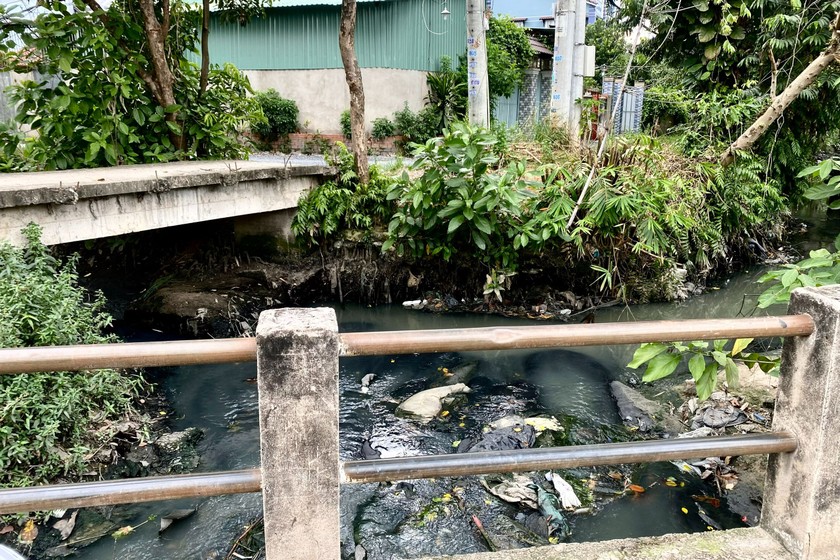
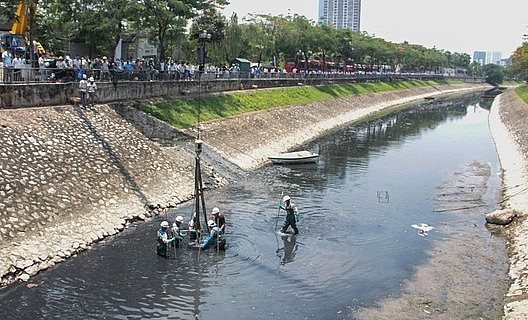
Một con kênh nhỏ nước đen bốc mùi khó chịu trong khu dân cư ở TP Thủ Đức, TP HCM. (Ảnh: Ngọc Mai)
(PLVN) – Nhiều kênh rạch tại TP HCM đang trong tình trạng ô nhiễm, tái ô nhiễm. Cư dân ở những khu vực này không những phải chịu hoàn cảnh sống “nghẹt thở” mà còn đối mặt với nguy cơ dịch bệnh.
Khổ vì kênh nước đen
Nhiều người dân khu vực rạch Văn Thánh, Bình Thạnh, TP HCM lâu nay đã phải sống cạnh một dòng kênh đen nghịt, bốc mùi khó chịu. Nguyên nhân do tình trạng bồi lấp dòng và lấn chiếm dòng rạch kéo dài, con rạch không có khả năng thoát nước, gây ùn ứ và rác thải.
Dòng nước ngọt của TP HCM khởi nguồn từ Lâm Đồng – thượng nguồn sông Đồng Nai; và Bình Phước – nơi bắt đầu của sông Sài Gòn
Thượng nguồn hai con sông được chặn dòng, tạo thành hồ Dầu Tiếng và hồ Trị An, làm nhiệm vụ điều tiết nước. Trong đó, Dầu Tiếng là hồ thuỷ lợi được xây dựng từ thập niên 80.
Hồ Dầu Tiếng và hồ Trị An là hai nguồn nước ngọt chính của hơn 10 triệu dân TP HCM, có tổng lượng nước bằng khoảng 5 triệu bể bơi Olympic (830 m3).
Lưu vực sông Sài Gòn – Đồng Nai chảy qua 10 tỉnh, thành trước khi đến TP HCM và nằm hoàn toàn trong Vùng kinh tế trọng điểm phía Nam – nơi có hơn 140 khu công nghiệp, khu chế xuất và 20 triệu dân.
Thông qua hai trạm bơm Hoà Phú và Hoá An, nước thô được lấy từ sông chuyển qua các nhà máy xử lý, cung cấp nước tới 94% dân số thành phố. 6% còn lại là nguồn nước ngầm.
Nước thô sau khi xử lý tại hai cụm nhà máy, được phân phối về 2,14 triệu hộ gia đình thông qua mạng lưới đường ống hơn 8.200 km, dài nhất Việt Nam.
Cái giá của sự phát triển
“Có váng dầu ngoài bờ sông”. Thông báo ngắn gọn lúc 6h ngày 20/3/2022 khiến ông Đinh Xuân Hòa tỉnh ngủ, lao đến Trạm bơm Hoá An, cách trung tâm thành phố gần 30 km.
“Đó là chủ nhật căng thẳng nhất trong 33 năm sự nghiệp làm trưởng trạm bơm của tôi”, ông Hòa nói về lần đầu tiên ứng phó sự cố tràn dầu.
5 nhân viên sống gần trạm được huy động. Giám đốc Nhà máy nước Thủ Đức từ trung tâm thành phố lập tức đến hiện trường.
The Río de la Plata and the city of Buenos Aires, Argentina. A report has warned of the contamination of the world’s rivers by active pharmaceutical ingredients (APIs), especially in developing countries. Copyright: Dan DeLuca/Flickr, (CC BY 2.0).
Pharmaceutical pollution in the world’s rivers is threatening environmental and human health and the attainment of UN goals on water quality, with developing countries the worst affected, a global study warns.
Active pharmaceutical ingredients (APIs) could be contributing to antimicrobial resistance in microorganisms, and may have unknown long-term effects on human health, as well as harming aquatic life, according to the report published in Proceedings of the National Academy of Sciences.
APIs – the chemicals used to make pharmaceutical drugs – can reach the natural environment during their manufacture, use and disposal, according to the study.
“Early results suggest that some of the more polluted mixes are extremely toxic to plants and invertebrates.”
Alistair Boxall, Department of Environment and Geography, University of York, UK
Researchers say they monitored 1,052 sampling sites along 258 rivers in 104 countries, representing the “pharmaceutical fingerprint” of 471 million people linked to these areas.
The highest cumulative concentrations of APIs were seen in Sub-Saharan Africa, South Asia and South America, with the most contaminated sites found in low-to-middle income countries where waste water management infrastructure is often poor, the report says.
Theo Bộ TN-MT, tính đến hết năm 2020, cả nước đã thành lập 968 cụm công nghiệp (CCN) với tổng diện tích 30.912 ha. Trong đó, có 730 CCN đã đi vào hoạt động, tỷ lệ lấp đầy 65%, tạo việc làm cho khoảng 600.000 lao động.
Xử lý nước thải công nghiệp
Tuy nhiên, số lượng CCN có biện pháp bảo vệ môi trường, công trình xử lý nước thải chỉ chiếm số lượng rất nhỏ. Cả nước mới chỉ có 141/730 CCN (chiếm 19,3%) có hệ thống xử lý nước thải tập trung đi vào hoạt động và khoảng 21,7% CCN có hệ thống quan trắc nước thải tự động.
Cả nước cũng có khoảng 377 khu công nghiệp (KCN) đã được thành lập, trong đó có 290 KCN đã đi vào hoạt động. Tỷ lệ KCN có hệ thống xử lý nước thải tập trung đạt 90,7% và có đến 90,9% KCN đang hoạt động có hệ thống quan trắc nước thải tự động.
Lee & Man Vietnam Ltd.’s waste water treatment system. The Ministry of Natural Resources and Environment has suggested Ministry suggests community-based environmental monitoring for the papermaker. — VNA/VNS Photo Duy Khương
HÀ NỘI – The Mekong Delta province of Hậu Giang has been urged to establish a community-based monitoring mechanism to evaluate papermaker Lee & Man Vietnam Ltd.’s environmental treatment.During a visit to the company’s paper mill on Thursday, Minister of Natural Resources and Environment, Trần Hồng Hà, asked the papermaker to complete a standard procedure for management and operation of its waste treatment, and to keep daily records of materials used for environmental treatment and to publicise them. Tiếp tục đọc “Ministry suggests community-based environmental monitoring for papermaker”→
VietNamNet Bridge – As state and local budgets are limited, calling for private investment in waste water treatment is considered the most feasible solution for now.
Experts participating in a workshop on water drainage and waste water treatment management in mid-June agreed that investment in the sector is coming in dribs and drabs.
Nguyen Kim Hoang from the Can Tho City Construction Department said except for the KfW-funded concentrated waste water treatment plant with capacity of 30,000 cubic meters per day, which is under execution, other waste water treatment projects in the city still have not received capital. Tiếp tục đọc “HCM City calls for private investment in waste water treatment”→
The developer and operator of the Da Phuoc Waste Treatment Complex, has been slapped with a hefty fine for violating multiple regulations.
The Vietnam Waste Solutions Co. (VWS) was fined VND1.5 billion (US$66,000) for five different offences, Nguyen Van Tai, head of the Vietnam Environment Administration under the Ministry of Natural Resources and Environment, said on Friday.
The first violation involves the company’s inability to process the required amount of 6,080 cubic meter of waste water per day. At the time of the investigation, the firm only met the capacity of 4,280 cubic meters per day.
The construction site of the VNT19 pulp mill is seen in Quang Ngai Province, located in central Vietnam.
With the fish death disaster caused by wastewater dumped by a steel plant into the waters off central Vietnam still fresh in the minds of citizens, administrators in a province housing a paper mill are worried about giving history the opportunity to repeat itself.