Lợi dụng mưa lớn, phá trắng trái phép 5 ha rừng tự nhiên ở Gia Lai

THANH TUẤN  –  Thứ bảy, 23/09/2023 09:48 (GMT+7)

Một vụ phá rừng trái phép với quy mô lớn vừa xảy ra tại huyện Kông Chro, tỉnh Gia Lai. Người dân sở tại đã phá trắng gần 5 ha rừng tự nhiên để lấy đất làm nương rẫy. Vụ việc không chỉ ảnh hưởng đến nguồn lợi lâm sản mà còn gây thiệt hại cho môi trường sinh thái và an ninh trật tự của địa phương.
Lợi dụng mưa lớn, phá trắng trái phép 5 ha rừng tự nhiên ở Gia Lai
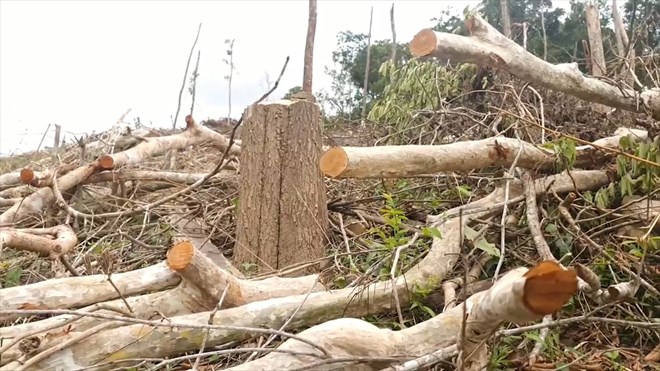
Những cây gỗ lớn bị đốn hạ. Ảnh: Thanh Tuấn

Theo ghi nhận của cơ quan chức năng, tại Tiểu khu 793 thuộc lâm phần Công ty TNHH Một thành viên Lâm nghiệp Kông H’de, thuộc xã Sró, huyện Kông Chro, 2 khoảnh rừng tự nhiên bị phá trắng, diện tích gần 5 ha, trong đó có khoảng 3 ha diện tích rừng có gỗ.

Kiểm đếm ban đầu, trên 641 cây rừng có đường kính gốc từ 8 cm – 30cm gồm nhiều loại như: Căm xe, bằng lăng, bình linh… bị chặt hạ.
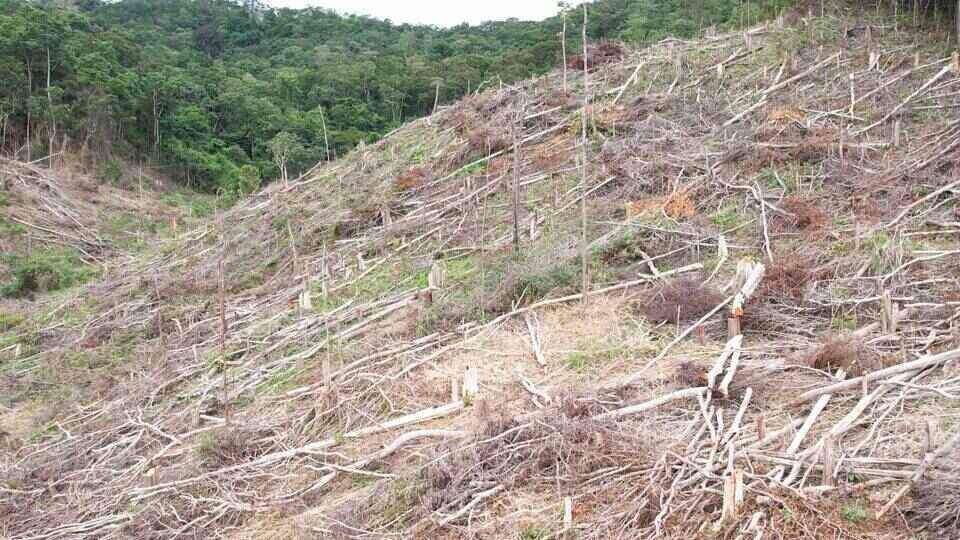
Hàng loạt cây rừng lớn nhỏ bị đốn hạ bằng cưa xăng, gãy đỗ la liệt. Ảnh: Thanh Tuấn

Ông Lê Văn Thuỷ – Giám đốc Công ty TNHH Một thành viên Lâm nghiệp Kông H’de, Gia Lai cho biết: “6, 7 hộ dân dùng cưa xăng, hạ cây rừng rất nhanh. Công ty phát hiện, nhưng chậm can thiệp vì nước lớn, khó qua sông. Tôi là người đứng đầu nên chịu trách nhiệm”.

Tiếp tục đọc “Lợi dụng mưa lớn, phá trắng trái phép 5 ha rừng tự nhiên ở Gia Lai”
Bảo vệ “lá phổi xanh” Cần Giờ

SGGP 09/10/2023 07:26 (GMT+7)

Khát vọng phát triển huyện Cần Giờ – vùng đất giáp biển, “lá phổi xanh” của TPHCM, đã thôi thúc từ nhiều thập niên qua; và nay với những dự án lớn chuẩn bị đầu tư, đang kỳ vọng sẽ mang lại cơ hội lớn để Cần Giờ cất cánh. Tuy nhiên, cùng với đó là làm sao vẫn bảo vệ được “lá phổi xanh” này.

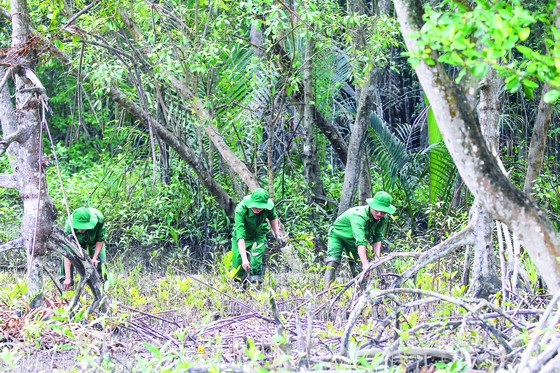
Trồng rừng ngập mặn ở Cần Giờ, TPHCM. Ảnh: HOÀNG HÙNG

Nhiều dự án tỷ USD

Tiếp tục đọc “Bảo vệ “lá phổi xanh” Cần Giờ”

High-resolution maps show that rubber causes substantial deforestation (in Southeast Asia)

SEI.org

Researchers used this data and cloud computing to generate powerful, high-resolution maps of rubber and its associated deforestation in Southeast Asia, where over 90% of global rubber is produced…The mapping showed that forest loss associated with rubber production is more than two to three times greater than indicated by previous research has suggested

A multi-partner team of researchers, led by the Royal Botanic Garden Edinburgh, have used new Earth observation satellite data and advanced computer modelling to show that rubber-related deforestation is far higher than previous estimates have suggested

Almost all tropical deforestation is related to the production of global commodities, but mapping this deforestation through satellite imagery is rare (oil palm and soy are the notable exceptions). Natural rubber ranks among these global commodities but its deforestation impact has proved difficult to measure: globally, 85% of natural rubber is produced by smallholders on scattered plantations which have proved difficult to detect through traditional satellite imaging due to their small size. Moreover, these plantations also have a very similar visual appearance to forest when viewed from space. Previous calculations of rubber deforestation have therefore used model-based data.

Due to recent improvements in the visual quality of Earth observation data, in this paper the authors were able to capture the smallholder plantations in their mapping and address the deforestation knowledge gap. Researchers used this data and cloud computing to generate powerful, high-resolution maps of rubber and its associated deforestation in Southeast Asia, where over 90% of global rubber is produced.

Rubber tapping on a plantation in Thailand.Photo: Pavel Muravev / iStock / Getty Images Plus
Tiếp tục đọc “High-resolution maps show that rubber causes substantial deforestation (in Southeast Asia)”

The Interdependence of Climate Security and Good Governance: A Case Study from Pakistan

Climateandsecurity.org

By Ameera Adil and Faraz Haider

Last year, Pakistan faced the most devastating floods in the history of the country, which is notable because the country lies on a geographical floodplain. The Indus is an ancient and powerful river. The floodplain of the river covers nearly half of Pakistan, where most of the country’s population resides. When the Indus breathes, as rivers do, the lives and livelihoods on the floodplains are quietly absorbed by the water. 

Climate change had a significant role to play in the 2022 floods. The affected areas received 900mm of rainfall between June to August, which is nearly 350 percent more than the long-term average. Tiếp tục đọc “The Interdependence of Climate Security and Good Governance: A Case Study from Pakistan”

Climate Change History – PM of the UK, Margaret Thatcher – Speech to UN (Nov. 8, 1989)

Prime Minister of the UK, Margaret Thatcher studied chemistry at Oxford, and worked briefly as a research chemist before becoming a barrister

Mr President, it gives me great pleasure to return to the Podium of this assembly. When I last spoke here four years ago, on the 40th anniversary of the United Nations, the message that I and others like me gave was one of encouragement to the organisation to play the great role allotted to it.

Of all the challenges faced by the world community in those four years, one has grown clearer than any other in both urgency and importance—I refer to the threat to our global environment. I shall take the opportunity of addressing the general assembly to speak on that subject alone.

INTRODUCTION

Tiếp tục đọc “Climate Change History – PM of the UK, Margaret Thatcher – Speech to UN (Nov. 8, 1989)”

Fukushima wastewater issue will further divide a nation, split families, and cause ‘atomic divorce’

thebulletin.org By Maxime Polleri | October 17, 2023

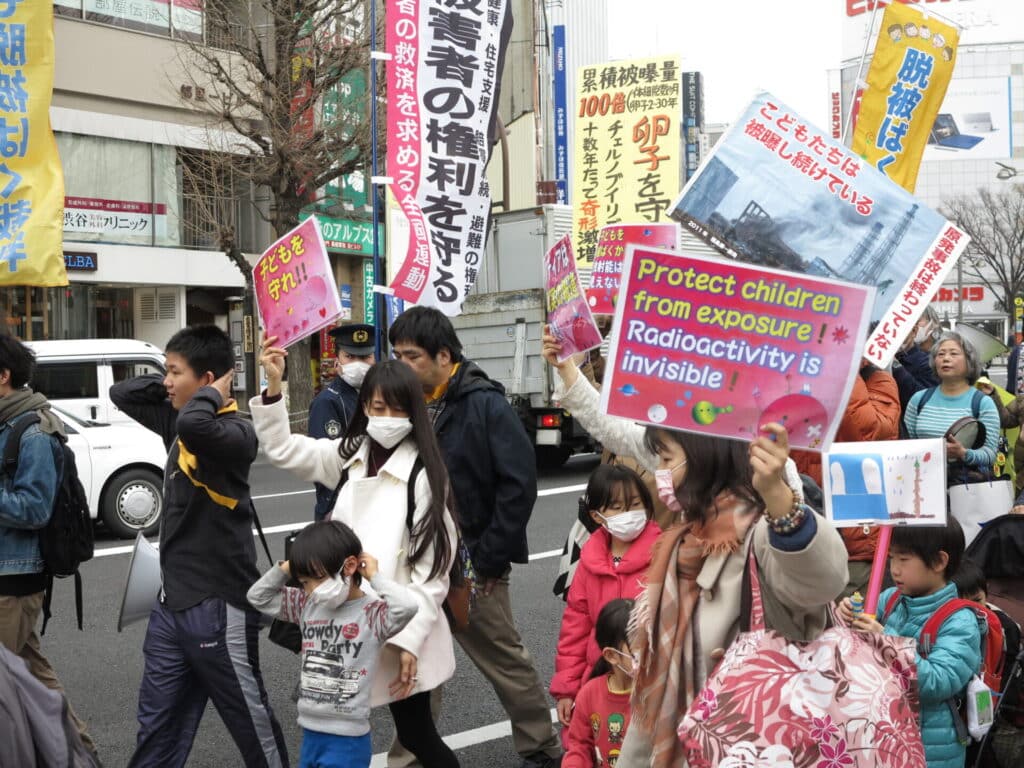
 Mothers march in Tokyo against radiation exposure risks five years after the Fukushima nuclear disaster on March 5, 2016. (Photo by Maxime Polleri)Share

In a bid to dispel seafood worries around the release of Fukushima nuclear wastewater into the ocean, Japan’s Prime Minister Fumio Kishida ate an array of sashimi late in August; the raw fish ranged from flounder to sea bass caught in the Fukushima area. It is “safe and delicious,” he joyfully declared during a public relations effort to revitalize the fishing industry, which has been affected by a Chinese seafood ban and consumer anxieties over the wastewater release.

Many applauded Kishida’s comment, which echoes the same government narrative around post-Fukushima food safety, as well as his firm support for the release of tritium-contaminated water—a discharge process that the International Atomic Energy Agency stated complies with operational safety limits for radiation.

But as someone who studied the aftermath of the Fukushima nuclear disaster for more than a decade, I believe that this decision will irreversibly erode public trust and create irreparable long-lasting tensions. During my years of research in Japan as an anthropologist, I witnessed first-hand how state policies around Fukushima’s economic recovery are fragmenting communities, which constitutes an enduring catastrophe of its own.

Tiếp tục đọc “Fukushima wastewater issue will further divide a nation, split families, and cause ‘atomic divorce’”

Amazon River hits lowest level in over a century

reuters.com

The Amazon River fell to its lowest level in over a century on Monday at the heart of the Brazilian rainforest as a record drought upends the lives of hundreds of thousands of people and damages the jungle ecosystem.

Rapidly drying tributaries to the mighty Amazon have left boats stranded, cutting off food and water supplies to remote villages, while high water temperatures are suspected of killing more than 100 endangered river dolphins.

Advertisement · Scroll to continue

Tiếp tục đọc “Amazon River hits lowest level in over a century”

Saving Pangolins from poachers in Cat Tien, Vietnam | The Last Defenders

Saving Pangolins From Poachers In Cat Tien, Vietnam | The Last Defenders | Full Episode

CNA Insider – 15-9-2023

Cat Tien is one of Vietnam’s most biologically diverse and largest national parks. It is home to 40 species of critically endangered wildlife, including the vulnerable pangolin population.

Lam and Julong are anti-poaching officers from Save Vietnam’s Wildlife. Together with the government’s forest rangers, they form a forest protection team to fight against the threats posed by poaching to wildlife. They face the risk of possible violent confrontation with armed poachers and the danger of the unpredictable elements of the forest.

Sạt lở đất – Thiên tai hay nhân tai?

Phóng sự VTV24 năm 2020

[VOV2] – Các hoạt động nhân sinh đang làm trầm trọng thêm các hình thái bất thường của thời tiết và đã đến lúc không thể chỉ nói rằng thảm hoạ xảy ra là do thiên tai, mà trong nhiều trường hợp cần phải nói đến là do cả nhân tai.

Chỉ trong vòng hơn 2 tháng qua, cả nước đã xảy ra 47 trận sạt lở đất, đá gây thiệt hại nghiêm trọng về người và tài sản. Điều đáng nói, không chỉ khu vực Tây Nguyên, Nam Bộ, Tây Bắc, mà ngay cả Hà Nội cũng đã xuất hiện những trận sạt lở lớn. Vậy đâu là nguyên nhân gây ra tình trạng này? Cần có những giải pháp hữu hiệu nào để phòng tránh những vụ sạt lở tương tự?

Trong cuộc trao đổi với phóng viên VOV2, PGS.TS Trần Tân Văn, nguyên Viện trưởng Viện Khoa học địa chất và khoáng sản Việt Nam, Bộ Tài nguyên và Môi trường đã có những nhận định và phân tích khá thẳng thắn xung quanh vấn đề này.

PGS.TS Trần Tân Văn, nguyên Viện trưởng Viện Khoa học địa chất và khoáng sản Việt Nam, Bộ Tài nguyên và Môi trường
Tiếp tục đọc “Sạt lở đất – Thiên tai hay nhân tai?”

Miền Trung đứng trước nguy cơ “đại hồng thuỷ” sau gần 25 năm

Kinh tế đô thị  Trọng Tùng 14:37 15/10/2023

Kinhtedothi – Miền Trung đang ở hình thế kinh điển (điển hình) của mùa mưa, rất giống với hình thái thời tiết từng gây ra trận lũ lụt lịch sử vào tháng 11/1999. Liệu một trận đại hồng thuỷ có lặp lại sau gần 25 năm?

TIN LIÊN QUAN

Gần 1.600 ngôi nhà bị ngập, sơ tán hơn 3.900 người dân tránh mưa lũ

Miền Trung chìm trong mưa lũ

Ký ức khó phai mờ

Đợt lũ lụt xảy ra tại miền Trung vào tháng 11/1999 (hay còn được biết đến với tên gọi là đại hồng thủy 1999) được xem là một trong những trận lũ lụt lớn nhất từng xảy ra. Nguyên nhân của trận lũ lụt lịch sử là do tác động của không khí lạnh mạnh kết hợp với dải áp thấp xích đạo, các nhiễu động trên cao và cuối cùng là áp thấp nhiệt đới.

Các tỉnh miền Trung nước ta đã phải hứng chịu những trận mưa rất lớn từ ngày 1 – 6/11/1999, gây ra lũ lụt nghiêm trọng, nhấn chìm nhiều huyện, thị xã, làm thiệt hại tài sản lên đến gần 3.800 tỷ đồng (giá thời điểm năm 1999, tương đương 21.203 tỷ đồng ở năm 2023).

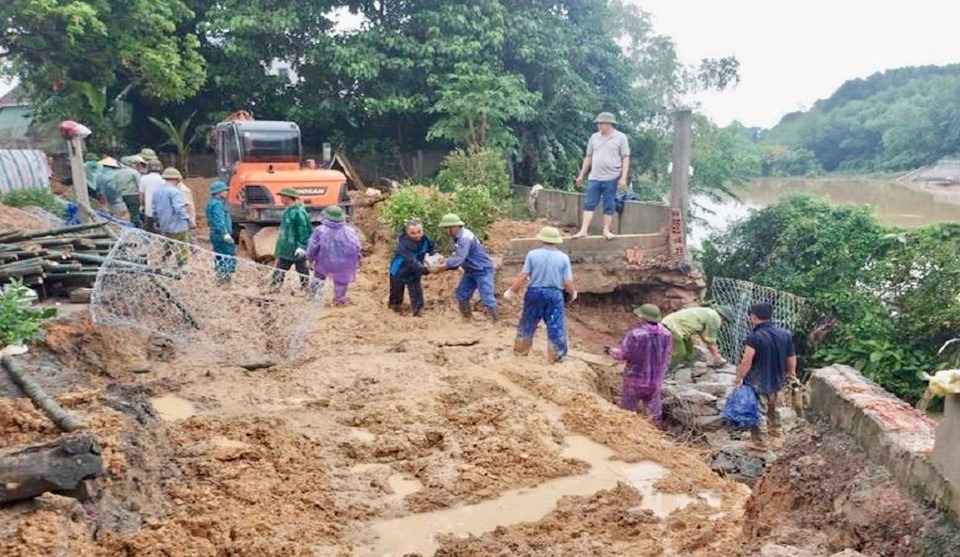
Gia cố bờ sông phòng, chống lũ lên do mưa lớn kéo dài tại tỉnh Hà Tĩnh.
Tiếp tục đọc “Miền Trung đứng trước nguy cơ “đại hồng thuỷ” sau gần 25 năm”

Miền Trung mưa lớn đến 700mm, kéo dài và rất phức tạp

vietnamnet.vn

Mưa lớn ở miền Trung liên tục được dự báo cực đoan khi tổng lượng mưa các ngày 13-15/10 có nơi lên đến 700mm. Người dân từ Hà Tĩnh đến Quảng Nam cần chủ động ứng phó với thiên tai phức tạp.

Theo Trung tâm dự báo khí tượng thủy văn quốc gia, đêm qua và sáng sớm nay (13/10), ở khu vực từ Hà Tĩnh đến Quảng Ngãi có mưa vừa, mưa to, cục bộ có mưa rất to. Lượng mưa tính từ 19h tối qua đến 8h sáng nay có nơi trên 170mm như: Hồ Kim Sơn (Hà Tĩnh) 216.6mm, Tân Lâm (Quảng Bình) 201.4mm, Thuận An (Thừa Thiên Huế) 171mm.

Tiếp tục đọc “Miền Trung mưa lớn đến 700mm, kéo dài và rất phức tạp”

How carbon prices are taking over the world

A quarter of global emissions are now covered, and the share is rising fast

A lump of coal penned-in by barcodes
image: matt chase

economist.com Oct 1st 2023

If global warming is to be limited, the world must forget fossil fuels as fast as possible—that much almost everyone agrees upon. How to do so is the complicated part. Economists have long favoured putting a price on carbon, a mechanism Europe introduced in 2005. Doing so allows the market to identify the cheapest unit of greenhouse gas to cut, and thus society to fight climate change at the lowest cost. Others, including many American politicians, worry that such schemes will provoke a backlash by raising consumer costs. Under President Joe Biden, America is instead doling out hundreds of billions of dollars to turn supply chains green.

Tiếp tục đọc “How carbon prices are taking over the world”

6 reasons why global temperatures are spiking right now

conversation.com

The world is very warm right now. We’re not only seeing record temperatures, but the records are being broken by record-wide margins.

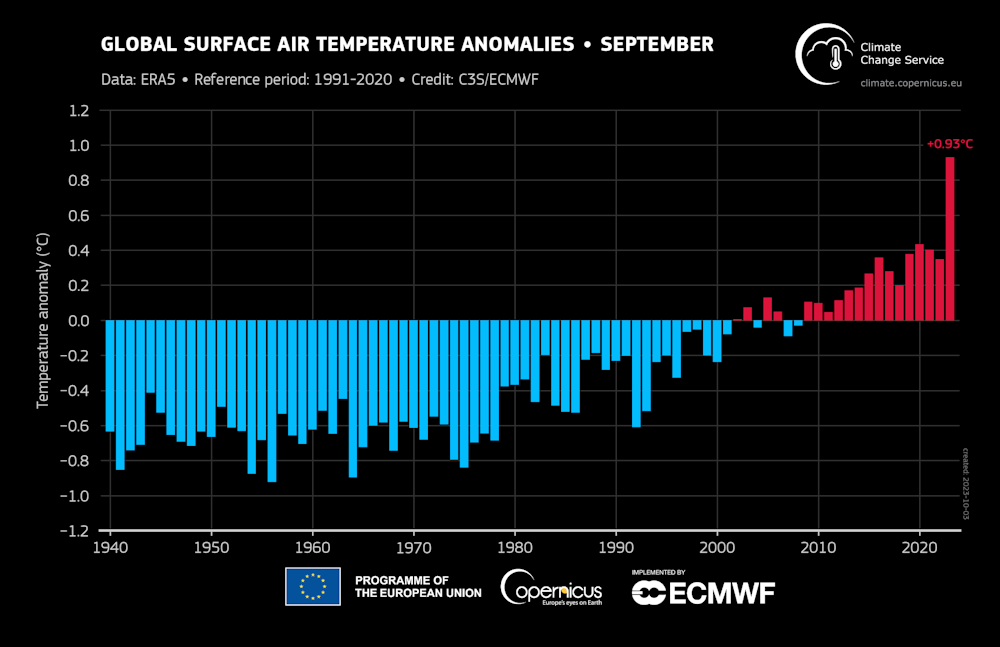
Take the preliminary September global-average temperature anomaly of 1.7°C above pre-industrial levels, for example. It’s an incredible 0.5°C above the previous record.

A chart showing global temperature anomalies, with September 2023 a clear standout
The preliminary September global temperature is well above every previous value in the instrumental record. Copernicus

So why is the world so incredibly hot right now? And what does it mean for keeping our Paris Agreement targets?

Here are six contributing factors – with climate change the main reason temperatures are so high.

1. El Niño

One reason for the exceptional heat is we are in a significant El Niño that is still strengthening. During El Niño we see warming of the surface ocean over much of the tropical Pacific. This warming, and the effects of El Niño in other parts of the world, raises global average temperatures by about 0.1 to 0.2°C.

Tiếp tục đọc “6 reasons why global temperatures are spiking right now”

Mother Nature Cambodia’s ‘relentless’ activism earns Right Livelihood Award

mongabay.com

  • Environmental activist group Mother Nature Cambodia has been named one of Right Livelihood’s 2023 laureates.
  • The award, established in 1980, recognizes groups and individuals striving to preserve the environment and those who protect it.
  • Mother Nature Cambodia has played a key role in campaigns against environmentally destructive dams, logging and sand mining, resulting in the imprisonment of multiple group members and banishment of its founder.

PHNOM PENH — Mother Nature Cambodia, one of the country’s most prominent environmental activism groups, was named one of Right Livelihood’s 2023 laureates on Sept. 28, making it the first group of Cambodians recognized in the award’s 43-year history.

Born out of a refusal from the Nobel Foundation to issue awards recognizing changemakers who champion environmental and social justice issues, Stockholm-headquartered Right Livelihood rewards groups and individuals committed to advancing causes around the world. The award offers recipients “a megaphone and a shield” with what Right Livelihood calls “lifelong support” to activists striving to preserve the environment and protect those who depend on it.

“Mother Nature Cambodia is a group of fearless young activists fighting for environmental rights and democracy in the face of repression by the Cambodian regime,” Ole von Uexkull, Right Livelihood’s executive director, said in a statement. “Through innovative and often humorous protests, their activism defends nature and livelihoods, while upholding communities’ voices against corrupt and damaging projects. Despite arrests, legal harassment and surveillance, they continue to fight relentlessly for Cambodians’ environmental and civic rights.”

Right Livelihood’s jury said Mother Nature Cambodia was receiving the award “for their fearless and engaging activism to preserve Cambodia’s natural environment in the context of a highly restricted democratic space.”

Activists protsting outside the Ministry of Justice in Phnom Penh.
Activists protesting outside the Ministry of Justice in Phnom Penh. Image by Gerald Flynn / Mongabay.
Tiếp tục đọc “Mother Nature Cambodia’s ‘relentless’ activism earns Right Livelihood Award”