Pollution in our waterways is not only dangerous and unsanitary for humans but it also affects wildlife. That’s why it is so exciting to see an initiative aimed at preventing such waste.
The Australian city of Kwinana has designed a simple and cost-effective solution to deal with the discharge of waste from drainage systems. The town has put nets on the outlet of drainage pipes.
These nets stop waste and pollutants from leaving the sewers, preventing garbage transported by rain waters from contaminating the town’s local water reserve. It is a simple filtering system and it works like a charm.
This short film pays tribute to professor Saleemul Huq, an environmental and climate change giant who died on 28 October 2023.
Professor Saleemul Huq OBE (1952-2023)
Following the passing of Professor Saleemul Huq, senior fellow of IIED. This book of remembrance is open to all who wish to share their memories of Saleem.
Article, 29 October 2023
Professor Saleemul Huq was an environmental and climate change giant and senior fellow and dear friend of IIED and many IIED colleagues past and present.
The honour was awarded in recognition of his work to build climate expertise in Bangladesh, the UK and across the world.
Saleem was an expert on the links between climate change and sustainable development, particularly from the perspective of vulnerable developing countries. A constant voice for climate action and justice for the global South, he was the lead author of chapters in the third, fourth and fifth assessment reports of the Intergovernmental Panel on Climate Change. Huq’s work with the IPCC spanned 1997 to 2014 and he contributed to reports that led to the panel being awarded the Nobel Peace Prize in 2007.
He set up the climate change research group at IIED in 2000 and was its initial director – continuing as a senior fellow until 2021 – and worked across the institute to ensure climate was at the heart of all that IIED did.
IIED executive director Tom Mitchell said: “I would like to offer my deepest sympathy and condolences to Saleem’s family and loved ones on behalf of IIED. There was no one quite like Saleem and I will remember his unique combination of warmth, generosity of spirit, academic prowess and enormous standing in climate science.
Brazil lawsuits allege direct relationship between meatpackers, deforesters on protected land
Cattle walk along an illegally deforested area in an extractive reserve near Jaci-Parana, Rondonia state, Brazil, Wednesday, July 12, 2023. (AP Photo/Andre Penner)
BY FABIANO MAISONNAVE, ASSOCIATED PRESS AND RUBENS VALENTE, AGENCIA PUBLICAU pdated 6:42 AM GMT+7, December 20, 2023 AP
JACI-PARANA, Brazil (AP) — Meat processing giant JBS SA and three other slaughterhouses are facing lawsuits seeking millions of dollars in environmental damages for allegedly purchasing cattle raised illegally in a protected area in the Brazilian Amazon.
The lawsuits, filed December 5 to 12 by the western Brazilian state of Rondonia, target the exploitation of a protected area known as Jaci-Parana, once rainforest but now mostly transformed into grassland by decades of misuse by land-grabbers, loggers and cattle ranchers. Despite a law forbidding commercial cattle in the reserve, some 216,000 head now graze on pasture there, according to the state animal division.
Tin từ Sở NN&PTNT tỉnh Quảng Bình cho biết, lần đầu tiên và bắt đầu từ năm 2023, Quảng Bình cùng 5 tỉnh Bắc Trung Bộ nhận được nguồn tiền từ dịch vụ hấp thụ và lưu giữ carbon của rừng.
Theo đó, căn cứ Nghị định số 107/2022/NĐ-CP về thí điểm chuyển nhượng kết quả giảm phát thải (bán tín chỉ carbon) và quản lý tài chính thỏa thuận chi trả giảm phát thải khí nhà kính vùng Bắc Trung Bộ, Bộ NN&PTNT sẽ chuyển nhượng 10,2 triệu tấn CO2 vùng Bắc Trung Bộ cho Ngân hàng Tái thiết và Phát triển quốc tế (IBRD).
Quảng Bình hiện có tỉ lệ che phủ rừng thuộc tốp cao trong cả nước, hơn 60%.
Từ đó, Quỹ Bảo vệ và Phát triển rừng Trung ương sẽ nhận được 51,5 triệu USD từ Quỹ Carbon thông qua IBRD, sau đó điều phối gần 50 triệu USD đến các tỉnh theo quy định. Trong đó, Quảng Bình chuyển nhượng hơn 2,4 triệu tấn CO2, được chi trả khoảng 235 tỷ đồng trong giai đoạn 2023-2025. Riêng năm 2023, Quảng Bình được nhận 82,4 tỷ đồng (cao thứ 2 trong 6 tỉnh của khu vực).
But better markets and better monitoring will let them do more
image: ben denzer
“Everything you see, as far as the eye can see, belongs to us,” says David Beleznay. “Us” is Mosaic, a forest-management company that looks after the upkeep and logging of much of Vancouver Island; Mr Beleznay is its director of climate and watersheds. “As far as the eye can see” takes in a long, deep valley whose forested flanks rise to the rocky top of Mount Arrowsmith. Towering evergreens—Douglas fir, cedar, hemlock—drape the island from its central peaks to the water’s rocky edge.
This drapery is, though, a bit patchy in places. Directly behind Mr Beleznay’s parked pickup are some “polygons”, as the industry calls them, where the trees have been clear-cut, leaving behind jumbled soil, stumps and woody debris; tiny saplings poke through it higgledy-piggledy. Mosaic has an eye to water quality in forest streams, to maintaining biodiversity, to being a partner to the island’s first nations. But the forest it manages is also the basis of a timber business.
Giữa tháng 10/2023 Cơ quan An ninh điều tra – Công an tỉnh Kiên Giang đã ra Quyết định khởi tố bị can, thực hiện Lệnh bắt tạm giam đối với Trần Văn Luyến (sinh năm 1981 – ngụ phường Vĩnh Bảo, TP. Rạch Giá) và Phạm Chí Dũng (sinh năm 1965, ngụ xã Mỹ Lâm, huyện Hòn Đất, tỉnh Kiên Giang) về tội “Tổ chức cho người khác xuất cảnh trái phép” theo khoản 3 Điều 348 Bộ luật Hình sự.
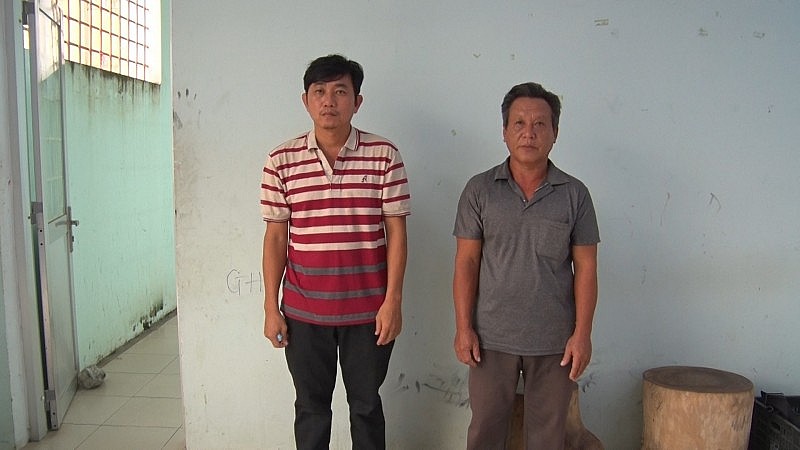
Trần Văn Luyến (bên trái) bị bắt giữ và khởi tố
Theo cơ quan Công an, để điều tra xử lý vụ việc nêu trên, Cục Cảnh sát hình sự- Bộ Công an đã cử một tổ công tác gồm những cán bộ, điều tra viên nhiều kinh nghiệm phối hợp với Công an tỉnh Kiên Giang tổ chức điều tra. Ban chuyên án xác định việc các đối tượng đưa tàu, thuyền viên ra vùng biển nước ngoài đánh bắt hải sản có dấu hiệu hành vi “Tổ chức, môi giới cho người khác xuất cảnh trái phép”.
Two Phu Quoc Ridgebacks at a conservation center in Kien Giang Province in southern Vietnam. Photo by VnExpress/Ngoc TaiLe Quoc Tuan, 59, has spent nearly 30 years looking for and protecting the Phu Quoc Ridgeback, and now runs a conservation center with over 400 of the dogs.
Ever since he was young, Tuan, who lives in Kien Giang Province in the Mekong Delta, has been going into the buffer zone of the U Minh forest to look for plants and animals and support his family. One day, when he got lost in the forest, he climbed on top of a tree to sleep, and his dog refused to leave his side.
Since then he has been dreaming about finding rare dog species to conserve them.
Once after completing college he went on a business trip to Phu Quoc and learned about the Phu Quoc Ridgeback and its unique characteristics like webbed feet, dorsal ridges and great swimming expertise, and decided to protect this species.
In 1999 he bought 2,000 m2 of land in Phu Quoc for VND200 million (US$8,270) to set up a farm and looked for purebred puppies.
Thailand’s new government is promising to “unlock” fisheries by reducing regulation and transparency around vessels’ activities.
A letter signed by 90 NGOs questions the National Fishing Association’s proposals for fisheries reform, including returning to day-rate salaries, permitting child labor and weakening punitive measures designed to deter illegal, unregulated and unreported (IUU) fishing.
This post is a commentary. The views expressed are those of the author, not necessarily Mongabay.
The government of Thailand is about to reverse eight years of progress.
Launched as policymakers lock horns with petrochemicals lobbyists over a treaty to end plastic pollution, the documentary produced by Eco-Business asks why opportunities to solve humanity’s waste crisis are being wasted. It will premiere in Singapore and screen on the sidelines of the upcoming COP28 climate summit.
More than a week after a third round of negotiations for a global treaty to stop plastic pollution came to a disappointing close, a new documentary launches that explores the truth behind the waste industry.
Negotiations for a binding global plastic agreement were stalled by lobbying from petrochemical and plastics industry-leaning governments, who are pushing for the treaty to focus solely on waste management rather than plastic production. The new film, titled “Wasted”, explores the role of “polluter pays” laws that hold corporations to account for the 280 million tonnes of short-lived plastic products that enter the environment every year.
“Why is waste ignored when it is staring us in the face? Maybe it is because the true impact is being hidden from us,” said Jessica Cheam, founder and managing director of Eco-Business, who co-produced the documentary with filmmaker Fraser Morton.
The film investigates the waste landscape in four key Asian countries for waste – Singapore, South Korea, Vietnam and India – and explores the solutions needed to stem the flow of trash into the environment. “Solutions to tackle this blight exist in plain sight, so why are we wasting opportunities to make change?” said Cheam.
On 7 December, Eco-Business will also be hosting the documentary’s premiere on the sidelines of the COP28 climate meeting in Dubai, in partnership with CC Forum. The event will be held at Grand Hyatt Dubai.
Vietnam is grappling with a critical plastic waste crisis. Each year, the country generates 1.8 million tonnes of plastic waste, about one-third of which ends up in the ocean. This constitutes 6 per cent of global marine plastic pollution and makes it the world’s fourth-largest emitter.
Not only does this exacerbate Vietnam’s environmental challenges, but it also casts a shadow over its international reputation as the nation has pledged robust commitments to sustainable dvelopment and the green transition.
Climate change is threatening the survival of plants and animals around the globe as temperatures rise and habitats change.
Some species have been able to meet the challenge with rapid evolutionary adaptation and other changes in behavior or physiology. Dark-colored dragonflies are getting paler in order to reduce the amount of heat they absorb from the sun. Mustard plants are flowering earlier to take advantage of earlier snowmelt. Lizards are becoming more cold-tolerant to handle the extreme variability of our new climate.
However, scientific studies show that climate change is occurring much faster than species are changing.
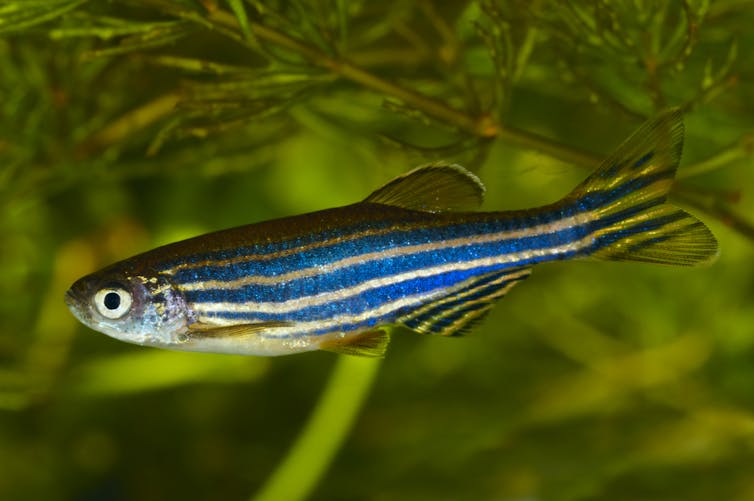
Zebrafish have evolved to thrive in water a degree or so warmer than normal, but they struggle to survive at higher temperatures. isoft/E+ Getty Images
Nhiều diện tích đất trồng cây hàng năm trên địa bàn Hà Tĩnh được phủ xanh bởi các loại cây lâm nghiệp. Điều đáng nói, việc sử dụng sai mục đích đất được giao sẽ mang nhiều hệ lụy nhưng người dân vẫn không hề hay biết ?.
Rừng trên đất trồng cây hàng năm
Những loại cây lạc, đậu, khoai.. đã gắn bó trên những cánh đồng sản xuất hoa màu quen thuộc bao đời nay. Tuy nhiên, trước tình hình biến đổi khí hậu khiến việc sản xuất bấp bênh, diện tích nhỏ, manh mún, cho hiệu quả không như mong muốn, một bộ phận người dân sử dụng đất đã chuyển sang trồng cây lâm nghiệp trong thời gian gần đây.
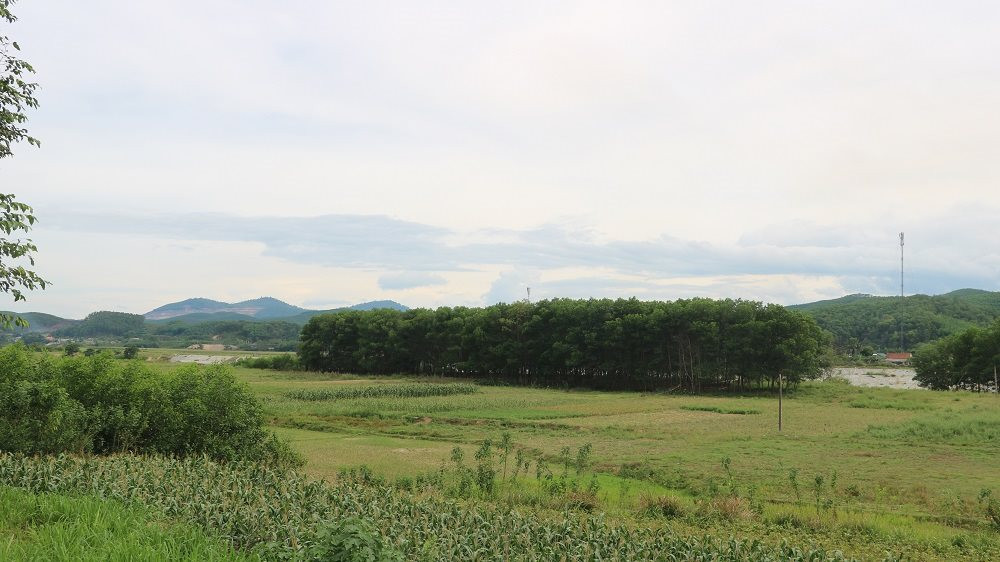
Rừng được trồng trên đất sản xuất hoa màu ở xã Hương Minh, huyện Vũ Quang
Tại Khu kinh tế mới Nam Sơn, xã Cẩm Sơn, huyện Cẩm Xuyên (Hà Tĩnh) ngút ngàn màu xanh của keo lá tràm. Được biết, những diện tích này thuộc dự án khai hoang xây dựng đồng ruộng bằng nguồn ngân sách nhà nước từ năm 2001. Nhiều năm nay, các hộ được giao khoán đã bỏ sản xuất hoa màu, chuyển sang trồng cây keo lá tràm vì cho rằng mang lại hiệu quả kinh tế cao hơn.
Ba dự án thủy điện bậc thang Đắk R’lấp 1, Đắk R’lấp 2, Đắk R’lấp 3 trên sông Đồng Nai được Bộ Công Thương đưa vào Quy hoạch Điện VIII khiến nhiều người lo ngại hàng trăm hecta vùng lõi Vườn Quốc gia (VQG) Cát Tiên và rừng phòng hộ Nam Cát Tiên sẽ biến mất.
Theo hồ sơ đề nghị bổ sung quy hoạch của Công ty CP Đầu tư – Phát triển năng lượng sạch Tây Nguyên (doanh nghiệp đề xuất), vị trí 3 dự án thủy điện Đắk R’lấp 1, 2, 3 nằm chủ yếu trong phân khu bảo vệ nghiêm ngặt của rừng đặc dụng VQG Cát Tiên (tả ngạn sông Đồng Nai, thuộc tỉnh Lâm Đồng) và rừng phòng hộ Nam Cát Tiên (hữu ngạn sông Đồng Nai, thuộc tỉnh Đắk Nông), chỉ một phần nhỏ ở tỉnh Bình Phước nhưng cũng là đất rừng.
Chưa có số liệu chính thức bao nhiêu hecta rừng sẽ bị ảnh hưởng nếu triển khai 3 dự án thủy điện này. Theo hồ sơ đề xuất của doanh nghiệp đề xuất, diện tích chiếm đất của 3 dự án là 197 ha, trong đó có đến 145 ha rừng. Song, cơ quan chức năng tỉnh Lâm Đồng xác định diện tích chiếm đất của 3 dự án này còn lớn hơn nhiều, ít nhất phải 464 ha.
Greenhouse gas emissions can be offset by carbon sinks such as forests, but expanding these areas can put Indigenous communities, reliant on the forests, at risk.
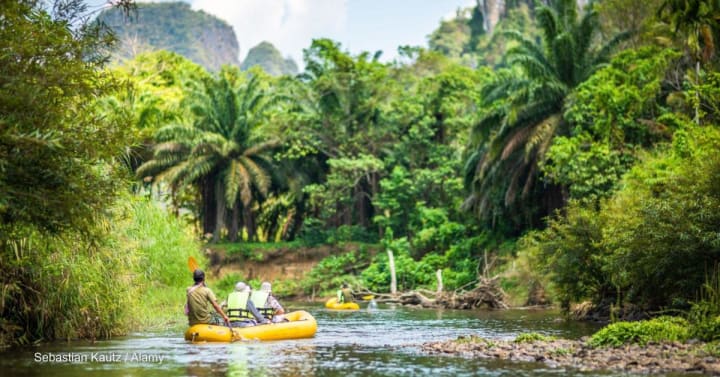
Khao Sok rainforest in Thailand. Photo by: Sebastian Kautz / Alamy
From Khao Sok National Park in the southwest to Phu Chi Fa Forest Park in the north, forests cover around 30% of Thailand’s total area. Approximately 23 million people live near or in these lush green landscapes, depending on them for sustenance and livelihoods. But that’s now at risk, due to both climate change-related threats and the policies implemented to protect the forests.
Warangkana Rattanarat, Thailand country director for The Center for People and Forests, warned that the arrival of El Niño earlier this year has caused long droughts and less rain, damaging crops and other forest resources. This has affected the availability of food, as well as the income local people can derive from forest resources, she added.
The country has also experienced floods and the highest temperatures on record this year, impacting forests and the communities within them. In theGermanWatch Global Climate Risk Index 2021, Thailand ranked at number nine globally for long-term climate risks.
Additionally, there are land and tenure rights issues for Indigenous forest communities to contend with, and national climate commitments that have the potential to negatively impact such communities, said experts.
The debut of the Chàm Islands Nature Reserve would help improve the protection of natural areas for Quảng Nam and bring more value in eco-tourism, research, education, investment and ‘green’ growth in the future.
A view of Chàm Islands, off the coast of Hội An ancient town. The islands have been developed as a Nature Reserve for better protection and conservation of their rich forest and marine value. VNS Photo Công Thành
CHÀM ISLANDS — The management board of Chàm Islands Marine Protected Area (MPA), 20km off the coast of Hội An City has been building procedures and requirements for the establishment of the Chàm Islands Nature Reserve for extended protection and conservation of natural resources on land and sea.

/img/iea/3oOpZZzb6W/drainage-picture-2.jpg)





 CVD
CVD 