Beneath the windmill-dotted marshlands of the Netherlands lies Europe’s largest natural gas reserve. The sprawling Groningen field has enough untapped capacity to replace, as soon as this winter, much of the fuel Germany once imported from Russia.
Instead the field is in the process of shutting down, and the Netherlands is rebuffing calls to pump more, even as Europe braces for perhaps its toughest winter since World War II. The reason: Drilling has led to repeated earthquakes, and Dutch officials are loath to risk a backlash from residents by breaking promises.
Analysis by Nadeen Ebrahim and Abbas Al Lawati, CNN
Updated 11:20 AM EDT, Fri October 14, 2022
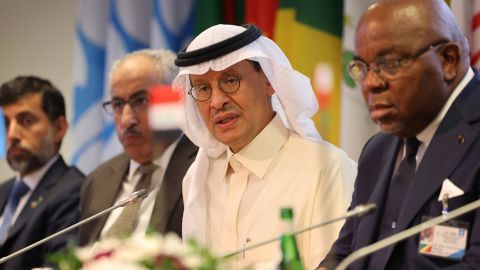
Abdulaziz bin Salman, Saudi Arabia’s energy minister, center, speaks during a news conference following a meeting of OPEC+ countries in Vienna, Austria, on October 5.Akos Stiller/Bloomberg/Getty Images
Editor’s Note: A version of this story first appeared in CNN’s Meanwhile in the Middle East newsletter, a three-times-a-week look inside the region’s biggest stories. Sign up here.Abu DhabiCNN —
The Saudi-American relationship appears to have hit rock bottom.
After a move by the Saudi-led OPEC+ oil cartel to cut oil production, which could see inflation in the United States soaring just weeks ahead of the midterm elections, President Joe Biden told CNN’s Jake Tapper that it’s time for the US to rethink its relationship with Saudi Arabia.
‘Are the best days behind China now?’ Disillusioned Chinese ponder future
14:05 – Source: CNNHong KongCNN Business —
When Xi Jinping came to power a decade ago, China had just overtaken Japan to become the world’s second largest economy.
It has grown at a phenomenal pace since then. With an average annual growth rate of 6.7% since 2012, China has seen one of the fastest sustained expansions for a major economy in history. In 2021, its GDP hit nearly $18 trillion, constituting 18.4% of the global economy, according to the World Bank.
South Korea’s SK Hynix and Taiwan Semiconductor Manufacturing granted authorisation to supply operations in China.
The US is reportedly scrambling to avoid disruptions to the semiconductor supply chain after announcing new export curbs on China’s chip industry [File: Aly Song/Reuters]
The United States is scrambling to tackle the unintended consequences of its new set of export curbs on China’s chip industry that could inadvertently harm the semiconductor supply chain, people familiar with the matter have said.
Hours before the new restrictions took effect, South Korean memory chipmaker SK Hynix said the US had granted it authorisation to receive goods for its chip production facilities in China without additional licensing imposed by the new rules.
BREAKING The UN General Assembly adopted a resolution that condemns #Russia‘s “illegal so-called referendums” in regions within #Ukraine‘s internationally-recognized borders, and demands it reverses its annexation declaration.
President Biden’s National Security Strategy outlines how the United States will advance our vital interests and pursue a free, open, prosperous, and secure world. We will leverage all elements of our national power to outcompete our strategic competitors; tackle shared challenges; and shape the rules of the road.
The Strategy is rooted in our national interests: to protect the security of the American people, to expand economic opportunity, and to realize and defend the democratic values at the heart of the American way of life. In pursuit of these objectives, we will:
Invest in the underlying sources and tools of American power and influence;
Build the strongest possible coalition of nations to enhance our collective influence to shape the global strategic environment and to solve shared challenges; and
Modernize and strengthen our military so it is equipped for the era of strategic competition.
COOPERATION IN THE AGE OF COMPETITION In the early years of this decisive decade, the terms of geopolitical competition will be set while the window of opportunity to deal with shared challenges will narrow. We cannot compete successfully to shape the international order unless we have an affirmative plan to tackle shared challenges, and we cannot do that unless we recognize how heightened competition affects cooperation and act accordingly.
Strategic Competition. The most pressing strategic challenge we face as we pursue a free, open, prosperous, and secure world are from powers that layer authoritarian governance with a revisionist foreign policy.
We will effectively compete with the People’s Republic of China, which is the only competitor with both the intent and, increasingly, the capability to reshape the international order, while constraining a dangerous Russia.
Strategic competition is global, but we will avoid the temptation to view the world solely through a competitive lens, and engage countries on their own terms.
Shared Challenges. While this competition is underway, people all over the world are struggling to cope with the effects of shared challenges that cross borders—whether it is climate change, food insecurity, communicable diseases, or inflation. These shared challenges are not marginal issues that are secondary to geopolitics. They are at the very core of national and international security and must be treated as such.
We are building the strongest and broadest coalition of nations to enhance our collective capacity to solve these challenges and deliver for the American people and those around the world.
To preserve and increase international cooperation in an age of competition, we will pursue a dual-track approach. On one track, we will work with any country, including our competitors, willing to constructively address shared challenges within the rules-based international order and while working to strengthen international institutions. On the other track, we will deepen cooperation with democracies at the core of our coalition, creating a latticework of strong, resilient, and mutually reinforcing relationships that prove democracies can deliver for their people and the world.
INVESTING AT HOME The Biden-Harris Administration has broken down the dividing line between domestic and foreign policy because our strength at home and abroad are inextricably linked. The challenges of our age, from strategic competition to climate change, require us to make investments that sharpen our competitive edge and bolster our resilience.
Our democracy is at the core of who we are and is a continuous work in progress. Our system of government enshrines the rule of law and strives to protect the equality and dignity of all individuals. As we strive to live up to our ideals, to reckon with and remedy our shortcomings, we will inspire others around the world to do the same.
We are complementing the innovative power of the private sector with a modern industrial strategy that makes strategic public investments in our workforce, strategic sectors, and supply chains, especially in critical and emerging technologies.
A powerful U.S. military helps advance and safeguard vital U.S. national interests by backstopping diplomacy, confronting aggression, deterring conflict, projecting strength, and protecting the American people and their economic interests. We are modernizing our military, pursuing advanced technologies, and investing in our defense workforce to best position America to defend our homeland, our allies, partners, and interests overseas, and our values across the globe.
OUR ENDURING LEADERSHIP The United States will continue to lead with strength and purpose, leveraging our national advantages and the power of our alliances and partnerships. We have a tradition of transforming both domestic and foreign challenges into opportunities to spur reform and rejuvenation at home. The idea that we should compete with major autocratic powers to shape the international order enjoys broad support that is bipartisan at home and deepening abroad.
Our alliances and partnerships around the world are our most important strategic asset that we will deepen and modernize for the benefit of our national security.
We place a premium on growing the connective tissue on technology, trade and security between our democratic allies and partners in the Indo-Pacific and Europe because we recognize that they are mutually reinforcing and the fates of the two regions are intertwined.
We are charting new economic arrangements to deepen economic engagements with our partners and shaping the rules of the road to level the playing field and enable American workers and businesses—and those of partners and allies around the world—to thrive.
As we deepen our partnerships around the world, we will look for more democracy, not less, to shape the future. We recognize that while autocracy is at its core brittle, democracy’s inherent capacity to transparently course-correct enables resilience and progress.
AFFIRMATIVE ENGAGEMENT The United States is a global power with global interests; we are stronger in each region because of our engagement in the others. We are pursuing an affirmative agenda to advance peace and security and to promote prosperity in every region.
As an Indo-Pacific power, the United States has a vital interest in realizing a region that is open, interconnected, prosperous, secure, and resilient. We are ambitious because we know that we and our allies and partners hold a common vision for the region’s future.
With a relationship rooted in shared democratic values, common interests, and historic ties, the transatlantic relationship is a vital platform on which many other elements of our foreign policy are built. To effectively pursue a common global agenda, we are broadening and deepening the transatlantic bond.
The Western Hemisphere directly impacts the United States more than any other region so we will continue to revive and deepen those partnerships to advance economic resilience, democratic stability, and citizen security.
A more integrated Middle East that empowers our allies and partners will advance regional peace and prosperity, while reducing the resource demands the region makes on the United States over the long term.
In Africa, the dynamism, innovation, and demographic growth of the region render it central to addressing complex global problems.
Russian Missiles Strike Across Ukraine Following Bridge Attack
Russia launched (FT) its most extensive air strikes on Ukraine in months after a Russian bridge was bombed over the weekend. At least ten people were killed across Ukraine, including at least five people in the capital, Kyiv. Russian President Vladimir Putin called the strikes a retaliation for Ukraine’s “terrorist attack” on a bridge linking Russia to Crimea, the Ukrainian peninsula Moscow annexed in 2014. Ukraine has not claimed responsibility for the bridge attack. The Russian strikes hit at least ten Ukrainian cities, targeting infrastructure and civilian areas. North Atlantic Treaty Organization (NATO) Secretary-General Jens Stoltenberg called the attacks (Reuters) “horrific and indiscriminate.” Meanwhile, Belarusian President Alexander Lukashenko said he ordered troops to deploy (Reuters) alongside Russian fighters near Ukraine.
A new report says Russian birch wood is routed through Asia before being shipped to American stores
By Michael Tatarski
October 1, 2022 at 2:00 a.m. EDT Ư=WashingtonPost
HO CHI MINH CITY, Vietnam — Russian birch wood has continued to flow to American consumers, disguised as Asian products, despite U.S. economic sanctions imposed on Russia over its invasion of Ukraine, a new report says.
The Environmental Investigation Agency (EIA), a nonprofit watchdog group based in Britain, has found that most birch products currently being exported from Vietnam to the United States originate in Russia. According to Vietnam customs data, roughly 40,000 cubic meters of birch wood is transported every month from Russia andChina into Vietnam, where it’s assembled into furniture and plywood.
Human Rights Advocates From Belarus, Russia, and Ukraine Win Nobel Peace Prize
This year’s Nobel Peace Prize was awarded (AP) to jailed Belarusian rights activist Ales Bialiatski, the Russian rights group Memorial, and the Ukrainian rights group Center for Civil Liberties. Norwegian Nobel Committee Chair Berit Reiss-Andersen celebrated their work toward anti-militarism, the rule of law, and “peace and fraternity between nations.” Bialiatski founded the human rights organization Viasna and was jailed without trial following his participation in the 2020 protests against the reelection of Belarusian President Alexander Lukashenko. A Russian court shut down Memorial in December, and the Center for Civil Liberties has worked to document Russian war crimes against Ukrainian civilians. While Reiss-Andersen said the prize is not intended to send a message to Russian President Vladimir Putin, it is seen as an implicit rebuke of Russia’s continued onslaught on Ukraine (Reuters).
OPEC+ Weighs Deep Supply Cuts Despite U.S. Concerns
The Organization of the Petroleum Exporting Countries (OPEC) and oil producers such as Russia are considering a sizable cut (NYT) in their oil output as they meet in Vienna today. The bloc and its allies, a grouping known as OPEC+, could cut production by two million barrels per day, or about 2 percent of global supply. The United States has lobbied Saudi Arabia against such a measure. Also today, European Union (EU) countries agreed (Reuters, AFP) to impose a price cap on Russian oil sales to third countries as part of a new sanctions package on Russia. The idea for a price cap was originally proposed by the Group of Seven (G7). G7 countries that aren’t part of the EU are expected to enact laws (NYT) similar to the EU’s to enforce the price cap.
TOMOYA ONISHI, Nikkei staff writerSeptember 29, 2022 11:11 JSTUpdated on September 29, 2022 11:56 JST
HANOI — Vietnam’s economy as measured by gross domestic product grew 13.67% in real terms in the July-September period from a year earlier as exports to the U.S. surged, the government said on Thursday.
A sharp recovery in personal consumption also contributed to the first quarterly growth of more than 10% since 2009, when comparable data began to be compiled, according to the General Statistics Office of Vietnam.
Ambassador Thomas-Greenfield’s Remarks at the UN Security Council Stakeout Following a Vote on a Resolution Condemning Russia’s Sham Referenda
Ambassador Linda Thomas-Greenfield U.S. Representative to the United Nations New York, New York September 30, 2022
AS DELIVERED
Let me thank all of you for waiting to see us this afternoon.
The illegal referenda that Russia held in Ukraine and the purported annexations of Ukrainian territory by force are a violation of the UN Charter and international law. They change nothing about the status and borders of Ukraine. That is the firmly-held conviction of the United States. This is the firmly-held conviction of the Secretary-General. And as you saw just now, that is the conviction of the Security Council – besides, of course, Russia.
A man uses an iPad device in a coffee shop in Hanoi, Vietnam May 18, 2018. REUTERS/Kham/File Photo
SINGAPORE/HANOI, Sept 28 (Reuters) – Vietnam is preparing new rules to limit which social media accounts can post news-related content, three people familiar with the matter said, as authorities tighten their control over news and information sources in the country.
The rules, expected to be announced by the year-end and with details yet to be hammered out, would establish a legal basis for controlling news dissemination on platforms like Facebook and YouTube while placing a significant moderation burden on platform providers, two of the sources added.
NATO Secretary General Jens Stoltenberg press point at NATO Headquarters in Brussels, 30 September 2022
NATO Secretary General Jens Stoltenberg condemned Russia’s attempts to annex four regions of Ukraine as “illegal and illegitimate.” Speaking to press on Friday (20 September 2022), he underlined that NATO Allies do not and will not recognise any of this territory as part of Russia. “We call on all states to reject Russia’s blatant attempts at territorial conquest,” he said.
Good evening.
President Putin has now claimed four more regions of Ukraine as part of Russia.
This is the largest attempted annexation of European territory by force since the Second World War.
Another 15 percent of Ukraine’s territory. An area roughly the size of Portugal. Illegally seized by Russia at gunpoint.
The sham referendums were engineered in Moscow. And imposed on Ukraine. In total violation of international law. This land grab is illegal and illegitimate.
NATO Allies do not, and will not, recognise any of this territory as part of Russia.
We call on all states to reject Russia’s blatant attempts at territorial conquest. These lands are Ukraine. Donetsk is Ukraine. Luhansk is Ukraine. Kherson is Ukraine. Zaporizhzhia is Ukraine. Just like Crimea is Ukraine.
This is the second time Russia has taken Ukrainian territory by force. But it does not change the nature of the conflict. This remains Russia’s brutal war of aggression against Ukraine.
And it does not change our commitment to support Ukraine. NATO is not party to the conflict. But we provide support to Ukraine so it can uphold its right for self-defence, enshrined in the UN Charter. Ours is a defensive Alliance.
We stand united and determined to defend and protect every NATO Ally. And every inch of Allied territory. This is a pivotal moment. Putin has mobilised hundreds of thousands of more troops. Engaged in irresponsible nuclear sabre-rattling. And now illegally annexed more Ukrainian territory. Together, this represents the most serious escalation since the start of the war. None of this shows strength. It shows weakness. It is an admission that the war is not going to plan. And that Putin has utterly failed in his strategic objectives.
Putin bears full responsibility for this war. And it is his responsibility to end it. To end the immense suffering of the brave Ukrainian people. To end the energy and food crisis that is affecting so many around the world.
If Russia stops fighting, there will be peace. If Ukraine stops fighting, it will cease to exist as an independent sovereign nation in Europe.
NATO reaffirms our unwavering support for Ukraine’s independence, sovereignty and territorial integrity. We remain resolute in providing support to Ukraine as it continues to defend itself against Russia’s aggression. For as long as it takes.
We firmly reject and unequivocally condemn the illegal annexation by Russia of Ukraine’s Donetsk, Luhansk, Zaporizhzhia and Kherson regions. By wilfully undermining the rules-based international order and blatantly violating the fundamental rights of Ukraine to independence, sovereignty and territorial integrity, core principles as enshrined in the UN Charter and international law, Russia is putting global security at risk.





 CVD
CVD 