– 83.4 million people were living in internal displacement at the end of 2024, more than twice as many as only six years ago (2018).
– 90 per cent had fled conflict and violence. In Sudan, conflict led to 11.6 million internally displaced people (IDPs), the most ever for one country. Nearly the entire population of the Gaza Strip remained displaced at the end of the year.
– Disasters triggered nearly twice as many movements in 2024 as the annual average over the past decade. The 11 million disaster displacements in the United States were the most ever recorded for a single country.
GENEVA, Switzerland – The number of internally displaced people (IDPs) reached 83.4 million at the end of 2024, the highest figure ever recorded, according to the Global Report on Internal Displacement 2025 published today by the Internal Displacement Monitoring Centre (IDMC). This is equivalent to the population of Germany, and more than double the number from just six years ago.
“Internal displacement is where conflict, poverty and climate collide, hitting the most vulnerable the hardest,” said Alexandra Bilak, IDMC director. “These latest numbers prove that internal displacement is not just a humanitarian crisis; it’s a clear development and political challenge that requires far more attention than it currently receives.”
We mark 50 years since the end of the U.S. war on Vietnam with the acclaimed Vietnamese American writer Viet Thanh Nguyen. On April 30, 1975, North Vietnamese troops took control of the South Vietnamese capital of Saigon as video of U.S. personnel being airlifted out of the city were broadcast around the world. Some 3 million Vietnamese people were killed in the U.S. war, along with about 58,000 U.S. soldiers. Hundreds of thousands of Lao, Hmong and Cambodians also died, and the impact of the war is still being felt in Vietnam and the region.
Nguyen says while the Vietnam War was deeply divisive in the United States during the 1960s and ’70s, American interference in Southeast Asia goes back to President Woodrow Wilson in 1919, when he rejected Vietnamese demands for independence from France. “And from that mistake, we’ve had a series of mistakes over the past century, mostly revolving around the fact that the United States did not recognize Vietnamese self-determination,” says Nguyen.
We Are Here Because You Are There”: Viet Thanh Nguyen on How U.S. Foreign Policy Creates Refugees
Pulitzer Prize-winning Vietnamese American writer Viet Thanh Nguyen discusses why he chooses to use the term “refugee” in his books, and speaks about his own experience as a refugee. His new novel tells the story of a man who arrives in France as a refugee from Vietnam, and explores the main character’s questioning of ideology and different visions of liberation. Titled “The Committed,” the book is a sequel to “The Sympathizer,” which won the Pulitzer Prize for Fiction in 2016. Nguyen says his protagonist is “a man of two faces and two minds” whose ability to see beyond Cold War divisions makes him the perfect figure to satirize the facile stories people tell themselves about the world. “He’s always going beyond the surface binaries to look underneath.” Nguyen is the chair of English and professor of English and American studies and ethnicity at the University of Southern California. His other books include “The Refugees” and the edited collection “The Displaced: Refugee Writers on Refugee Lives.”
Viet Thanh Nguyen Interview: The Vietnam War Refugee Experience Behind The Sympathizer
Pulitzer Prize-winning author Viet Thanh Nguyen reflects on his childhood as a refugee in America, his writing career, and family: from the trauma of displacement to the healing found in fatherhood and literature. Nguyen shares how these experiences have shaped his life and work, from his novel The Sympathizer to his commentary on war, cultural identity, and American life.
00:00 Introduction to Viet Thanh Nguyen and The Sympathizer
00:49 Refugee journey, family separation, and overcoming trauma
03:43 Humor, cultural expectations, and Vietnamese Catholic roots 05:29 Cultural identity, rebellion, and hidden writing career
07:14 Family relationships, cultural silence, and lessons in parenting 09:35 Impact of fatherhood, learning from children, and rediscovering play
12:13 Art, personal identity, and American cultural values 14:49 Vietnamese American identity, racism, and vision for the future
17:27 Teaching about war, challenges of digital information overload
20:31 Apocalypse Now, self identity struggles, and power of storytelling
24:41 Vietnam War legacy, draft-era resistance vs. modern volunteer military
26:47 Family history, generational trauma, and refugee story from Vietnam
Mapped: The Countries with the Most Stateless People
Mapped: The Countries with the Most Stateless People
This was originally posted on our Voronoi app. Download the app for free on iOS or Android and discover incredible data-driven charts from a variety of trusted sources.
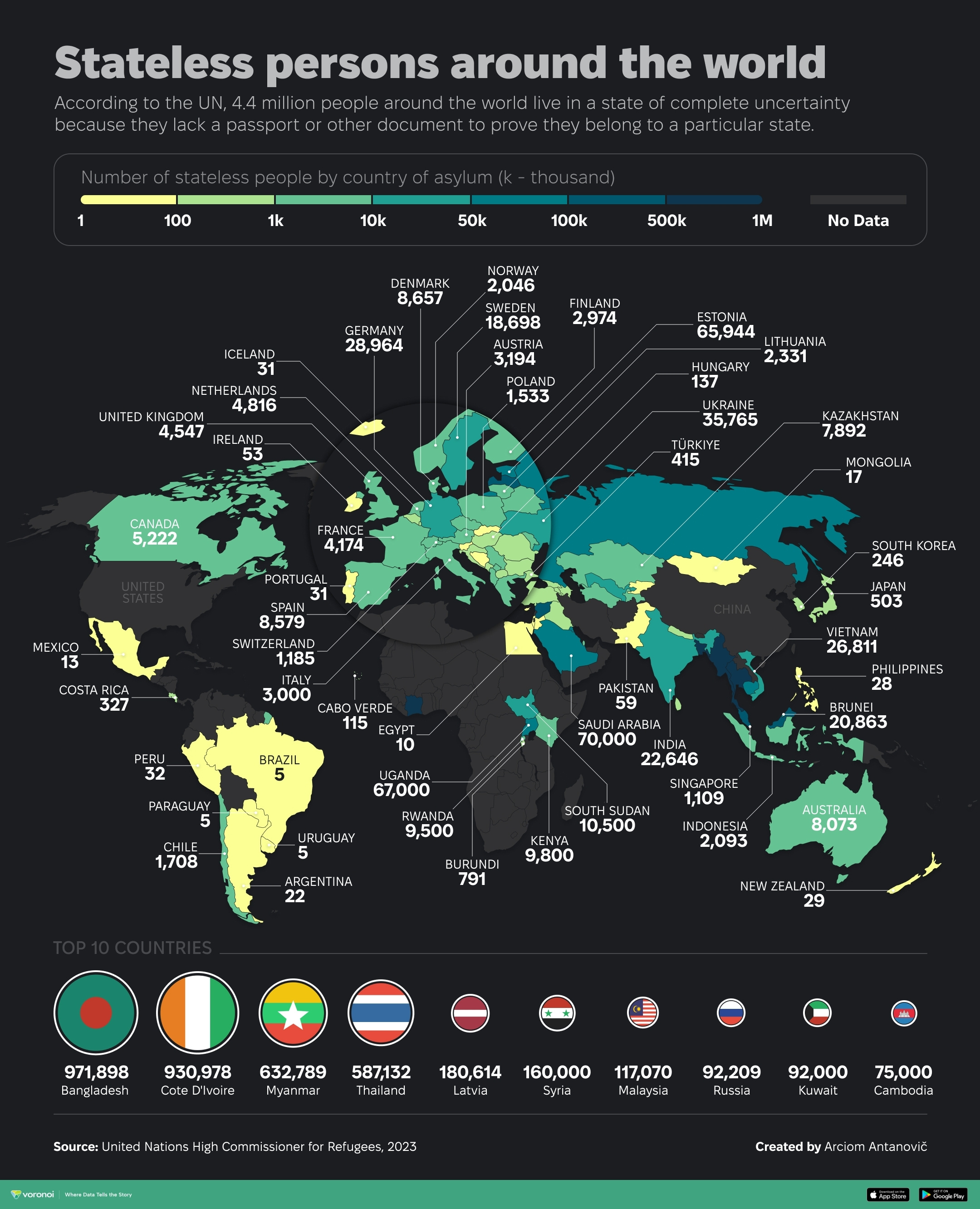
The United Nations High Commissioner for Refugees (UNHCR) officially recognizes over 4.4 million people worldwide as stateless or of undetermined nationality. However, the actual number is likely much higher due to data collection challenges.
Stateless persons—those not recognized as citizens of any country—are deprived of fundamental rights such as education, healthcare, and employment, leaving them highly vulnerable to exploitation and discrimination. But which countries have the most?
This map, created by Arciom Antanovič, uses data from the United Nations High Commissioner for Refugees to show the countries with the most stateless persons in 2023.
Bangladesh Tops the List
Certain countries are home to a disproportionate share of the world’s stateless people, often due to historical, social, and legal complexities.
Bangladesh comes in first with 971,898, followed by Côte d’Ivoire with 930,978, while Myanmar comes in third with 632,789.Search:
Country of Asylum
Stateless Persons
🇦🇱 Albania
2,018
🇦🇷 Argentina
22
🇦🇲 Armenia
520
🇦🇺 Australia
8,073
🇦🇹 Austria
3,194
🇦🇿 Azerbaijan
513
🇧🇩 Bangladesh
971,898
🇧🇾 Belarus
5,567
🇧🇪 Belgium
936
🇧🇦 Bosnia and Herzegovina
21
‹12345…10›
The raw number drops significantly after the fourth-placed Thailand with 587,132, as the fifth-placed Latvia only has 180,614.
The Causes of Statelessness
One of the primary drivers of statelessness is that in some countries, nationality can only be inherited through the father. When fathers are absent, the children may be left without a recognized nationality. This issue is particularly harmful for single mothers and families separated by conflict or migration.
Another significant cause of statelessness is racial and ethnic discrimination. Some governments use citizenship laws to exclude specific minority groups. In Myanmar, the Rohingya are a well-known example of such discrimination.
Geopolitical changes, such as shifting borders and citizenship revocation, also contribute to the issue. Governments sometimes strip individuals of their nationality as a punitive measure.
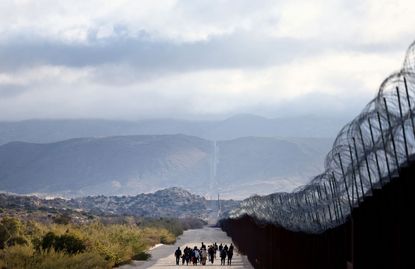
Asylum-seeking migrants walk toward a makeshift camp to await processing by the U.S. Border Patrol after crossing into the United States past a gap in the border barrier Dec. 1, 2023 in Jacumba Hot Springs, CaliforniaPUBLISHED 5 DAYS AGO
Immigration policy has been a hot-button issue for generations, in the United States and around the world. But waves of people fled their homes by land or by sea in 2023, triggering migrant crisis after migrant crisis in multiple regions. Battles over migration policy stoked domestic political feuds and diplomatic clashes.
International Organization for Migration officials told delegates at the United Nations’ COP28 climate conference that more than half of forced “internal displacements,” which totaled 32.6 million people last year, were driven by climate-related events, according to Forbes. Wars, like Russia’s invasion of Ukraine and the conflict between Israel and Hamas, drove more people to seek a better life in a new country, and increased tensions once they got there.
Here are some of the migration routes where the crisis was intense in 2023:
The U.S.-Mexico border
A “growing wave of migration” exploded at the U.S.-Mexico border in 2023, The Wall Street Journal reported recently. It hit especially hard in the small border city of Eagle Pass, Texas, where Mayor Rolando Salinas Jr. declared a state of emergency as the number of migrants entering from Mexico hit 3,000 per day. “We are on pace for this to be the worst of the border crisis yet, and we’ve seen some doozies,” said Rep. Tony Gonzalez (R-Texas), whose district includes Eagle Pass. The migrants included people fleeing turmoil in Venezuela, drug cartel violence in Ecuador and other once-safe countries, gang violence in Haiti, and a broad economic downturn across Latin America blamed on the Covid-19 pandemic.
But the impact wasn’t just felt at the U.S.-Mexico border. New York City Mayor Eric Adams declared a state of emergency as thousands of migrants — more than 146,000 between spring 2022 and November 2023 — arrived from the southern border. Many were sent north by Texas’ Republican governor, Greg Abbott, to cities run by Democrats in a campaign to pressure President Joe Biden to crack down at the border. Adams warned the city was facing a humanitarian crisis that would cost $12 billion over three years, The New York Times reported. City officials said in November their homeless shelters had no room for any more asylum-seekers.
The EU and UK
European nations have faced a huge influx of migrants in recent years. The EU is on track to receive more than one million asylum seekers in 2023, the most since a wave of people in 2015 and 2016, most of them fleeing Syria’s civil war. In Germany — already home to three million refugees, the most since waves of ethnic Germans returned from Eastern Europe after World War II — Chancellor Olaf Scholz is under pressure from overwhelmed states to do something about a more than 70 percent rise in asylum applications in 2023. “I don’t want to use big words,” Scholz told reporters in November, according to Politico, “but I think this is a historic moment.”
Italy and the United Kingdom joined forces in October to lead a European effort to fight “illegal migration.” Italy’s right-wing prime minister, Giorgia Meloni, came to power last year after vowing “to clamp down on unauthorized arrivals from North Africa with harsher immigration laws, restrictions on sea rescue charities, and plans to build migrant reception camps in Albania,” Reuters reported. U.K. Prime Minister Rishi Sunak’s conservative government wants to pay Rwanda to process asylum applications for people arriving illegally in the U.K., which Sunak said would help “break the cycle of tragedy” of people-smuggling using small boats, the BBC reported. The UK also is taking steps to curb legal migration, including a higher minimum salary.
South to South
Migrant waves to Western countries get most of the headlines, but most migration occurs between countries in the same region. “That has put a significant burden on states that border conflict zones, like Uganda, which sits alongside both South Sudan and the Democratic Republic of Congo,” according to the World Politics Review. Fighting between Sudan’s army and paramilitaries has internally displaced three million people, and sent 926,841 people seeking refuge in Egypt, Libya, Chad, the Central African Republic, South Sudan, Ethiopia, and other neighboring countries, according to the United Nations International Organization for Migration.
These crises threaten to only get worse as rising global temperatures fuel mass climate migrations, according to Fortune. Global carbon emissions are rising, and climate scientists say the greenhouse gasses already accumulated in our atmosphere all but guarantee that Earth’s average temperature rise will exceed the tipping point of two degrees Celsius, which it did briefly in November 2023. This, according to Fortune, could make countries like Bolivia or Yemen “vacant states,” as their people leave seeking “fertile” ground, with their leaders unable to give them reason to stay. As Fortune put it: “Solar panels for an Eritrean village won’t keep its boys from fleeing the country’s hopeless economy and austere politics.”
Since November, more than 1,500 refugees have arrived in Indonesia’s Aceh province, triggering anger among the locals.
A Rohingya woman rests on a beach following her arrival in Blang Raya, Pidie, Aceh province, Indonesia [Reuters]
Published On 10 Dec 202310 Dec 2023
Over 300 Rohingya refugees have arrived on the coast of Aceh province in Indonesia after weeks of drifting across the sea from Bangladesh.
The emaciated survivors – children, women and men – told of running out of supplies and of fearing death at sea as they landed on the unwelcoming shores of the villages of Pidie and Aceh Besar in the pre-dawn hours of Sunday morning.
“The boat was sinking. We had no food or water left,” told Shahidul Islam, a 34-year-old survivor, saying he had left from a refugee camp in Bangladesh.
A group of 180 refugees arrived by boat at 3am local time (20:00 GMT on Saturday) on a beach in the Pidie regency of Aceh province.
The second boat carrying 135 refugees landed in neighbouring Aceh Besar regency hours later after being adrift at sea for more than a month, while a third boat is missing.
Generations of Palestinians have called Lebanon home. Many fled here during the 1948 Arab-Israeli War.
It has been a struggle for them to survive. But the current level of poverty is unprecedented – the result of one of the worst economic crises in recent history.
The United Nations agency that is supposed to support them has been crippled by a shortage of funds. Children are hungry, and many people are jobless, while others die at sea trying to reach Europe.
Lebanon’s forgotten Palestinians | The Full Report
HANOI, Dec 9 (Reuters) – A Vietnamese oil service vessel rescued 154 people from a sinking boat in the Andaman Sea and has transferred them to Myanmar’s navy, state media reported, a group that was confirmed by activists as minority Rohingya Muslims.
The vessel, Hai Duong 29, was en route from Singapore to Myanmar when it spotted the boat in distress 285 miles (458.7 km) south of the Myanmar coast on Wednesday, VTCNews said in a report aired late on Thursday.
The Rohingya are a minority that has for years been persecuted in Myanmar and many risk their lives attempting to reach predominantly Muslim Malaysia and Indonesia on rickety boats.
A rare look inside Bangladesh’s island camp for Rohingya refugees | 101 East Documentary
Al Jazeera English – 6-10-2022
Bangladesh is home to the world’s largest refugee camp, hosting more than a million Rohingya refugees who fled a brutal crackdown by Myanmar’s military in 2017.
Around the world, far-right populist parties continue to stoke the popular backlash against global migration, driving some centrist governments to adopt a tougher line on immigration. But with short-term strategies dominating the debate, many of the persistent drivers of migration go unaddressed, even as efforts to craft a global consensus on migration are hobbled by demands for quick solutions. Learn more when you subscribe to World Politics Review (WPR).
Migrants rest on a Mediterranea Saving Humans NGO boat, as they sail off Italy’s southernmost island of Lampedusa, just outside Italian territorial waters, Thursday, July 4, 2019 (AP photo by Olmo Calvo).
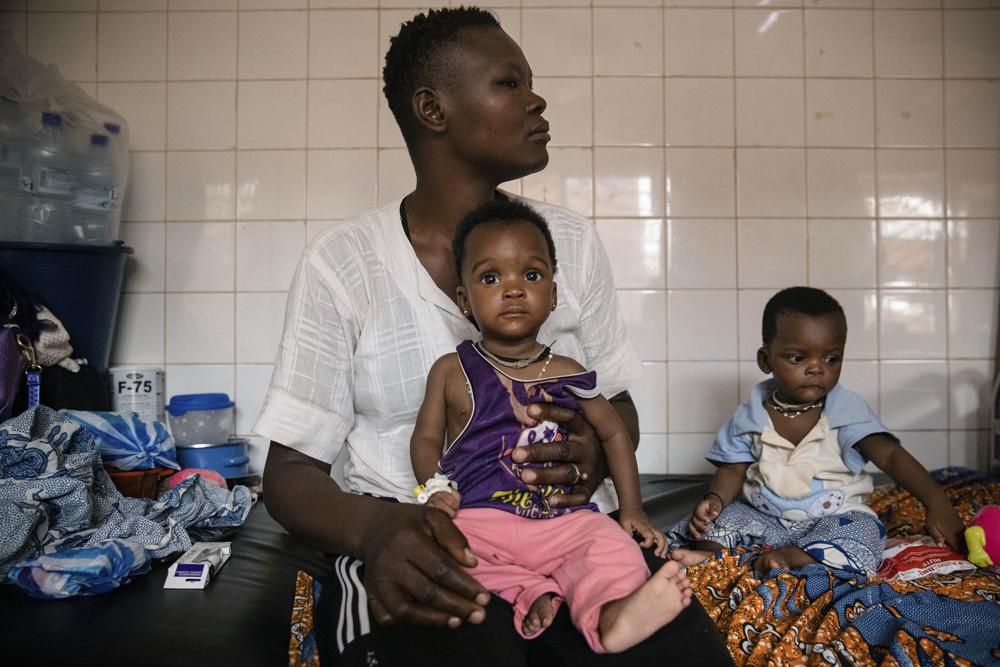
FILE- In this April 15, 2022 file photo, malnourished children wait for treatment in the pediatric department of Boulmiougou hospital in Ouagadougou, Burkina Faso. The U.N. is warning that 18 million people in Africa’s Sahel region face severe hunger in the next three months. Two U.N. agencies are citing the impacts of war in Ukraine, the coronavirus pandemic, climate-induced shocks and rising costs – and warning that people may try to migrate out of the affected areas. (AP Photo/Sophie Garcia, File)
GENEVA (AP) — The head of the U.N. refugee agency says “Europe should be much more worried” that more people from Africa’s Sahel region could seek to move north to escape violence, climate crises like droughts and floods and the impact of growing food shortages caused by Russia’s invasion of Ukraine.Filippo Grandi, the U.N. High Commissioner for Refugees, called for more efforts to build peace in the world as conflicts and crises like those in Ukraine, Venezuela, Myanmar, Syria and beyond have driven over 100 million people to leave their homes — both within their own countries and abroad.
UNHCR, the U.N.’s refugee agency, on Thursday issued its latest “Global Trends” report, which found over 89 million people had been displaced by conflict, climate change, violence and human rights abuses by 2021. The figure has since swelled after at least 12 million people fled their homes in Ukraine to other parts of the country or abroad following Russia’s Feb. 24 invasion.
This year, the world is also facing growing food insecurity — Ukraine is a key European breadbasket and the war has greatly hurt grain exports
The African Union, whose continent relies on imports of wheat and other food from Ukraine, has appealed for help to access grain that is blocked in Ukrainian silos and unable to leave Ukrainian ports amid a Russian naval blockade in the Black Sea.
As a child, I fled Afghanistan with my family. When we arrived in Britain after a harrowing journey, we thought we could start our new life in safety. But the reality was very different.
Cộng đồng người Việt cho rằng chính sách trục xuất của chính quyền Trump đã phản bội những người đến Mỹ tị nạn sau chiến tranh.
Người Việt biểu tình ở New Orleans để phản đối chính sách trục xuất của chính quyền Trump. Nguồn: AP.
“Những người này đã đền tội. Thật không công bằng khi dựa vào quá khứ để o ép họ”, AFP dẫn lời Minh Nguyên, lãnh đạo tổ chức VAYLA chuyên hỗ trợ thanh niên và các gia đình ở New Orleans, phát biểu. Cộng đồng người Việt ở thành phố New Orleans khá lớn, bao gồm nhiều người đến Mỹ tị nạn sau chiến tranh và con cái của họ. “Họ có mọi quyền được sống ở đây. Họ được bảo vệ. Họ là thường trú nhân trên đất Mỹ. Họ chưa bao giờ phải lo lắng về việc bị trục xuất và giờ bỗng nhiên họ đối mặt với nguy cơ đó”. Tiếp tục đọc “Người Việt ở New Orleans biểu tình phản đối lệnh trục xuất của Trump”→
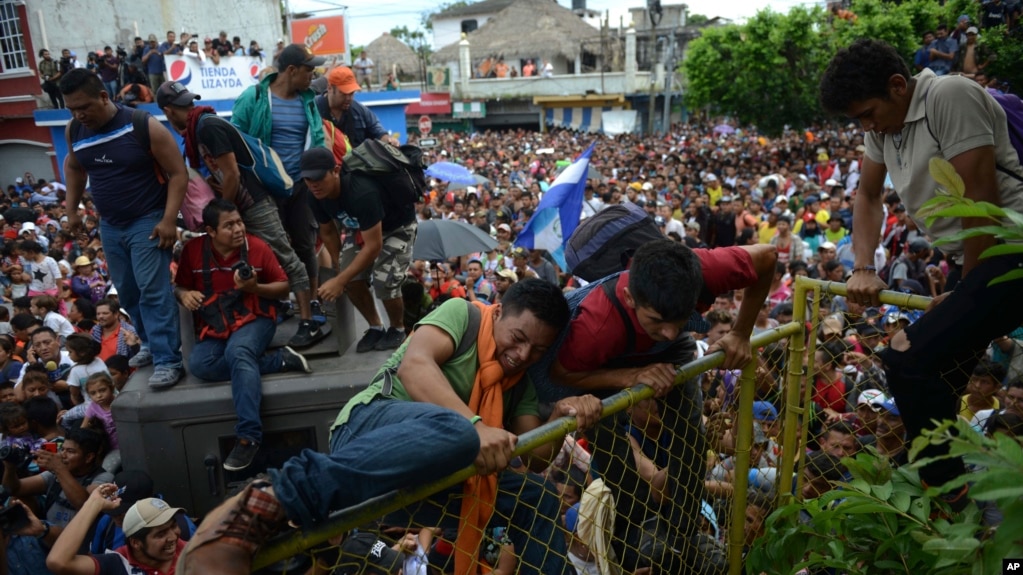
Thousands of Honduran migrants rush across the border toward Mexico, in Tecun Uman, Guatemala, Oct. 19, 2018.
The presidents of Honduras and Guatemala are set to meet Saturday to implement a strategy to return a caravan of thousands of migrants to Honduras after U.S. President Donald Trump warned the convoy must be stopped before it reaches the U.S.
A standoff between the migrants and Mexican police continued as they settled on a bridge separating Guatemala and Mexico, with some clinging to the closed border gate crying “there are children here.”




 CVD
CVD 