Singapore: Investigating exploitation and abuse of young domestic workers

Al Jazeera English – 12-3-2025

There are more than 200,000 foreign domestic workers in Singapore.

Under the law, they have to be at least 23 years old.

But one NGO says it is seeing more and more minors at its shelter for abused maids.

Most of these girls come from Myanmar, where investigations reveal a web of deceit and corruption in the recruitment process, and immigration officials are regularly bribed to doctor birthdates on travel documents.

Because of their youth, the girls are often easy targets for abusive employers and sexual predators.

But just how bad is the problem and what is being done to remedy it? 101 East investigates.

How the climate crisis fuels gender inequality

The climate crisis may be a collective problem, but its impacts do not fall equally. Women and girls often bear the heaviest burdens.

November 30, 2023

Editor’s note

This story is part of As Equals, CNN’s ongoing series on gender inequality. For information about how As Equals is funded and more, check out our FAQ.

Climate change acts as a threat multiplier, finding existing injustices and amplifying them. Women and girls already grapple with gender inequality, but when extreme weather devastates a community, the UN found that inequalities worsen: Intimate partner violence spikes, girls are pulled from school, daughters are married early, and women and girls forced from their homes face a higher risk of sexual exploitation and trafficking.

“When we look at who’s affected worse, who’s on the frontlines of the climate crisis, it’s primarily women — women in poor and vulnerable countries,” Selwin Hart, UN Special Adviser to the Secretary-General on Climate Action and Just Transition, told CNN. “And unfortunately, our policies or strategies are really not geared to address this challenge.”

To explore the complex links between gender and climate change, CNN worked with seven women photojournalists who spent time with women and girls in seven countries across the Global South to document the challenges they face.

This visual project gives a snapshot of the myriad ways the human-induced climate crisis is upending their lives, but also shows how they are fighting back. Every image shows both struggle and survival, the battle to live a decent life in a swiftly changing climate.

Girls’ education in Nigeria

The Center for Girls’ Education runs a series of programs in Nigeria to help girls stay in school. One in every five of the world’s children who are out of school is in Nigeria, according to UNICEF, and it is girls who are impacted the most.

Photographs by Taiwo Aina for CNN

More than 10 million children between 5 and 14 years old are absent from classrooms across Nigeria, according to UNICEF. For girls, the statistics are even bleaker: In states in the northeast and northwest of the country, fewer than half attend school.

This education crisis is the result of a tangle of factors, including poverty, geography and gender discrimination, the UN agency adds. But against the backdrop of these individual factors is the broader context of the climate crisis.

Nigeria is growing hotter and dryer, and extreme weather such as flash floods and landslides are becoming fiercer and more frequent. Climate disasters can make schools inaccessible and classrooms unsafe. Communities struggling to cope with extreme weather sometimes turn to their children to help or to earn extra money to support the family. And girls, whose attendance at school is already discouraged in some communities, are often most affected.

For every additional year the average girl attends school, her country’s resilience to climate disasters can be expected to improve by 3.2 points on an index that measures vulnerability to climate-related disasters, according to estimates from the Brookings Institution.

There are efforts to support girls’ education and equip them with the resources to cope with a fast-changing climate. The Center for Girls’ Education in the northern Nigerian city of Zaria runs programs to help girls stay in school and offers training on how to cope with the impacts of extreme weather.

“I feel when we give the girls education on climate change, how to mitigate it, it will go a long way in helping the girls in how to support themselves in times of difficulties, and even help them prepare for it,” said Habiba Mohammed, director of the Center for Girls’ Education.

Asiya Sa’idu, 17

Tiếp tục đọc “How the climate crisis fuels gender inequality”

Why has the Philippines arrested ex-President Duterte on ICC warrant?

Aljazeera.com

Families of victims, human rights groups call for ‘expeditious surrender and transfer of custody’ of Duterte to the ICC.

Relatives of victims of former Philippine president Rodrigo Duterte's war on drugs cry during a mass for victims at a church in Manila on March 11, 2025. Former Philippines president Rodrigo Duterte was arrested on March 11 in Manila by police acting on an International Criminal Court warrant tied to his deadly war on drugs. (Photo by TED ALJIBE / AFP)
Relatives of victims of former Philippine President Rodrigo Duterte’s deadly war on drugs cry during a mass for victims at a church in Manila following his arrest on Tuesday [Ted Aljibe/AFP]

By Ted Regencia Published On 11 Mar 202511 Mar 2025

Manila, Philippines – Almost three years after leaving the presidency, former President Rodrigo Duterte has been arrested by Philippine authorities in Manila, upon the request of the International Criminal Court (ICC) at The Hague, which is investigating allegations of “crimes against humanity” committed during his six years in power.

Duterte was immediately taken into police custody on Tuesday at the Manila international airport following his arrival from Hong Kong, in a move hailed by human rights groups as “a critical step for accountability in the Philippines”.

His trip to Hong Kong over the weekend had whipped up speculation that he would evade arrest.

Tiếp tục đọc “Why has the Philippines arrested ex-President Duterte on ICC warrant?”

The Countries with the Most Stateless People

Visual Capitalist: By Arciom Antanovič  Featured Creator Article/Editing: Ryan Bellefontaine

Demographics

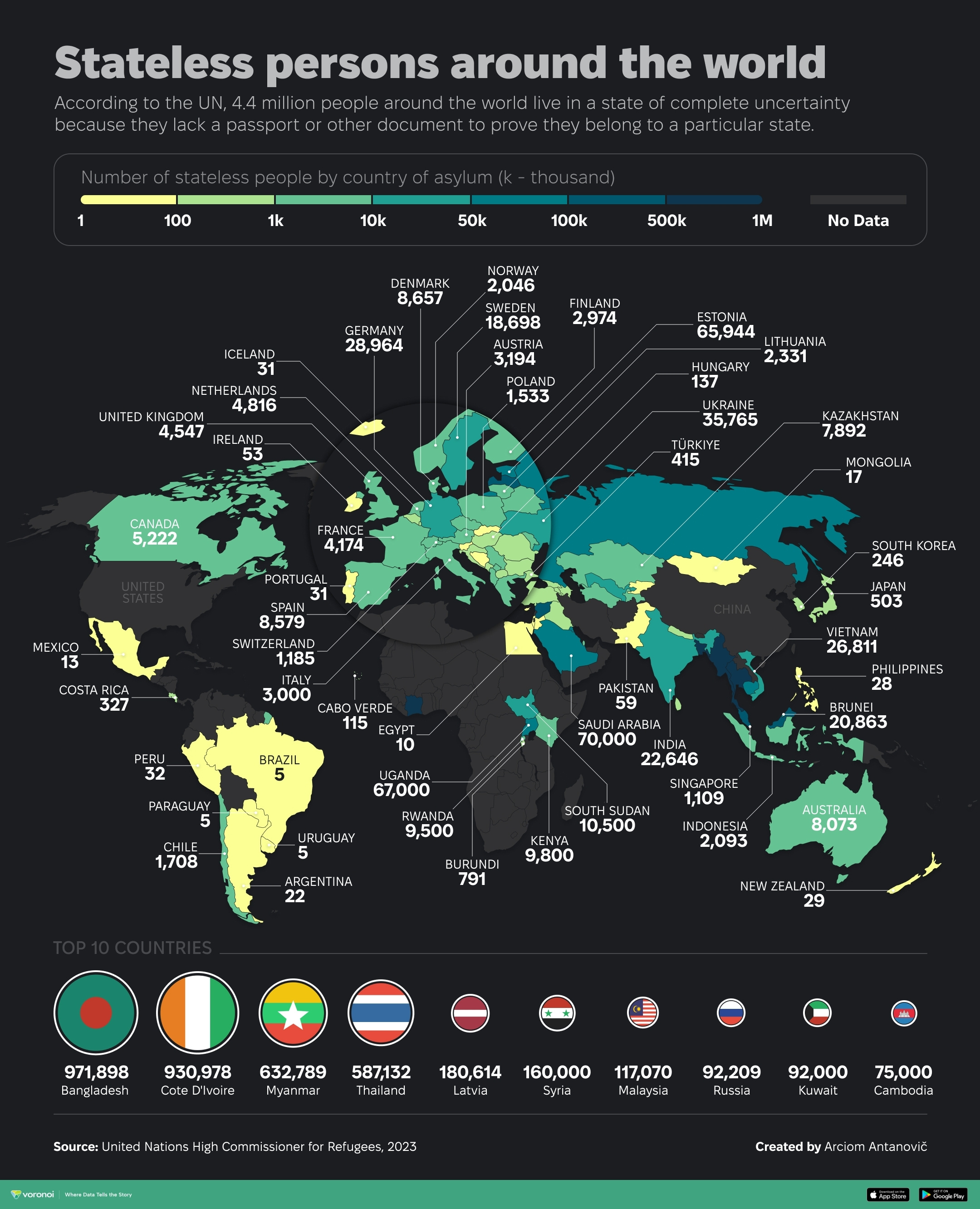
Mapped: The Countries with the Most Stateless People

A map of the countries with the most stateless persons in 2023, using data from the United Nations High Commissioner for Refugees.

Mapped: The Countries with the Most Stateless People

This was originally posted on our Voronoi app. Download the app for free on iOS or Android and discover incredible data-driven charts from a variety of trusted sources.

The United Nations High Commissioner for Refugees (UNHCR) officially recognizes over 4.4 million people worldwide as stateless or of undetermined nationality. However, the actual number is likely much higher due to data collection challenges.

Stateless persons—those not recognized as citizens of any country—are deprived of fundamental rights such as education, healthcare, and employment, leaving them highly vulnerable to exploitation and discrimination. But which countries have the most?

This map, created by Arciom Antanovič, uses data from the United Nations High Commissioner for Refugees to show the countries with the most stateless persons in 2023.

Bangladesh Tops the List

Certain countries are home to a disproportionate share of the world’s stateless people, often due to historical, social, and legal complexities.

Bangladesh comes in first with 971,898, followed by Côte d’Ivoire with 930,978, while Myanmar comes in third with 632,789.Search:

Country of AsylumStateless Persons
🇦🇱 Albania2,018
🇦🇷 Argentina22
🇦🇲 Armenia520
🇦🇺 Australia8,073
🇦🇹 Austria3,194
🇦🇿 Azerbaijan513
🇧🇩 Bangladesh971,898
🇧🇾 Belarus5,567
🇧🇪 Belgium936
🇧🇦 Bosnia and Herzegovina21

‹12345…10›

The raw number drops significantly after the fourth-placed Thailand with 587,132, as the fifth-placed Latvia only has 180,614.

The Causes of Statelessness

One of the primary drivers of statelessness is that in some countries, nationality can only be inherited through the father. When fathers are absent, the children may be left without a recognized nationality. This issue is particularly harmful for single mothers and families separated by conflict or migration.

Another significant cause of statelessness is racial and ethnic discrimination. Some governments use citizenship laws to exclude specific minority groups. In Myanmar, the Rohingya are a well-known example of such discrimination.

Geopolitical changes, such as shifting borders and citizenship revocation, also contribute to the issue. Governments sometimes strip individuals of their nationality as a punitive measure.

Nói KHÔNG với kết hôn sớm – Bộ phim về tảo hôn

Plan International Vietnam – 29-1-2024

Sanh chưa bao giờ nghĩ mình sẽ kết hôn khi mới chỉ lớp 9. Như bao bạn gái khác tại địa phương, cuộc sống sau hôn nhân của em có vô vàn trắc trở. Con của Sang không có giấy khai sinh, khi ốm đau cũng không đưa đi bệnh viện được mà chỉ ở nhà sử dụng thuốc Nam.

Nhưng Sanh vẫn tiếp tục hỗ trợ cho cộng đồng nơi em sinh sống. Là một nhà truyền thông tài ba, Sanh chia sẻ câu chuyện của mình tại những buổi sinh hoạt tại xã, tại trường để lan tỏa thông điệp nói không với tảo hôn và sống trọn vẹn với tuổi trẻ đáng giá của mình.

Only 0.5% of neuroscience studies look at women’s health

inspirethemind.org 

Neuroscience has Underserved Women. That’s Changing

A symmetrical pattern of brains are shown against a light-blue background.
Photo by DS stories on Pexels.

Neuroscientists are making strides in mapping and understanding the human brain, but like many other scientific fields, neuroscientific research has suffered from gender bias: men have been studied far more than women.

Since it came on the scene, magnetic resonance imaging (MRI), where a magnetic camera looks through the skull and captures pictures of a living brain, mountains of neuroimaging studies have been made by scientists eagerly delving into the most complex organ we have. It’s led to amazing discoveries and insights, and revolutionised our understanding of how we function.

But the neuroscientific investigation into brain health in relation to conditions only affecting women, girls, and people who have or have had menstrual periods, has been comparably pitifully small.

My name’s Livia. I’m a freelance science writer and journalism student, and I found myself diving into this as I wondered why hormonal birth control, several decades after its invention, still causes negative effects on many users’ moods and well-being. Shouldn’t somebody have looked into how our brains get affected when we go on the pill — and created something better?

It turns out that this large neuroscience knowledge gap leaves billions of people in the dark about the organ that creates their lived experiences, affects drug development, and is bad for science, generally.

It’s time for neuroscience to catch up.

Tiếp tục đọc “Only 0.5% of neuroscience studies look at women’s health”

The deadly truth about a world built for men – from stab vests to car crashes

theguardian.com

Crash-test dummies based on the ‘average’ male are just one example of design that forgets about women – and puts lives at risk

Caroline Criado PerezSat 23 Feb 2019 08.59 GMTShare822

When broadcaster Sandi Toksvig was studying anthropology at university, one of her female professors held up a photograph of an antler bone with 28 markings on it. “This,” said the professor, “is alleged to be man’s first attempt at a calendar.” Toksvig and her fellow students looked at the bone in admiration. “Tell me,” the professor continued, “what man needs to know when 28 days have passed? I suspect that this is woman’s first attempt at a calendar.”

Women have always tracked their periods. We’ve had to. Since 2015, I’ve been reliant on a period tracker app, which reassures me that there’s a reason I’m welling up just thinking about Andy Murray’s “casual feminism”. And then there’s the issue of the period itself: when you will be bleeding for up to seven days every month, it’s useful to know more or less when those seven days are going to take place. Every woman knows this, and Toksvig’s experience is a neat example of the difference a female perspective can make, even to issues that seem entirely unrelated to gender.

For most of human history, though, that perspective has not been recorded. Going back to the theory of Man the Hunter, the lives of men have been taken to represent those of humans overall. When it comes to the other half of humanity, there is often nothing but silence. And these silences are everywhere. Films, news, literature, science, city planning, economics, the stories we tell ourselves about our past, present and future, are all marked – disfigured – by a female-shaped “absent presence”. This is the gender data gap.

These silences, these gaps, have consequences. They impact on women’s lives, every day. The impact can be relatively minor – struggling to reach a top shelf set at a male height norm, for example. Irritating, certainly. But not life-threatening. Not like crashing in a car whose safety tests don’t account for women’s measurements. Not like dying from a stab wound because your police body armour doesn’t fit you properly. For these women, the consequences of living in a world built around male data can be deadly.

The gender data gap is both a cause and a consequence of the type of unthinking that conceives of humanity as almost exclusively male. In the 1956 musical My Fair Lady, phoneticist Henry Higgins is baffled when, after enduring months of his hectoring put-downs, his protege-cum-victim Eliza Doolittle finally bites back. “Why can’t a woman be more like a man?” he grumbles.

Tiếp tục đọc “The deadly truth about a world built for men – from stab vests to car crashes”

Thien An school: Keeping kids in class and out of early work

Through a combination of educational support, awareness raising, and social support, the ILO ENHANCE project is supporting a primary school in Ho Chi Minh City to empower students to stay in school and achieve their dreams.

ILO – 30 May 2024

Content also available in:tiếng Việt

Ho Chi Minh City, VIET NAM (ILO News) – In the heart of Ho Chi Minh City’s Binh Tan district lies a haven of opportunity amidst the bustling streets – Thien An School. Established in 2000 by a local parish, this school plays a vital role in the lives of many underprivileged children. 

Tiếp tục đọc “Thien An school: Keeping kids in class and out of early work”

Exploited in South Korea: Migrant workers fight for their rights

Al Jazeera English – 12-12-2024

For decades, South Korea prided itself on being a mono-ethnic country.

Until the late 1980s, the nation tightly controlled immigration, largely keeping foreigners out.

But facing the world’s lowest fertility rate and a dramatic population decline, South Korea is opening up.

The country is now letting in record-high numbers of foreign workers to fill labour shortages and fuel economic growth.

Yet migrants often face exploitation and deadly working conditions.

101 East asks if South Korea is ready to embrace its growing diversity.

Inside Italy’s designer bag sweatshops

Inside Italy’s designer bag sweatshops | 101 East Documentary

Al Jazeera English – 21-11-2024

101 East goes undercover in Italy to expose the sweatshops making bags for some of the world’s leading luxury brands.

The Italian city of Prato is a manufacturing hub for some of the world’s leading luxury brands.

But the city harbours a dark secret – sweatshops where thousands of migrants endure harsh working conditions and low wages.

In this undercover investigation, 101 East gets rare access inside the sweatshops making products for designer labels and exposes the ugly side of a $200bn industry.

To read full statements from designer labels and factory owner Sofia Zhuang, please click here: https://www.aljazeera.com/program/101-east/2024/11/21/inside-italys-designer-bag-sweatshops

Gaza Doctor Corrects CNN Anchor: ‘This Is Not a Humanitarian Crisis… This Is Genocide’

commondreams.org

“History books will be written on this and countries will have to reckon—media agencies will have to reckon—with their major role in the genocide,” said Dr. Tanya Haj-Hassan.

Brett Wilkins

Dr. Tanya Haj-Hassan appears on CNN

Dr. Tanya Haj-Hassan (left) pushes back on CNN anchor Kate Bolduan’s (center) description of the Gaza genocide as a “humanitarian crisis” during an October 7, 2024 interview. 

(Photo: CNN screen grab)

Oct 11, 2024

Human rights advocates on Friday highlighted a rare instance in which a U.S. corporate media outlet allowed a pro-Palestinian voice to set the record straight about Israel’s crimes against humanity in Gaza.

Earlier this week, CNN “News Central” aired a panel segment on the anniversary of the October 7, 2023 Hamas-led attack on Israel and Israel’s retaliatory war. Anchor Kate Bolduan noted that around 1,200 people were killed during the Hamas attack—although she did not say that at least some of them were slain by Israeli forces in “friendly fire” incidents and under the Hannibal Directive—and that 250 others were kidnapped.

Tiếp tục đọc “Gaza Doctor Corrects CNN Anchor: ‘This Is Not a Humanitarian Crisis… This Is Genocide’”

Dưới mái trường của đám trẻ di cư

NĐT –   08:20 | Thứ hai, 06/05/2024 0

Trường phổ cập Tam Hà (TP. Thủ Đức) (1) là cơ sở giáo dục ưu tiên tiếp nhận học sinh có hoàn cảnh đặc biệt. Mỗi em có một hoặc hơn một rào cản tiếp cận hệ thống giáo dục công lập lẫn tư thục. Thiếu hồ sơ, giấy tờ theo quy định. Không đủ khả năng chi trả. Bị khiếm thị. Mắc chứng tự kỷ… Những thân phận hẩm hiu được gột rửa, nâng đỡ. Trường giàu tình thương, trò hạnh phúc.

Ba thế hệ ở hẻm rau muống 

“Hẻm rau muống” là cách người địa phương gọi hẻm 252 đường Tam Bình, TP. Thủ Đức.

Tiếp tục đọc “Dưới mái trường của đám trẻ di cư”

What’s the point of international law?

Al Jazeera – 17-9-2024

From the Gaza war to Ukraine – the role of international law has been under intense scrutiny recently. What exactly is international law? How does it work? And what’s the point of it, if so often it doesn’t seem to lead to the accountability and justice that many people want? Sandra Gathmann takes #AJStartHere to The Hague – the home of the International Court of Justice (ICJ) and International Criminal Court (ICC) – to explain.

Tiếp tục đọc “What’s the point of international law?”

US-bound with risks and dreams, the ‘border crossers’ from China

South China Morning Post – 7-7-2024

US authorities arrested about 50,000 Chinese nationals for illegal entry at America’s southern border between January 2023 and May 2024. Chinese migrants are the fastest-growing group illegally entering the US from Mexico, with their numbers spiking after China eased pandemic travel restrictions in late 2022. Most of the Chinese asylum seekers begin pursuing new lives in communities like Monterey Park, a Los Angeles suburb with a large Chinese community. The Post spoke with some of the new arrivals about the challenges they face in the US. Their experiences revealed a complex picture of migration, adaptation and American dreams at times fulfilled – yet often shattered.