“We did not stop the holocaust. We did not stop the genocide in Ruanda. We did not stop the genocide in Srebrenica. We must stop the genocide in Gaza. There are no excuses any more. None.”
Ireland – PM Addresses United Nations “We have recognised the State of Palestine.”
Viet Nam – State President Addresses United Nations “Viet Nam welcomes the recent recognition of the State of Palestine by more countries, and urges the international community to act swiftly to end the humanitarian crisis faced by the Palestinian people.”
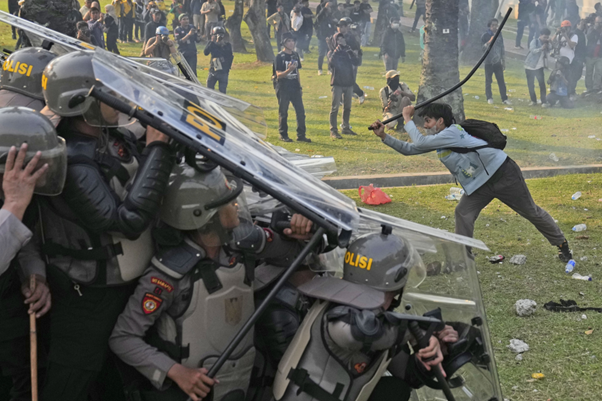
Cuối tháng 8/2025, Indonesia chứng kiến làn sóng biểu tình dữ dội bùng nổ sau sự việc của một tài xế xe công nghệ trong vụ va chạm với xe bọc thép cảnh sát. Từ một sự cố mang tính bộc phát, phong trào nhanh chóng lan rộng khắp các đô thị lớn, tập hợp hàng chục nghìn sinh viên, tài xế và các tầng lớp lao động trẻ xuống đường. Các cuộc đụng độ với cảnh sát đã khiến nhiều người thiệt mạng và hàng trăm người bị bắt giữ, làm dấy lên lo ngại về một cuộc khủng hoảng chính trị sâu sắc. Sự kiện này diễn ra trong bối cảnh Indonesia vừa giữ vai trò trung tâm của ASEAN vừa phải cân bằng giữa cạnh tranh Mỹ–Trung ở khu vực Ấn Độ Dương – Thái Bình Dương. Bởi vậy, sự kiện khủng hoảng này không chỉ đặt ra vấn đề nội bộ của riêng Indonesia mà còn gợi mở nhiều tín hiệu đáng lưu ý với các quốc gia lân cận trong đó có Việt Nam.
19 năm qua (từ năm 2006), chênh lệch giới tính khi sinh ở Việt Nam vẫn ở mức rất cao, có năm 114 bé trai/100 bé gái. Và bình quân mỗi năm Việt Nam có gần 46.000 thai nhi gái không được chào đời, theo Quỹ Dân số Liên hợp quốc (UNFPA).
Người Việt ra cả nước ngoài để chọn giới tính thai nhi. Trong ảnh: bác sĩ của một bệnh viện ở Thái Lan tư vấn, mô phỏng quy trình thực hiện IVF lựa chọn giới tính thai nhi – Ảnh: TRÚC QUYÊN
Nhóm phóng viên Tuổi Trẻ đã có nhiều ngày vào Nam ra Bắc, sang tận Thái Lan – nơi được những tay môi giới lựa chọn giới tính thai nhi gọi là “trung tâm công nghiệp tạo ra con người” – để tìm câu trả lời cho câu hỏi: Vì sao chênh lệch giới tính khi sinh ở Việt Nam vẫn ở mức cao đáng báo động?
Để thực hiện mục tiêu chiến lược phân bố dân số phục vụ cho phát triển kinh tế – xã hội đất nước và củng cố quốc phòng, ngay từ những năm 1960 của thế kỷ trước, Đảng và Nhà nước ta đã quan tâm phân bố lại dân cư và lao động trong cả nước bằng những chính sách cụ thể như: chính sách vận động nhân dân đi xây dựng kinh tế mới, chính sách định canh định cư ổn định di dân tự do, chính sách di dân ổn định biên giới… Gần đây nhất là các chính sách di dân để phục vụ mục tiêu công nghiệp hóa, hiện đại hóa đất nước, mục tiêu dân sinh trên một số địa bàn miền núi, vùng sâu, biên giới, để vừa đảm bảo cho khai hoang phát triển kinh tế, vừa đảm bảo mục tiêu quốc phòng, an ninh. Đánh giá tình hình thực hiện các chính sách di dân của Đảng, Nhà nước qua các thời kỳ, đã có một số công trình nghiên cứu, các ấn phẩm, bài viết về thực hiện chính sách di dân.
Các nghiên cứu về chính sách di dân
1. Các nghiên cứu về tình hình thực hiện chính sách di dân xây dựng kinh tế mới, di dân định canh định cư, di dân ổn định biên giới. Một trong những nghiên cứu đề cập khá toàn diện đến chính sách di dân là công trình của Đặng Nguyên Anh về Chính sách di dân trong quá trình phát triển kinh tế – xã hội ở các tỉnh miền núi [1]. Trong nghiên cứu này, tác giả đã đi sâu tìm hiểu các loại hình di dân nổi bật ở miền núi trong những năm 1990, bao gồm di dân kinh tế mới, định canh, định cư di dân tự do và di dân ổn định biên giới, chỉ ra thực chất của các loại hình di dân này là loại hình di dân nông thôn – nông thôn. Đặc biệt là nghiên cứu đã đánh giá tổng quan về các chính sách di dân trên ba loại hình, phân tích những mặt được và chưa được trong chủ trương chính sách đối với các loại hình di dân nêu trên. Nhấn mạnh mặt được lớn nhất của chính sách di dân là phân bố lại lao động – dân cư, giãn dân đến những vùng vắng dân, thưa dân, vùng còn nhiều tài nguyên đất để phát triển kinh tế, đảm bảo quốc phòng, an ninh, biên giới. Đồng thời chỉ ra mặt hạn chế của chính sách là nhiều quy định của chính sách đã bộc lộ sự bất cập, ít khả thi như chính sách di dân kinh tế mới với quy mô đầu tư dàn trải, thiếu đồng bộ, mang tính bình quân và chưa tính đến những đặc trưng riêng của từng vùng. Công tác định canh định cư mặc dù được lồng ghép trong các chính sách hỗ trợ cho miền núi song chưa đem lại hiệu quả như mong muốn, chưa góp phần ổn định đời sống của đồng bào tộc người thiểu số ở các tỉnh miền núi.
Quá trình đánh giá thực trạng, kiểm định hiệu quả của các chính sách di dân đối với các loại hình di dân, tác giả đã đi sâu phân tích, đánh giá đặc điểm chủ yếu của các cộng đồng di dân, dựa trên kết quả khảo sát mẫu của đề tài với 7 tỉnh tại miền núi phía Bắc và Tây Nguyên. Kết quả cho thấy, người di cư có cuộc sống tương đối ổn định và có mục đích di cư lâu dài, ổn định cuộc sống. Tuy có sự khác nhau giữa các địa phương trong nội dung các chính sách di dân và định hướng phát triển kinh tế – xã hội, song mức độ hiểu biết về chính sách của người dân địa phương và nhận thức của cán bộ quản lý còn nhiều hạn chế. Khả năng tiếp cận được các chính sách hiện hành phụ thuộc rất nhiều vào công tác thông tin, tuyên truyền và sự triển khai thực hiện đến người dân bằng các lợi ích cụ thể, dù dưới loại hình di dân nào. Vì vậy, việc xây dựng và thực hiện một hệ thống chính sách đồng bộ và hiệu quả, phù hợp với tình hình di dân và điều kiện phát triển kinh tế – xã hội ở các tỉnh miền núi hiện nay là rất cần thiết.
A warning to our viewers – the images in this report are deeply disturbing.
Israel’s ongoing blockade on Gaza has led to an alarming rise in the number of people who have been starved to death. Gaza’s health ministry says 19 Palestinians have died of hunger in 24 hours.
The UN says it’s receiving ‘desperate messages of starvation’ while aid is stockpiled just outside and remains blocked.
Bảo tồn, phát huy giá trị văn hóa dân tộc nói chung và di sản văn hóa truyền thống của đồng bào dân tộc thiểu số nói riêng luôn là chủ trương nhất quán của Đảng, Nhà nước ta, được đặt trong tổng thể sự phát triển quốc gia, dân tộc. Thời gian qua, nhờ các chính sách tích cực, hiệu quả, các di sản văn hóa vật thể và phi vật thể của đồng bào các dân tộc thiểu số được quan tâm bảo tồn, tôn vinh và phát huy giá trị, góp phần quan trọng nâng cao đời sống tinh thần đồng bào các dân tộc, đóng góp vào sự phát triển chung của đất nước. Tuy nhiên, bên cạnh những kết quả đã đạt được, vẫn còn những hạn chế, bất cập cần quan tâm khắc phục. Báo Quân đội nhân dân giới thiệu loạt bài “Bảo tồn bản sắc văn hóa các dân tộc thiểu số – Trăn trở của những người trong cuộc”.
Bài 1: Những người giữ hồn văn hóa dân tộc giữa lòng Thủ đô
Tại “Ngôi nhà chung” Làng Văn hóa – Du lịch các dân tộc Việt Nam (Sơn Tây, Hà Nội), chúng tôi đã gặp những Nghệ nhân Ưu tú, những người bằng tình yêu, trách nhiệm và cả những băn khoăn, trăn trở đang ngày ngày bền bỉ, lặng thầm giữ gìn hồn cốt văn hóa dân tộc. Họ không chỉ là những người trực tiếp bảo tồn di sản văn hóa mà còn thắp lên ngọn lửa đam mê, truyền cảm hứng để những giá trị quý báu không bị lãng quên, mai một.
Hero image description: A Palestinian healthcare worker wades through the destroyed remains of a pharmaceutical warehouseImage credit:A Palestinian healthcare worker inspects the damage to a pharmaceutical warehouse after it was targeted by Israeli warplanes in Khan Yunis, southern Gaza Strip, in May 2025. Credit: Anas-Mohammed/Shutterstock
Over the next fortnight, crucial discussions will be made in Geneva and New York that will shape the future of humanitarian action, as United Nations (UN) agencies and donor governments try to agree a way forwards after the sweeping cuts of the first half of 2025.
A fight is underway: on one side, those who recognise that this has to be the moment for long-awaited change; on the other, those who are trying to hold on to past ways of working. For anyone still uncertain about the right path, all they need to do is to look at the situation in Gaza.
See Gaza’s first episode takes us to Oslo, where artists, students, and citizens fill the streets in support of Gaza. Though far from Palestine, their voices echo beyond Norway’s borders. Watch the first episode to see how they demand justice, resist violence, and call for accountability. Tiếp tục đọc “I see Gaza”→
Critics say the Cambodian government’s attacks on opposition members and activists have gone global.
On January 7, 2025, former Cambodian opposition politician, Lim Kimya, was gunned down outside a busy bus station in central Bangkok.
A former Thai marine confessed to carrying out the hit as a gun for hire, but two Cambodians with ties to their country’s governing party are on the run, suspected of organising the murder.
While Lim Kimya’s family and friends are seeking justice, Cambodia’s prime minister, Hun Manet, denies his government had any involvement.
101 East investigates the brazen killing and Cambodia’s increasingly repressive government.
We are running out of time to save lives. The humanitarian situation in Gaza is catastrophic, as a result of the ongoing Israeli-imposed siege that has lasted for over two months. We call on the Israeli authorities and their supporters to abide by International Humanitarian Law and follow the principles which allow for unhindered humanitarian aid for people trapped inside the Strip. Tiếp tục đọc “Palestinians in Gaza are facing a death sentence”→
– 83.4 million people were living in internal displacement at the end of 2024, more than twice as many as only six years ago (2018).
– 90 per cent had fled conflict and violence. In Sudan, conflict led to 11.6 million internally displaced people (IDPs), the most ever for one country. Nearly the entire population of the Gaza Strip remained displaced at the end of the year.
– Disasters triggered nearly twice as many movements in 2024 as the annual average over the past decade. The 11 million disaster displacements in the United States were the most ever recorded for a single country.
GENEVA, Switzerland – The number of internally displaced people (IDPs) reached 83.4 million at the end of 2024, the highest figure ever recorded, according to the Global Report on Internal Displacement 2025 published today by the Internal Displacement Monitoring Centre (IDMC). This is equivalent to the population of Germany, and more than double the number from just six years ago.
“Internal displacement is where conflict, poverty and climate collide, hitting the most vulnerable the hardest,” said Alexandra Bilak, IDMC director. “These latest numbers prove that internal displacement is not just a humanitarian crisis; it’s a clear development and political challenge that requires far more attention than it currently receives.”
Tibetan spiritual leader says in a new book that his people’s aspiration for freedom cannot be indefinitely delayed.
The Dalai Lama offers blessings to his followers at his Himalayan residence in the northern hill town of Dharamshala, India, on December 20, 2024 [Priyanshu Singh/Reuters]
Published On 11 Mar 202511 Mar 2025
The Dalai Lama has said that his successor will be born in the “free world” outside of China.
In a new book released on Tuesday, the 89-year-old spiritual leader of Tibetan Buddhism says that he will be reincarnated outside of Tibet, which is an autonomous region of China.
“Since the purpose of a reincarnation is to carry on the work of the predecessor, the new Dalai Lama will be born in the free world so that the traditional mission of the Dalai Lama – that is, to be the voice for universal compassion, the spiritual leader of Tibetan Buddhism, and the symbol of Tibet embodying the aspirations of the Tibetan people – will continue,” the Dalai Lama, who fled Tibet for India in 1959, writes in Voice for the Voiceless.
China considers Tibet, which has alternated between independence and Chinese control over the centuries, as an integral part of the country and views movements advocating greater autonomy or independence as threats to its national sovereignty.
Beijing has labelled the current Dalai Lama, who was identified as the reincarnation of his predecessor at two years old, a “separatist” and insisted on the right to appoint his successor after his death.
The Dalai Lama, who stepped down as the political leader of the Tibetan government-in-exile in 2011 to focus on his spiritual role, has denied advocating Tibetan independence and argued for a “Middle Way” approach, which would grant the mainly Buddhist territory greater autonomy.
In his book, the Dalai Lama writes that he has received numerous petitions from people in and outside Tibet asking him to ensure that his lineage continues, and says that Tibetan people’s aspirations for freedom cannot be denied indefinitely.
“One clear lesson we know from history is this: If you keep people permanently unhappy, you cannot have a stable society,” he writes.
Enforced disappearances, torture, extrajudicial killings: The human rights abuses allegedly committed by former Prime Minister Sheikh Hasina’s regime have left scores of Bangladeshis scarred and traumatised.
After a student-led movement overthrew the government in 2024, the full extent of the suffering is finally coming to light as an interim government, led by 84-year-old Nobel Peace Prize winner Muhammad Yunus, tries to rebuild a shattered nation.
From repairing the demoralised police force to seeking justice for victims and presiding over unstable relations with India, it’s a daunting task. How will Bangladesh rise from the rubble of a dictator’s rule? 101 East investigates.
We mark 50 years since the end of the U.S. war on Vietnam with the acclaimed Vietnamese American writer Viet Thanh Nguyen. On April 30, 1975, North Vietnamese troops took control of the South Vietnamese capital of Saigon as video of U.S. personnel being airlifted out of the city were broadcast around the world. Some 3 million Vietnamese people were killed in the U.S. war, along with about 58,000 U.S. soldiers. Hundreds of thousands of Lao, Hmong and Cambodians also died, and the impact of the war is still being felt in Vietnam and the region.
Nguyen says while the Vietnam War was deeply divisive in the United States during the 1960s and ’70s, American interference in Southeast Asia goes back to President Woodrow Wilson in 1919, when he rejected Vietnamese demands for independence from France. “And from that mistake, we’ve had a series of mistakes over the past century, mostly revolving around the fact that the United States did not recognize Vietnamese self-determination,” says Nguyen.
We Are Here Because You Are There”: Viet Thanh Nguyen on How U.S. Foreign Policy Creates Refugees
Pulitzer Prize-winning Vietnamese American writer Viet Thanh Nguyen discusses why he chooses to use the term “refugee” in his books, and speaks about his own experience as a refugee. His new novel tells the story of a man who arrives in France as a refugee from Vietnam, and explores the main character’s questioning of ideology and different visions of liberation. Titled “The Committed,” the book is a sequel to “The Sympathizer,” which won the Pulitzer Prize for Fiction in 2016. Nguyen says his protagonist is “a man of two faces and two minds” whose ability to see beyond Cold War divisions makes him the perfect figure to satirize the facile stories people tell themselves about the world. “He’s always going beyond the surface binaries to look underneath.” Nguyen is the chair of English and professor of English and American studies and ethnicity at the University of Southern California. His other books include “The Refugees” and the edited collection “The Displaced: Refugee Writers on Refugee Lives.”
Viet Thanh Nguyen Interview: The Vietnam War Refugee Experience Behind The Sympathizer
Pulitzer Prize-winning author Viet Thanh Nguyen reflects on his childhood as a refugee in America, his writing career, and family: from the trauma of displacement to the healing found in fatherhood and literature. Nguyen shares how these experiences have shaped his life and work, from his novel The Sympathizer to his commentary on war, cultural identity, and American life.
00:00 Introduction to Viet Thanh Nguyen and The Sympathizer
00:49 Refugee journey, family separation, and overcoming trauma
03:43 Humor, cultural expectations, and Vietnamese Catholic roots 05:29 Cultural identity, rebellion, and hidden writing career
07:14 Family relationships, cultural silence, and lessons in parenting 09:35 Impact of fatherhood, learning from children, and rediscovering play
12:13 Art, personal identity, and American cultural values 14:49 Vietnamese American identity, racism, and vision for the future
17:27 Teaching about war, challenges of digital information overload
20:31 Apocalypse Now, self identity struggles, and power of storytelling
24:41 Vietnam War legacy, draft-era resistance vs. modern volunteer military
26:47 Family history, generational trauma, and refugee story from Vietnam


![The Dalai Lama offers blessings to his followers at his Himalayan residence in the northern hill town of Dharamshala, India, on December 20, 2024 [Priyanshu Singh/Reuters]](https://www.aljazeera.com/wp-content/uploads/2025/03/2025-03-11T023323Z_218289473_RC2RSBA1K164_RTRMADP_3_INDIA-DALAI-LAMA-CHINA-1-1741677530.jpg?resize=770%2C513&quality=80)
 CVD
CVD