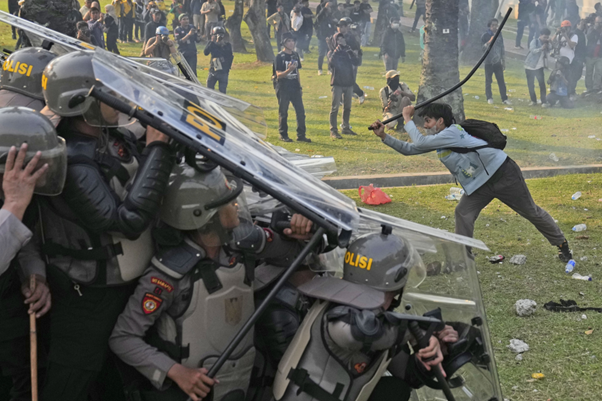
Cuối tháng 8/2025, Indonesia chứng kiến làn sóng biểu tình dữ dội bùng nổ sau sự việc của một tài xế xe công nghệ trong vụ va chạm với xe bọc thép cảnh sát. Từ một sự cố mang tính bộc phát, phong trào nhanh chóng lan rộng khắp các đô thị lớn, tập hợp hàng chục nghìn sinh viên, tài xế và các tầng lớp lao động trẻ xuống đường. Các cuộc đụng độ với cảnh sát đã khiến nhiều người thiệt mạng và hàng trăm người bị bắt giữ, làm dấy lên lo ngại về một cuộc khủng hoảng chính trị sâu sắc. Sự kiện này diễn ra trong bối cảnh Indonesia vừa giữ vai trò trung tâm của ASEAN vừa phải cân bằng giữa cạnh tranh Mỹ–Trung ở khu vực Ấn Độ Dương – Thái Bình Dương. Bởi vậy, sự kiện khủng hoảng này không chỉ đặt ra vấn đề nội bộ của riêng Indonesia mà còn gợi mở nhiều tín hiệu đáng lưu ý với các quốc gia lân cận trong đó có Việt Nam.
The Israel-Gaza war has taken a severe toll on journalists since Hamas launched its unprecedented attack against Israel on October 7 and Israel declared war on the militant Palestinian group, launching strikes on the blockaded Gaza Strip.
CPJ is investigating all reports of journalists and media workers killed, injured, or missing in the war, which has led to the deadliest period for journalists since CPJ began gathering data in 1992.
As of December 21, 2023, CPJ’s preliminary investigations showed at least 68 journalists and media workers were among the more than 20,000 killed since the war began on October 7—with more than 19,000 Palestinian deathsin Gaza and the West Bank and 1,200 deaths in Israel.
The Israel Defense Forces (IDF) told Reuters and Agence France Press news agencies that it could not guarantee the safety of their journalists operating in the Gaza Strip, after they had sought assurances that their journalists would not be targeted by Israeli strikes, Reuters reported on October 27.
Journalists in Gaza face particularly high risks as they try to cover the conflict during the Israeli ground assault, including devastating Israeli airstrikes, disrupted communications, supply shortages and extensive power outages.
As of December 21:
68 journalists and media workers were confirmed dead: 61 Palestinian, 4 Israeli, and 3 Lebanese.
CPJ is also investigating numerous unconfirmed reports of other journalists being killed, missing, detained, hurt, or threatened, and of damage to media offices and journalists’ homes.
India prides itself as the largest democracy in the world, with nearly 1 billion eligible voters for the upcoming 2024 general election. But what’s been holding that democracy together has changed drastically under Prime Minister Narendra Modi and his nationalist party, BJP. Modi’s influence has shifted Indian society and widened rifts between communities.
How has Indian democracy changed? And why is it time to worry about India?
Internet freedom remained restricted in Vietnam, as the government enforced stringent controls over the country’s online environment. Though the government did not disrupt connectivity or throttle Facebook servers as it had done previously, the state continued mandating that companies remove content and imposed draconian criminal sentences for online expression. A COVID-19 surge in late 2021 propelled government surveillance, and authorities have also sought to expand control over content on social media platforms.
Vietnam is a one-party state, dominated for decades by the ruling Communist Party of Vietnam (CPV). Although some independent candidates are technically allowed to run in legislative elections, most are banned in practice. Freedom of expression, religious freedom, and civil society activism are tightly restricted. Judicial independence is absent.
Key Developments, June 1, 2021 – May 31, 2022
Government officials ordered international social media companies to remove thousands of pieces of content, particularly targeting criticism of the authorities (see B2).
New regulations tightened content restrictions on websites that host advertisements and increased administrative fines on companies found to be hosting online speech that authorities deem illegal (see B3, B6, and C2).
Authorities imposed prison sentences on human rights defenders and everyday internet users for their online activities, including a ten-year sentence issued to activist Trịnh Bá Phương (see C3).
The expansion of government-run COVID-19 apps and the creation of a central database for new identification cards have raised privacy concerns (see C5).
A Obstacles to Access
A1 0-6 pts
Do infrastructural limitations restrict access to the internet or the speed and quality of internet connections?
4 6
The internet penetration rate was 71 percent by the end of 2021, according to data from the Ministry of Infomation and Communications (MIC).1 Mobile broadband has played a significant role in increasing access to faster internet service. As of May 2022, the median mobile download speed stood at 35.29 megabits per second (Mbps) while the upload speed stood at 16.89 Mbps according to Ookla’s Speedtest Global Index. The median fixed broadband download speed was 71.79 Mbps and upload speed was 67.20 Mbps.2 Market data aggregator Statista estimated smartphone penetration at 61.37 percent as of May 2021.3 Fixed broadband remains a relatively small market segment.
As of December 2021, 4G signal covered 99.8 percent of Vietnam’s territory, while 5G had been tested in 16 provinces, according to the MIC.4
Disruptions to international internet cables took place repeatedly during the coverage period when the country was in full or partial lockdowns due to COVID-19 outbreaks.5 In February 2022, three undersea cables—the Intra-Asia, Asia-America Gateway, and Asia-Pacific Gateway cables—were disrupted at the same time, seriously affecting internet users nationwide.6 The cables are pivotal for connectivity to the international internet.
A2 0-3 pts
Is access to the internet prohibitively expensive or beyond the reach of certain segments of the population for geographical, social, or other reasons?
May 9, 2023
Thayer Consultancy
ABN # 65 648 097 123
We request your assessment about the state of freedom of the press in Vietnam.
Q1. Have you ever witnessed some extent of freedom of the press in Vietnam?
ANSWER: I first visited reunified Vietnam in August 1981 and have returned regularly since then. I have given numerous interviews to the Vietnamese print and online media, radio and television. As a result, I have come to know certain journalists quite well. I also appreciate the practical constraints they work under. For example, on sensitive matters like relations with China and disputes in the South China Sea, I am aware that they can quote me as a foreigner when they are not permitted to comment on the same issue. Tiếp tục đọc “Vietnam: Assessing Freedom ofthe Press”→
Governments across Southeast Asia have little incentive to protect freedom of expression domestically but steps taken by both domestic and international actors could mean the difference between freedom and its opposite.
All of the countries of Southeast Asia currently sit in the bottom half of the World Press Freedom Index, with four – Brunei, Laos, Singapore and Vietnam – ranked below 150 in the 180-country list, and Myanmar expected to join them following its February 2020 coup.
In these countries, critical coverage is not formally banned but there is no presumption of the right to publish. In Cambodia, Indonesia, Malaysia, Philippines and Thailand, for example, a theoretical commitment to freedom of expression is marred by restrictive legislation, intimidation and even the killing of journalists.
The media in Southeast Asia faces two problems – vaguely worded laws open to abuse and politically-motivated prosecutions – and, in the absence of robust independent courts willing to challenge these governments, politicians have been able to pursue personal vendettas against publications and individuals with few limitations.
.
Without independent courts, even those countries with rules-based legal systems, will fail to defend dissenting voices against politicians in power.
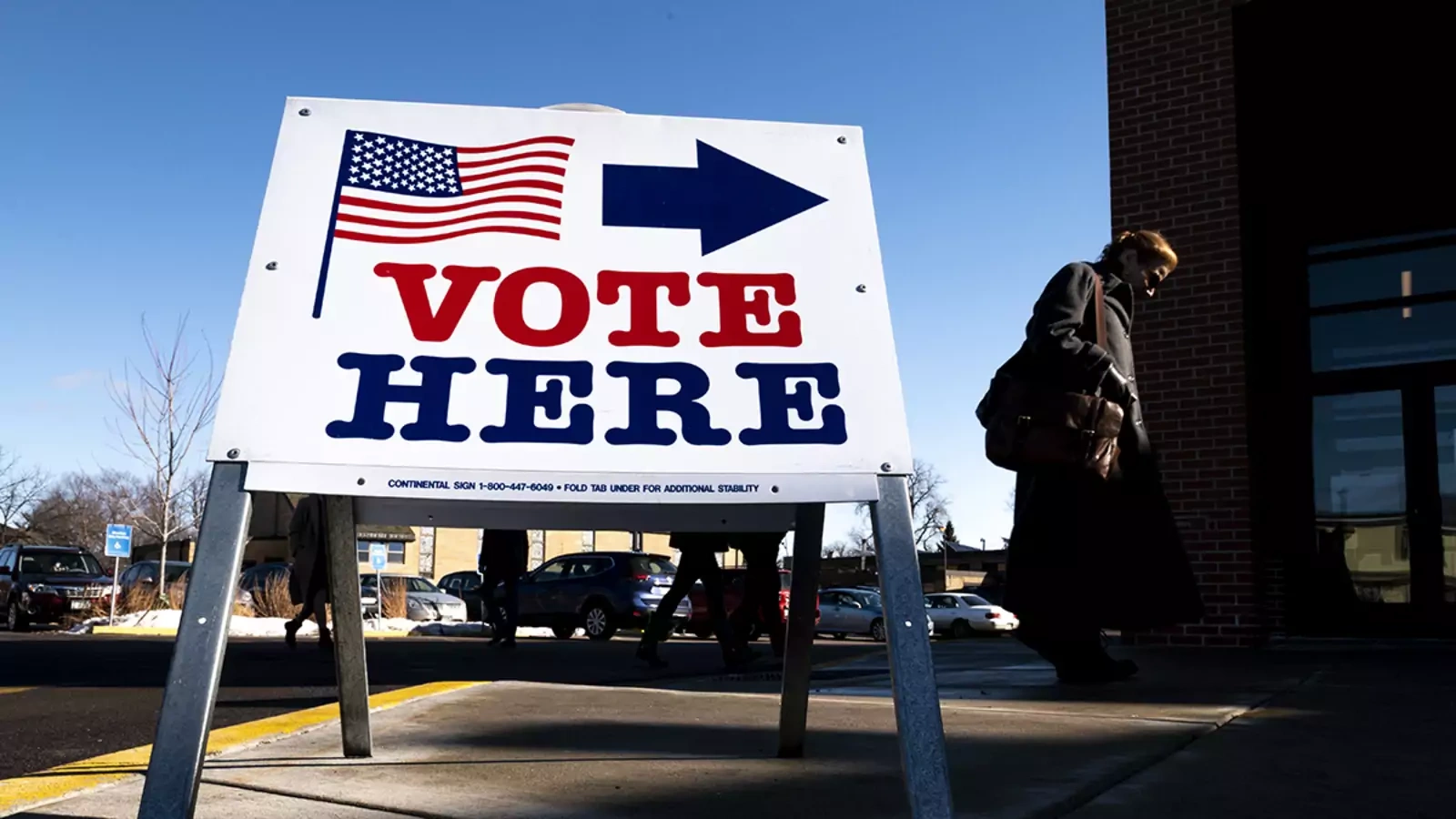
A voter arrives at a polling place on March 3, 2020 in Minneapolis, Minnesota. Stephen Maturen/Getty Images
For more than three-quarters of a century, the United States has played an outsized, constructive role in the world. To be sure, there have been major errors, including the Vietnam War and the 2003 Iraq War, but the US got it right far more often than not.
They’ve endured genocide, war and grinding poverty, and now the people of Cambodia appear to be battling another enemy, with a crackdown on opposition voices.
nikkei – Nearly 50 years after Ferdinand Marcos Sr. declared brutal martial law, the Philippines is poised to elect his son. Has history been forgotten?
Nikkei staff writersMay 7, 2022 03:26 JST
NEW YORK — Welcome to Nikkei Asia’s podcast: Asia Stream.
Every week, Asia Stream tracks and analyzes the Indo-Pacific with a mix of expert interviews and original reporting by our correspondents from across the globe.
This week, we focus on one of Asia’s most dynamic but flawed democracies: the Philippines. With the election just days away, we get under the hood of the electoral system and investigate the powerful role that dynasties play in the country, with a special focus on Ferdinand Marcos Jr., the front-runner on the cusp of taking power. We then take into account that other essential, if dangerous, tenet of modern Philippine democracy: disinformation, and how it is being used to gain support among the country’s most vulnerable populations.
For the hardline conservatives ruling Poland and Hungary, the transition from communism to liberal democracy was a mirage. They fervently believe a more decisive break with the past is needed to achieve national liberation. By Nicholas Mulder
Chinese President Xi Jinping at the Great Hall of the People in Beijing Photo Credit: Aly Song/Reuters.
China is challenging the West. What is the West? It is not only nations in Europe or North America. It is countries that practice democracy.
India, Japan, South Korea, and Australia are Western nations that surround China. They worry about China’s size and ambitions. They view China with suspicion. Also, in the West, the United States and most of Europe see China as an adversary.
Anti-government protesters march in Havana, Cuba, July 11, 2021 (AP photo by Eliana Aponte).
In mid-February, a court in Holguin, Cuba, about 500 miles east of Havana, handed down sentences of up to 20 years in prison to 20 people convicted of sedition the previous month. Their crime, and that of the hundreds of others like them still awaiting verdicts elsewhere, was to have participated in widespread protests last summer, some peaceful but some violent, that took the Cuban government—and the world—by surprise.





 CVD
CVD