Hanoi and HCMC now proportionately more expensive than Singapore and Tokyo
HO CHI MINH CITY — To get by in Vietnam’s crowded, bustling capital Hanoi, university employee Nguyen Bich Ha shares a room with her husband and two kids that is 16.5 square meters in size, little bigger than a parking space for a car.
She wishes that the four of them could have a home of their own instead of living in a room in her husband’s parents’ house. She and her husband depend on the in-laws for help taking their children to and from school but sometimes disagree with them on issues related to bringing up the kids and the timing of meals.
“There isn’t much privacy either since there are many shared living spaces,” said Ha, 36. “And since it’s their house, we can’t make decisions on decoration or changes around the house.
The world is facing an unprecedented housing crisis. According to the latest UN-Habitat estimates, 318 million people are homeless, while 2.8 billion people—over a third of the global population—lack access to adequate housing. Behind these stark figures lie deep inequalities that undermine social progress and human dignity.
Adequate housing is more than shelter, it is a foundation for stability, health, education, and opportunity. Without a safe and secure home, individuals are more vulnerable to poverty, exclusion, and poor health outcomes. Homelessness also carries a heavy social cost, eroding trust, cohesion, and the potential for societies to thrive.
The housing challenge is global but manifests differently across contexts. In rapidly urbanizing regions, millions live in informal settlements or slums, where basic services are scarce and conditions unsafe. Today, 1.1 billion people live in such informal settlements, with 90 percent concentrated in Africa and Asia. Conflict, economic inequality, climate change, and natural disasters are major drivers of displacement and housing insecurity, pushing millions into precarious living conditions.
The urgency of the crisis was underlined at the UN-Habitat Assembly in Nairobi (29–30 May 2025), where Member States adopted the UN-Habitat Strategic Plan for 2026–2029. The plan places affordable housing, secure land tenure, and access to basic services at the heart of global priorities. Leaders called for bold and coordinated action, stressing that housing must be treated as a human right and a cornerstone of sustainable development.
The right to adequate housing is embedded in international human rights instruments and explicitly tied to the 2030 Agenda for Sustainable Development. Goal 11 commits the international community to make cities and human settlements inclusive, safe, resilient, and sustainable. Addressing homelessness and housing insecurity is therefore essential to achieving the SDGs and ensuring that no one is left behind.
Tackling homelessness and inadequate housing requires integrated strategies at local, national, and global levels:
Scaling up affordable housing initiatives through innovative financing, public-private partnerships, and policy reforms.
Expanding social protection systems to prevent families from falling into homelessness.
Investing in resilient housing solutions to adapt to the realities of climate change and disasters.
Strengthening community-based models such as cooperatives and housing associations that empower people to participate in shaping their own futures.
Homelessness is not inevitable. With coordinated action and commitment, the global community can reverse these trends. As the world prepares for the Second World Summit for Social Development in Doha, 4-6 November 2025, the message is clear: accelerating social progress requires that every person has access to a safe, secure, and dignified place to call home.
Many poor people in HCM City are forced to live in makeshift houses along canals, where the environment is dirty, dangerous and unhealthy. They all hope for a more stable life in better places. Hear what they have to say.
PETITION FOR THE REVIEW AND INDEPENDENT ASSESSMENT OF THE CAN GIO TOURIST CITY PROJECT IN HO CHI MINH CITY, VIETNAM
KIẾN NGHỊ XEM XÉT LẠI VÀ ĐÁNH GIÁ ĐỘC LẬP TOÀN BỘ DỰ ÁN KHU ĐÔ THỊ DU LỊCH LẤN BIỂN CẦN GIỜ – TPHCM
Kính gửi: Thủ tướng Chính Phủ nước CHXHCN Việt Nam
Ủy ban Thường vụ Quốc Hội nước CHXHCN Việt Nam
UBND Thành phố Hồ Chí Minh
Chúng tôi kí tên dưới đây, là các cá nhân và tổ chức xã hội yêu môi trường, hoạt động trong các lĩnh vực liên quan, đồng kiến nghị Thủ tướng Chính phủ, Ủy ban Thường vụ Quốc Hội, UBND TPHCM xem xét lại và đánh giá độc lập toàn bộ dự án Khu Đô thị du lịch lấn biển Cần Giờ 2.870 ha, vì những lí do sau đây:
1. Quyết định phê duyệt Báo cáo Đánh giá tác động môi trường dự án Khu Đô thị du lịch lấn biển Cần Giờ của Bộ Tài nguyên Môi trường cho thấy các tác động của dự án lên môi trường chưa được đánh giá khách quan, toàn diện. Đặc biệt, những vấn đề quan trọng nhất đã chưa được đánh giá đầy đủ trước khi phê duyệt, như: tác động của việc thực hiện dự án đến Khu Dự trữ sinh quyển rừng ngập mặn Cần Giờ, vấn đề xói lở, bồi tụ và dòng chảy các khu vực xung quanh dự án, các biện pháp giảm thiểu thích đáng các tác động tiêu cực của dự án.
Nguy cơ Khu Đô thị lấn biển Cần Giờ tác động xấu lên rừng ngập mặn Cần Giờ sẽ kéo theo hàng loạt ảnh hưởng tiêu cực khác lên khu vực đô thị TPHCM, nơi hiện tại người dân và chính quyền vốn đang phải đối mặt với nhiều gánh nặng về ô nhiễm môi trường, ngập lụt, sụt lún, v.v. Tiếp tục đọc “XEM XÉT LẠI VÀ ĐÁNH GIÁ ĐỘC LẬP DỰ ÁN KHU ĐÔ THỊ DU LỊCH LẤN BIỂN CẦN GIỜ”→
Apartment buildings seen in Hoang Mai District, Hanoi. Photo by VnExpress/Nhat Quang.
Surging prices and a decline in the supply of affordable apartments are making it almost impossible for young Vietnamese to buy their first home.
Pham Hoai Nam used to think that being a grown-up means having a stable job, a good salary, a beautiful girlfriend, and his own house.
Now, at age 28, he is able to check off all of those items except the last one.
“My girlfriend and I plan to get married next year, and our only major concern now is finding a place to live,” Nam, who works as an electronics salesman in Hanoi, says.
He is among many young Vietnamese in major cities who are finding that their dream of owning a home is becoming increasingly elusive as real estate prices rise faster than incomes amid a decline in affordable apartment supply.
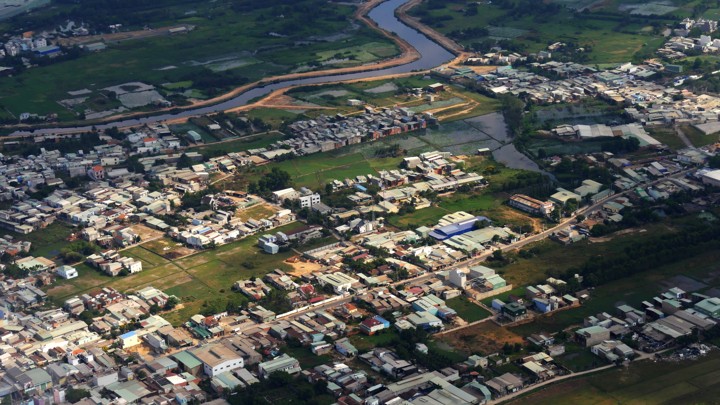
In Ho Chi Minh City, computer analysis of orbital images overlooks some urban communities. To represent them, cities will have to put boots on the ground.
An aerial view of the outskirts of Ho Chi Minh CityRAKSYBH / SHUTTERSTOCK
Mapping a city’s buildings might seem like a simple task, one that could be easily automated by training a computer to read satellite photos. Because buildings are physically obvious facts out in the open that do not move around, they can be recorded by the satellites circling our planet. Computers can then “read” these satellite photographs, which are pixelated images like everyday photographs except that they carry more information about the light waves being reflected from various surfaces. That information can help determine the kind of building material and even plant species that appears in an image. Other patterns match up with predictable objects, like the straight lines of roads or the bends of rivers.
It turns out to be more complicated than that. When three different research groups (including my own at the University of Southern California) processed almost the same images of Ho Chi Minh City’s rapid urbanization during the 2000s, we produced different results. All three groups agreed on the location of the city center, but mine mapped the city’s periphery differently. That’s the place where most megacities in the global South exhibit their most dramatic physical growth. In particular, we identified more of the informal, self-built housing in the swampier southern area of the city. Tiếp tục đọc “Satellite Images Can Harm the Poorest Citizens”→
A boarding house for construction workers in District 2, HCM City. — VNS Photo Việt Thanh
Lê TuyếtHCM CITY – When municipal authorities issued a Decision No.18 in 2011 on granting preferential loans to landlords for building and upgrading houses to rent to workers, it was widely welcomed.
However, six years later, the number of landlords accessing this facility has been very limited, despite the fact that they provide 85 per cent of workers in the city with a place to live.




 CVD
CVD 