Activists from Jewish Voice for Peace group unfurl banners reading ‘Palestinians should be free’ at the base of New York landmark.
Activists from Jewish Voice for Peace occupy the pedestal of the Statue of Liberty. [Stephanie Keith/Getty Images via AFP]
Published On 7 Nov 20237 Nov 2023
Hundreds of US Jewish activists have peacefully occupied New York’s Statue of Liberty to demand an end to Israel’s “genocidal bombardment” of civilians in Gaza and a ceasefire.
Dressed in black T-shirts emblazoned with the slogans “Jews demand ceasefire now” or “Not in our name”, the protesters from the Jewish Voice for Peace group on Monday unfurled banners reading “The whole world is watching” and “Palestinians should be free” at the base of New York’s landmark.
On Saturday, tens of thousands of demonstrators, gathered in Washington, DC to call for an immediate ceasefire in the Gaza Strip, and to denounce US policy of support for Israel.
Dr. Mohammed Obeid, a surgeon with Doctors Without Borders/Médecins Sans Frontières (MSF) working inside Al-Shifa hospital in Gaza, described the situation on November 11, 2023. “Since this morning, there is no electricity. There is no water. There is no food,” he said. The hospital and the areas outside the hospital where people are sheltering have been hit with bombs. A sniper has wounded patients inside the hospital. Premature babies have died because the incubator cannot function without electricity. “We need help,” he said. “No one hears us.”
Premature babies are dying at Gaza’s al-Shifa Hospital
Healthcare workers gathered in front of UK Prime Minister Rishi Sunak’s office in London, raising signs with the names of more than 200 physicians who have been killed so far by Israel’s constant bombardment of Gaza.
Doctor who worked in Gaza describes dire situation at Al-Shifa Hospital
Trade unions, youth movements, and Palestine solidarity groups have organized protests and blockades across Europe, opposing the role of their governments in Israel’s genocidal war on PalestiniansNovember 03, 2023 by Peoples Dispatch
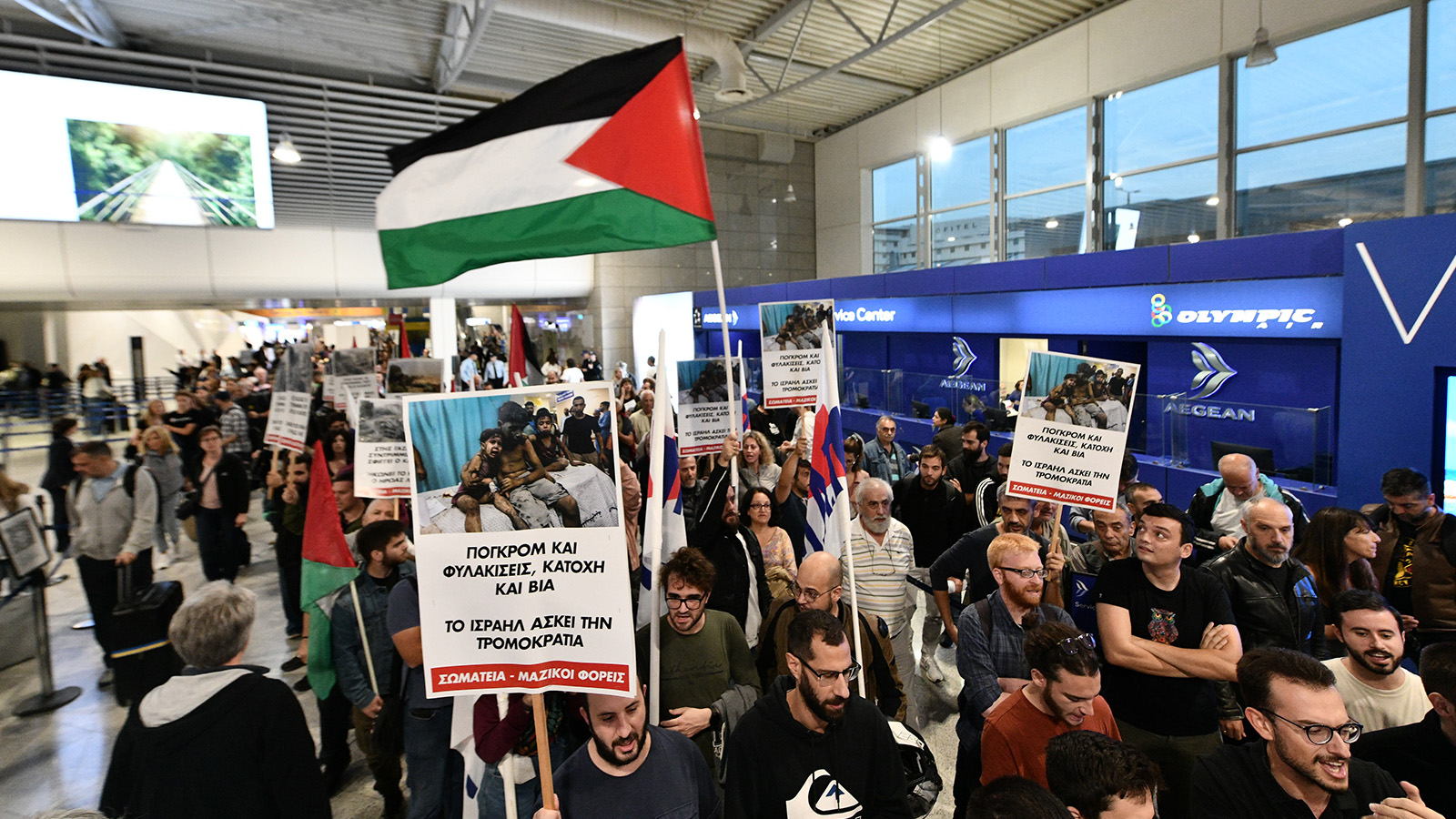
Trade unionists of PAME carry out flash protest inside Athens International Airport (Photo: PAME)
As Israel’s genocidal war on Gaza continues unabated for the fourth week straight, workers across Europe have stepped up their solidarity with Palestine and organized resistance to the supply of arms from various parts of the continent to Israel.
On Thursday, November 2, Greek trade unionists from the All Workers Militant Front (PAME) held a flash protest inside the Athens International Airport in solidarity with Palestine. The protest started in front of the offices of the Israeli airline El Al with protesters then marching inside the airport denouncing the genocidal war against Palestinians.
In their statement, PAME harshly criticized Israeli war crimes in Gaza. “No one can remain silent when the death toll from Israeli bombing in Gaza exceeds 8,000, including over 3000 children and over 1000 women,” PAME said.
“No one can remain silent when a child is killed in Gaza every 10 minutes. No one can remain silent when there are more than 15,000 wounded in Gaza without the necessary treatment because of the suffocating blockade by the murderer state of Israel.”
PAME has also demanded that the Greek government stop all economic, political, and military cooperation with Israel. The union called for an end to the facilitation of bases and other infrastructure by Greece to the US, NATO, and Israel.
PAME has also called for the immediate recognition of the Palestinian state along the 1967 borders with East Jerusalem as its capital.
Meanwhile, on October 31, transport unions in Belgium including the Belgian Union of Transport Workers (BTB), BBTK, ACV-Transcom, and ACV Puls issued a joint statement announcing their resolve to refuse loading or unloading weapons in transit to Israel, which are destined for the genocidal war against the Palestinians.
In their statement, the trade unions said that while genocide is taking place in Palestine, workers at various airports in Belgium note the arrival of arms shipments to the conflict zone. Workers’ participation in loading or unloading these weapons “means supporting regimes that kill innocent people,” the statement said.
In the UK, on October 31, activists from Palestine Action blockaded the road to the headquarters of Elbit Systems in Bristol, notorious for manufacturing parts for Israeli drones and other pilotless aircraft.
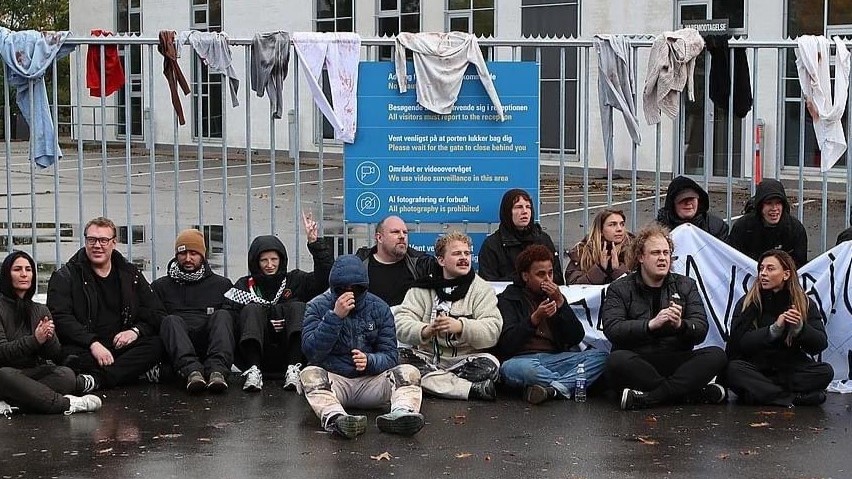
DKU activist blocading Terma A/S in Soborg (Photo: DKU)
On October 30, in Demark, activists from various anti-war groups including the Communist Youth of Denmark (DKU), blocked all entrances to the Søborg plant of the Danish arms company, Terma, in protest against its sale of weapons and equipment to the Israeli Defense Forces.
According to reports, the Aarhus-based defense contractor supplies Israel with equipment for F-16 and F-35 fighter jets, which Israel uses to bomb Gaza. Terma has also been accused of sending arms for the war in Yemen.
During the blockade at Terma, DKU members hung up blood-stained children’s clothes to symbolize the consequences of Terma’s bloody business for civilians in Palestine.
Dagbladet Arbejderen has reported that the protestors have demanded that authorities publish all information about Terma’s activities and disseminate that information in a way that allows the people of Denmark to understand exactly what the company is doing.
They also demanded and end to the manufacturing of weapons parts used by the Israeli military and the termination of their agreements with F35 manufacturer Lockheed Martin, which supplies the Israeli genocidal apparatus.
As of November 3, the ongoing genocidal war carried out by Israel in the Gaza Strip since October 7, has claimed the lives of more than 9,000 people, wounded more than 30,000 people, and displaced over 1.4 million.
This Gazan doctor won't let himself feel hate – despite losing 25 members of his family in an Israeli airstrike last week, and the deaths of his daughters 14 years ago. pic.twitter.com/QLbVZOtcik
Two dozen aid workers from Doctors Without Borders made it out of Gaza Wednesday through the Rafah crossing. Andrea Mitchell is joined by Faris Al Jawad, Communications Manager for Doctors Without Borders in Jerusalem, to discuss the status of hospitals and medical experts in Gaza, the desperate need for fuel and the potential for more mass casualties. “Our international staff that have just recently got out are safely over the border. However, I think what we are far more concerned about now is the 300 or so Palestinian staff that we still have in Gaza, still working, many of them in some of the most dangerous areas that are being relentlessly struck,” Al Jawad says. “There are bombs going off very nearby. There are thousands of people taking shelter there, there’s no medication, there’s no anesthesia, we’re doing operations on the floor.”
Moment BBC reporter falls to his knees and weeps while reporting inside Gaza hospital
U.N. secretary general: I repeat my call for a humanitarian ceasefire in the Middle East, the unconditional release of all hostages, and the delivery of life-saving supplies at the scale needed. Everyone must assume their responsibilities. This is a moment of truth. History will judge us all.
I repeat my call for a humanitarian ceasefire in the Middle East, the unconditional release of all hostages, and the delivery of life-saving supplies at the scale needed.
A new UN report has found continued evidence of war crimes and human rights violations committed by Russian authorities in Ukraine, including torture, rape and the deportation of children.
While aid workers serving conflict-affected civilian populations depend on a set of laws to protect them, some warring parties violate these global agreements, from targeting hospitals and schools to blocking aid workers from reaching civilians with lifesaving goods and services.
But, what exactly are the rules of war and what happens when they are broken?
To find out more about international humanitarian law, known by its acronym IHL, UN News spoke with Eric Mongelard at the UN human rights office, OHCHR.
Here’s what you need to know:
Rules of war
International humanitarian law is as old as war. From passages in the Bible and Quran to medieval European codes of chivalry, this ever-growing set of rules of engagement aims to limit a conflict’s effects on civilians or non-combatants.
The laws represent “the very minimum rules to preserve humanity in some of the worst situations known to mankind,” Mr. Mongelard said, noting that the rules of war apply the moment an armed conflict has begun.
ByJUSTIN KABUMBA Associated Press October 8, 2023, 12:11 AM
GOMA, Congo — At least 15 people were killed in eastern Congo after a group of children brought home an explosive device that they had found while they were playing, a community leader said Saturday.
The tragedy took place Friday evening in the village of Kyangitsi, located in Masisi territory in North Kivu province.
“At around 8 p.m. local time, while some of the residents were trying to find out what it was, the bomb exploded,” said Telesphore Mitondeke, a member of a Masisi grouping of civil society organizations.
For the past two weeks, the region has been the scene of hostilities between local armed groups vying for control of villages.
Antipersonnel landmines are explosive devices designed to injure or kill people. They can lie dormant for years and even decades under, on, or near the ground until a person or animal triggers their detonating mechanism.
They can be activated by direct pressure from above, by pressure put on a wire or filament attached to a pull switch, by a radio signal or other remote firing method, or even simply by the proximity of a person within a predetermined distance. Because no one controls the detonation of landmines, they can be referred to as victim-activated weapons. Since mines are not aimed at a specific target they can indiscriminately kill or injure civilians, including children, soldiers, peacekeepers, and aid workers.
Status of 2008 Convention on Cluster Munitions
Cluster Munition Casualties in 2022 and in Historical Record
Descriptive Note: Memorandum
Corporate Author: RAND CORP SANTA MONICA CA
Personal Author(s): Gurtov, Melvin
Report Date: 1968-07-01
Abstract:
An analysis is made of 1 U.S. policy and diplomacy during the 1954 Geneva Conference on Indochina, 2 the objectives of the participants in the conference, 3 the tactics used during the negotiations, and 4 the implications of those tactics for the present conflict. Although Vietnamese unity was not a priority objective of China or the Soviet Union, neither power may have expected a South Vietnamese regime to survive until the national elections. The U.S. goal, among others, was to maximize the Saigon governments chances of posing an authentic challenge in the elections of 1956. In terms of the present conflict, additional Communist participation might complicate rather than strengthen Hanois position by increasing the opportunity for division on issues of troop withdrawal and political settlement. Saigons influence could be reduced if the United States were to limit South Vietnams role to talks with the Viet Cong. In the realm of tactics, Geneva indicates, first, that an ambiguous commitment on the part of the United States to a negotiated settlement can have far greater value than an obvious disposition to accept terms second, that the threat of a use of force hitherto restrained can be more valuable to the U.S. bargaining position than force already applied.
Full report https://www.rand.org/content/dam/rand/pubs/research_memoranda/2005/RM5617.pdf
This winter marks 50 years since U.S. and Vietnamese diplomats in Paris ceremoniously signed “peace accords” that did not end the Vietnam War, but that achieved America’s withdrawal from it. Thus, the accords permitted, a half-century later, what is now a durable American-Vietnamese reconciliation. In the face of seemingly intractable wars — in Ukraine, Afghanistan, the eastern Congo basin, Yemen or elsewhere — the growing U.S.-Vietnamese relationship shows that even a peace that seems impossible today can indeed be built for our children.
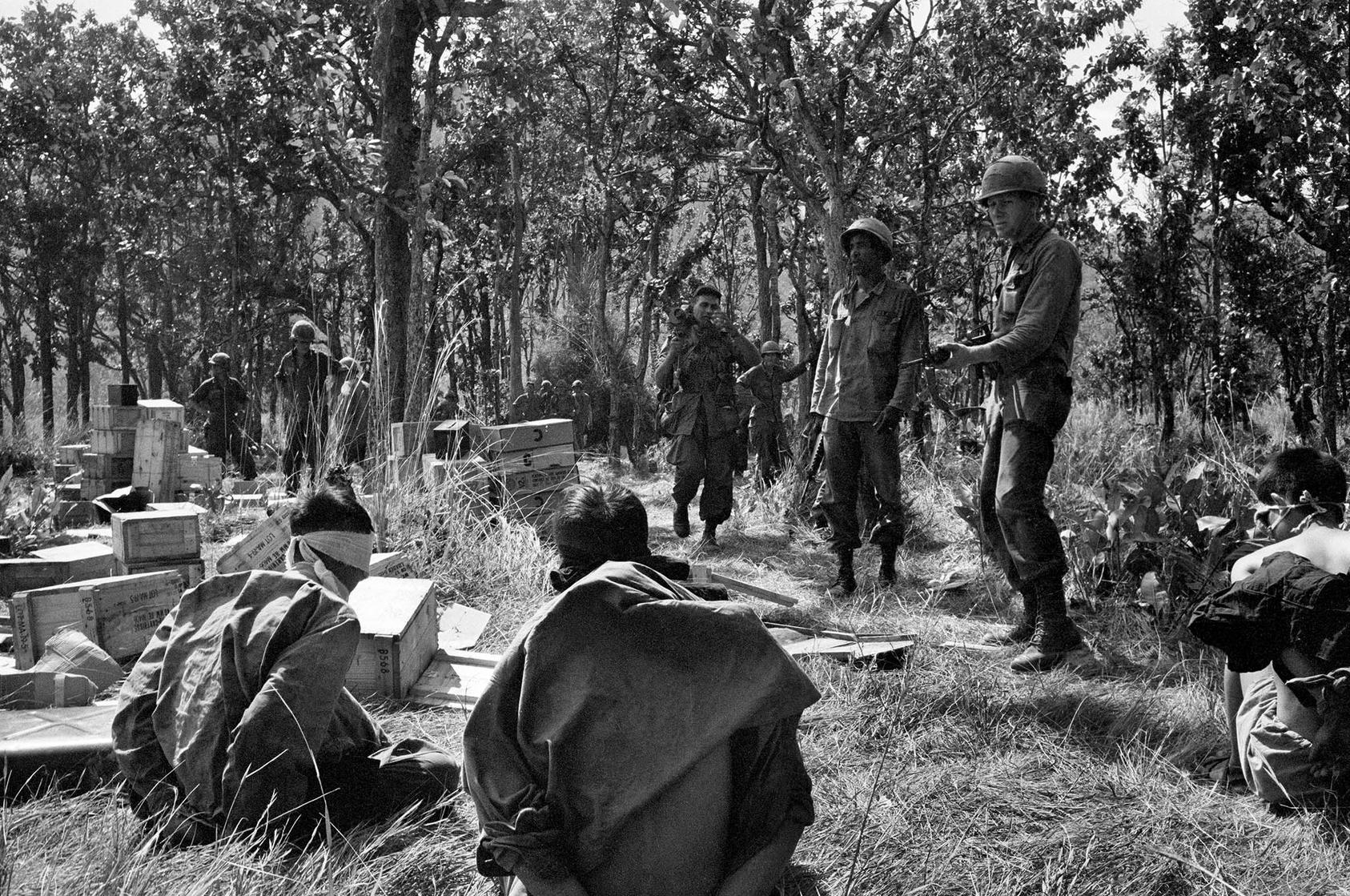
U.S. troops guard North Vietnamese prisoners in 1965, early in the Vietnam War. U.S. and Vietnamese veterans have led reconciliation work in decades since, notably in searching for remains of those killed in the war. (Neil Sheehan/The New York Times)Tiếp tục đọc “We Can Heal War’s Traumas; U.S. and Vietnam Show How”→




 CVD
CVD 