chatthamhouse.org Research paper Published 20 April 2020 ISBN: 978 1 78413 391 7
Royal Navy Vanguard Class submarine HMS Vigilant returning to HMNB Clyde after extended deployment. The four Vanguard-class submarines form the UK’s strategic nuclear deterrent force. Photo: Ministry of Defence.21st century. Researchers at Chatham House have worked with eight experts to produce this collection of essays examining four contested themes in contemporary policymaking on deterrence.
“Loạt bài ghi lại những quan sát của tác giả sau gần 4 tháng sống tại Ukraine, Nga và một số nước trong vùng đệm của hai bên chiến tuyến, tháng 6-9/2025”
Kỳ 1: Bom đạn – Thần Chết không có khuôn mặt người
Kỳ 2: Đổ nát – sự hủy hoại tinh thần của cuộc chiến
Kỳ 3: Kiên cường, sống chung với bão
Kỳ 4: Tuyển quân – hai cuộc chiến và hai kẻ thù
Còn nữa
Kỳ 5: Tiền tuyến – Định nghĩa lại chiến trường
Kỳ 6: Quê hương – Danh tính địa phương và cộng đồng tự quản
Kỳ 7: Nga hóa – ‘Không có Putin này sẽ có Putin khác’
Cuộc chiến tranh tại Ukraine bắt đầu bằng việc Nga phát động cuộc tấn công quân sự toàn diện vào quốc gia láng giềng hồi tháng 2/2022. Sau gần bốn năm, bom đạn vẫn rơi và máu vẫn đổ mỗi ngày khi mà Tổng thống Nga Vladimir Putin chưa cho thấy ý định dừng tay, còn phía Ukraine vẫn tiếp tục kháng cự và trả đũa. Những đề xuất từ Mỹ mới đây liệu có mang tới tương lai bình yên lâu dài cho vùng đất này vẫn là điều chưa chắc chắn.
Trong dịp này, BBC News Tiếng Việt khởi đăng loạt ghi chép của Tiến sĩ Nguyễn Phương Mai sau những ngày đi thực địa tại Ukraine, Nga và các nước lân cận.
Chào mừng đến Ukraine
Khi tôi nói mình sẽ đi Ukraine, bạn bè không ai còn ngạc nhiên nữa. Họ nghĩ vài tháng ở đó chẳng thấm tháp gì bởi tôi vốn đã sống sót một năm trời ở Trung Đông thời Mùa xuân Ả Rập. Tuy nhiên, một đồng nghiệp người Nga lại bảo: “Mai nên viết di chúc đi”.
Tôi nghe lời anh. Nhưng thời gian gấp quá nên không hãng luật nào nhận lời. Tôi phải nói mình chuẩn bị tới “khu vực có chiến sự” thì một công ty mới thông cảm và làm mọi thứ online. Tôi chỉ cần về Hà Lan một ngày để ký.
Chuyến xe khách từ Ba Lan diễn ra suôn sẻ. Ở biên giới, cán bộ cửa khẩu cười tươi tắn và hỏi tôi định ở lại Ukraine bao lâu. Tôi nhún vai: “Khoảng một tháng, còn nếu an toàn thì hết tiền tôi mới về.” Chúng tôi cùng cười thành tiếng.
Tôi nhìn quanh. Phía trên ô cửa trình giấy tờ là một tấm biển: “Lực lượng biên phòng Ukraine cam kết đón chào quý vị nồng nhiệt, phục vụ chu đáo, giải thích cặn kẽ và phản hồi nhanh chóng mọi thắc mắc.” Trên tường treo bản tin của Văn phòng Thanh tra Quốc hội về Quyền con người và nơi công dân gửi khiếu nại.
Improved aid access means there is no longer famine in Gaza, but the war-ravaged territory still faces emergency conditions, a UN-backed global hunger monitor said on Friday. Israel denied that there is a food shortage in Gaza, where around 1.6 million people are expected to face crisis levels of food insecurity in the coming months.
Starbucks, KFC, Pizza Hut, and McDonald’s suffer sales slumps as Gaza war boycotts continue across Asia, boosting local and Palestinian brands
Gaza boycotts batter fast-food chains Starbucks, KFC, Pizza Hut, and McDonald’s and other US brands in Malaysia and Indonesia | Photo: PexelsVasudha Mukherjee New Delhi
In Malaysia and Indonesia, some of the biggest names in fast food — Starbucks, KFC, Pizza Hut, and McDonald’s — are still struggling to recover from the financial hit caused by boycotts sparked by the war in Gaza, according to a report by Nikkei Asia.
Steep sales drops for US fast food chains in Malaysia
In Malaysia, Starbucks operator Berjaya Food reported an 18 per cent year-on-year revenue drop in early 2024, with net losses widening to 37.2 million ringgit (US $9 million). Its share price has fallen another 15 per cent this year. The chain has leaned on heavy localisation efforts — drinks curated by Malaysian baristas, locally designed merchandise, and menu items by a popular local chef — but store managers expect the total number of outlets to shrink from 350 to under 300 by 2026.
QSR Brands, which runs KFC and Pizza Hut, swung from a pre-tax profit of 49.6 million ringgit in 2023 to a 66.2 million ringgit loss in 2024. It has cut prices, pizzas as low as 5 ringgit, stressed its halal credentials, and hired more local staff to appeal to customers.
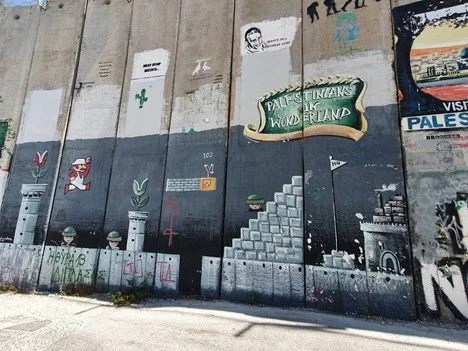
It has many names. In Hebrew: “separation wall.” In Arabic: “wall of Apartheid.” In the media: “West Bank barrier,” “security fence,” “Apartheid wall,” or simply, “The Wall.” Whatever you call it, upon completion, it will encircle the West Bank stretching 708 kilometers (440 miles).[1]
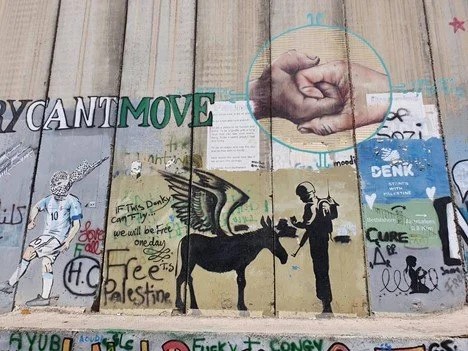
Grey concrete slabs eight meters high and three meters thick snake around the landscape, annexing Palestinians from their farmland, communities, and places of work. About 80 percent of Palestinians separated from their land by the wall have not received permits from Israeli authorities to cultivate their fields.[2]
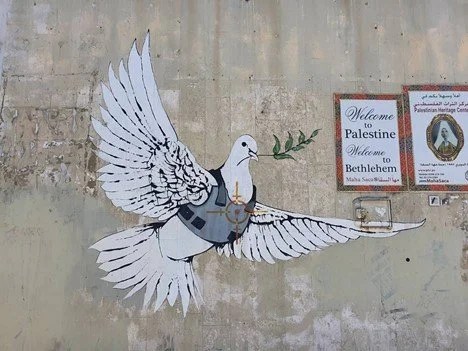
In 2007, the section of the wall in the Palestinian town of Bethlehem attracted the attention of the England-based street artist and political activist known as “Banksy.” He and other graffiti artists transplanted an annual, London-based pop-up art display known as “Santa’s Ghetto” to Bethlehem where Banksy painted four stencils on the wall. Some of the art born out of this project can still be seen today. While other pieces have been painted over, the site remains what could be the world’s largest fluid art installation. Over the course of just a few months in 2021, new art constantly appeared.
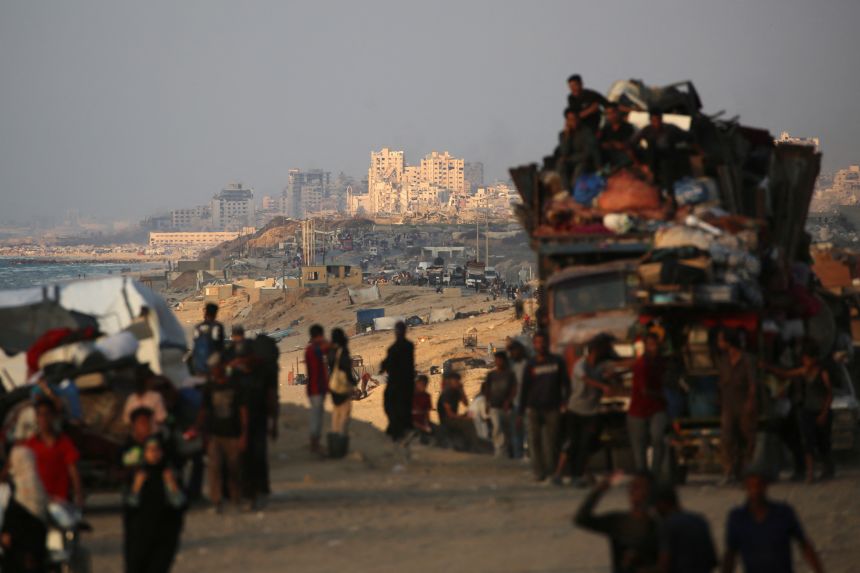
Displaced Palestinians move with their belongings southwards on a road in the Nuseirat refugee camp area in the central Gaza Strip. Eyad Baba/AFP/Getty Images
Microsoft has terminated a set of services for the Israeli military after an investigation suggested Israel was using the company’s cloud computing technology for mass surveillance of Palestinians.
In a statement posted the company’s blog, Microsoft President Brad Smith said the company had “ceased and disabled a set of services to a unit within the Israel Ministry of Defense.” The move comes after an investigation by The Guardian and Israel’s +972 Magazine in early-August reported that Israel’s military intelligence unit, known as 8200, relied on Microsoft Azure to store millions of phone calls made by Palestinians in Gaza and the occupied West Bank.
Microsoft announced on August 15 that it had begun a review of the allegations. Smith said Microsoft does not provide technology “to facilitate mass surveillance of civilians,” a principle it has applied “in every country around the world.” The review, Smith said, focused on business records, financial statements, internal documents and other records without accessing the content of the stored material.
During the investigation, the company says it found evidence that supports elements of the investigation from the news outlets, including Israel’s “consumption of Azure storage capacity in the Netherlands and the use of AI services.” Microsoft informed Israel of the decision “to cease and disable specific [Israel Defense Ministry] subscriptions and their services, including their use of specific cloud storage and AI services and technologies.”
An Israeli security official said, “There is no damage to the operational capabilities of the IDF.”
Robert Calabretta holds his baby photo from before he was adopted out of South Korea to a family in the United States, Thursday, Feb. 15, 2024, at his apartment in New York. (AP Photo/David Goldman)
SEOUL, South Korea (AP) — As the plane descended into Seoul, Robert Calabretta swaddled himself in a blanket, his knees tucked into his chest like a baby in the womb. A single tear ran down his cheek.
The 34-year-old felt like a newborn — he was about to meet his parents for the first time since he was 3 days old.
Most of his life, he thought they’d abandoned him for adoption to the United States. When he finally found them, he learned the truth: The origin story on his adoption paperwork was a lie. Instead, he said, his parents were told in 1986 that their infant was very sick and they thought he had died.
“I am so sorry,” his birth father had written when they found each other, his words interrupted by fits of weeping. “I miss you. How did you endure this cruel world?”
Robert Calabretta sits for a portrait at the restaurant where he works, Feb. 15, 2024, in New York. (AP Photo/David Goldman)
Calabretta is among a growing and vocal community of victims of an adoption system they accuse of searching out children for would-be parents, rather than finding parents for vulnerable children — sometimes with devastating consequences only surfacing today.
South Korea’s government, Western countries and adoption agencies worked in tandem to supply some 200,000 Korean children to parents overseas, despite years of evidence they were being procured through questionable or downright unscrupulous means, an investigation led by The Associated Press found. Those children grew up and searched for their roots — and some realized they are not who they were told.
Their stories have sparked a reckoning that is rocking the international adoption industry, which was built in South Korea and spread around the world. European countries have launched investigations and halted international adoption. The South Korean government has accepted a fact-finding commission under pressure from adoptees, and hundreds have submitted their cases for review.
Nearly 250,000 South Korean children were adopted to the West as “orphans” in the 60 years following the Korean War. Some to loving homes. Others to tragic ends. Raised in places where they looked like nobody else, many were told to forget their past and be grateful.
But the innate desire to understand where you came from has led many Korean adoptees to search for their roots. In the process, they discover lies in their past and families they never knew existed. In this documentary, correspondent Wei Du travels around the world to meet Korean adoptees and accompany a few on their journey to reclaim who they are. Together, they reveal how an “orphan rescue” mission separated families and erased the roots of hundreds of thousands.
00:00 Meet the adoptees 01:44 The lie of Korea’s “orphans” 03:04 A song I no longer recognise 05:15 Why 10,000 Korean children were sent to Sweden 07:11 How Sweden became a hub for Korean adoptions 10:29 Why the US took in so many Korean children 15:06 GI babies: Korea’s children of US soldiers 19:54 Cult leader’s adopted Korean children 24:13 “Saved from prostitution”? The truth of my adoption 27:55 Why this US couple adopted in 2005 32:03 Lies in our adoption stories 38:22 How Sweden pressured Korea to give up more children 42:49 Chase’s biological sister visits for his 20th birthday 46:15 Anna’s life in Sweden: Always different 48:54 Phil’s search for his birth family 52:46 Rebuilding siblinghood: Mary & Chase’s struggle 58:17 Catherine’s complex relationship with her adoptive mother 1:00:47 Catherine and Anna reunite after 50 years 1:06:58 Phil returns to Korea after 50 years 1:08:58 Koroot: NGO supporting Korean adoptees 1:10:15 Were adoption agencies in it for the money? 1:11:53 “A child supply market”: Moses Farrow 1:17:24 Korea investigates human rights violations in adoption 1:19:26 Confronting the orphanage manager who sent him abroad 1:23:41 Adoptees find comfort in each other 1:26:25 Han Tae-soon’s hunt for her kidnapped daughter 1:29:28 The fight for truth continues
We are running out of time to save lives. The humanitarian situation in Gaza is catastrophic, as a result of the ongoing Israeli-imposed siege that has lasted for over two months. We call on the Israeli authorities and their supporters to abide by International Humanitarian Law and follow the principles which allow for unhindered humanitarian aid for people trapped inside the Strip. Tiếp tục đọc “Palestinians in Gaza are facing a death sentence”→
– 83.4 million people were living in internal displacement at the end of 2024, more than twice as many as only six years ago (2018).
– 90 per cent had fled conflict and violence. In Sudan, conflict led to 11.6 million internally displaced people (IDPs), the most ever for one country. Nearly the entire population of the Gaza Strip remained displaced at the end of the year.
– Disasters triggered nearly twice as many movements in 2024 as the annual average over the past decade. The 11 million disaster displacements in the United States were the most ever recorded for a single country.
GENEVA, Switzerland – The number of internally displaced people (IDPs) reached 83.4 million at the end of 2024, the highest figure ever recorded, according to the Global Report on Internal Displacement 2025 published today by the Internal Displacement Monitoring Centre (IDMC). This is equivalent to the population of Germany, and more than double the number from just six years ago.
“Internal displacement is where conflict, poverty and climate collide, hitting the most vulnerable the hardest,” said Alexandra Bilak, IDMC director. “These latest numbers prove that internal displacement is not just a humanitarian crisis; it’s a clear development and political challenge that requires far more attention than it currently receives.”
In July 2024, famine was detected in the Sudan’s Zamzam IDP camp. In the following months, the official alert expanded to other camps in Darfur and Western Nuba Mountains. From December until now, famine has been confirmed in five other areas of the war-torn country. A further 17 areas are at risk.
It is the first time since 2017 that a famine has been declared anywhere on Earth.
In the 20 months since the war between rival militaries erupted, 13 million Sudanese have been forcibly displaced and over 30.4 million are in desperate need of humanitarian assistance, according to UN estimates.
CAO LANH CITY, Vietnam, March 29 (Reuters) – On her trusty motorcycle, Vietnamese artist Dang Ai Viet travels around the Southeast Asian country in a quest to ensure that the thousands of women who suffered the loss of two or more loved ones during the Vietnam War are not forgotten.
The 75-year-old has painted the portraits of 2,765 of the women, who are part of a group known in Vietnam as “heroic mothers”, in recognition of their sacrifice during the war that ended in 1975.
The Reuters Tariff Watch newsletter is your daily guide to the latest global trade and tariff news. Sign up here.
Mahmoud Ajjour, nine (left), who was injured during an Israeli attack on Gaza City in March 2024, finds refuge and medical help in Doha, Qatar, on June 28, 2024 [Samar Abu Elouf, for The New York Times] Kim Phuc, nine (right) is seen running down Route 1 near Trang Bang after a South Vietnamese plane accidentally dropped its flaming napalm on its own troops and civilians, on June 8, 1972. The terrified girl ripped off her burning clothes while fleeing [Nick Ut/AP]
Ajjour had both of his arms blown off by an Israeli strike on the Gaza Strip, where Israel’s ongoing genocide has now killed at least 52,365 Palestinians since October 2023. In the award-winning photograph, the boy’s head and armless torso are cast in partial shadow, his gaze nevertheless intense in its emptiness.
We mark 50 years since the end of the U.S. war on Vietnam with the acclaimed Vietnamese American writer Viet Thanh Nguyen. On April 30, 1975, North Vietnamese troops took control of the South Vietnamese capital of Saigon as video of U.S. personnel being airlifted out of the city were broadcast around the world. Some 3 million Vietnamese people were killed in the U.S. war, along with about 58,000 U.S. soldiers. Hundreds of thousands of Lao, Hmong and Cambodians also died, and the impact of the war is still being felt in Vietnam and the region.
Nguyen says while the Vietnam War was deeply divisive in the United States during the 1960s and ’70s, American interference in Southeast Asia goes back to President Woodrow Wilson in 1919, when he rejected Vietnamese demands for independence from France. “And from that mistake, we’ve had a series of mistakes over the past century, mostly revolving around the fact that the United States did not recognize Vietnamese self-determination,” says Nguyen.
We Are Here Because You Are There”: Viet Thanh Nguyen on How U.S. Foreign Policy Creates Refugees
Pulitzer Prize-winning Vietnamese American writer Viet Thanh Nguyen discusses why he chooses to use the term “refugee” in his books, and speaks about his own experience as a refugee. His new novel tells the story of a man who arrives in France as a refugee from Vietnam, and explores the main character’s questioning of ideology and different visions of liberation. Titled “The Committed,” the book is a sequel to “The Sympathizer,” which won the Pulitzer Prize for Fiction in 2016. Nguyen says his protagonist is “a man of two faces and two minds” whose ability to see beyond Cold War divisions makes him the perfect figure to satirize the facile stories people tell themselves about the world. “He’s always going beyond the surface binaries to look underneath.” Nguyen is the chair of English and professor of English and American studies and ethnicity at the University of Southern California. His other books include “The Refugees” and the edited collection “The Displaced: Refugee Writers on Refugee Lives.”
Viet Thanh Nguyen Interview: The Vietnam War Refugee Experience Behind The Sympathizer
Pulitzer Prize-winning author Viet Thanh Nguyen reflects on his childhood as a refugee in America, his writing career, and family: from the trauma of displacement to the healing found in fatherhood and literature. Nguyen shares how these experiences have shaped his life and work, from his novel The Sympathizer to his commentary on war, cultural identity, and American life.
00:00 Introduction to Viet Thanh Nguyen and The Sympathizer
00:49 Refugee journey, family separation, and overcoming trauma
03:43 Humor, cultural expectations, and Vietnamese Catholic roots 05:29 Cultural identity, rebellion, and hidden writing career
07:14 Family relationships, cultural silence, and lessons in parenting 09:35 Impact of fatherhood, learning from children, and rediscovering play
12:13 Art, personal identity, and American cultural values 14:49 Vietnamese American identity, racism, and vision for the future
17:27 Teaching about war, challenges of digital information overload
20:31 Apocalypse Now, self identity struggles, and power of storytelling
24:41 Vietnam War legacy, draft-era resistance vs. modern volunteer military
26:47 Family history, generational trauma, and refugee story from Vietnam


 "Fast food")



 CVD
CVD 